Why Is Swiggy Falling Behind in Quick Commerce?

Finnovate’s editorial team researches and creates financial content using trusted sources, regulatory references and inputs from subject experts.
Delivering your dinner and delivering your groceries might look like similar businesses. Open an app, place an order, and someone arrives at your doorstep.
For Swiggy, however, the financial results are very different.
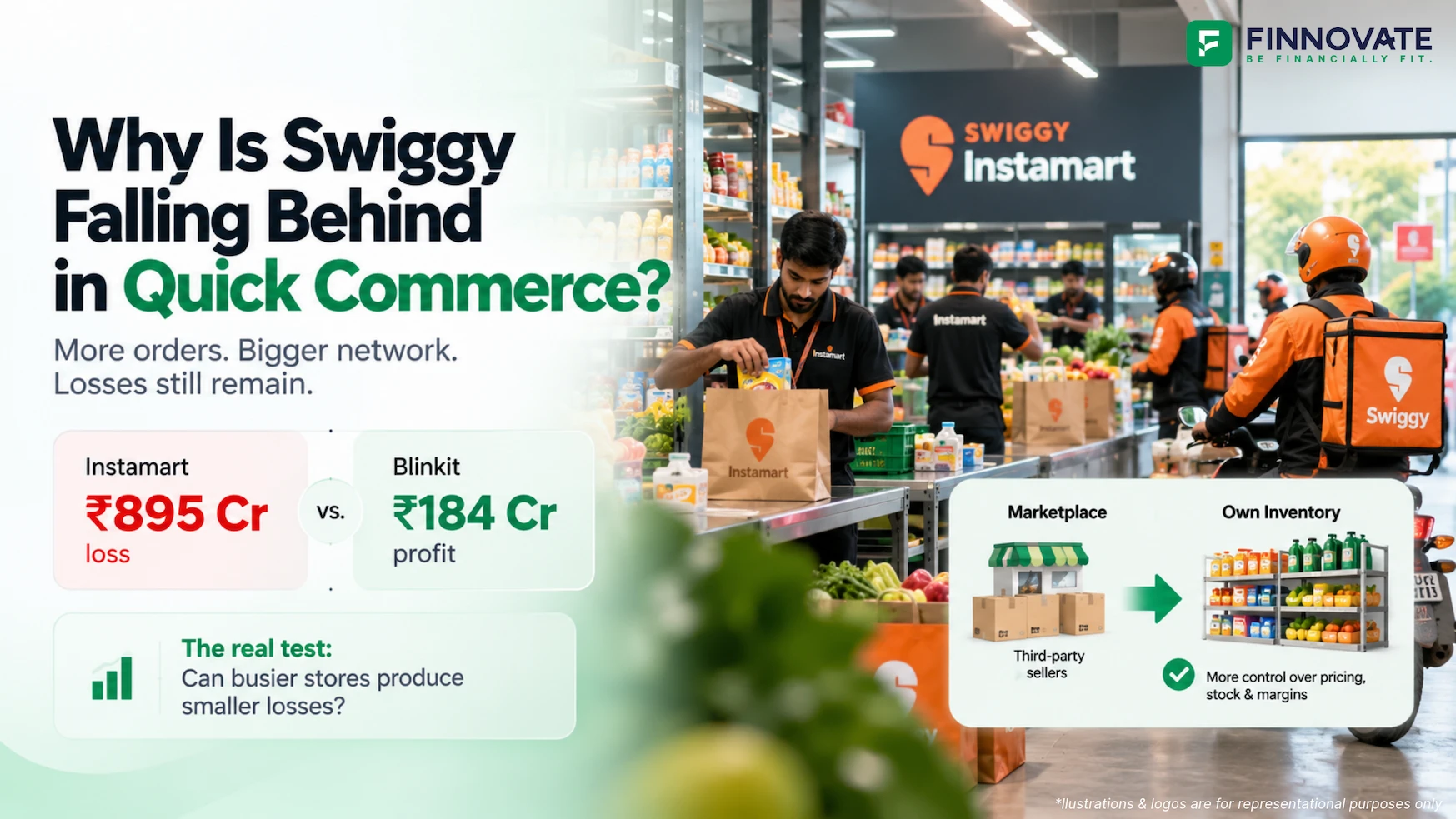
In the September 2026 quarter, its food-delivery business generated ₹341 crore in adjusted operating earnings. Instamart, its quick-commerce business, recorded an ₹895 crore loss on the same measure.
Together with its other businesses and expenses, Swiggy ended Q2FY27 with a consolidated net loss of ₹922 crore.
Across the competitive divide, Blinkit, owned by Zomato’s parent Eternal, reported positive adjusted operating earnings.
Swiggy is now preparing to change how Instamart operates. Instead of primarily facilitating sales by other sellers, it plans to own the goods being sold.
That could give it more control over prices, product availability and margins. But how much can changing who owns the groceries change the business?
The problem sits behind the delivery counter
Think of a small grocery shop serving a neighbourhood.
Before its first customer walks in, the shopkeeper must pay rent, hire staff, install shelves and keep the lights on. Selling more products helps spread those expenses across more transactions.
Quick commerce follows a similar principle, with an additional challenge: every order also needs to reach the customer’s doorstep.
Its neighbourhood warehouses, called dark stores, need enough orders to support the cost of stocking, picking, packing and dispatching products. Delivery costs, discounts and customer acquisition add further pressure.
A larger network creates more selling opportunities, but each location needs enough business to justify its costs.
Opening a store is therefore only the beginning. Building repeat demand around it is what makes the investment worthwhile.
This is where Swiggy’s results become interesting. Instamart is growing, and its stores are getting busier. Yet its losses remain substantial.
More orders, but losses remain high
Instamart handled 13.03 crore orders in Q2FY27, up from 10.08 crore a year earlier.
Average orders per dark store per day increased from 1,025 to 1,192 over the same period. Its store network expanded from 1,102 to 1,240 locations.
These are signs of improving utilisation. More customers are ordering, and existing infrastructure is handling more activity.
However, Instamart’s adjusted EBITDA loss increased from ₹849 crore to ₹895 crore year on year.
Adjusted EBITDA is an operating-performance measure that excludes interest, taxes, depreciation and certain company-defined adjustments. The final net profit or loss also reflects expenses outside this measure.
The contrast with Blinkit shows the distance Instamart still needs to cover.
| Metric | Swiggy Instamart | Eternal’s Blinkit |
|---|---|---|
| Reporting period | Q2FY27 | Q2FY27 |
| Stores at September-end | 1,240 | 2,751 |
| Net stores added during the quarter | 69 | 308 |
| Adjusted EBITDA | ₹895 crore loss | ₹184 crore profit |
Scroll horizontally to view the full table →
Figures are company-reported. Adjusted EBITDA definitions should be read alongside each company’s disclosures.
Blinkit has a substantially larger network and reported positive adjusted EBITDA while continuing to expand. Its net order value, which measures customer spending after discounts, grew 79.3% year on year to ₹20,940 crore.
For Instamart, the challenge is to increase business flowing through its stores while retaining more money from that business.
Why more sales do not automatically produce profits
A quick-commerce platform can encourage customers to order more through discounts, lower prices and promotional offers.
Those orders help build habits. A customer who initially buys milk might eventually add vegetables, toiletries and household supplies.
But the platform must pay for that habit-building phase.
If attracting additional orders requires substantial spending, a busier store can still lose money. The important question is how much each order contributes after the costs of serving it.
Swiggy reported an Instamart contribution margin of minus 1% of gross order value in Q2FY27. This measure reflects the money remaining after specified operating costs, before the broader expenses captured further down the profit statement.
Getting this margin into positive territory would be an important step. Covering the remaining business expenses would come next.
That explains why Swiggy’s inventory shift matters.
Swiggy wants to own what Instamart sells
Under a marketplace arrangement, third-party sellers own the products. The platform connects those sellers with customers and earns fees for its services.
Under an inventory-led arrangement, the business purchases products and sells them directly.
Consider a packet of biscuits.
A marketplace earns a fee associated with selling that packet. An inventory-owning retailer buys it from a supplier, sells it to the customer and keeps the trading margin after accounting for costs.
Owning inventory can offer greater control over:
- Which products are available.
- How much stock each store holds.
- Procurement and supplier terms.
- Pricing and promotional decisions.
For customers, this could mean fewer unavailable products and a more useful selection. For the business, better purchasing and stock management could improve margins.
Swiggy says its transition to an Indian-owned and controlled structure will enable Instamart to own inventory. Shareholders approved a 49.5% cap on foreign ownership on a fully diluted basis.
Management expects the transition to begin in mid-Q3FY27 and take two to three quarters.
Its estimated benefit is approximately 80 basis points, or 0.8 percentage points, to Instamart’s contribution margin once fully implemented.
That is a meaningful potential improvement. It also leaves further work to reach sustained operating profitability.
Owning groceries brings its own bills
Buying inventory means taking responsibility for it.
Products can expire. Demand can shift. A store might hold too much of one item while running out of another. Money spent on unsold goods remains tied up until those products sell.
Supplier payment terms and stock turnover become especially important.
Swiggy expects improvements in its working-capital cycle of 8–10 days to offset the additional investment in inventory. Management consequently expects no significant incremental working-capital deployment from the transition.
That outcome depends on execution.
The company will need to purchase efficiently, sell stock promptly and manage supplier payments while maintaining product availability.
The benefit comes from running the inventory well, as much as owning it.
A revenue jump will need a closer look
The transition also changes how sales appear in the accounts.
Under a marketplace model, revenue largely includes commissions and service fees. When a company owns and sells inventory as the principal, revenue includes the sale value of the goods, with their purchase cost recorded separately.
For illustration, a ₹100 sale might previously generate a ₹10 marketplace commission. Under an inventory model, the company could report ₹100 of revenue and separately recognise the product’s cost.
The customer has still bought ₹100 worth of goods.
Eternal’s disclosures already explain that Blinkit’s inventory transition increased reported revenue because it included the full value of goods sold.
When Instamart makes its transition, order growth, customer spending, margins and cash requirements will help investors assess the underlying progress.
Food delivery gives Swiggy something to build on
Swiggy’s food-delivery business offers a more encouraging picture.
Its adjusted EBITDA increased from ₹240 crore to ₹341 crore year on year in Q2FY27. The business has established customer demand and is generating positive adjusted operating earnings.
Instamart is still working towards that position.
The next few quarters will show whether higher store activity and inventory ownership can translate into better financial results.
Four developments deserve attention:
- Store productivity: Are orders per store increasing consistently?
- Contribution margins: Is more money remaining after the costs of fulfilling orders?
- Operating losses: Are losses shrinking as the business grows?
- Cash requirements: Is inventory expansion being managed without a sharp increase in funding needs?
Swiggy already has customers ordering groceries through its app. Its task is to make serving those customers financially sustainable.
Owning the groceries could improve its control over the business. The stronger evidence of a turnaround will arrive when busier stores also produce smaller losses.
Sources
Disclaimer: This article is for information and education only and is not a recommendation to buy, sell or hold any security. Investments in securities markets are subject to market risks. Management estimates are forward-looking and actual outcomes may differ.