

FPI Flows First Half October 2026: ₹47,955 Crore Outflow
Explore FPI equity flows for October First Half, 2026: ₹47,955 crore in net outflows, th...
23 October 2026

Finnovate’s editorial team researches and creates financial content using trusted sources, regulatory references and inputs from subject experts.
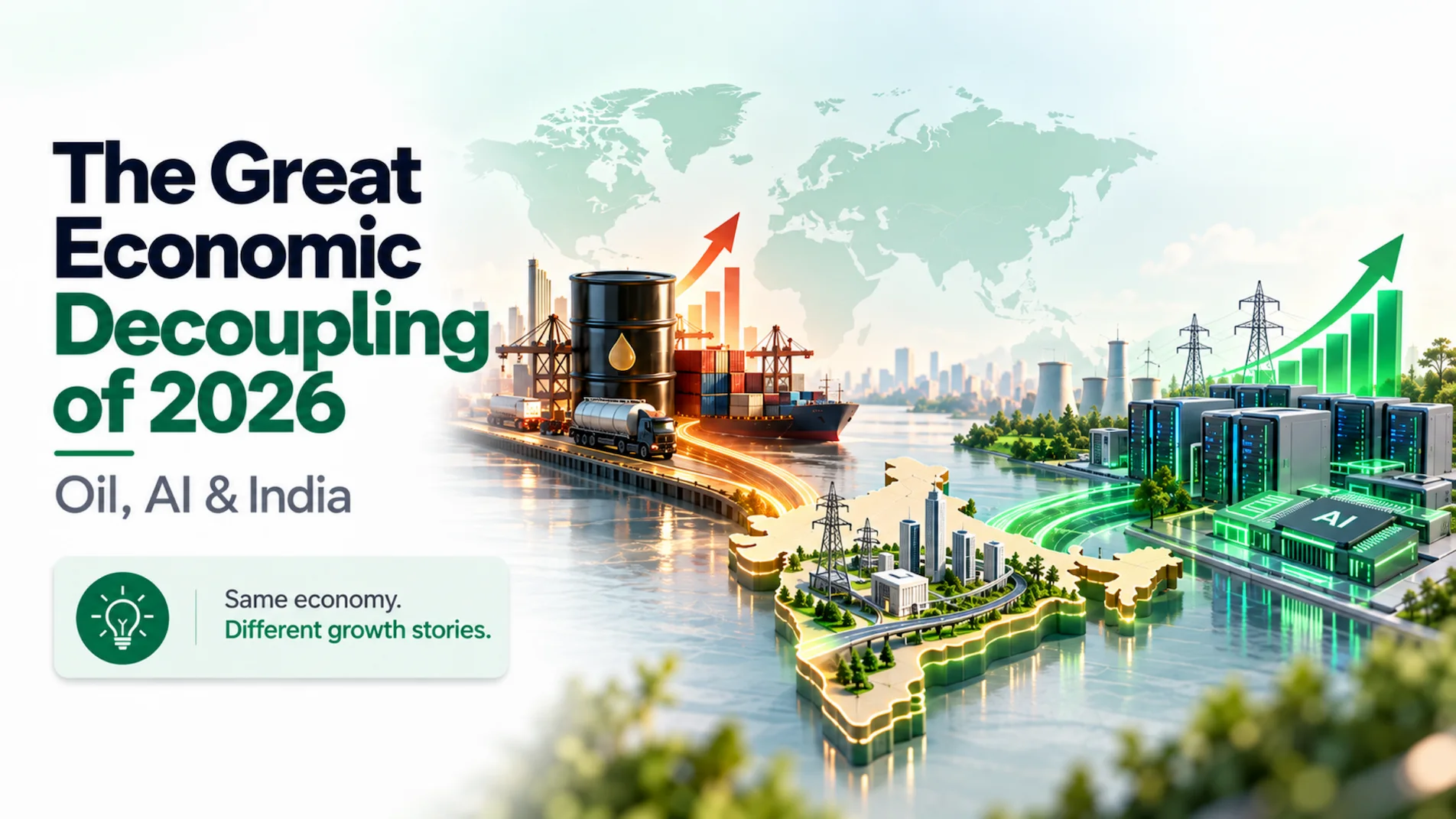
Oil is getting more expensive. Technology companies are spending hundreds of billions of dollars. And the global economy is still growing.
For a household watching its monthly expenses rise, that last part can feel difficult to reconcile.
But follow where the money is going, and the picture starts to make sense.
One stream is paying for costlier energy, shipping and supplies. Another is pouring into chips, data centres and the infrastructure behind artificial intelligence. Some businesses are absorbing higher bills. Others are receiving enormous new orders.
The same global economy is producing very different experiences of growth.
The IMF’s October outlook captures this divide. It projects global growth of 3.1% in 2026, alongside 4.7% inflation. Beneath those averages are economies benefiting from technology investment and others struggling with energy costs, disrupted trade and limited room to respond.
This is the economic decoupling taking shape in 2026: growth, household finances and investment returns are moving at different speeds.
And India sits where several of those paths cross.
Brent crude futures settled at $116.72 a barrel on October 23, as threats to Middle Eastern supplies kept oil markets under pressure.
To understand how that travels through an economy, start with a transport company.
Its trucks cover the same routes and carry the same goods. But a higher diesel bill makes each delivery more expensive.
The owner can raise freight charges, accept a smaller profit or try to reduce fuel consumption. How much can be passed on depends on competition and customer contracts.
Now follow those freight charges to the manufacturer using the trucks.
Materials become more expensive to receive. Finished products cost more to deliver. The manufacturer faces the same decision: raise prices, absorb the expense or reduce costs elsewhere.
Eventually, some of that pressure reaches household budgets.
An energy shock spreads through the cost of doing business, even when the business has little to do with energy.
For an importing economy, higher international prices also increase the foreign-currency bill for supplies. If its currency weakens, those purchases become more expensive in local terms.
Governments can cushion the impact through taxes or subsidies. Companies can absorb part of the increase. Either way, the cost falls somewhere.
Supply recovery offers some relief, but it can be fragile. The International Energy Agency reported that global oil supply increased in September, led by Gulf producers, while renewed attacks threatened the recovery.
A buyer needs more than a shipment available today. It needs confidence about the next shipment, its delivery date and the cost of getting it safely to its destination.
That uncertainty keeps businesses cautious.
While businesses worry about energy bills, technology companies are committing extraordinary sums to computing infrastructure.
Meta expects $135–$145 billion in capital expenditure during 2026, including finance-lease principal payments, to support its AI ambitions and existing businesses.
The number is enormous. The activity behind it is surprisingly physical.
Data centres need land, buildings, servers, networking equipment, cooling systems and electricity connections. They need people to construct them and suppliers to deliver the equipment.
Long before an AI service earns money from a customer, the companies building its infrastructure can be receiving orders.
Chipmaker TSMC reported third-quarter revenue of $46.72 billion, up 41.2% year-on-year in US dollars. Its customers serve markets beyond AI, but its results illustrate the scale of demand reaching advanced semiconductor manufacturing.
That spending supports economic activity immediately. Equipment gets manufactured. Construction begins. Suppliers hire, invest and deliver.
The longer-term promise comes later: businesses using AI to complete work faster, improve products and use resources more efficiently.
For now, the investment itself is an important source of demand.
Imagine two businesses facing the same increase in fuel costs.
One supplies components for new computing facilities. Its expenses rise, but it also receives a growing stream of orders.
The other supplies a market where customers are cutting back. Its expenses rise while sales become harder to secure.
Both face the energy shock. Their ability to absorb it is very different.
Something similar happens across economies.
Countries connected to technology supply chains can benefit from investment and export demand. Energy importers with little participation in those supply chains face the higher bill without the same source of additional business.
The IMF identifies this second group as facing a particularly difficult outlook.
Yet the division runs through countries as well as between them.
A technology exporter may depend on imported fuel. An energy producer may face damaged infrastructure or disrupted shipments. A country attracting data-centre investment may still have households struggling with food and transport costs.
Growth can remain healthy in aggregate while becoming much less widely felt.
That is what makes the current divide worth watching. The headline number describes the size of the economy. It says much less about who is benefiting from its expansion.
The two forces eventually meet at the electricity connection.
Data centres need reliable power around the clock. As computing capacity expands, so does the infrastructure required to support it.
The IEA’s 2025 Energy and AI report estimated that data centres consumed 415 terawatt-hours of electricity in 2024. Its base-case projection puts consumption at about 945 TWh by 2030, with AI the largest driver of growth alongside other digital services.
These figures cover all data centres. Their electricity requirements are also distinct from the crude oil used heavily in transport and industry.
But building that power supply takes time.
A facility may need new transmission connections, transformers, generation capacity and cooling equipment. Computing hardware can arrive before the surrounding infrastructure is ready.
The IEA estimated that, without action to address electricity-sector constraints, around one-fifth of planned data-centre projects could face delays.
This creates opportunities for infrastructure suppliers. It also introduces competition for equipment, construction capacity and funding.
The AI boom can support growth while adding pressure to the resources needed to sustain it.
For investors, a booming industry creates another question: how much of the growth will become a return on the money invested?
Meta’s third-quarter revenue increased 26%. Its free cash flow was nevertheless negative $2.12 billion, with capital spending exceeding cash generated from operations.
Those figures show two sides of the same expansion.
The business was growing, and the investment required to support its ambitions was substantial. Investors must assess how future earnings could justify that spending, how long it will take and what additional funding may be needed.
Suppliers face their own version of the problem.
Strong orders can encourage them to build more capacity. That capacity must still earn an adequate return if customers slow their spending or competitors expand too aggressively.
The IMF has highlighted risks from concentrated AI investment and the possibility that disappointing revenue or earnings could unsettle financial markets.
A successful technology can still produce disappointing investments when too much capital chases returns that arrive late or fall short.
The economic opportunity and the investment outcome depend on different calculations.
India experiences both sides of this divide.
Higher imported-energy costs can put pressure on businesses, household budgets and external payments. At the same time, investment in computing and digital infrastructure creates opportunities within the country.
Google’s $15 billion commitment over 2026–2030 is one example. In April 2026, the company announced groundbreaking for its AI hub in Visakhapatnam.
Its construction update also identified supporting investment in transmission lines, clean-energy generation and storage.
The project shows how a technology investment can create demand across several industries. It also shows why an announcement takes years to turn into completed infrastructure and operating income.
The IMF’s October address included India among economies connected to the AI value chain receiving growth upgrades.
So the useful question is how much of that opportunity becomes business for Indian companies.
Who wins the contracts? How much equipment and work is sourced locally? What margins do suppliers earn? How much cash must they commit before customers pay?
Those answers determine how a large investment programme reaches company earnings.
The great economic decoupling of 2026 is visible in the gap between broad growth figures and individual experiences.
A household can face rising expenses while a chipmaker reports strong revenue. A supplier can receive record orders while its customer burns cash. An economy can attract investment while parts of its business sector struggle with costs.
For investors, four questions help connect the bigger picture to a particular company:
Oil costs and AI investment are pulling on the economy in different ways. Neither affects every business equally.
The opportunity lies in understanding those differences: who receives the new orders, who carries the higher costs, and who keeps enough of the money to build a stronger business.
Disclaimer: This article is for information and education only and does not constitute investment advice or a recommendation to buy or sell any security. Forecasts and investment plans may change, and market investments carry risk.
No spam. Only new posts, simple explainers, and practical money checklists for busy professionals.
Finnovate is a SEBI-registered financial planning firm that helps professionals bring structure and purpose to their money. Over 3,500+ families have trusted our disciplined process to plan their goals - safely, surely, and swiftly.
Our team constantly tracks market trends, policy changes, and investment opportunities like the ones featured in this Weekly Capsule - to help you make informed, confident financial decisions.
Learn more about our approach and how we work with you:
No comments yet. Start the conversation. What would you add?
No spam. Only new posts, simple explainers, and practical money checklists.
You may also like
Explore FPI equity flows for October First Half, 2026: ₹47,955 crore in net outflows, th...
Understand the India–Mauritius tax treaty’s Principal Purpose Test, its August 2026 ef...

Explore India’s AI hardware opportunity through the proposed Adani–Jabil venture, from...
India’s CPI inflation rose to 5.54% in September 2026. Compare monthly trends, food pric...
Popular now

Learn how to easily download your NSDL CAS Statement in PDF format with our step-by-step g...

Looking for the best financial freedom books? Here’s a handpicked 2026 reading list with...
Learn what SIF investment means in India, SEBI rules, Rs 10 lakh minimum investment, avail...

Clear guide to mutual fund taxation in India for FY 2025–26 after July 2024 changes: equ...