
The Great Economic Decoupling of 2026: Oil, AI & India
Rising oil prices and booming AI investment are shaping an uneven global economy in 2026. ...
24 October 2026

Finnovate’s editorial team researches and creates financial content using trusted sources, regulatory references and inputs from subject experts.
If a narrow stretch of water can disrupt your biggest source of income, how much would you spend to find another way out?
For the Gulf’s energy producers, that question has become increasingly urgent.
Oil fields can keep producing. Overseas customers can keep placing orders. But getting the cargo from one to the other depends heavily on the Strait of Hormuz, the passage connecting the Persian Gulf with the Gulf of Oman and the wider ocean.
Now, a bold prediction has put the alternatives in focus.
Speaking in Dubai on October 20, HSBC CEO Georges Elhedery suggested that investment in alternative routes could make Hormuz redundant in about five years.
It is an intriguing possibility. Build enough pipelines, connect them to ports outside the strait, and the world’s energy supplies become harder to disrupt.
But replacing a shipping route involves much more than building a bigger pipe.
The real test is how much energy can reach customers through another route, reliably and at an acceptable cost.
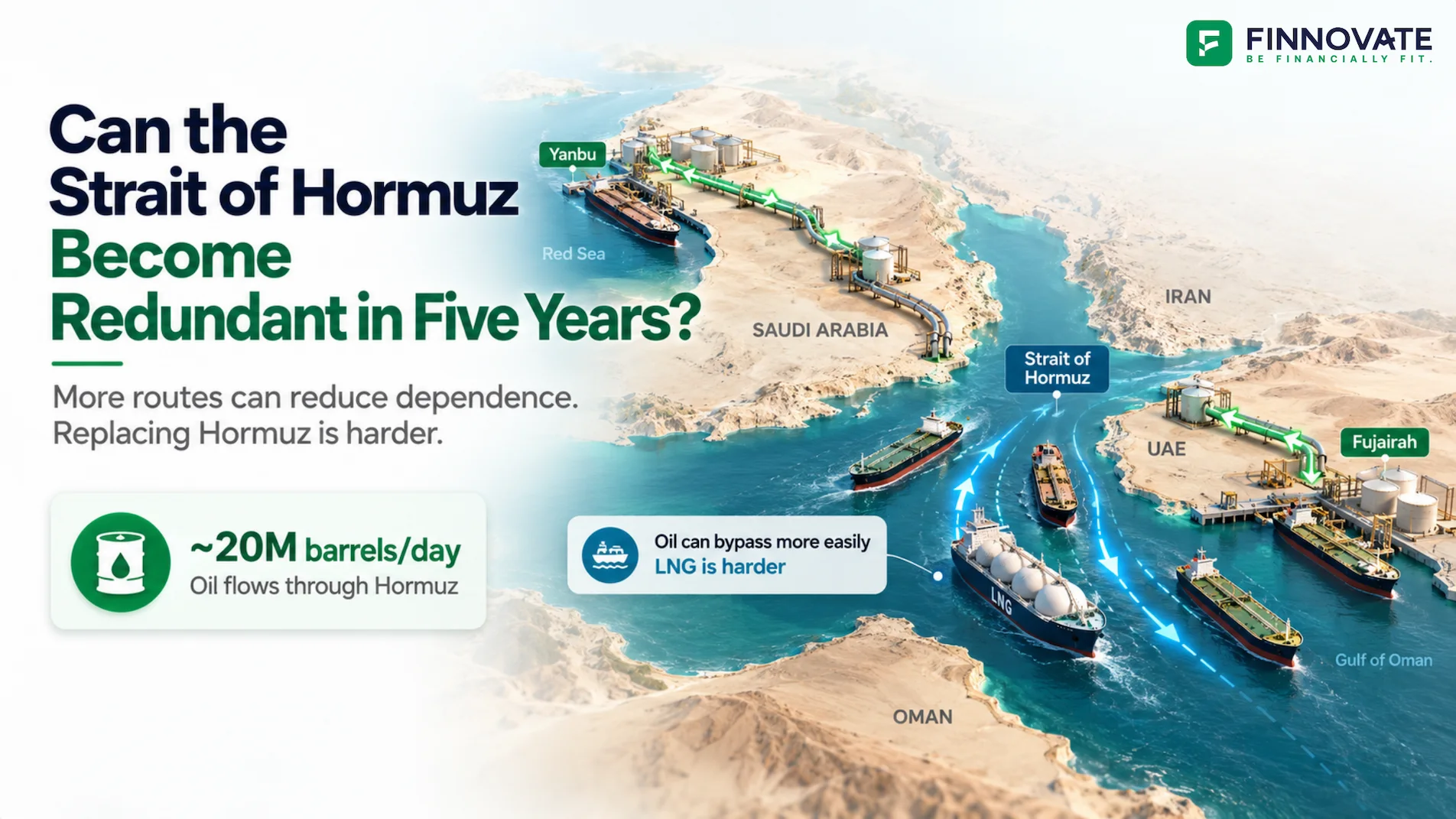
In 2024, oil flows through Hormuz averaged about 20 million barrels a day, equivalent to roughly 20% of global petroleum liquids consumption, according to the US Energy Information Administration.
Around 20% of global liquefied natural gas trade also passed through the strait that year, primarily from Qatar.
Those are two separate measures of energy dependence. The frequently repeated claim that Hormuz carries one-fifth of all world trade overstates its role.
Its importance is nevertheless substantial, particularly for Asia.
The EIA estimated that 84% of the crude oil and condensate moving through Hormuz in 2024 went to Asian markets. India was among the leading destinations, alongside China, Japan and South Korea.
For these buyers, disruption can affect both the availability of cargoes and the cost of securing them.
Producers face the other side of the problem. Oil that cannot reach an export terminal or customer generates no export revenue. Storage can provide breathing room, but it cannot accommodate an indefinite interruption.
That gives both sides a reason to want alternatives.
Saudi Arabia’s East–West pipeline moves crude from its eastern oil-producing region across the country to Yanbu on the Red Sea.
The geography is the advantage.
Instead of loading the oil inside the Persian Gulf and sending a tanker through Hormuz, Saudi Arabia can move it over land and load it on the western coast.
Recent reporting puts the system’s capacity at around 7 million barrels a day. Aramco is studying an expansion to 10 million barrels a day.
The route provides a valuable alternative, although some pipeline capacity serves domestic refineries rather than exports.
The UAE has a similar option on its eastern coast.
Its existing Habshan–Fujairah pipeline can transport approximately 1.8 million barrels a day to Fujairah, which sits outside Hormuz on the Gulf of Oman.
ADNOC has also announced a new West–East pipeline intended to double its export capacity through Fujairah, with operations targeted for 2027.
These projects show why HSBC’s argument deserves attention. The Gulf can build more ways to move oil without using the strait.
| Route or project | How it helps | Capacity or project status | Main limitation |
|---|---|---|---|
| Saudi East–West pipeline to Yanbu | Moves crude over land to the Red Sea, bypassing Hormuz | Around 7 million barrels a day reported; expansion to 10 million under study | Some capacity serves refineries; exports also depend on terminals and onward shipping |
| Existing Habshan–Fujairah pipeline | Takes UAE crude to a port outside Hormuz | Approximately 1.8 million barrels a day | Capacity already in use provides no additional room for displaced cargoes |
| ADNOC’s new West–East pipeline | Adds another crude-export route through Fujairah | Intended to double ADNOC’s Fujairah export capacity; operations targeted for 2027 | Completion, commissioning and supporting facilities determine usable capacity |
| Qatar’s existing LNG export system | Supplies overseas buyers by specialised ships | LNG cargoes departing the Gulf depend on passage through Hormuz | Crude-oil bypass pipelines cannot carry these cargoes |
↔ Scroll horizontally to view the full table. The first column stays fixed.
Capacity figures describe different systems and stages of development. They should not be added together as though all represent spare capacity available today.
Imagine a factory connected to a warehouse by a wide road.
Doubling the road’s capacity helps little if the warehouse has limited storage and only one loading bay.
Energy infrastructure works in a similar way.
Oil must reach the pipeline, move through pumping stations, enter storage, load onto tankers and continue towards the buyer. Each stage must accommodate the additional volume.
The amount a route can export is constrained by the tightest part of that chain.
There is also a difference between total capacity and spare capacity.
A pipeline carrying oil every day is already doing a job. Only its unused capacity can absorb additional shipments during a disruption, unless existing flows are redirected elsewhere.
This is why a headline announcing a ten-million-barrel pipeline cannot be read as ten million barrels of new protection against a Hormuz closure.
The starting point, existing usage and supporting export facilities all matter.
Moving oil outside Hormuz solves one geographical problem. The next journey depends on where the customer is.
A tanker leaving Fujairah can head towards Asian markets without entering the Persian Gulf.
A tanker leaving Yanbu for Asia would typically travel south through the Red Sea and towards Bab al-Mandeb, another strategically important passage.
Europe-bound oil from Yanbu can travel north towards Suez or use Egypt’s SUMED pipeline system to reach the Mediterranean.
That makes the alternatives more complicated than a single replacement corridor.
Some routes offer a shorter or more convenient journey to particular customers. Others introduce additional handling, longer voyages or exposure to different security risks.
Pipelines, pumping stations and terminals also remain physical infrastructure that can be damaged or interrupted.
The benefit comes from having several workable routes, so that a problem in one place leaves more options elsewhere.
Crude oil receives much of the attention, but Qatar’s LNG exports complicate the five-year claim.
LNG is natural gas cooled into liquid form for transport in specialised ships. Exporting it requires liquefaction facilities, storage and loading infrastructure.
An oil pipeline to Yanbu or Fujairah cannot take over that job.
Natural gas can travel through pipelines. But creating an alternative for Qatar’s overseas LNG customers would require suitable cross-border connections and, depending on the destination and design, additional facilities to turn the gas into LNG for shipping.
That brings engineering, financing, land access, commercial contracts and agreements between countries into the picture.
A proposed route must also connect to the right customers. A regional gas pipeline serving nearby users would perform a different function from an LNG export system serving buyers across Asia and Europe.
For oil, the Gulf already has established bypasses to expand. For LNG, the replacement challenge involves a much larger redesign of the export chain.
A figure of $1.4 trillion has appeared alongside the discussion about alternative routes.
Its meaning needs care.
The figure cited in the reporting refers to a broader collection of planned, unawarded infrastructure projects across the Middle East, North Africa and Türkiye. It is not a committed budget devoted entirely to oil pipelines bypassing Hormuz.
Here, a “pipeline of projects” describes prospective developments.
For investors assessing infrastructure opportunities, the distinction matters. A project can move through several stages before producing revenue: proposal, approval, financing, contract award, construction and operation.
The relevant question is how much of the announced activity progresses through those stages, and which businesses secure profitable work.
For India, more functioning export routes could improve supply reliability and give refiners greater flexibility when disruption occurs.
But the price of a cargo depends on more than whether it passes through Hormuz.
Refiners also consider the crude’s characteristics, freight, insurance, delivery time and how well it suits their facilities. A supplier offering an alternative route still has to compete on the full cost of delivery.
India also buys in a global market. Disruption affecting other customers can influence prices even when an Indian shipment uses a different route.
The potential benefit is therefore broader access to supplies and a better ability to manage interruptions. The effect on prices would depend on how much additional oil reaches the market and what is happening to demand.
For investors, this creates questions across energy, shipping and infrastructure. New contracts can create business opportunities, while construction costs, delays and financing determine the eventual returns.
The projects identified so far support a credible case for reducing dependence on Hormuz. They do not establish that the strait will become dispensable within five years.
Saudi Arabia and the UAE can expand their alternatives. Other producers face different infrastructure and geographical constraints. LNG adds a separate challenge, and every route needs functioning facilities from the production site to the customer.
Still, an alternative does not have to replace every shipment to be valuable.
If more energy can keep moving during a disruption, producers preserve revenue, buyers retain access to supplies and the wider economy has more room to adjust.
The most useful measure of progress is therefore how much additional energy can reach customers when Hormuz is disrupted.
The Gulf’s investment challenge is to turn a vulnerable export network into one with enough alternatives to keep trading. Five years will test how far that ambition can become working infrastructure.
Disclaimer: This article is for information and education only and does not constitute investment advice or a recommendation to buy or sell any security. Infrastructure plans, capacity estimates and completion timelines may change.
No spam. Only new posts, simple explainers, and practical money checklists for busy professionals.
Finnovate is a SEBI-registered financial planning firm that helps professionals bring structure and purpose to their money. Over 3,500+ families have trusted our disciplined process to plan their goals - safely, surely, and swiftly.
Our team constantly tracks market trends, policy changes, and investment opportunities like the ones featured in this Weekly Capsule - to help you make informed, confident financial decisions.
Learn more about our approach and how we work with you:
No comments yet. Start the conversation. What would you add?
No spam. Only new posts, simple explainers, and practical money checklists.
You may also like
Rising oil prices and booming AI investment are shaping an uneven global economy in 2026. ...

Explore FPI equity flows for October First Half, 2026: ₹47,955 crore in net outflows, th...
Understand the India–Mauritius tax treaty’s Principal Purpose Test, its August 2026 ef...

Explore India’s AI hardware opportunity through the proposed Adani–Jabil venture, from...
Popular now

Learn how to easily download your NSDL CAS Statement in PDF format with our step-by-step g...

Looking for the best financial freedom books? Here’s a handpicked 2026 reading list with...
Learn what SIF investment means in India, SEBI rules, Rs 10 lakh minimum investment, avail...

Clear guide to mutual fund taxation in India for FY 2025–26 after July 2024 changes: equ...