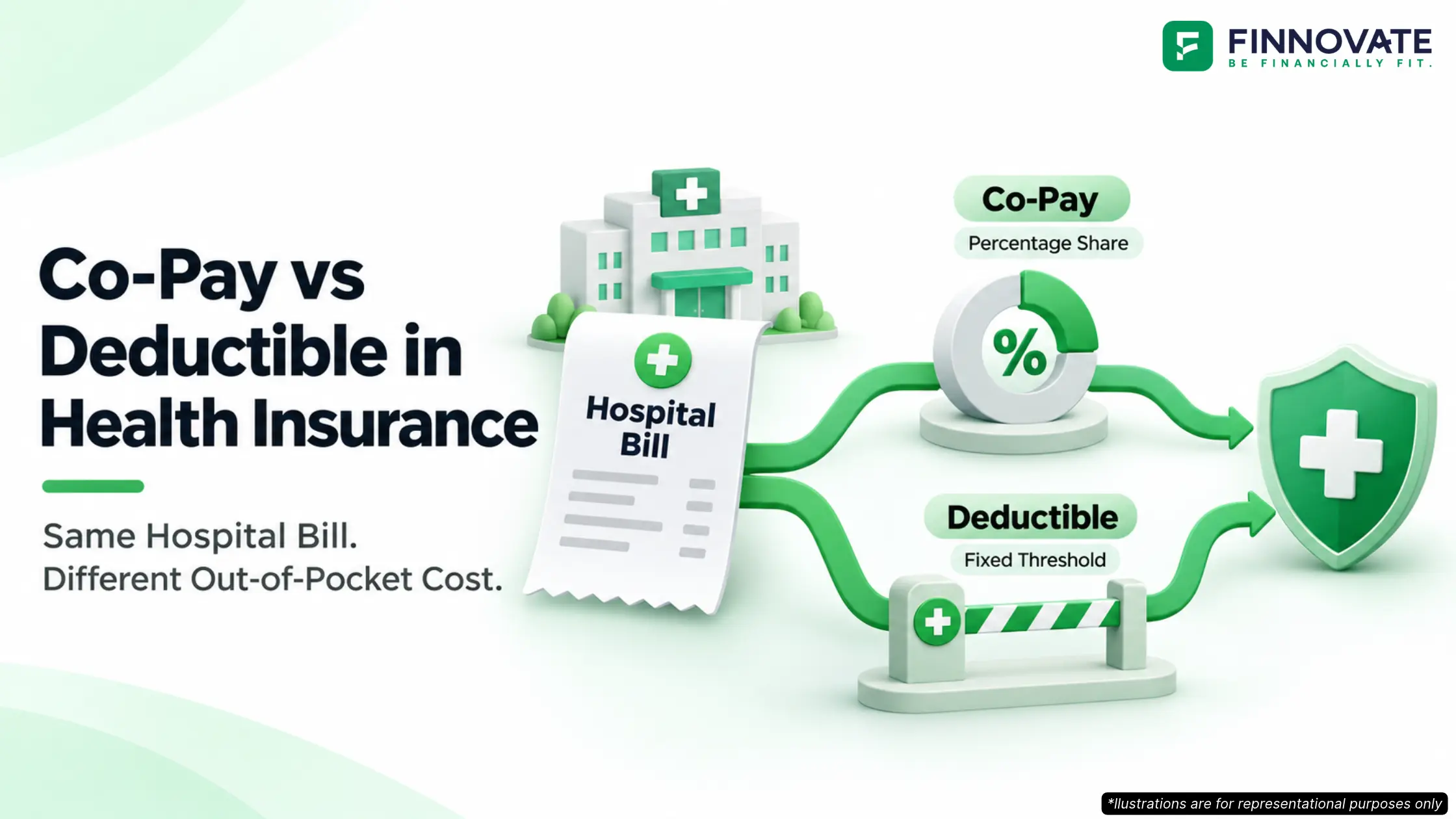
Co-Pay vs Deductible in Health Insurance

Finnovate’s editorial team researches and creates financial content using trusted sources, regulatory references and inputs from subject experts.
You are hospitalised and receive an admissible hospital bill of ₹5 lakh.
Your health insurance policy has a ₹10 lakh sum insured, so you may expect the insurer to cover the full ₹5 lakh.
But suppose the policy has a 20% co-payment.
You would have to bear ₹1 lakh yourself, while the insurer's share would be ₹4 lakh, subject to the other policy terms.
Now take the same ₹5 lakh admissible claim under a policy with a ₹50,000 deductible.
In that case, ₹50,000 sits below the insurer's liability and ₹4.5 lakh is potentially payable by the insurer.
Co-pay: You bear a specified percentage of the admissible claim.
Deductible: A fixed threshold of eligible medical expenses must be met before insurer liability begins.
Co-pay therefore moves with the admissible claim amount because it is percentage-based. A deductible works as a defined threshold under the policy.
What Is Co-Pay in Health Insurance?
Co-payment, usually called co-pay, is a cost-sharing condition where you bear a specified percentage of the admissible claim.
The insurer pays the remaining admissible amount, subject to the available sum insured and other policy conditions.
Suppose your policy has a 20% co-pay and the admissible claim is ₹5 lakh.
| Particulars | Amount |
|---|---|
| Admissible claim | ₹5,00,000 |
| 20% co-pay | ₹1,00,000 |
| Insurer's share | ₹4,00,000 |
The percentage depends on the policy.
Some products have a compulsory co-pay. Others may offer a voluntary co-pay option in return for a lower premium.
A co-pay can also apply only in certain situations, such as specific age groups, treatments, hospitals or geographical zones.
Where the clause applies to every admissible claim, that percentage can affect each claim made during the year.
What Is a Deductible in Health Insurance?
A deductible is a fixed rupee threshold that applies before the insurer starts paying according to the policy terms.
Suppose:
- Admissible hospitalisation expenses: ₹5 lakh
- Deductible: ₹50,000
The deductible and the sum insured serve different purposes.
A ₹50,000 deductible does not turn a ₹5 lakh sum insured into ₹4.5 lakh of cover.
The deductible sets the threshold for insurer liability. The sum insured is the amount of cover available under the policy, subject to its conditions.
Does the Deductible Apply to Every Claim?
That depends on its structure.
A deductible may apply:
- to each claim or hospitalisation;
- to aggregate eligible claims during the policy year;
- per insured person;
- across a family under certain floater structures.
So two policies with the same ₹50,000 deductible can still behave differently during claims.
Co-Pay vs Deductible: Key Differences
| Feature | Co-Pay | Deductible |
|---|---|---|
| Calculation | Percentage of the admissible claim | Fixed rupee threshold |
| What you bear | A share of the admissible claim | Eligible expenses below the applicable threshold |
| Effect of a larger claim | Your rupee contribution rises if the same percentage continues to apply | The threshold remains defined by the policy structure |
| How it applies | According to the co-pay clause | Can be per claim, annual aggregate, per person or family |
| Can be voluntary | Yes, in some products | Yes, in some products |
| Can affect premium | Voluntary options may come with a lower premium | Voluntary deductible options may come with a lower premium |
| Reduces sum insured | No | No |
Same ₹5 Lakh Claim, Two Different Calculations
Assume the full ₹5 lakh is admissible, the sum insured is sufficient and no other deductions apply.
With these numbers, the deductible leaves ₹50,000 below insurer liability, while the co-pay leaves ₹1 lakh with the policyholder.
A different deductible, co-pay percentage or claim amount can produce a different result.
How Co-Pay Changes as the Claim Gets Bigger
Because co-pay is percentage-based, the rupee amount you bear rises with the admissible claim.
Take a policy with a 20% co-pay.
| Admissible Claim | Co-Pay | Your Share |
|---|---|---|
| ₹2 lakh | 20% | ₹40,000 |
| ₹5 lakh | 20% | ₹1 lakh |
| ₹10 lakh | 20% | ₹2 lakh |
The percentage is unchanged, but the amount borne by the policyholder moves from ₹40,000 to ₹2 lakh.
Now take an assumed ₹50,000 per-claim deductible.
On a ₹5 lakh admissible claim, the deductible remains ₹50,000. On a ₹10 lakh admissible claim, it remains ₹50,000 under that same per-claim structure.
This difference in calculation is why the two clauses can lead to very different out-of-pocket amounts on larger claims.
Per-Claim Deductible vs Annual Aggregate Deductible
The deductible amount tells you only part of the story. Its structure decides how multiple claims are treated.
Per-Claim Deductible
A per-claim deductible can apply separately to each admissible claim or hospitalisation.
Annual Aggregate Deductible
An annual aggregate deductible considers eligible medical expenses across claims during the policy year.
Consider:
- First eligible claim: ₹30,000
- Second eligible claim: ₹2 lakh
- Annual deductible: ₹50,000
The two eligible claims can be considered together. Once the ₹50,000 annual threshold is met, the insurer assesses eligible expenses according to the policy.
This distinction is also central to how top-up and super top-up health insurance plans work. Read: Top-Up vs Super Top-Up Health Insurance .
Can a Policy Have Both Co-Pay and Deductible?
Yes.
If both clauses apply, they can increase the amount that remains with the policyholder.
Consider:
- Admissible claim: ₹5 lakh
- Deductible: ₹50,000
- Co-pay: 20%
For this example, assume the policy applies the deductible first and then calculates the co-pay on the remaining admissible amount.
| Particulars | Amount |
|---|---|
| Admissible claim | ₹5,00,000 |
| Deductible | ₹50,000 |
| Balance after deductible | ₹4,50,000 |
| 20% co-pay on ₹4.5 lakh | ₹90,000 |
| Total borne by policyholder | ₹1,40,000 |
| Potential insurer payment | ₹3,60,000 |
Where Do These Clauses Commonly Appear?
Senior-Oriented Health Insurance
Some senior-focused policies carry compulsory co-pay conditions. A large claim can therefore leave a meaningful part of the admissible expense with the family even when the policy has a sizeable sum insured.
For more on this, read: Health Insurance for Parents Above 60 .
Voluntary Cost-Sharing Options
Some insurers allow policyholders to choose a co-pay or deductible in return for a lower premium.
The relevant comparison is the premium saved versus the additional amount that may have to be borne during a claim.
Top-Up and Super Top-Up Plans
Deductibles are central to these policies. The way eligible claims are measured against the deductible determines when the additional cover starts responding.
Employer or Group Health Insurance
Group policies can also include co-pay or deductible conditions, including on benefits provided to dependent parents.
Three Common Misunderstandings
Gross Bill vs Admissible Claim
Suppose:
- Hospital bill: ₹5 lakh
- Admissible claim after applicable policy adjustments: ₹4 lakh
- Co-pay: 20%
In this case, the co-pay is calculated on ₹4 lakh rather than the ₹5 lakh hospital invoice.
What Should You Check Before Buying?
Final Takeaway
A co-pay makes you share a percentage of the admissible claim. A deductible sets a fixed threshold before insurer liability begins.
The difference becomes more visible as claim amounts rise.
Take a realistic ₹5 lakh or ₹10 lakh admissible hospital claim and calculate what the co-pay or deductible would leave with you.
That gives a much better view of the policy's claim-side cost than comparing premiums alone.
FAQs
1. Is co-pay mandatory in health insurance?
It depends on the policy. Some products have a compulsory co-pay, while others may offer a voluntary co-pay option. The clause can also apply only under specified conditions.
2. Does a deductible apply to every claim?
It depends on the deductible structure. It may apply per claim, per policy year, per insured person or across a family.
3. Can a policy have both co-pay and deductible?
Yes. If both apply, check how the policy calculates them because the order can affect the amount you bear.
4. Does co-pay reduce the sum insured?
No. Co-pay determines the percentage of an admissible claim that you bear. It does not by itself reduce the policy's sum insured.
5. Does a deductible reduce the sum insured?
No. A deductible sets a threshold before insurer liability begins. It does not by itself reduce the stated sum insured.
6. Which costs more during a claim, co-pay or deductible?
It depends on the numbers. A percentage co-pay can become substantial on a large admissible claim, while a high deductible can leave a sizeable initial amount with you. Compare both using the same claim amount.
7. Can co-pay apply only after a certain age?
Some policies have age-linked co-pay conditions. Check the policy schedule and wording to see when the clause applies.
8. What is an annual aggregate deductible?
It considers eligible medical expenses across claims during the policy year. Once the aggregate threshold is crossed, eligible expenses are assessed according to the policy terms.
9. Can choosing a voluntary deductible reduce the premium?
Some products offer a premium discount when you voluntarily select a deductible. Compare that saving with the amount you may need to bear during a claim.
10. What should I check in a co-pay clause?
Check the percentage, when it applies and the amount on which it is calculated. These determine how much of an admissible claim may remain with you.