

Tax Planning and Benefits for Married Couples in India: 2026 Guide
Tax planning for married couples in India explained for 2026. Compare tax regimes, deducti...
05 September 2026

Finnovate’s editorial team researches and creates financial content using trusted sources, regulatory references and inputs from subject experts.

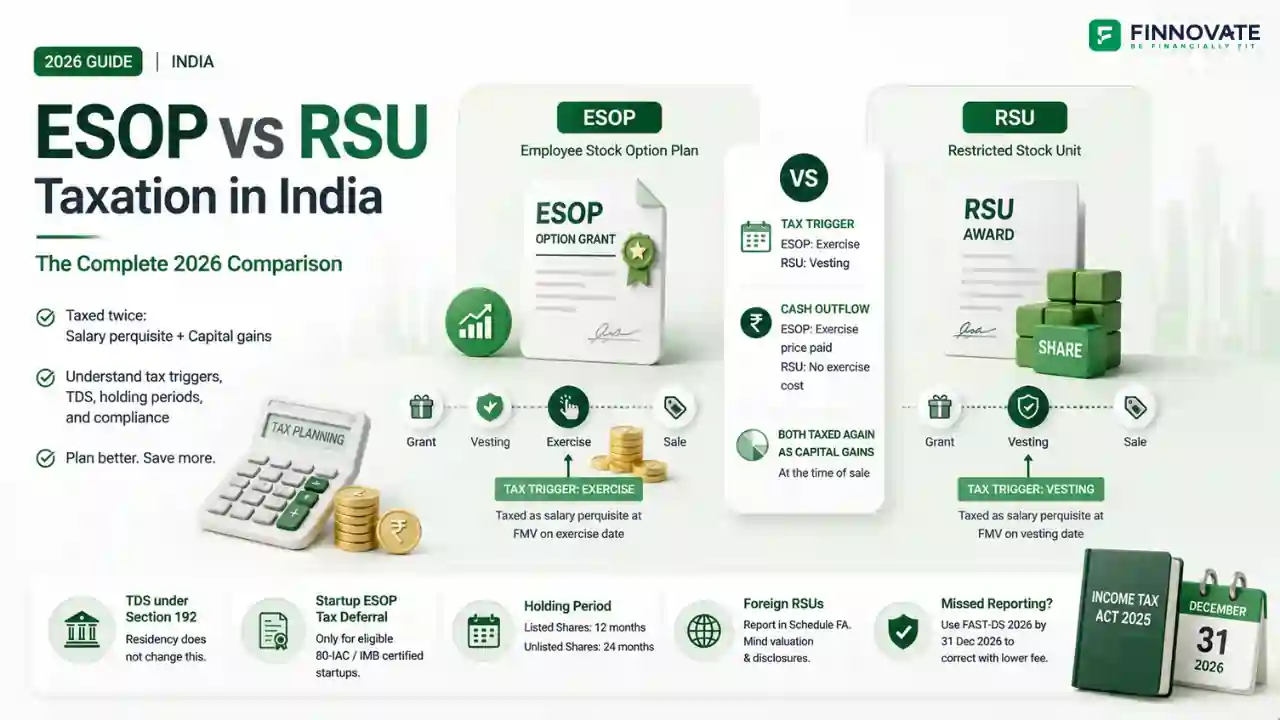
Both ESOPs and RSUs are taxed twice in India: once as a salary perquisite, and again as capital gains. ESOPs are taxed on exercise, RSUs are taxed on vesting, and that single difference decides when the cash flow pressure actually hits.
| Dimension | ESOP | RSU |
|---|---|---|
| Upfront cost to employee | Exercise price paid in cash | None, shares delivered free |
| Tax trigger | Exercise | Vesting |
| Valuation basis | FMV on exercise date | FMV on vesting date |
| Risk profile | Employee bears exercise cost risk before any liquidity | No exercise cost, but tax is still due on illiquid shares |
| Typical employer type | Startups, unlisted companies | MNCs, listed and foreign listed companies |
In this guide
In short: ESOPs are taxed as a perquisite at exercise. The formula is FMV on the exercise date minus the exercise price, multiplied by the number of shares exercised, added to salary and taxed at slab rate.
Ananya joins an unlisted startup, TechNova Pvt Ltd, as an early employee.
In short: RSUs fall under the same Section 17(2)(vi) framework as ESOPs, but the trigger is vesting, not exercise, because there is no exercise price to pay. The full FMV on the vesting date becomes taxable salary.
Rohit works at the India office of a US listed company, GlobalTech Inc.
In short: TDS on ESOP and RSU perquisite value is always under Section 192, because it is salary income, regardless of the employee's residency status.
Section 192 applies only to residents, Section 195 applies to non-residents.
Section 195 covers non-salary payments to non-residents, such as interest, royalty, or fees for technical services, and explicitly excludes salary. ESOP and RSU perquisite value is salary, so Section 192 applies no matter the employee's residency.
For RSUs specifically, employers commonly use a "sell to cover" mechanism: a portion of the vested shares is sold immediately to fund the TDS, and the rest is credited to the employee.
Please consult a qualified chartered accountant or registered tax practitioner for guidance specific to your residency status and your employer's TDS practice.
In short: only DPIIT-recognised startups that also hold a valid Section 80-IAC / IMB certificate qualify for ESOP TDS deferral. DPIIT recognition alone is not enough, and only a small fraction of DPIIT startups hold the extra certification.
At the earliest of:
Some commentary suggests this window may extend to 60 months under the restructured Income Tax Act 2025, and that deferral may expand to all DPIIT-registered startups. Neither is confirmed against primary legislative text. This guide uses the verified 48-month, IMB-certified-only rules until that changes.
In short: capital gains = sale price minus the FMV already taxed as perquisite. This is what stops the same rupee of gain from being taxed twice.
In short: foreign RSU income is converted to INR using the SBI TTBR, taxed as salary at vesting, and any resulting double taxation can usually be resolved through a DTAA foreign tax credit.
| Event | Rule | Rate used |
|---|---|---|
| Vesting (perquisite) | Rule 26 | SBI TTBR on the vesting date |
| Sale (capital gains) | Rule 115 | SBI TTBR on the last day of the month before the month of sale |
Foreign tax withheld can be claimed as a credit via Form 67. Several tax practitioner sources report that CBDT amended Rule 128 to allow this to be filed on or before the end of the relevant assessment year, provided the return itself was filed on time, which would put the deadline for AY 2026-27 at 31 March 2027. The e-filing portal's own published user guidance still describes the older rule, filing before the return due date under Section 139(1), so this is worth confirming directly with a chartered accountant or on the e-filing portal before relying on the later date.
FAST-DS 2026, introduced through Clauses 114 to 128 of the Finance Bill 2026, gives eligible taxpayers a one-time six month window to disclose foreign assets or income never reported before. It splits into two categories, and picking the right one matters.
| Category A | Category B | |
|---|---|---|
| Covers | Foreign income or assets never taxed and never reported | Income already taxed in India (e.g. via employer TDS) but never disclosed in Schedule FA, or an asset acquired while non-resident and not reported after returning to India |
| Value limit | Up to Rs 1 crore (as on 31 March 2026) | Up to Rs 5 crore (as on 31 March 2026) |
| Cost | Roughly 60% of asset value (30% tax + 30% additional charge) | Flat one-time fee of Rs 1,00,000 |
| Most relevant to | Wholly undisclosed foreign income or assets | Most salaried ESOP/RSU holders who paid tax but skipped Schedule FA |
If your ESOP or RSU shares were correctly taxed at the time but never reported afterward, check Category B before assuming the larger Category A charge applies to you.
As per the Black Money Act's stated framework, non-disclosure can attract a penalty and, for willful evasion, prosecution with possible imprisonment. A carve-out from prosecution applies where aggregate undisclosed foreign movable assets, excluding immovable property, stay below Rs 20 lakh. Confirm exact current figures with a qualified professional, since this framework has evolved with recent legislative changes.
Missed reporting foreign RSU shares? The FAST-DS 2026 window closes on 31 December 2026.
Talk to a Tax AdvisorIn short: the Income Tax Act 2025 replaced the 1961 Act from 1 April 2026 and renumbered the relevant sections, but changed no ESOP or RSU tax rates or mechanics. It is a numbering change, not a rules change.
In short: neither is universally better. It depends on whether you can absorb exercise cost risk and whether the shares are liquid enough to sell when tax comes due.
ESOPs and RSUs share the same underlying framework: perquisite tax when the employee actually receives value, capital gains tax when the shares are eventually sold. The trigger event, exercise for ESOPs and vesting for RSUs, decides when the first bill arrives.
Want a second opinion on your ESOP or RSU tax planning?
Book a Call With Our TeamNeither is universally better. It depends on exercise cost risk, share liquidity, and residency status.
Yes, once as perquisite at exercise and again as capital gains at sale, but the cost basis rule under Section 49(2AA) prevents the same gain from being taxed twice.
As a salary perquisite at vesting, converted to INR via the SBI TTBR, with capital gains taxed separately at sale and a DTAA foreign tax credit available for tax paid abroad.
Yes. It is a mandatory annual disclosure from the year of vesting until the year of sale, and it requires ITR-2 or ITR-3.
Claim a foreign tax credit via Form 67. Consult a chartered accountant or registered tax practitioner to confirm the current filing deadline for your assessment year before relying on any specific date.
A one-time, six month disclosure window closing 31 December 2026. Category A charges roughly 60 percent of asset value for wholly undisclosed income up to Rs 1 crore. Category B charges a flat Rs 1,00,000 for already-taxed income that just wasn't reported in Schedule FA, up to Rs 5 crore.
Likely not. That situation typically falls under Category B, with a flat Rs 1,00,000 fee, not the roughly 60 percent Category A charge. Confirm your exact categorisation with a tax advisor before filing.
The long-term holding period is 24 months instead of 12, and long-term gains are taxed at a flat 12.5 percent with no indexation and no exemption threshold, under Section 112.
Disclaimer: This article is for general information and educational purposes only. It does not constitute investment or tax advice, a recommendation, or an offer to buy or sell any securities or financial instruments. Tax rates, thresholds, and disclosure schemes referenced in this article, including the FAST-DS 2026 scheme, are based on publicly available sources as of the date of writing and are subject to revision by the government. Past tax treatment is not indicative of future rules. Please consult a SEBI-registered investment adviser or a qualified chartered accountant before making any tax or investment decision.
No spam. Only new posts, simple explainers, and practical money checklists for busy professionals.
Finnovate is a SEBI-registered financial planning firm that helps professionals bring structure and purpose to their money. Over 3,500+ families have trusted our disciplined process to plan their goals - safely, surely, and swiftly.
Our team constantly tracks market trends, policy changes, and investment opportunities like the ones featured in this Weekly Capsule - to help you make informed, confident financial decisions.
Learn more about our approach and how we work with you:
No comments yet. Start the conversation. What would you add?
No spam. Only new posts, simple explainers, and practical money checklists.
You may also like
Tax planning for married couples in India explained for 2026. Compare tax regimes, deducti...
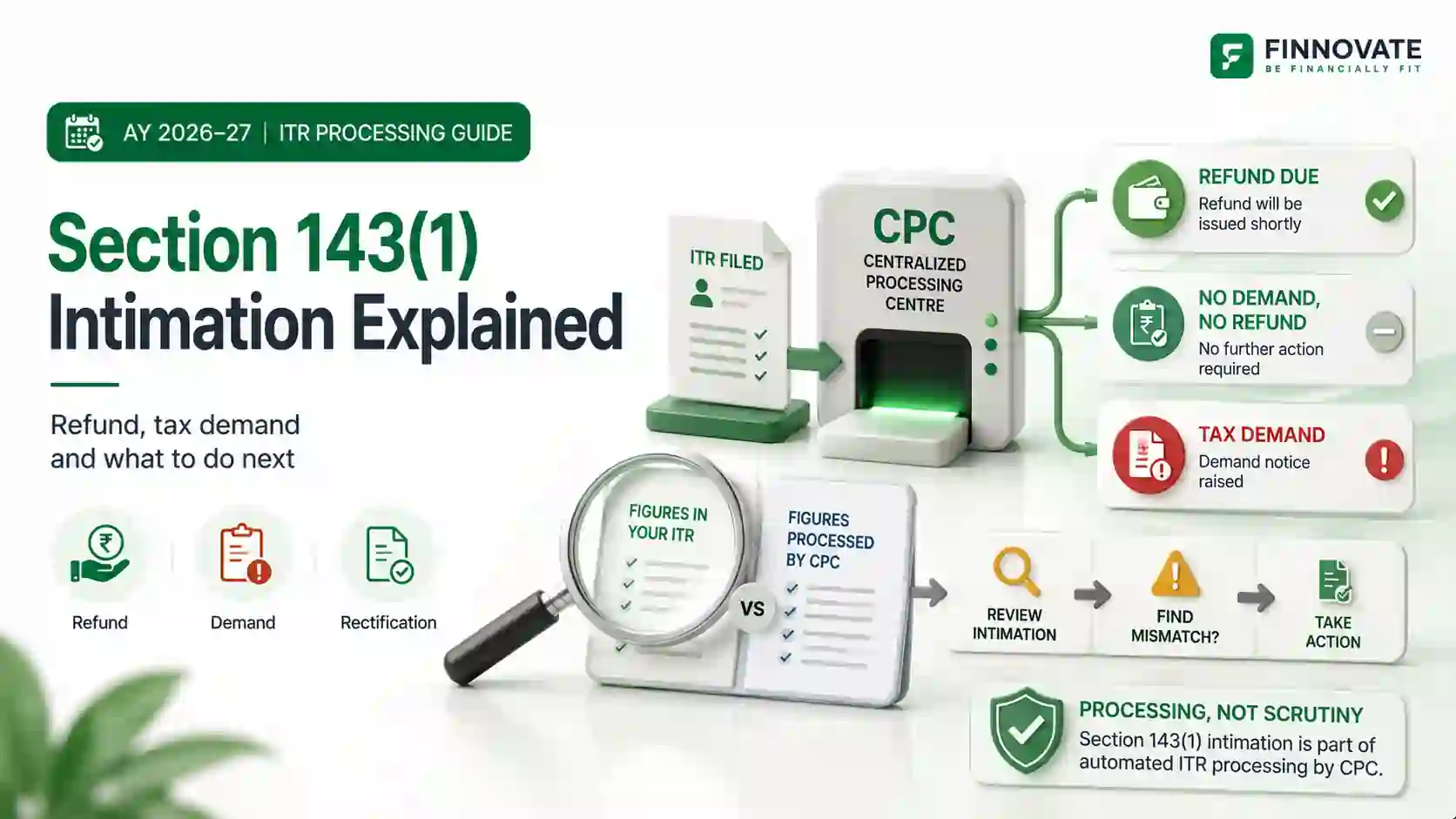
Received a Section 143(1) intimation? Understand CPC adjustments, refunds, tax demands, re...
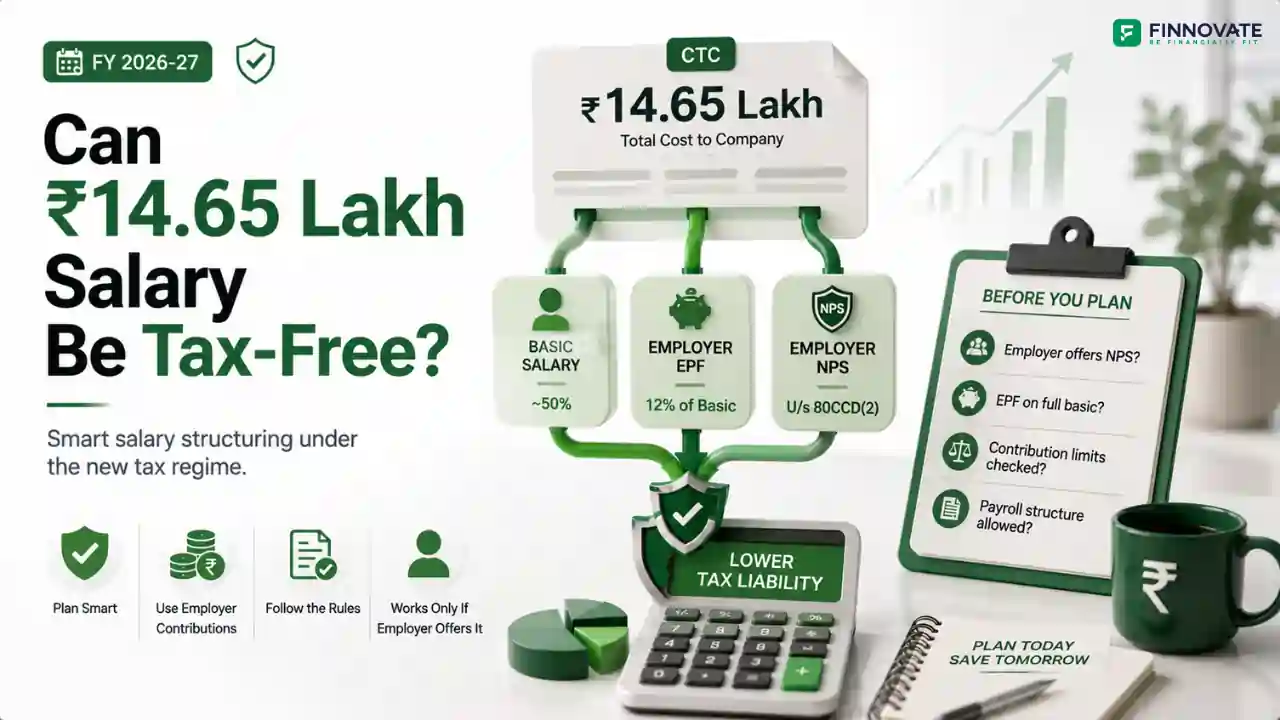
Zero tax on a ₹14.65 lakh salary is real, but only if your employer contributes EPF on f...

Changed jobs in FY 2025-26? See why combining two Form 16s can create a tax shortfall past...
Popular now

Learn how to easily download your NSDL CAS Statement in PDF format with our step-by-step g...

Looking for the best financial freedom books? Here’s a handpicked 2026 reading list with...

Learn what SIF investment means in India, SEBI rules, Rs 10 lakh minimum investment, avail...

Clear guide to mutual fund taxation in India for FY 2025–26 after July 2024 changes: equ...