

Tax Planning and Benefits for Married Couples in India: 2026 Guide
Tax planning for married couples in India explained for 2026. Compare tax regimes, deducti...
05 September 2026

Finnovate’s editorial team researches and creates financial content using trusted sources, regulatory references and inputs from subject experts.

Updated: July 2026
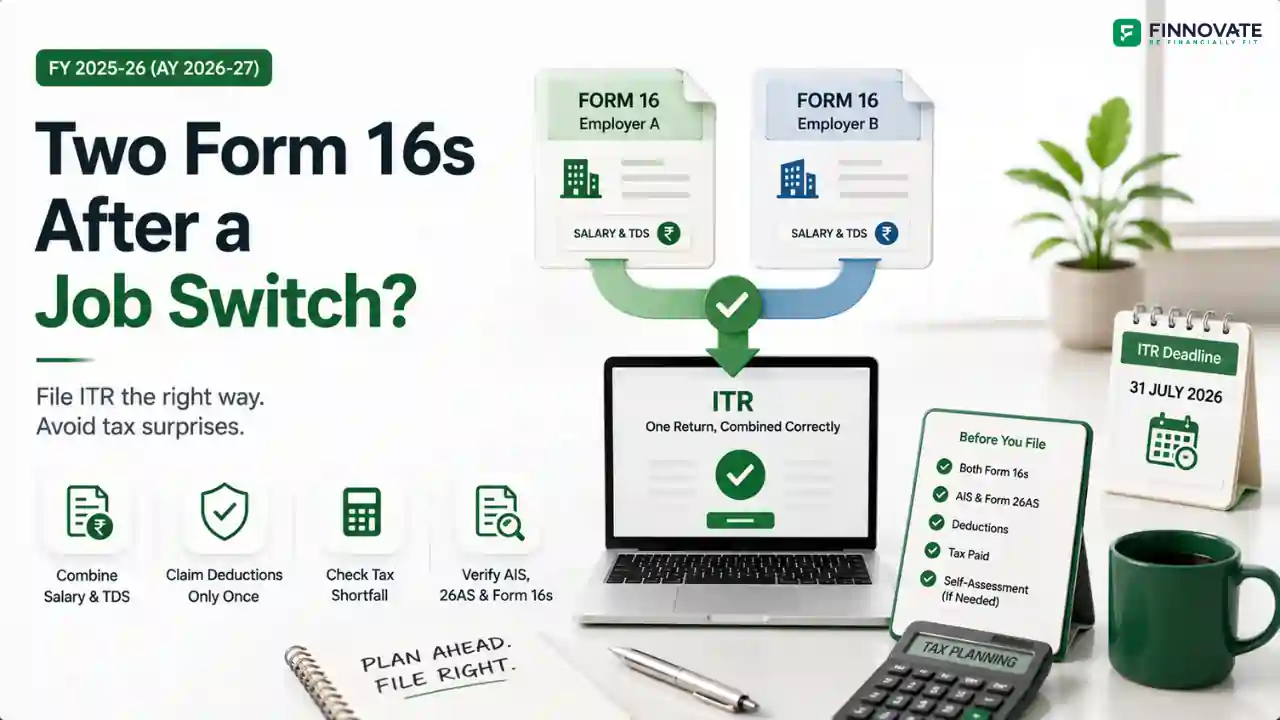
Switching jobs mid-year means two Form 16s, and two Form 16s means two employers who each calculated your tax as if they were your only source of income. That's usually where the surprise at filing time comes from, not from anything you did wrong.
This article covers why the shortfall happens, a worked example using this year's numbers, and the exact steps to file correctly for FY 2025-26.
Table of Contents
Each employer only knows what it paid you. Neither one automatically knows what the other employer paid, unless you tell them.
Form 12B is useful during the financial year, before TDS is finalized. It does not replace the need to combine both Form 16s when you file your ITR.
The two most common reasons are the same deduction getting applied twice, and the Section 87A rebate disappearing once your combined income crosses ₹12,00,000.
| Employer A | Employer B | Combined Reality | |
|---|---|---|---|
| Standard deduction applied | ₹75,000 | ₹75,000 | Should apply once: ₹75,000 |
| Section 87A rebate applied (if its own payment is ₹12,00,000 or below) | Yes, its own TDS is zero | Yes, its own TDS is zero | Rebate does not apply once combined income exceeds ₹12,00,000 |
An illustrative example, salary split evenly across two employers in the same financial year.
| Employer A | Employer B | Combined | |
|---|---|---|---|
| Salary paid | ₹7,00,000 | ₹7,00,000 | ₹14,00,000 |
| Taxable income (standard deduction applied independently by each) | ₹6,25,000 | ₹6,25,000 | n/a |
| TDS deducted (each applies the 87A rebate, since its own portion is under ₹12L) | ₹0 | ₹0 | ₹0 total |
| Taxable income on combined salary (standard deduction applied once) | n/a | n/a | ₹13,25,000 |
| Tax due on combined income (incl. cess) | n/a | n/a | ₹81,900 |
| Shortfall to pay at filing | n/a | n/a | ₹81,900 |
This shortfall may attract interest under both Sections 234B and 234C. Paying it as self-assessment tax as early as possible limits further Section 234B interest, which keeps accruing until the shortfall is paid. Section 234C interest, if applicable, is fixed to the missed advance-tax instalment dates and doesn't reduce by paying early.
Book a 30-minute Tax Planning session with our advisory team to review your shortfall, your declarations, and what to submit before you file. No product pitch, just clarity on your numbers.
Book a Tax Planning SessionNo. Standard deduction is the most common example, but several other limits also apply once per financial year, not once per employer:
If the new job came with a move to a different city, your HRA exemption needs to be calculated separately for each period, using the applicable metro or non-metro rate for that city at the time, not one rate applied to the full year.
Our advisory team can review your new offer, your regime choice, and what to submit to your new employer, so this year's switch doesn't turn into next year's shortfall.
Book a Tax Planning SessionNo. You file a single ITR for the financial year, combining the salary income and TDS from both Form 16s into one return under a single "Income from Salary" figure.
Each employer calculates TDS as if it were your only source of income, applying the full standard deduction and, under the new regime, the Section 87A rebate independently. Once your combined income is added together, it can cross the ₹12,00,000 rebate threshold or a higher slab, creating a gap between what was deducted and what's actually due.
Form 12B is a declaration you give your new employer disclosing your previous employer's salary and TDS details, so the new employer can calculate TDS on your combined income. It applies for FY 2025-26. From FY 2026-27 onwards, it's replaced by Form 122 under the Income-tax Act, 2025.
No. The standard deduction (₹75,000 under the new regime, ₹50,000 under the old regime) applies once per financial year regardless of how many employers you had. If both employers applied it independently while deducting TDS, correct this when filing and pay any resulting shortfall.
You can still file using your payslips and the salary and TDS details reflected in AIS and Form 26AS, since employers must deposit TDS with the government regardless of whether they issue Form 16 on time. Cross-check the figures carefully before filing.
Your new employer calculates TDS based only on what it pays you, without accounting for your previous employer's income. This commonly results in a shortfall that shows up only when you file your return, which you'll need to pay as self-assessment tax.
Possibly. If the combined shortfall from both employers is significant, interest under Sections 234B and 234C may apply. Paying the shortfall as self-assessment tax as early as possible limits further Section 234B interest, which keeps accruing until paid. Section 234C interest, if applicable, is fixed to the missed advance-tax instalment dates and isn't reduced by paying early.
Yes. HRA exemption is calculated separately for each period based on the applicable city classification and rent paid during that period. If you moved between a metro and a non-metro city, calculate the exemption for each period rather than applying one rate to the full year.
Disclaimer: This article is for general information and educational purposes only. It does not constitute investment advice, a recommendation, or an offer to buy or sell any securities or financial instruments. Tax rules, slab rates, and deduction limits referenced here are based on publicly available sources and are applicable for FY 2025-26 (AY 2026-27). Rules may change in subsequent budgets. Past tax outcomes are not indicative of future liability. Please consult a SEBI-registered investment adviser or qualified tax professional before making any tax-related financial decision.
No spam. Only new posts, simple explainers, and practical money checklists for busy professionals.
Finnovate is a SEBI-registered financial planning firm that helps professionals bring structure and purpose to their money. Over 3,500+ families have trusted our disciplined process to plan their goals - safely, surely, and swiftly.
Our team constantly tracks market trends, policy changes, and investment opportunities like the ones featured in this Weekly Capsule - to help you make informed, confident financial decisions.
Learn more about our approach and how we work with you:
No comments yet. Start the conversation. What would you add?
No spam. Only new posts, simple explainers, and practical money checklists.
You may also like
Tax planning for married couples in India explained for 2026. Compare tax regimes, deducti...
Received a Section 143(1) intimation? Understand CPC adjustments, refunds, tax demands, re...
Zero tax on a ₹14.65 lakh salary is real, but only if your employer contributes EPF on f...
Compare ESOP vs RSU taxation in India: perquisite tax, capital gains, TDS rules, and the n...
Popular now
Learn how to easily download your NSDL CAS Statement in PDF format with our step-by-step g...

Looking for the best financial freedom books? Here’s a handpicked 2026 reading list with...
Learn what SIF investment means in India, SEBI rules, Rs 10 lakh minimum investment, avail...
Clear guide to mutual fund taxation in India for FY 2025–26 after July 2024 changes: equ...