

Tax Planning and Benefits for Married Couples in India: 2026 Guide
Tax planning for married couples in India explained for 2026. Compare tax regimes, deducti...
05 September 2026

Finnovate’s editorial team researches and creates financial content using trusted sources, regulatory references and inputs from subject experts.

Updated: July 2026
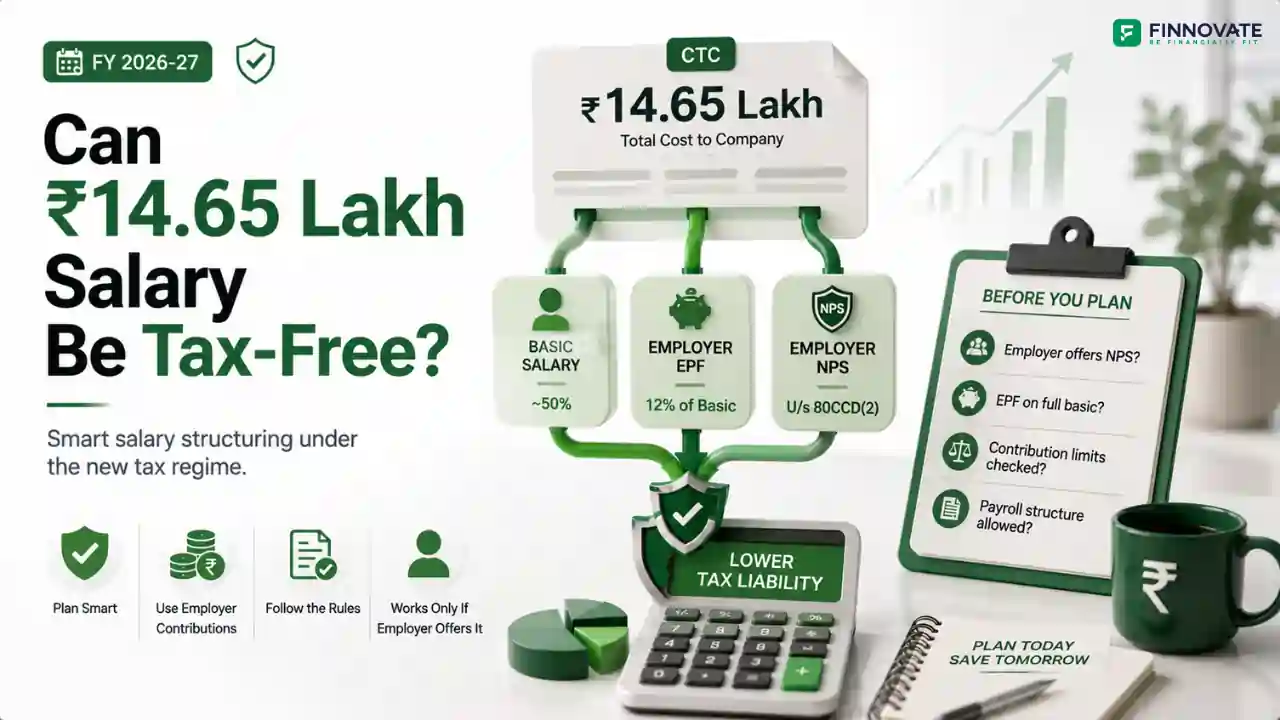
You've probably seen the number by now: a ₹14.65 lakh salary can be structured to pay zero tax under the new regime. It's true, and the math behind it is simple enough to fit in a graphic.
What most versions of this story leave out is where it stops working, what it depends on, and what to do if your employer doesn't offer half the pieces. That's what this article covers.
Table of Contents
The structure uses three things that already exist in the new regime: the standard deduction, employer EPF, and employer NPS. None of it needs a special filing or a new deduction, only how your CTC is split.
| Amount | |
|---|---|
| CTC | ₹14,65,000 |
| Basic salary (50% of CTC) | ₹7,32,500 |
| Employer EPF (12% of basic), excluded from taxable salary | ₹87,900 |
| Employer NPS (14% of basic), deductible under Section 80CCD(2) | ₹1,02,550 |
| Standard deduction | ₹75,000 |
| Net taxable income | ₹11,99,550 |
| Tax liability | ₹0 |
Because ₹11,99,550 stays under ₹12,00,000, the Section 87A rebate wipes out the computed tax entirely, that's the specific rule behind the zero-tax result, not a special exemption tied to this exact structure.
This illustration assumes employer EPF is contributed at 12% of full basic salary (₹87,900 a year here). Employers are only statutorily required to contribute EPF up to a wage ceiling of ₹15,000 a month, just ₹21,600 a year, and contributing beyond that is a voluntary employer policy, not a legal obligation. If your employer restricts PF to this ceiling instead of your full basic, the ₹14.65 lakh zero-tax threshold won't hold. Confirm this with your payroll team before relying on it.
A large share of employers don't offer employer NPS at 14%, some don't offer it at all. Without it, the ceiling for zero tax drops, but the structure still works using EPF and the standard deduction alone.
₹14.65 lakh isn't an arbitrary number, it's the ceiling before this specific limit kicks in. Push the same percentages onto a higher CTC and you can run into it without realizing:
No. The structure needs your employer's payroll and NPS plan to actually support ~50% basic salary and NPS contributions up to 14%. Some employers already run compensation this way, many don't, and you generally have to ask for it rather than expect it by default.
We can review your specific CTC, check whether it actually clears the ₹7.5 lakh cap, and help you structure the request before you talk to HR. No product pitch, just clarity on your numbers.
Book a Tax Planning SessionOn top of the main structure, two smaller employer-provided benefits got more generous from FY 2026-27 and are easy to miss:
Our advisory team can walk through your specific numbers and tell you honestly whether this structure works for you, and what to ask your employer for.
Book a Tax Planning SessionNo. It requires your employer's compensation structure to support roughly 50% basic salary and employer NPS contributions up to 14% of basic, on top of standard EPF. Not every employer offers this combination.
Zero tax on a higher CTC is possible, but scaling the same percentages can push your combined employer contributions to EPF, NPS, and superannuation past the ₹7,50,000 aggregate annual cap. Past that point, the excess is taxed as a perquisite, so it needs checking against the cap rather than just repeating the same percentages.
Employer NPS under Section 80CCD(2) is available in the old regime too, but capped at 10% of basic for private-sector employees rather than 14%. Combined with the old regime's lower ₹50,000 standard deduction and the Section 87A rebate applying only up to ₹5,00,000, this specific zero-tax outcome doesn't carry over to the old regime.
The amount above ₹7,50,000 a year in combined employer contributions is added to your taxable salary as a perquisite, and any interest or growth on that excess is taxed annually as well. It doesn't cancel the benefit on the portion below the cap, it only means the extra employer contribution beyond it stops being tax-free.
Yes, usually at your annual appraisal or CTC revision, though it depends on whether your employer's payroll and NPS plan support restructuring outside of onboarding. It's a request you make to HR and payroll, not something you can change unilaterally on your own return.
You won't face a sudden jump in tax. Section 87A includes a marginal relief provision that caps your tax at the amount your taxable income exceeds ₹12,00,000, not the full slab-computed tax. If your taxable income lands at, say, ₹12,10,000, tax is capped at roughly ₹10,400 including cess, rather than the ~₹63,960 the slabs alone would compute. The zero-tax outcome fades gradually just above the threshold, it doesn't fall off a cliff.
Disclaimer: This article is for general information and educational purposes only. It does not constitute investment advice, a recommendation, or an offer to buy or sell any securities or financial instruments. Tax rules, limits, and thresholds referenced here are based on publicly available sources and are applicable for FY 2026-27 (AY 2027-28) unless stated otherwise. Rules may change in subsequent budgets. Past tax outcomes are not indicative of future liability. Please consult a SEBI-registered investment adviser or qualified tax professional before making any tax-related financial decision.
No spam. Only new posts, simple explainers, and practical money checklists for busy professionals.
Finnovate is a SEBI-registered financial planning firm that helps professionals bring structure and purpose to their money. Over 3,500+ families have trusted our disciplined process to plan their goals - safely, surely, and swiftly.
Our team constantly tracks market trends, policy changes, and investment opportunities like the ones featured in this Weekly Capsule - to help you make informed, confident financial decisions.
Learn more about our approach and how we work with you:
No comments yet. Start the conversation. What would you add?
No spam. Only new posts, simple explainers, and practical money checklists.
You may also like
Tax planning for married couples in India explained for 2026. Compare tax regimes, deducti...
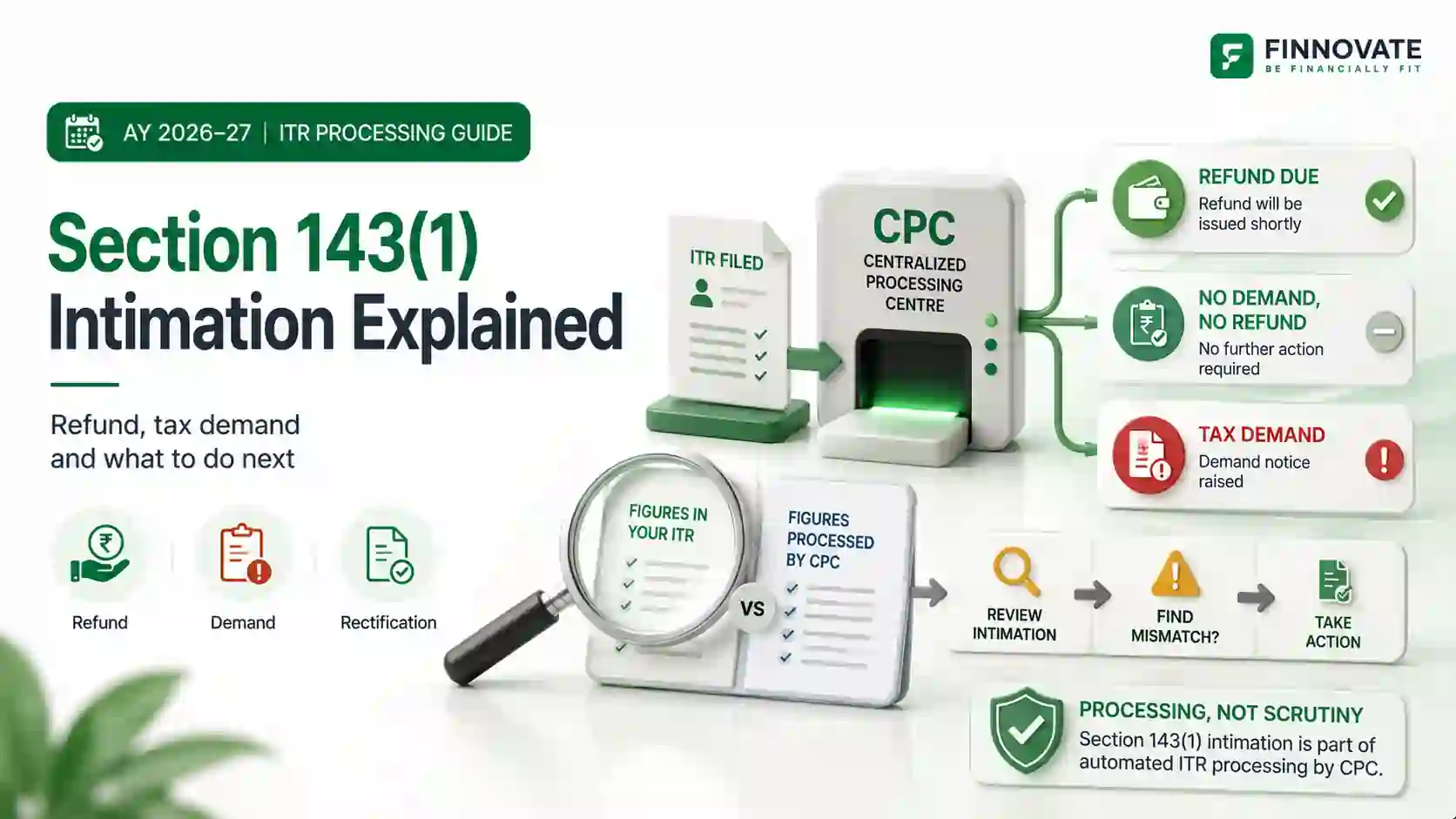
Received a Section 143(1) intimation? Understand CPC adjustments, refunds, tax demands, re...

Changed jobs in FY 2025-26? See why combining two Form 16s can create a tax shortfall past...
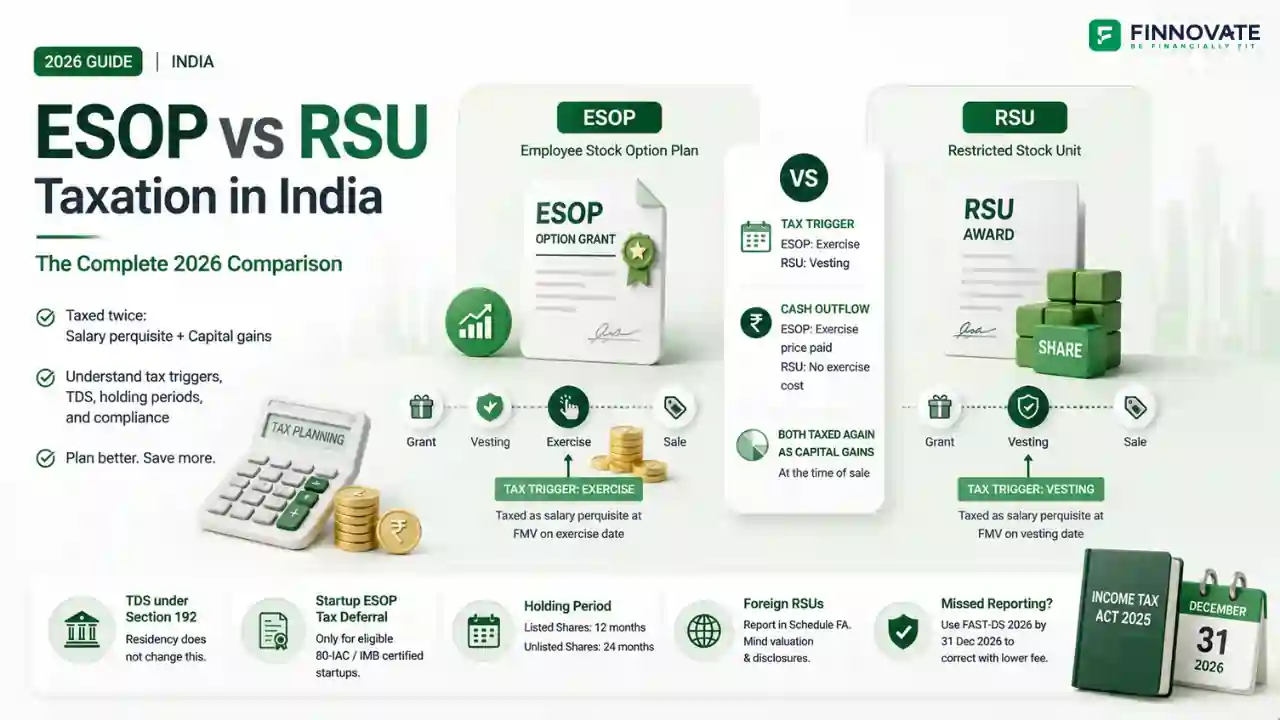
Compare ESOP vs RSU taxation in India: perquisite tax, capital gains, TDS rules, and the n...
Popular now

Learn how to easily download your NSDL CAS Statement in PDF format with our step-by-step g...

Looking for the best financial freedom books? Here’s a handpicked 2026 reading list with...
Learn what SIF investment means in India, SEBI rules, Rs 10 lakh minimum investment, avail...

Clear guide to mutual fund taxation in India for FY 2025–26 after July 2024 changes: equ...