Income Tax Calculator
Compare new vs old regime instantly, with HRA, deductions, capital gains & TDS
Other Income
HRA Exemption Old Regime
Deductions & Investments Old Regime
Capital Gains
TDS Already Paid
| Annual Income | New Regime | Old Regime | New Saves |
|---|---|---|---|
| ₹5,00,000 | ₹0 | ₹0 | — |
| ₹7,50,000 | ₹0 | ₹54,600 | ₹54,600 |
| ₹10,00,000 | ₹0 | ₹1,06,600 | ₹1,06,600 |
| ₹12,00,000 | ₹0 | ₹1,63,800 | ₹1,63,800 |
| ₹15,00,000 | ₹97,500 | ₹2,57,400 | ₹1,59,900 |
| ₹20,00,000 | ₹1,92,400 | ₹4,13,400 | ₹2,21,000 |
| ₹30,00,000 | ₹4,75,800 | ₹7,25,400 | ₹2,49,600 |
Think your tax can go lower? A Finnovate tax expert will review your regime choice, salary structure, and deductions to find what you might be missing.
On this page
What Is Income Tax in India?
Income tax in India is a direct tax levied by the central government on income earned by individuals, Hindu Undivided Families, firms, companies, and other persons during a financial year. It is administered by the Income Tax Department under the Ministry of Finance.
For individuals, income tax applies across five heads: salaries, income from house property, profits and gains from business or profession, capital gains, and income from other sources (interest, dividends, and other receipts). Tax is computed on the aggregate taxable income across all heads after eligible deductions and exemptions under the chosen regime.
From 1 April 2026, the Income Tax Act 2025 replaced the Income Tax Act 1961 with identical rates and slabs but reorganised section numbering. For FY 2025-26 (ITR filing year), IT Act 1961 applies. For FY 2026-27 (current planning year), IT Act 2025 applies. Both use exactly the same slab logic because Parliament made no rate changes during this transition.
Income Tax Slabs FY 2025-26 and FY 2026-27
India offers two parallel tax regimes. The new regime is the default from FY 2023-24 onwards. The old regime is opt-in. Both regimes and their slabs are identical for FY 2025-26 and FY 2026-27.
New Regime Slabs (Default)
Salaried employees and pensioners get a flat ₹75,000 standard deduction. The 87A rebate (up to ₹60,000) makes effective tax zero for taxable income up to ₹12 lakh, subject to conditions.
| Taxable Income Slab | Tax Rate | Tax on Slab (per band) |
|---|---|---|
| ₹0 to ₹4,00,000 | Nil | ₹0 |
| ₹4,00,001 to ₹8,00,000 | 5% | ₹20,000 |
| ₹8,00,001 to ₹12,00,000 | 10% | ₹40,000 |
| ₹12,00,001 to ₹16,00,000 | 15% | ₹60,000 |
| ₹16,00,001 to ₹20,00,000 | 20% | ₹80,000 |
| ₹20,00,001 to ₹24,00,000 | 25% | ₹1,00,000 |
| Above ₹24,00,000 | 30% | 30% of excess |
Surcharge: 10% on tax above ₹50L taxable, 15% above ₹1Cr, 25% above ₹2Cr (capped at 25% in new regime). Plus 4% Health and Education Cess on total tax including surcharge.
Old Regime Slabs
Standard deduction of ₹50,000 for salaried employees. The 87A rebate (up to ₹12,500) makes tax zero for taxable income up to ₹5 lakh. Deductions under 80C, HRA, home loan, 80D, and NPS can reduce taxable income significantly.
| Age Group | Nil Slab | 5% Slab | 20% Slab | 30% Slab |
|---|---|---|---|---|
| Under 60 | Up to ₹2,50,000 | ₹2.5L to ₹5L | ₹5L to ₹10L | Above ₹10L |
| Senior (60 to 79) | Up to ₹3,00,000 | ₹3L to ₹5L | ₹5L to ₹10L | Above ₹10L |
| Super Senior (80+) | Up to ₹5,00,000 | Not applicable | ₹5L to ₹10L | Above ₹10L |
How to Use This Income Tax Calculator
This calculator compares new and old regime taxes for your exact income profile. Results update instantly as you type, with no page refresh required.
-
1
Select your financial year
Use the FY toggle above the calculator. Choose FY 2025-26 for ITR filing season; choose FY 2026-27 for current year tax planning. Both use identical slabs.
-
2
Enter your annual income and profile
Type your gross annual salary or drag the slider. Select your age group (Under 60, 60 to 79, or 80+) and employment type. Age affects old regime slab thresholds. Employment type determines whether the ₹75,000 standard deduction applies.
-
3
Open the deductions section for old regime comparison
Expand Deductions to enter 80C investments, NPS, health insurance, and home loan interest. These only affect old regime tax. The new regime applies the standard deduction automatically and ignores all other deductions.
-
4
Add capital gains and TDS if applicable
Expand Capital Gains to enter equity STCG, LTCG, and other gains. For TDS reconciliation, enter the total TDS from your Form 26AS or AIS. The results panel shows whether you get a refund or owe a balance.
-
5
Read the verdict and slab breakdown
The right panel shows which regime wins, by how much, effective tax rate, and TDS outcome. The full slab-by-slab breakdown table appears below the calculator with a regime tab toggle.
The Rs.12 Lakh Zero-Tax Rule Explained
Is ₹12 lakh income really tax-free in FY 2025-26? Yes, for most salaried individuals in the new regime, under specific conditions.
Section 87A Rebate (New Regime, FY 2025-26 and FY 2026-27)
If taxable income does not exceed ₹12,00,000, a tax credit of up to ₹60,000 reduces net tax liability to zero.
For salaried individuals: the ₹75,000 standard deduction means gross salary can be up to ₹12,75,000 and still produce zero tax.
How the 87A Rebate Works: Step by Step
For a salaried person with ₹12 lakh gross salary under the new regime:
- Gross salary: ₹12,00,000
- Less standard deduction: ₹75,000
- Taxable income: ₹11,25,000
- Slab tax: ₹0 (0-4L) + ₹20,000 (4-8L at 5%) + ₹32,500 (8-11.25L at 10%) = ₹52,500
- 87A Rebate (taxable income ≤ ₹12L, rebate up to ₹60,000): ₹52,500 credited back
- Net tax payable: ₹0
When the Rs.12L Zero-Tax Rule Does NOT Apply
- Equity capital gains present: Any equity STCG or LTCG removes the 87A rebate entirely. Even ₹1 of equity gains means slab tax is levied on your full salary income.
- Taxable income above ₹12L: Even ₹1 above ₹12L of taxable income disqualifies the rebate. However, marginal relief applies for incomes between ₹12L and ₹12.75L.
- Old regime: The old regime 87A rebate is only ₹12,500 and applies only at taxable income up to ₹5 lakh.
Marginal Relief at the Rs.12 Lakh Boundary
If your taxable income is ₹12,50,000, normal slab computation gives ₹85,500 in tax. Marginal relief caps this at ₹50,000 (the exact excess over ₹12L). You are never taxed more than the additional income above the rebate threshold. This calculator applies marginal relief automatically for all inputs.
Salary-Wise Tax Comparison: New vs Old Regime
The table below shows final tax payable (including 4% cess) for salaried individuals under 60 with no additional income or deductions. These are the numbers with only the standard deduction applied, before any 80C, HRA, or home loan deductions.
| Annual Salary | New Regime Tax | Old Regime Tax | New Regime Saves |
|---|---|---|---|
| ₹5,00,000 | ₹0 | ₹0 | Both zero |
| ₹7,50,000 | ₹0 | ₹54,600 | ₹54,600 |
| ₹10,00,000 | ₹0 | ₹1,06,600 | ₹1,06,600 |
| ₹12,00,000 | ₹0 | ₹1,63,800 | ₹1,63,800 |
| ₹15,00,000 | ₹97,500 | ₹2,57,400 | ₹1,59,900 |
| ₹20,00,000 | ₹1,92,400 | ₹4,13,400 | ₹2,21,000 |
| ₹25,00,000 | ₹3,19,800 | ₹5,69,400 | ₹2,49,600 |
| ₹30,00,000 | ₹4,75,800 | ₹7,25,400 | ₹2,49,600 |
| ₹50,00,000 | ₹10,99,800 | ₹13,49,400 | ₹2,49,600 |
Assumptions: Salaried, under 60, no HRA, no 80C or 80D investments, no capital gains. Old regime includes ₹50,000 standard deduction; new regime includes ₹75,000. No surcharge (income below ₹50L taxable).
When Does the Old Regime Win? Break-Even Analysis
The old regime wins only when eligible deductions reduce your taxable income enough that old-regime tax falls below new-regime tax. The new regime starts with lower slab rates and a ₹12L zero-tax threshold. The only way the old regime can win is if your deductions are large enough to overcome that difference.
Break-Even Deduction Thresholds by Income
The question to ask: how much in total deductions do I need for old regime to pay less than new regime?
| Annual Income | New Regime Tax | Total Deductions Needed for Old to Win | Realistic? |
|---|---|---|---|
| ₹10,00,000 | ₹0 | Old regime cannot beat ₹0 new tax | New regime always wins here |
| ₹12,00,000 | ₹0 | Old regime cannot beat ₹0 new tax | New regime always wins here |
| ₹15,00,000 | ₹97,500 | ~₹6L+ total deductions needed | Possible with significant HRA |
| ₹20,00,000 | ₹1,92,400 | ₹7L+ (large HRA and home loan) | Uncommon without both |
| ₹30,00,000+ | ₹4,75,800+ | ₹8L+ (very hard to achieve) | Rare |
The HRA and Home Loan Conflict
Two of the largest old-regime deductions are HRA (for rented accommodation) and home loan interest under Section 24(b) (for self-occupied property). In practice, these are largely mutually exclusive: if you own the home you live in, you do not pay rent, so you cannot claim HRA. Someone can claim HRA or home loan interest, but rarely both at the same time. This limits how much the old regime can actually save in practice for most people.
Who Should Still Evaluate the Old Regime?
- Employees in Delhi, Mumbai, Kolkata, or Chennai paying high rent with a significant HRA component in salary. Metro HRA exemptions can reach ₹3 to ₹5 lakh for senior roles in high-cost cities.
- Home loan holders with large outstanding loans. Self-occupied property allows up to ₹2 lakh deduction per year under Section 24(b).
- Senior citizens with large FD interest income. Section 80TTB allows up to ₹1 lakh deduction on FD and savings interest, available only in old regime.
- Employees with maxed 80C (₹1.5L) plus NPS (₹50K) plus 80D (₹50K). This stack adds ₹2.5 lakh in deductions but still needs additional large deductions to beat the new regime above ₹15L.
The Simplest Way to Decide
Enter your income and all actual deduction amounts in this calculator. The verdict panel shows which regime wins and by exactly how much. Declare your regime choice to your employer before April 1 so payroll deducts TDS on the correct basis from the start of the financial year.
Key Deductions and Exemptions in the Old Regime
The old regime allows a wide set of deductions that can reduce taxable income significantly if you qualify for multiple heads simultaneously. For a full breakdown of qualifying instruments, investment deadlines, and planning tips, see our Section 80C deductions guide.
| Deduction or Exemption | Maximum Limit | What Qualifies |
|---|---|---|
| Standard Deduction | ₹50,000 | All salaried employees and pensioners (automatic) |
| Section 80C | ₹1,50,000 | PPF, ELSS, LIC premium, EPF contribution, home loan principal, NSC, tuition fees |
| Section 80CCD(1B) NPS | ₹50,000 | Voluntary NPS Tier I contributions over and above the 80C limit |
| Section 80D Health Insurance | ₹50,000 (₹1,00,000 for seniors) | Premium for self, family, and parents. Senior citizen limit: ₹50K self + ₹50K parents |
| HRA Exemption (Sec 10(13A)) | Least of three Rule 2A limits | Actual HRA received, rent paid minus 10% of salary, 50% of salary (metro) or 40% (non-metro) |
| Home Loan Interest (Sec 24b) | ₹2,00,000 | Self-occupied property. Let-out properties have no cap on interest deduction. |
| Section 80TTB (seniors only) | ₹1,00,000 | FD interest, savings interest, post office interest for citizens aged 60 and above |
| Section 80TTA | ₹10,000 | Savings account interest for individuals under 60 (not FD interest) |
| Section 80E Education Loan | No limit | Interest on education loan for higher studies, for up to 8 assessment years |
| Section 80G Donations | 50% or 100% of donation | Approved charitable institutions and government relief funds |
None of these deductions apply in the new regime except employer NPS contribution under Section 80CCD(2) (up to 14% of basic salary, available in both regimes). The new regime's simplicity is a deliberate trade-off: lower rates in exchange for fewer deductions.
For Salaried Employees
Most salaried employees benefit from the new regime for FY 2025-26 and FY 2026-27. The revised slabs and ₹12L zero-tax threshold give salaried individuals a materially lower tax burden compared to the old regime, especially for incomes between ₹7.5 lakh and ₹15 lakh.
Declaring Regime Choice to Your Employer
Inform your employer about regime choice at the start of the financial year, typically in April. Employers default to new regime and deduct TDS on that basis unless you specifically request old regime in writing before April. Changing mid-year is allowed but requires filing ITR to get any excess TDS refunded. For salary restructuring strategies that reduce tax without switching regimes, see our tax planning guide for salaried employees.
Standard Deduction and Form 16
The ₹75,000 standard deduction (new regime) or ₹50,000 (old regime) is applied automatically by your employer while computing monthly TDS. Your Form 16 Part B will reflect this. When entering salary in this calculator, always use gross salary before any deductions. The calculator applies the standard deduction automatically based on your employment type selection.
Employer NPS Contribution Under Section 80CCD(2)
If your employer contributes to your NPS Tier I account, that contribution is deductible under Section 80CCD(2) up to 14% of basic salary. This deduction is available in the new regime and is not subject to the ₹50,000 cap that applies to your own voluntary contributions. It is one of the few deductions that persist in the new regime and can meaningfully reduce taxable income for employees with a high basic salary component.
For Senior Citizens (60 and Above)
Senior citizens face a different tax landscape because of age-specific benefits available only in the old regime. The new regime treats all age groups identically, which works against some retirees and in favour of others depending on their income composition.
Old Regime Benefits Specific to Senior Citizens
- Higher nil slab: Senior citizens (60 to 79) have a nil slab up to ₹3 lakh versus ₹2.5L for under-60. Super seniors (80+) have a nil slab up to ₹5 lakh and skip the 5% bracket entirely.
- Section 80TTB: Allows deduction of up to ₹1 lakh in interest income from FDs, savings, recurring deposits, and post office schemes. Available only in old regime. For retirees living on FD income, this single deduction is often the deciding factor.
- Form 15H: If estimated annual tax liability is nil, senior citizens can submit Form 15H to banks to prevent TDS deduction on FD interest.
When Should Senior Citizens Consider Old Regime?
If primary income is pension plus FD interest and total income is between ₹5 lakh and ₹12 lakh, the old regime may give a lower tax bill because of the higher nil slab and 80TTB deduction. Above ₹15 lakh, the new regime's lower slab rates typically win even for senior citizens. Run both in this calculator with your actual interest income to compare. For a complete picture of age-specific benefits, Form 15H eligibility, and FD interest planning, see our income tax guide for senior citizens.
For Freelancers and Self-Employed Professionals
Freelancers, consultants, and self-employed professionals face rules that differ from salaried employees in an important way: there is no standard deduction for self-employed individuals in the new regime. The ₹75,000 standard deduction applies only to salaried employees and pensioners.
Section 44ADA Presumptive Taxation
Eligible professionals (architects, doctors, engineers, accountants, lawyers, consultants, and others notified under Section 44AA) with gross receipts up to ₹75 lakh per year can opt for Section 44ADA presumptive taxation. Under 44ADA, 50% of gross receipts is deemed taxable income. No books of accounts are required and no actual expenses need to be documented separately.
Section 44ADA Example:
Gross receipts: ₹30 lakh. Deemed taxable income = 50% = ₹15 lakh. Tax under new regime = ₹97,500 (including cess). No standard deduction applies.
For the full eligibility list, books of accounts requirements, and how 44ADA interacts with both regimes, read our Section 44ADA guide for professionals.
Advance Tax Instalments for Freelancers
If estimated annual tax liability exceeds ₹10,000, quarterly advance tax payments are mandatory. This calculator shows a warning when employment is set to Self-Employed or Freelance and liability exceeds this threshold.
- 15 June: At least 15% of estimated annual tax
- 15 September: At least 45% of estimated annual tax (cumulative)
- 15 December: At least 75% of estimated annual tax (cumulative)
- 15 March: 100% of estimated annual tax (cumulative)
Missing advance tax due dates attracts interest under Sections 234B and 234C. The penalty is 1% per month on the shortfall, so quarterly discipline matters.
Capital Gains and the 87A Rebate
Capital gains from equity shares, equity mutual funds, property, and gold are taxed separately from salary income. Two things to know before filing:
Equity Capital Gains Remove the 87A Rebate
If you earned any STCG or LTCG from equity or equity mutual funds during the year, the ₹60,000 Section 87A rebate does not apply at all. Even if your salary income alone would have been zero-tax (under ₹12L taxable), the presence of equity gains removes the rebate entirely and your salary is now taxed from the first slab. Most salaried people who sold equity shares mid-year discover this only at ITR filing time.
Capital Gains Tax Rates FY 2025-26
- Equity STCG (held under 12 months): 20% flat rate under Section 111A. No 87A rebate available.
- Equity LTCG (held over 12 months): 12.5% under Section 112A on gains above ₹1.25 lakh per year. The first ₹1.25 lakh of equity LTCG is fully exempt annually.
- Property, gold, debt MFs, and other assets: Taxed at slab rate if short-term. For long-term (24 months for property and gold), taxed at 12.5% without indexation for assets acquired on or after 23 July 2024.
Capital gains tax applies identically under both regimes. This calculator adds it as a separate line when you enter values in the Capital Gains accordion, showing the combined total under each regime. If your gains include ETF units, see our ETF taxation guide. For dividend income from stocks or mutual funds, see tax on dividend income in India.
Advance Tax: Who Pays and When
Advance tax spreads your annual tax liability across the year in four instalments. It prevents large cash outflows at filing time and avoids interest charges under Sections 234B and 234C.
Who Must Pay Advance Tax?
Any taxpayer whose estimated net tax liability (after TDS and other credits) exceeds ₹10,000 for the financial year must pay advance tax. This includes freelancers, self-employed individuals, those with significant capital gains or rental income, and salaried employees whose employer has not deducted sufficient TDS. Salaried employees whose employer handles full TDS are generally exempt from advance tax obligations.
Due Dates for FY 2026-27
- 15 June 2026: Pay at least 15% of estimated annual tax
- 15 September 2026: Pay at least 45% of estimated annual tax (cumulative)
- 15 December 2026: Pay at least 75% of estimated annual tax (cumulative)
- 15 March 2027: Pay 100% of estimated annual tax (cumulative)
Frequently Asked Questions
Answers to the most common questions about income tax slabs, regime choice, the zero-tax threshold, and related provisions for FY 2025-26 and FY 2026-27:
What are the income tax slabs for FY 2025-26 under the new regime?
New regime slabs for FY 2025-26: ₹0 to ₹4L at nil, ₹4 to ₹8L at 5%, ₹8 to ₹12L at 10%, ₹12 to ₹16L at 15%, ₹16 to ₹20L at 20%, ₹20 to ₹24L at 25%, and above ₹24L at 30%. Salaried individuals get a ₹75,000 standard deduction and a 87A rebate that makes effective tax zero for taxable income up to ₹12 lakh.
Are FY 2025-26 and FY 2026-27 income tax slabs identical?
Yes. Budget 2026 made no changes to individual income tax rates, slabs, or rebate limits. The Income Tax Act 2025 (effective 1 April 2026) replaced the Income Tax Act 1961 with section renumbering only, not rate changes. All slabs, the 87A rebate, standard deduction amounts, and capital gains rates are identical for FY 2026-27 as they were for FY 2025-26.
Is ₹12 lakh really tax-free in FY 2025-26 and FY 2026-27?
Yes, for most salaried individuals in the new regime. If taxable income after the ₹75,000 standard deduction does not exceed ₹12 lakh and you have no equity capital gains, the 87A rebate of up to ₹60,000 brings your tax to zero. For a salaried person, gross salary up to ₹12,75,000 is effectively tax-free under the new regime without any additional investments or deductions.
What is the Section 87A tax rebate and who is eligible?
Section 87A is a tax credit that reduces your computed slab tax liability, not a deduction from income. In the new regime, it provides a credit of up to ₹60,000 for individuals whose taxable income does not exceed ₹12,00,000. In the old regime, the rebate is up to ₹12,500 for taxable income up to ₹5 lakh. The rebate is not available against special-rate income like equity STCG or equity LTCG.
Which tax regime is better, new or old, in FY 2025-26?
The new regime wins for the majority of taxpayers, particularly salaried individuals with income below ₹15 lakh and limited deductions. The old regime can win if you have significant HRA exemptions (₹3 lakh or more), home loan interest near ₹2 lakh, and ₹1.5 lakh in 80C investments simultaneously. The break-even deduction threshold is roughly ₹6 lakh at ₹15L income and ₹7.5 lakh at ₹20L income. Enter your actual numbers in this calculator to compare.
Can I switch between new and old regime every year?
Salaried individuals and pensioners can switch between new and old regime every year at ITR filing. Self-employed individuals with business income can opt for the old regime only once and cannot switch back to new regime thereafter. For salaried taxpayers, the choice is completely flexible annually. Inform your employer of your regime preference before April 1 so TDS is deducted on the correct basis from the start of the year.
What are the income tax slabs for senior citizens (60 and above)?
In the new regime, senior citizens have the same slabs as everyone else (no age-based concession). In the old regime, senior citizens aged 60 to 79 have a higher nil slab of ₹3 lakh (versus ₹2.5L for under-60). Super senior citizens aged 80 and above have a nil slab of ₹5 lakh and skip the 5% bracket entirely, going directly to 20%. Select your age group in this calculator to see the old regime difference automatically.
How much income tax on a ₹15 lakh salary in FY 2025-26?
For a salaried individual under 60 with no other income or deductions: under the new regime, after ₹75,000 standard deduction, taxable income is ₹14.25 lakh. Tax is ₹93,750 plus 4% cess = ₹97,500. Under the old regime (no deductions), tax is ₹2,57,400. New regime saves ₹1,59,900 in this base case. Old regime can win only if total deductions including HRA or home loan exceed approximately ₹6 lakh.
How much income tax on a ₹20 lakh salary in FY 2025-26?
For a salaried individual under 60 with no deductions: under the new regime, taxable income is ₹19.25 lakh after standard deduction. Tax is ₹1,85,000 plus 4% cess = ₹1,92,400. Under the old regime, tax is ₹4,13,400. New regime saves ₹2,21,000. Old regime wins only if total deductions including HRA and home loan exceed approximately ₹7 lakh, which requires both significant HRA and a home loan simultaneously.
Does equity capital gains income block the 87A rebate?
Yes, completely. If you earned any equity STCG (taxed at 20%) or equity LTCG (taxed at 12.5% above ₹1.25 lakh), the ₹60,000 Section 87A rebate does not apply to any of your income including salary. Even ₹1 of equity gains removes the rebate entirely. A salaried person with ₹12L taxable salary income who also sold equity shares goes from zero tax to full slab tax on the salary. Expand the Capital Gains section in this calculator to see the full impact.
Is HRA exemption allowed in the new tax regime?
No. HRA exemption under Section 10(13A) is not available in the new tax regime. All allowances including HRA, LTA, and special allowances are fully taxable in the new regime. The new regime replaces them with a flat ₹75,000 standard deduction for salaried employees. HRA exemption is available only in the old regime, which is why high-rent metro employees sometimes find old regime more advantageous despite its higher slab rates.
What deductions are available in the new tax regime?
The new regime permits very few deductions: the ₹75,000 standard deduction for salaried individuals and pensioners, employer NPS contribution under Section 80CCD(2) (up to 14% of basic salary), home loan interest for let-out properties (no self-occupied limit applies here), and family pension standard deduction. Deductions under 80C, 80D, HRA exemption, home loan interest on self-occupied property, and most other sections are not available.
What is advance tax and who needs to pay it?
Advance tax is pre-payment of estimated annual income tax in four quarterly instalments. Any individual whose net tax liability (after TDS) exceeds ₹10,000 for the year must pay advance tax by June 15, September 15, December 15, and March 15. Salaried employees whose employer fully deducts TDS on salary are generally exempt. Freelancers, self-employed professionals, and those with capital gains or rental income must typically pay advance tax.
What is Form 26AS and how do I use it for income tax filing?
Form 26AS is the consolidated annual tax statement that shows all TDS deducted against your PAN, advance tax paid, and self-assessment tax paid during the year. Download it from the Income Tax e-filing portal. The TDS field in this calculator corresponds to the TDS total shown in Form 26AS. Entering this figure lets the calculator show whether you expect a refund or owe additional tax when you file your ITR. Also check the Annual Information Statement (AIS), which captures additional income sources Form 26AS may miss. Our guide on AIS vs TIS vs Form 26AS explains what to reconcile before filing.
Can NPS contributions reduce income tax in both regimes?
Partially. Employee voluntary NPS contributions under Section 80CCD(1B), up to ₹50,000, are available only in the old regime. Employer NPS contributions under Section 80CCD(2), up to 14% of basic salary, are available in both regimes. The employer NPS contribution route is therefore a valuable planning tool in the new regime, as it reduces taxable income without requiring a switch to old regime.
What is the ITR filing deadline for FY 2025-26?
The original ITR filing due date for most individual taxpayers for FY 2025-26 (Assessment Year 2026-27) is 31 July 2026, subject to any extension by CBDT. With a late-filing fee, you can file until 31 December 2026. Updated returns under Section 139(8A) are allowed for up to two years from the end of the assessment year, with an additional tax of 25% to 50% of the tax due. Filing before the July deadline avoids interest under Section 234A. Not sure which ITR form applies to your income type? See our ITR form selection guide.
What is marginal relief near the ₹12 lakh threshold?
Marginal relief prevents a situation where tax on income slightly above ₹12L exceeds the incremental income itself. If taxable income is between ₹12L and approximately ₹12.75L, tax is capped at the excess over ₹12L. For example, at ₹12.5L taxable income, normal slab computation gives ₹85,500 but marginal relief caps tax at ₹50,000. This calculator applies marginal relief automatically for all inputs in that range.
What is Section 80TTB and who benefits from it?
Section 80TTB allows senior citizens (60 and above) to deduct up to ₹1 lakh of interest income in the old regime. This includes interest from savings accounts, fixed deposits, recurring deposits, and post office schemes. It is only available in the old regime. For retirees with significant FD income, this deduction alone can make the old regime better than the new regime despite higher slab rates.
How does the Section 44ADA presumptive scheme work for freelancers?
Section 44ADA allows eligible professionals (doctors, lawyers, engineers, architects, accountants, consultants) with gross receipts up to ₹75 lakh per year to declare 50% of gross receipts as taxable income without maintaining books of accounts. The remaining 50% is treated as expenses without requiring documentation. This income is taxed at normal slab rates. The ₹75,000 standard deduction does not apply to 44ADA income as it is available only for salaried and pensioner income.
What is surcharge on income tax and when does it apply?
Surcharge is an additional levy on income tax for high-income taxpayers. In the new regime: 10% for taxable income above ₹50 lakh, 15% above ₹1 crore, and 25% above ₹2 crore. The new regime caps surcharge at 25%. The old regime goes up to 37% surcharge for income above ₹5 crore. Marginal relief applies at each surcharge threshold. After surcharge, a 4% Health and Education Cess is levied on the combined tax plus surcharge amount.
Other Calculators
Tools that complement income tax planning:
Tax Guides and Planning Resources
In-depth articles on income tax: from ITR filing to deductions to investment taxation:
Year-round tax planning framework covering regime choice, deductions, and capital gains harvest.
Salary restructuring, NPS, ELSS timing, and regime choice strategies for FY 2025-26.

Every qualifying investment and expense under 80C, with limits, lock-in, and tax treatment.
ITR-1, ITR-2, ITR-3, ITR-4: which applies to your income type and why.
How to reconcile these three documents to avoid notices and missed TDS credits.
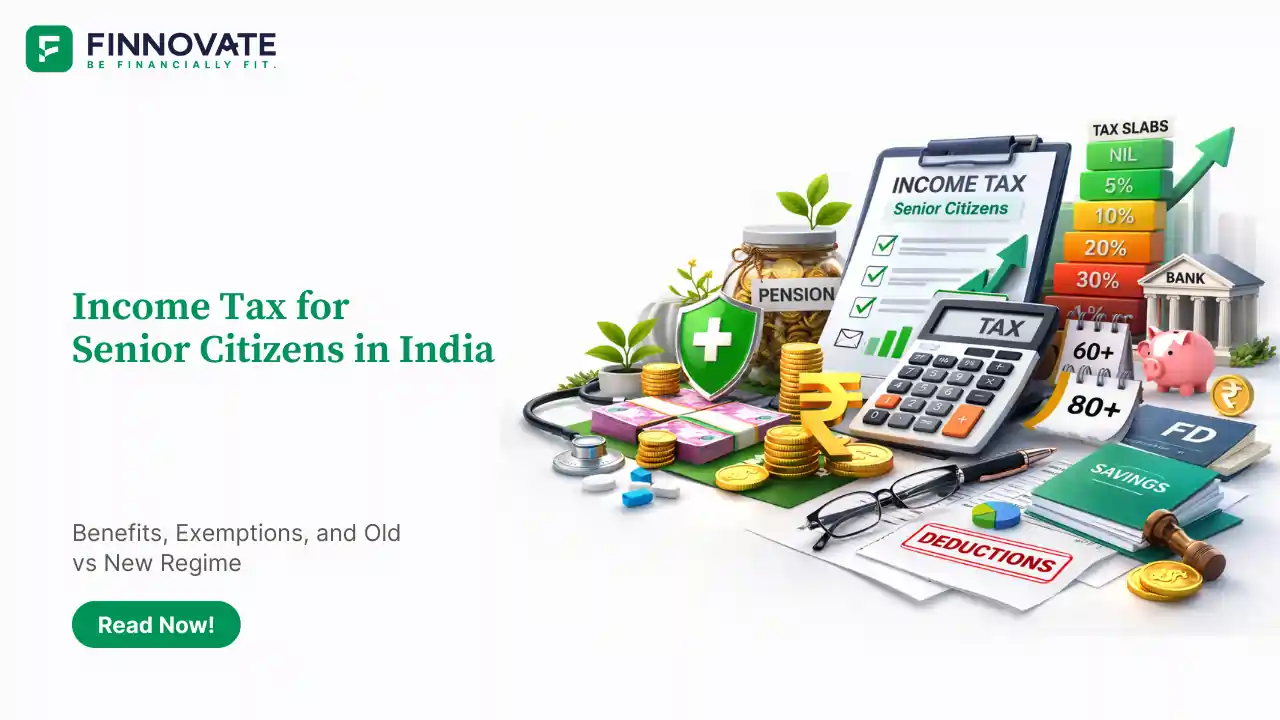
Higher nil slab, 80TTB deduction, Form 15H, and when old regime still wins for retirees.
Who qualifies, how 50% deemed income works, and whether old or new regime makes sense.
How dividends from stocks and mutual funds are taxed at slab rates, and TDS implications.
How equity and debt ETFs are taxed differently, and what changed after Budget 2024.
The calculator shows your number. An advisor helps you act on it.
Tax planning is not a once-a-year exercise. The right regime choice, NPS structuring, ELSS timing, and capital gains harvesting together can meaningfully reduce your effective tax rate over time. A Finnovate SEBI-registered advisor looks at your full financial picture and builds a plan around your salary, investments, and goals. See our tax planning service ›
Disclaimer: This calculator is for estimation and educational purposes only. Tax liability depends on surcharge, marginal relief, specific deduction conditions, and applicable provisions that may not be fully reflected here. Consult a SEBI Registered Investment Adviser or qualified tax professional before making financial decisions. Finnovate Financial Services Pvt. Ltd. is not liable for discrepancies between estimates provided here and actual tax due.