

India CPI Inflation September 2026 Rises to 5.54%
India’s CPI inflation rose to 5.54% in September 2026. Compare monthly trends, food pric...
13 October 2026

Finnovate’s editorial team researches and creates financial content using trusted sources, regulatory references and inputs from subject experts.
An AI chip has a long shopping list.
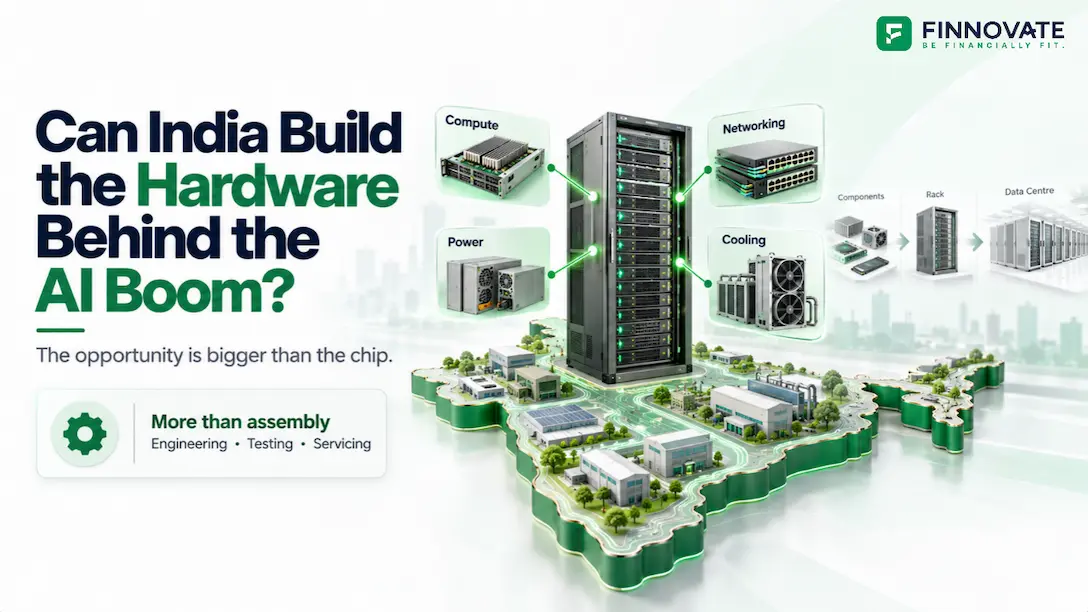
It needs memory to work with, a network to exchange data, a steady supply of electricity and a cooling system to carry away heat. Buy the processor, and there is still an entire machine to build around it.
For India, that creates an opportunity across several industries. Electronics manufacturers, electrical-equipment suppliers and cooling specialists all have something to contribute. The question is how much of that work they can win, and how much money they can keep.
On October 13, 2026, Adani Enterprises and Jabil announced a non-binding agreement outlining a proposed 50:50 joint venture to manufacture and assemble AI and data-centre equipment in India.
The planned range covers servers, storage, networking, integrated AI racks, power-distribution units, transformers and liquid-cooling systems. The venture remains subject to definitive agreements and approvals. Its investment size, factory location and production start date have yet to be disclosed.
It is an ambitious list. Understanding why those products belong together explains where the opportunity lies.
Think about buying an engine to build a car. You would still need a transmission, brakes, electronics and a cooling system. Each part must work with the others before the car can leave the factory.
An AI computing system has a similar coordination problem.
Its processors need data delivered quickly enough to keep them busy. Servers need to communicate. Electricity must reach the equipment reliably. Heat must be removed as the machines work.
Much of this comes together inside a rack: a cabinet containing interconnected computing equipment and the systems supporting it.
Delivering a complete, tested rack is a substantial engineering job. Manufacturers must fit the components together, configure the system and check that it performs as required.
That creates several places for a supplier to earn revenue:
| Part of the system | What the customer needs |
|---|---|
| Servers and storage | Equipment to process and hold data |
| Networking | Fast connections between machines |
| Power equipment | Reliable electricity delivery |
| Cooling | Heat removal suited to the computing load |
| Integration and servicing | A working system that can be installed, maintained and repaired |
The value lies partly in making the individual parts and partly in getting the whole system to work.
Anyone whose laptop gets hot during a video call understands the basic problem. Concentrate far more computing power in a confined space, and removing heat becomes a demanding task.
One approach is direct liquid cooling. Coolant flows through plates attached to high-power chips, absorbs heat and carries it away through a controlled circuit.
The idea sounds simple. Manufacturing it reliably takes precision.
Tiny passages can become blocked by contamination. Connections need to withstand pressure without leaking. The cooling equipment must suit the electronics it serves, and the assembled system needs careful testing.
For a customer paying for expensive computing equipment, an unreliable cooling component can put much more valuable machinery out of action.
That is why engineering quality matters alongside the price of the component.
The scale of demand is also growing. Global data centres consumed an estimated 485 terawatt-hours of electricity in 2025. The central projection for 2030 is approximately 950 terawatt-hours, close to double.
These figures cover all data centres. AI adds to that demand while placing particularly demanding requirements on power delivery and cooling.
For equipment suppliers, the opportunity is in meeting those requirements repeatedly, at a cost customers will accept.
Server manufacturing is already happening here.
In April 2024, HPE announced the deployment of servers manufactured with VVDN at Manesar, Haryana. Its Indian manufacturing programme also includes printed circuit board assembly for server motherboards.
That detail matters. Populating a motherboard with electronic components adds another manufacturing step within India.
It also shows how an industry can develop: firms begin with capabilities they can deliver, then take on more demanding work as their skills and supplier networks improve.
The Adani–Jabil proposal would combine Jabil’s engineering and manufacturing experience with Adani’s presence in energy, infrastructure and data centres.
The commercial logic is understandable. One partner works on the equipment, while the other has experience with the infrastructure in which it operates. Together, they could help coordinate manufacturing and deployment.
Turning that combination into a competitive product will still require customers willing to place orders.
Suppose a factory imports processors, memory and other components, builds them into a server and sells the finished machine.
The sale may be large. Much of the money received must still pay for the purchased components.
The value created locally comes from activities such as manufacturing, engineering, assembly, testing and servicing, along with locally sourced parts. That income then pays wages, operating expenses and other costs before leaving a profit.
A large sales figure tells us far less than knowing what the factory actually does.
For India, the opportunity grows as businesses undertake more of those activities and develop suppliers around them. A cooling specialist might design a component. An electronics manufacturer might produce a board. A service team might maintain the installed equipment.
Each capability gives customers another reason to source work here.
Importing advanced components can remain part of that business model. The useful measure of progress is whether local firms gain more expertise and retain more value as production grows.
For the proposed venture, the share of components to be sourced locally remains undisclosed.
There is also a timing problem.
A manufacturer may prepare a production line for a customer's new data centre. But the customer needs land, electricity connections, financing and computing equipment to come together on schedule.
A delay in one part can affect orders elsewhere.
The wider industry already faces constraints in grid connections, chips and manufacturing capacity. Strong demand can coexist with projects that take longer than expected to complete.
Manufacturers face their own pressures too. They must buy components, train employees and invest in equipment. If orders arrive unevenly, some of that capacity may sit idle while costs continue.
Technology adds another challenge. A new generation of hardware can require changes to product design, cooling and production processes.
Jabil’s financial disclosures identify changing demand, dependence on major customers, component availability and manufacturing efficiency among its business risks.
Winning AI-related work is one achievement. Earning a sound return on the money invested is another.
India has an existing server-manufacturing base and a chance to take on more complex work. The next evidence will come from operating factories and customer deliveries.
For investors following this business, four developments deserve attention:
The most revealing moment may come after the first rack has been delivered. Does it work reliably? Does the customer order more? Can the manufacturer earn enough to invest in the next generation?
Those answers will tell us how much of the AI hardware business India can build.
Disclaimer: Information checked as of October 14, 2026. This article is for information and education only and does not constitute investment advice or a recommendation to buy or sell any security. Company plans and projections may change. Please consult a SEBI-registered investment adviser before making investment decisions.
No spam. Only new posts, simple explainers, and practical money checklists for busy professionals.
Finnovate is a SEBI-registered financial planning firm that helps professionals bring structure and purpose to their money. Over 3,500+ families have trusted our disciplined process to plan their goals - safely, surely, and swiftly.
Our team constantly tracks market trends, policy changes, and investment opportunities like the ones featured in this Weekly Capsule - to help you make informed, confident financial decisions.
Learn more about our approach and how we work with you:
No comments yet. Start the conversation. What would you add?
No spam. Only new posts, simple explainers, and practical money checklists.
You may also like
India’s CPI inflation rose to 5.54% in September 2026. Compare monthly trends, food pric...

The Shiller CAPE ratio is near its 1999 peak. Explore what it means for US stock valuation...

Can Starlink change internet access in India? Explore why Jio and Airtel signed deals, how...

AI demand is pushing up memory chip prices. Here's why the shortage could make smartphones...
Popular now

Learn how to easily download your NSDL CAS Statement in PDF format with our step-by-step g...

Looking for the best financial freedom books? Here’s a handpicked 2026 reading list with...
Learn what SIF investment means in India, SEBI rules, Rs 10 lakh minimum investment, avail...

Clear guide to mutual fund taxation in India for FY 2025–26 after July 2024 changes: equ...