

Equity Mutual Fund Inflows August 2026: Which Categories Led?
Equity mutual funds received ₹29,329 crore in August 2026. See which categories saw the ...
15 September 2026

Finnovate’s editorial team researches and creates financial content using trusted sources, regulatory references and inputs from subject experts.
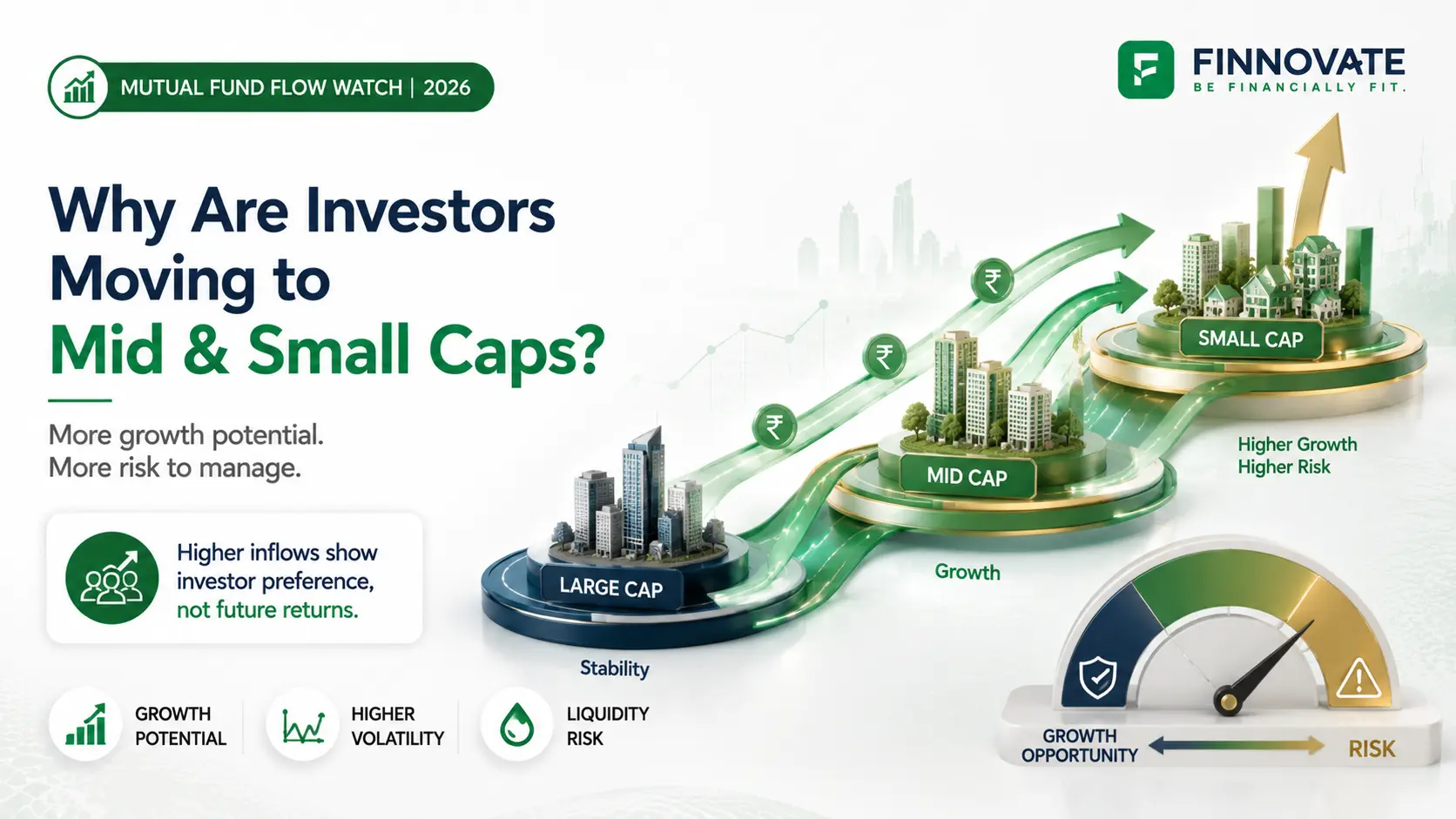
Indian mutual fund investors are making a clear choice in 2026.
Between February and July, small-cap funds received about ₹35,347 crore of net inflows and mid-cap funds another ₹33,285 crore. Large-cap funds, by comparison, attracted only about ₹9,973 crore.
Put together, small- and mid-cap funds attracted almost 7 times as much fresh money as large-cap funds over these six months.
July made the difference even sharper. Small-cap funds received a record ₹7,768 crore, mid-cap funds attracted ₹6,192 crore, while large-cap funds saw a ₹1,322 crore net outflow.
Table of Contents
The six-month numbers show how pronounced investor preference has become.
| Fund Category | Net Inflows, Feb-Jul 2026 |
|---|---|
| Small-cap funds | ₹35,347 crore |
| Mid-cap funds | ₹33,285 crore |
| Large-cap funds | ₹9,973 crore |
July alone widened that gap further.
| Fund Category | July 2026 Net Flow |
|---|---|
| Small-cap funds | ₹7,768 crore |
| Mid-cap funds | ₹6,192 crore |
| Large-cap funds | -₹1,322 crore |
Large-cap funds therefore moved into monthly net outflows even as small- and mid-cap funds continued attracting fresh money.
The simplest explanation is also one of the most important.
Investors often perceive smaller businesses as having more room to expand.
A mature large company may already dominate its industry and operate at significant scale. A smaller or mid-sized business can potentially grow revenue and earnings faster if it successfully expands capacity, distribution, market share or product reach.
Typically established businesses with greater liquidity, institutional ownership and mature operating scale.
Can offer higher growth potential, but usually with greater business, valuation and market risk.
The shift became particularly visible after the broader-market correction earlier in 2026. When valuations reset, investors returned aggressively to smaller companies as earnings expectations and market sentiment improved.
That recovery itself can also influence behaviour.
That distinction matters because recent outperformance does not guarantee superior future returns.
There is also a structural reason mid- and small-cap funds may appeal to investors looking for alpha.
SEBI's market-cap framework broadly classifies listed companies as:
A large-cap fund must invest at least 80% of its assets in large-cap companies. Mid-cap and small-cap funds must invest at least 65% in their respective segments.
This gives large-cap managers a relatively narrow universe of heavily researched companies. Most of these businesses are already closely tracked by institutional investors, brokerages, analysts and foreign investors.
Further down the market-cap spectrum, the opportunity set becomes much larger.
There are hundreds of businesses across manufacturing, financial services, healthcare, consumption, technology and newer industries where differences in earnings growth, valuation and execution can potentially create more stock-selection opportunities.
Another part of the appeal comes from diversification.
Buying an individual small-cap stock exposes an investor heavily to the fortunes of one business. A small-cap mutual fund spreads that exposure across a portfolio of companies.
That reduces company-specific risk.
But it does not make small-cap investing safe.
Liquidity is important enough that mid-cap and small-cap mutual funds are subject to regular stress-test and liquidity disclosures.
Investors do not have to choose between staying entirely in large caps and moving aggressively into small caps.
| Fund Category | Basic Allocation Rule | What It Does |
|---|---|---|
| Large-cap | Minimum 80% in large caps | Concentrates on established top-100 companies |
| Mid-cap | Minimum 65% in mid caps | Targets 101st-250th companies |
| Small-cap | Minimum 65% in small caps | Targets companies ranked 251st onwards |
| Large & Mid Cap | Minimum 35% each in large and mid caps | Combines stability and higher-growth exposure |
| Multi-cap | Minimum 25% each in large, mid and small caps | Maintains structural exposure to all three |
| Flexi-cap | Minimum 65% in equities overall | Lets the manager shift across market caps |
A multi-cap fund must maintain meaningful exposure to all three market-cap segments. A flexi-cap fund gives the fund manager much greater freedom to decide where opportunities look attractive.
So market-cap diversification can be built in several ways without simply adding more and more dedicated funds.
This is the most important conclusion from the data.
Small- and mid-cap funds are attracting significantly more money than large-cap funds. That tells us something about current investor preference. It does not tell us what will outperform next.
| Category | What Investors Generally Seek | Main Trade-Off |
|---|---|---|
| Large cap | Stability, liquidity, established businesses | Lower perceived alpha opportunity |
| Mid cap | Higher growth potential | Higher volatility |
| Small cap | Broad growth and stock-selection opportunity | Highest liquidity and drawdown risk |
| Flexi-cap | Manager-led market-cap allocation | Outcome depends heavily on fund strategy |
| Multi-cap | Structural exposure across all market caps | Mandatory allocation even when one segment looks expensive |
Large-cap businesses generally offer greater liquidity, more established business models and, in many cases, stronger ability to withstand difficult economic conditions.
Mid and small caps sit further up the risk curve. That can be reasonable for investors with long horizons and the capacity to tolerate deeper corrections.
The danger begins when recent returns cause investors to treat a small-cap or mid-cap fund as simply a higher-return version of a large-cap fund.
It is not. It is a different risk-return exposure.
The right allocation therefore depends less on which category received the most money last month and more on the investor's goals, time horizon, existing portfolio and ability to remain invested through a substantial drawdown.
Investors appear attracted by higher perceived growth opportunities, stronger broader-market recovery and the possibility of higher long-term returns. Strong recent performance may also be encouraging additional flows.
Small-cap funds received about ₹35,347 crore and mid-cap funds about ₹33,285 crore, compared with approximately ₹9,973 crore for large-cap funds.
Yes. Large-cap funds recorded around ₹1,322 crore of net outflows in July 2026.
No. Diversification reduces dependence on one company, but small-cap funds still carry higher volatility, liquidity risk and potential drawdowns than large-cap funds.
Multi-cap funds must invest at least 25% each in large-, mid- and small-cap stocks. Flexi-cap funds must maintain at least 65% equity overall but allow the fund manager to decide the mix across market-cap segments.
Disclaimer: Mutual fund investments are subject to market risks. Small-cap and mid-cap funds can experience significantly higher volatility, liquidity risk and drawdowns than large-cap funds. Historical returns, AUM changes and fund flows do not indicate future performance. Investors should consider goals, investment horizon, asset allocation and risk tolerance before investing.
No spam. Only new posts, simple explainers, and practical money checklists for busy professionals.
Finnovate is a SEBI-registered financial planning firm that helps professionals bring structure and purpose to their money. Over 3,500+ families have trusted our disciplined process to plan their goals - safely, surely, and swiftly.
Our team constantly tracks market trends, policy changes, and investment opportunities like the ones featured in this Weekly Capsule - to help you make informed, confident financial decisions.
Learn more about our approach and how we work with you:
No comments yet. Start the conversation. What would you add?
No spam. Only new posts, simple explainers, and practical money checklists.
You may also like
Equity mutual funds received ₹29,329 crore in August 2026. See which categories saw the ...

When should you exit a mutual fund? Learn when to hold, stop a SIP, rebalance or redeem ba...

Mutual fund AUM rose ₹3.54 lakh crore in July 2026. See how much came from fresh inflows...

Passive fund AUM rose 25.1% YoY to ₹15.61 lakh crore in July 2026, while inflows slowed....
Popular now

Learn how to easily download your NSDL CAS Statement in PDF format with our step-by-step g...

Looking for the best financial freedom books? Here’s a handpicked 2026 reading list with...

Learn what SIF investment means in India, SEBI rules, Rs 10 lakh minimum investment, avail...

Clear guide to mutual fund taxation in India for FY 2025–26 after July 2024 changes: equ...