
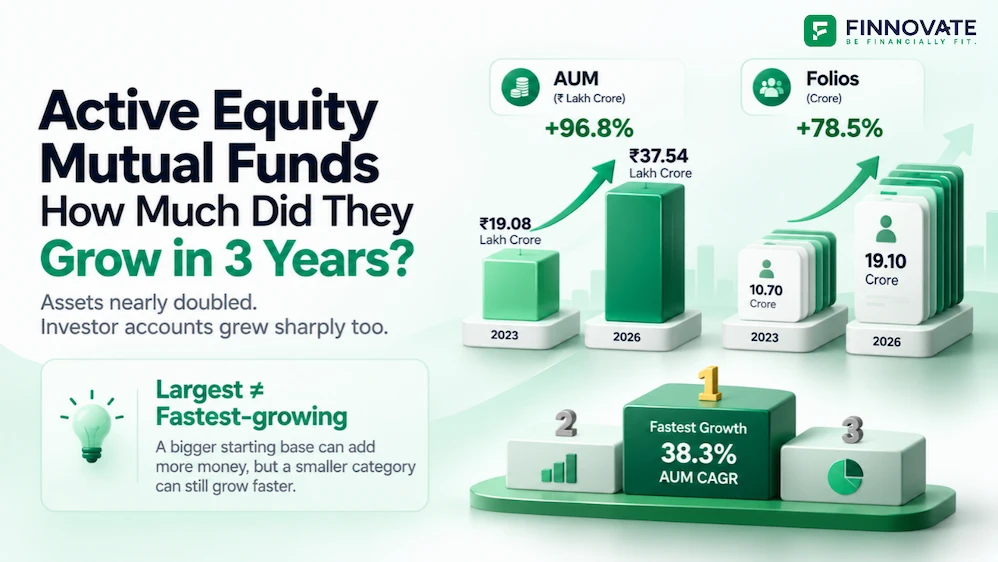
Active Equity Fund Growth 2023–2026: AUM & Folio Rankings
Compare active equity mutual fund growth from September 2023 to September 2026, with categ...
21 October 2026

You open your investment app on a Sunday evening, scroll through the fund list, and count. Eleven. Twelve. Maybe fourteen. You remember adding most of them: the mid-cap during a bull run, the NFO your relationship manager called "a unique opportunity," the ELSS you started for tax saving and then forgot about. Each one made sense at the time. Together, they have quietly built a portfolio you can no longer explain.
If this sounds familiar, you are not unusual. Most Indian investors who have been investing for 7 to 10 years end up here. Not because they were careless. Because every touchpoint in the mutual fund ecosystem is built to encourage addition, and nothing ever tells you to stop.
This article explains why overlap is a structural reality, and tells you exactly what to do if you already have too many funds. That last part is what most articles skip entirely.
Quick answer
For most investors, 4 to 6 mutual funds across different categories is the right number. Beyond that, most Indian equity portfolios stop adding diversification and start adding duplication. The same 30 to 35 stocks appear across multiple funds at different expense ratios under different AMC names. The right number is not a fixed rule. It is the minimum number of funds needed to cover each goal you are investing for, with no two funds doing the same job.
For most mid-career investors with 2 to 4 active financial goals, a portfolio of 4 to 6 mutual funds is adequate. Here is how the number changes across the spectrum:
The number follows from the structure. Build the right structure and the right number reveals itself.
Each layer has one job. One well-chosen fund per layer is enough. When a fund cannot answer "what do I do that no other fund in this portfolio does?" it is not earning its place.
| Layer | Fund Type | Purpose | How Many |
|---|---|---|---|
| Core | Large-cap index or consistent flexi-cap | Broad market anchor. Long-term compounding. Reliable, not exciting. | 1 |
| Engine | Mid-cap or small-cap | Genuine growth exposure from outside the top 100 stocks. 7 to 10 year horizon. | 1 |
| Buffer | Short-duration or dynamic bond | Capital protection for the nearest goal's timeline. Not for accumulation. | 1 |
| Goal-specific | International, sector, or ELSS if genuinely needed | Earns its place only when a different exposure is required. Not held "just because." | 1–3 |
Beyond 6 funds, each addition must answer: what does this do that nothing else already does? If there is no clear answer, the fund is redundant.
Portfolio accumulation is not a failure of discipline. It is the predictable output of a system that rewards addition and has no mechanism for subtraction.
Every mutual fund app is optimised for discovery. Weekly notifications, NFO alerts, top-performer lists. An investor across three platforms receives 15 to 20 fund suggestions per week without searching. No app has a feature that says "you already have enough."
Relationship managers earn commissions on new fund purchases, not on continuation of an existing SIP. An annual portfolio review often ends with a new recommendation, rarely with a consolidation plan.
Between 2020 and 2025, over 250 equity category NFOs launched in India. Most were category variants of existing holdings, with a lower NAV creating a false impression of being cheaper. The NFO pipeline is historically supply-driven, not demand-driven.
A bank FD matures and forces a decision. A mutual fund SIP runs indefinitely. There is no notification that says "this fund now overlaps 68% with your existing holding." Portfolios grow by accretion until someone finally counts.
SEBI's 2018 categorisation circular mandated that large-cap funds invest at least 80% in the top 100 stocks by market capitalisation. There are exactly 100 stocks in that universe. Two large-cap funds from different AMCs are fishing in an identical pond.
A portfolio with a large-cap fund, a flexi-cap fund, a multi-cap fund, and a bluechip fund is not four different bets. It is roughly the same 30 to 35 companies held four times, under four names, at four expense ratios.
| Fund Pair | Category Type | Typical Stock Overlap |
|---|---|---|
| Two large-cap active funds | Large Cap vs Large Cap | 60–75% |
| Large-cap active + Nifty 50 index | Active vs Passive | 70–85% |
| Large-cap + Flexi Cap | Large Cap vs Flexi Cap | 45–60% |
| Two Flexi Cap funds | Flexi Cap vs Flexi Cap | 50–65% |
| Flexi Cap + Multi Cap | Flexi Cap vs Multi Cap | 40–55% |
| Aggressive Hybrid + Large Cap | Hybrid vs Large Cap | 35–50% |
Mid-cap and small-cap categories are genuinely different. The investible universe is far larger and two mid-cap funds typically overlap just 20 to 35%. This is why the engine layer provides real incremental exposure that no large-cap holding can replicate. See the article on active vs passive portfolio management for how this interacts with the index fund decision.
Run this before making any changes. Twenty minutes. Reveals whether the portfolio is structured or just accumulated.
Can you describe what each fund does that no other fund in your portfolio does?
If two funds have the same answer, they are likely duplicates regardless of AMC or fund name.
If you removed one fund today, would your market exposure actually change?
For a well-structured portfolio, removing any fund changes the exposure. If the answer is no, that fund is redundant.
Can you name the top 5 holdings of each fund you own?
Most large-cap and flexi-cap funds share the same top 5: Reliance, HDFC Bank, ICICI Bank, Infosys, TCS. If those names appear across 4 of 8 funds, the diversification story deserves scrutiny.
Has any fund underperformed its benchmark for 3 or more consecutive years?
Consistent underperformance across a full market cycle raises a legitimate question about whether the active management fee is earning its place.
Does each SIP map to a specific goal with a target amount and target date?
An SIP with no attached goal is a savings habit, not a plan. Each SIP that cannot answer "for what, by when, how much" is a candidate for review.
An investor with 12 funds does not need to be told the ideal number is 5. They need the path from 12 to 5 without an unnecessary tax bill.
Stop SIPs into redundant funds first.
Stopping an SIP has no exit load, no tax implication, and no lock-in (except ELSS, where each invested instalment has its own 3-year lock-in). The existing corpus keeps compounding. The portfolio stops getting more crowded. There is no cost or tax implication in stopping an SIP.
Wait for the 12-month mark before redeeming.
LTCG on equity funds above Rs 1.25 lakh per year is taxed at 12.5%. STCG on units held under 12 months is taxed at 20%. Waiting until the 12-month mark saves 7.5 percentage points on every rupee of gain. For the full tax framework, see the Finnovate article on mutual fund taxation for FY 2025-26.
Tax rates per Finance Act 2024 (Union Budget, July 23, 2024). Full provisions at incometaxindia.gov.in.
Redeem in tranches across two financial years.
The Rs 1.25 lakh LTCG exemption resets every April 1. An investor with Rs 3.5 lakh in gains on a redundant fund can redeem Rs 1.25 lakh in March and another Rs 1.25 lakh in April. Two transactions, two financial years, two exemptions. The entire exit is potentially tax-free.
SEBI's February 26, 2026 circular on mutual fund categorisation introduced three separate timelines. Not one blanket August 2026 deadline.
By August 2026 (6 months): AMCs must align all fund names and nomenclature to their category. No more marketing-friendly names that do not reflect what is inside the fund.
Over 3 years: Sectoral and thematic equity funds must reduce portfolio overlap with other equity schemes to below 50%. Schemes that cannot comply within the 3-year phased window will be required to merge.
Immediately: Solution-oriented schemes (Children's Funds and Retirement Funds) were discontinued. No fresh subscriptions. Existing schemes will eventually merge into similar funds after SEBI approval. SEBI has introduced Life Cycle Funds as the structured replacement for goal-based investors. See the Finnovate explainer on SEBI's new Life Cycle Mutual Funds for how these work.
Source: SEBI circular HO/24/13/15(2)2026-IMD-RAC4/I/5764/2026, dated February 26, 2026. Full text at sebi.gov.in.
The overlap rule applies specifically to sectoral and thematic funds. But every investor with a crowded portfolio has the same underlying problem: funds added without a clear purpose, on someone else's recommendation, at someone else's timing. Each April is a natural moment to review that. For context on where passive funds fit into the review, see our articles on passive fund flows in India and how to build a strategy around passive funds.
A 4 to 6 fund portfolio reviewed annually against clear goals has historically performed comparably to a 12 to 15 fund portfolio in the same broad categories.
The additional funds add cost and complexity. Not better returns. Not better diversification.Beyond 6 to 8 funds, most equity portfolios in India show significant overlap without meaningful improvement in diversification. The more useful question: does each fund serve a purpose that no other fund already serves? If the answer is no for two or more funds, the portfolio has redundancy worth addressing.
In large-cap and flexi-cap categories, two funds will often overlap 50 to 75% in underlying stocks because the investible universe is constrained by SEBI mandates. In mid-cap and small-cap categories, where the universe is much larger, two funds may genuinely provide complementary exposure. The test is overlap, not the category label alone.
Not necessarily. A single well-chosen equity fund can serve multiple long-term accumulation goals simultaneously. Separate funds become useful when two goals have very different time horizons. A retirement goal 18 years away and a home down payment 3 years away require genuinely different risk profiles and asset classes.
Below 33% weighted overlap between any two funds is a reasonable benchmark. Overlap above 50% in the same category is a strong signal that the two funds are doing substantially the same job. Please consult a SEBI-registered investment adviser for a formal assessment of your specific portfolio's overlap profile.
Stop SIPs into redundant funds first: free and immediate. Then wait until each investment crosses 12 months to qualify for the 12.5% LTCG rate instead of 20% STCG. Then redeem in tranches across two financial years to use the Rs 1.25 lakh annual exemption twice, potentially eliminating the tax entirely on moderate-sized gains.
An annual review each April is the ideal cadence. This aligns with the LTCG exemption reset, availability of previous-year performance data across a full market cycle, and the natural window to stop or modify SIPs. Mid-year reviews are worth considering after a significant life event such as a change in income, a new goal, or a major market correction.
Disclaimer: This article is for general information and educational purposes only. It does not constitute investment advice, a recommendation, or an offer to buy or sell any securities or financial instruments. References to mutual fund categories, SEBI regulations, and portfolio overlap data are based on publicly available information and are subject to change. Past portfolio structures and historical overlap patterns are not indicative of future outcomes. Investors should not make any investment decision based solely on this article. Please consult a SEBI-registered investment adviser or a qualified financial professional before making any investment decision or portfolio change. Mutual fund investments are subject to market risks. Please read all scheme-related documents carefully before investing.
No spam. Only new posts, simple explainers, and practical money checklists for busy professionals.
Finnovate is a SEBI-registered financial planning firm that helps professionals bring structure and purpose to their money. Over 3,500+ families have trusted our disciplined process to plan their goals - safely, surely, and swiftly.
Our team constantly tracks market trends, policy changes, and investment opportunities like the ones featured in this Weekly Capsule - to help you make informed, confident financial decisions.
Learn more about our approach and how we work with you:
No comments yet. Start the conversation. What would you add?
No spam. Only new posts, simple explainers, and practical money checklists.
You may also like
Compare active equity mutual fund growth from September 2023 to September 2026, with categ...

Explore September 2026 ETF and index fund flows, with category-wise inflows, outflows, AUM...

Equity fund net inflows rose 30.61% to ₹38,306.55 crore in September 2026. Compare 13 ca...

Equity mutual funds received ₹29,329 crore in August 2026. See which categories saw the ...
Popular now

Learn how to easily download your NSDL CAS Statement in PDF format with our step-by-step g...

Looking for the best financial freedom books? Here’s a handpicked 2026 reading list with...
Learn what SIF investment means in India, SEBI rules, Rs 10 lakh minimum investment, avail...

Clear guide to mutual fund taxation in India for FY 2025–26 after July 2024 changes: equ...