

Tax Planning and Benefits for Married Couples in India: 2026 Guide
Tax planning for married couples in India explained for 2026. Compare tax regimes, deducti...
05 September 2026


Finnovate’s editorial team researches and creates financial content using trusted sources, regulatory references and inputs from subject experts.

Property capital gains rules changed after Union Budget 2024, so the old "20% with indexation" default is no longer the safe assumption.
Today, your tax outcome depends on three things:
This guide explains what changed, how to calculate gains, how to decide between the indexation and non-indexation methods (where allowed), and which exemptions actually work.
Quick Answer
| Scenario | Holding period | Tax treatment |
|---|---|---|
| Property sold within 24 months of purchase | Short-term | STCG added to total income, taxed at slab rate |
| Property sold after 24 months, acquired on or after 23 July 2024 | Long-term | LTCG at 12.5% without indexation |
| Property sold after 24 months, acquired before 23 July 2024, seller is resident individual or HUF | Long-term | Pay lower of: 12.5% without indexation, or 20% with indexation (grandfathering) |
| Property sold after 24 months, acquired before 23 July 2024, seller is NRI / company / LLP | Long-term | LTCG at 12.5% without indexation. No indexation option. |
Note: Senior citizens have no special capital gains rate on property. The rates above apply regardless of age.
Before 23 July 2024, LTCG on property was taxed at 20% with indexation benefit for all taxpayers, including NRIs. That uniform framework no longer applies to transfers on or after 23 July 2024.
For transfers on or after 23 July 2024, the default LTCG rate is 12.5% without indexation.
The taxable gain can appear larger because inflation adjustment is not available, but the headline rate is lower. Whether this results in a higher or lower tax bill depends on how long you held the property and how much it appreciated.
Under the second proviso to Section 112(1)(a), a resident individual or resident HUF selling property (land or building or both) that was acquired before 23 July 2024 is protected from paying more tax under the new regime than they would have under the old one.
In practice, this means: tax is computed under both methods, and if the 12.5% tax exceeds the 20% with indexation tax, the excess is ignored. The taxpayer pays whichever is lower.
Four conditions must all be met for this protection to apply:
NRIs, companies, LLPs, firms, and non-resident HUFs do not qualify. They pay 12.5% without indexation on all post-23 July 2024 transfers.
NRI sellers pay LTCG at 12.5% without indexation on property held for more than 24 months, regardless of when the property was acquired. There is no grandfathering option available to non-residents. In addition, the buyer of an NRI's property is required to deduct TDS under Section 195 at the rates in force. For LTCG on property transferred on or after 23 July 2024, this rate is 12.5% plus applicable surcharge and cess, generally applied on the sale consideration. NRIs planning a property sale may apply for a lower or nil deduction certificate under Section 197 before the transaction.
For a full treatment of NRI property taxation including FEMA, remittance, and repatriation rules, see the NRI taxation in India explained article.
Summary:
This includes the purchase value and other eligible acquisition-linked costs such as stamp duty and registration charges paid at the time of purchase.
Cost of improvement means capital improvements, not routine upkeep.
Costs that are commonly disputed include painting, routine repairs, maintenance, plumbing fixes, minor replacement work, and general refurbishing. These are usually treated as maintenance and not as capital improvement.
Costs that are more defensible include structural renovation, adding a room or floor, major alterations that add value or extend the life of the property, and major permanent upgrades, provided you have proper invoices and payment proofs.
Selling expenses can include brokerage, legal fees, and documentation charges that are directly linked to the transfer. Keep invoices and proof of payment for all of these.
The calculation follows a four-step sequence. The same steps apply to both the with-indexation and without-indexation methods; only the cost figure differs.
Use the actual sale value or the stamp duty value (circle rate), whichever is higher, as required under Section 50C.
Add: purchase price + eligible improvement costs + acquisition-linked expenses (stamp duty, registration at time of purchase).
Under the without-indexation method, use this figure as-is.
Under the with-indexation method (where eligible), multiply by: CII of sale year divided by CII of acquisition year. For FY 2025-26, the CII is 376 (CBDT Notification No. 70/2025).
Deduct brokerage, legal fees, and other documented transfer costs from the sale consideration.
Capital gains = Net sale consideration minus indexed (or actual) cost.
Multiply by 12.5% (default) or 20% (where grandfathering applies and gives a lower result).
Add surcharge and cess as applicable to arrive at total tax outgo.
If the holding period is under 24 months, the gains are added to total income and taxed at your applicable slab rate. There is no separate flat rate for STCG on property.
If the holding period is more than 24 months, LTCG applies and the rate depends on acquisition date and residential status, as set out in the table above.
If you are eligible to use both methods, always calculate both and compare the total tax outgo, not just the gains figure.
Example setup: property bought in June 2018 and sold in December 2025, seller is a resident individual. Both methods available under grandfathering.
| Particulars | With Indexation | Without Indexation |
|---|---|---|
| Purchase value | Rs 85.00 lakh | Rs 85.00 lakh |
| Registration / Stamp duty | Rs 2.50 lakh | Rs 2.50 lakh |
| Cost of improvement | Rs 42.00 lakh | Rs 42.00 lakh |
| Total purchase cost | Rs 129.50 lakh | Rs 129.50 lakh |
| Indexation factor (CII 376 / CII 280) | 1.343 | N.A. |
| Effective cost | Rs 173.92 lakh | Rs 129.50 lakh |
| Sale value | Rs 277.80 lakh | Rs 277.80 lakh |
| Expenses on sale | Rs 1.50 lakh | Rs 1.50 lakh |
| Capital gains | Rs 102.38 lakh | Rs 146.80 lakh |
| Tax rate | 20% | 12.5% |
| Tax | Rs 20.48 lakh | Rs 18.35 lakh |
| Net realised value | Rs 255.82 lakh | Rs 257.95 lakh |
In this illustration, 12.5% without indexation gives slightly better net proceeds. This will not hold in every case. For properties with high improvement costs or older acquisition dates, the indexed cost can grow large enough that 20% with indexation produces a lower tax bill. Always compute both.
Three sections of the Income Tax Act allow you to reduce or eliminate LTCG on property when the proceeds are reinvested in a specified way. Each section has distinct conditions, timelines, and caps.
Important note for taxpayers using the grandfathering option
When the grandfathering protection applies, tax is computed under both methods: once using indexed gains at 20%, and once using non-indexed gains at 12.5%. Exemptions under Sections 54, 54EC, and 54F are applied separately under each computation. The taxpayer pays whichever total tax is lower after exemptions. In high-value transactions where indexed gains and non-indexed gains differ materially, the two computations can produce different exemption amounts, so both should be worked through carefully before filing.
Section 54 applies when you sell a residential house property and reinvest the capital gains into another residential house. You can buy within 1 year before the sale date or 2 years after, or construct within 3 years after the sale.
Under Section 54, the exemption is the lower of the capital gain or the amount reinvested in the new house. If the amount reinvested is less than the capital gain, the exemption is limited to the amount reinvested and the balance is taxable. If you reinvest an amount equal to or more than the capital gain, the full LTCG can be exempt. There are holding conditions on the new property, and a breach leads to reversal of the exemption.
From AY 2024-25 onwards, where the cost of the new residential property exceeds Rs 10 crore, the exemption calculation caps the investment at Rs 10 crore. In high-value transactions, this means the full LTCG cannot be sheltered through Section 54 alone even with full reinvestment.
Section 54EC allows you to reinvest eligible capital gains into specified bonds issued by REC, NHAI, PFC, and IRFC.
The Rs 50 lakh cap is per financial year. If your gain exceeds Rs 50 lakh and the sale straddles two financial years, you may be able to invest Rs 50 lakh in each, subject to conditions. The Rs 10 crore cap that applies to Sections 54 and 54F does not apply to Section 54EC.
Section 54F applies when you sell a long-term capital asset other than a residential house (such as a plot of land, commercial property, shares, or gold) and invest the net sale consideration into one residential house.
Unlike Section 54 where only the capital gains need to be reinvested, Section 54F requires the entire net consideration to be invested for a full exemption. Partial investment gives proportionate exemption. The Rs 10 crore investment cap (from AY 2024-25) applies here as well.
A common real-life situation: you sell a property, you plan to reinvest within the allowed window, but you have not reinvested before filing your ITR.
In such cases, you generally need to deposit the unutilised amount into the Capital Gains Account Scheme (CGAS) before the ITR due date to keep the exemption claim valid. The CGAS amount counts as reinvestment for the purpose of computing the exemption.
Many people lose exemptions not because the plan was wrong, but because this step was missed.
A property sale changes your tax planning for the year. One wrong assumption on capital gains, exemptions, or deadlines can increase tax outgo or force a revised return later.
In a short consultation, we help you:
Book a 15-Minute Tax Planning Clarity Call
Useful if you sold property, are planning an exemption claim, or want a quick check on your overall tax plan for the year.
Before filing, reconcile the reporting in AIS, TIS, and Form 26AS: AIS vs TIS vs Form 26AS before filing ITR
Property capital gains is no longer one default formula.
The process is:
Tax Planning in India: Definition, Types, Benefits & Common Methods
Tax Planning for Salaried Employees in India (2026 Guide)
Disclaimer: This article is for informational and educational purposes only. It does not constitute tax, legal, or financial advice. Tax rules can change and the correct treatment depends on your specific facts and residential status. The section numbers cited refer to the Income Tax Act 1961 as amended by the Finance (No.2) Act 2024, applicable for FY 2025-26 ITR filings. From FY 2026-27 onwards, these provisions are renumbered under the Income Tax Act 2025 (Section 54 becomes Section 82; Section 54F becomes Section 86) but the substantive rules remain unchanged for the current year. Consult a qualified tax professional for advice specific to your situation.
No spam. Only new posts, simple explainers, and practical money checklists for busy professionals.
Finnovate is a SEBI-registered financial planning firm that helps professionals bring structure and purpose to their money. Over 3,500+ families have trusted our disciplined process to plan their goals - safely, surely, and swiftly.
Our team constantly tracks market trends, policy changes, and investment opportunities like the ones featured in this Weekly Capsule - to help you make informed, confident financial decisions.
Learn more about our approach and how we work with you:
No comments yet. Start the conversation. What would you add?
No spam. Only new posts, simple explainers, and practical money checklists.
You may also like
Tax planning for married couples in India explained for 2026. Compare tax regimes, deducti...
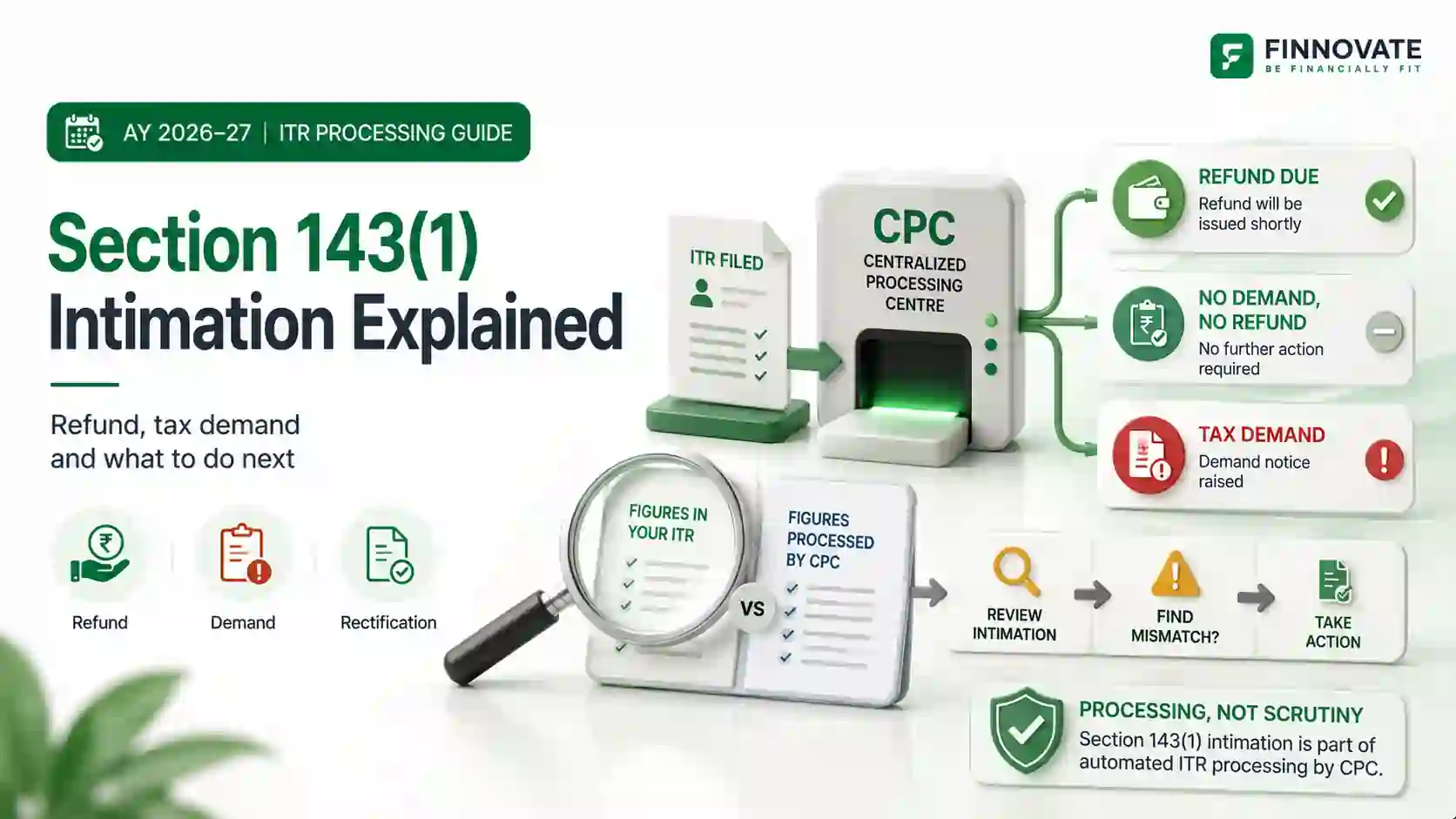
Received a Section 143(1) intimation? Understand CPC adjustments, refunds, tax demands, re...
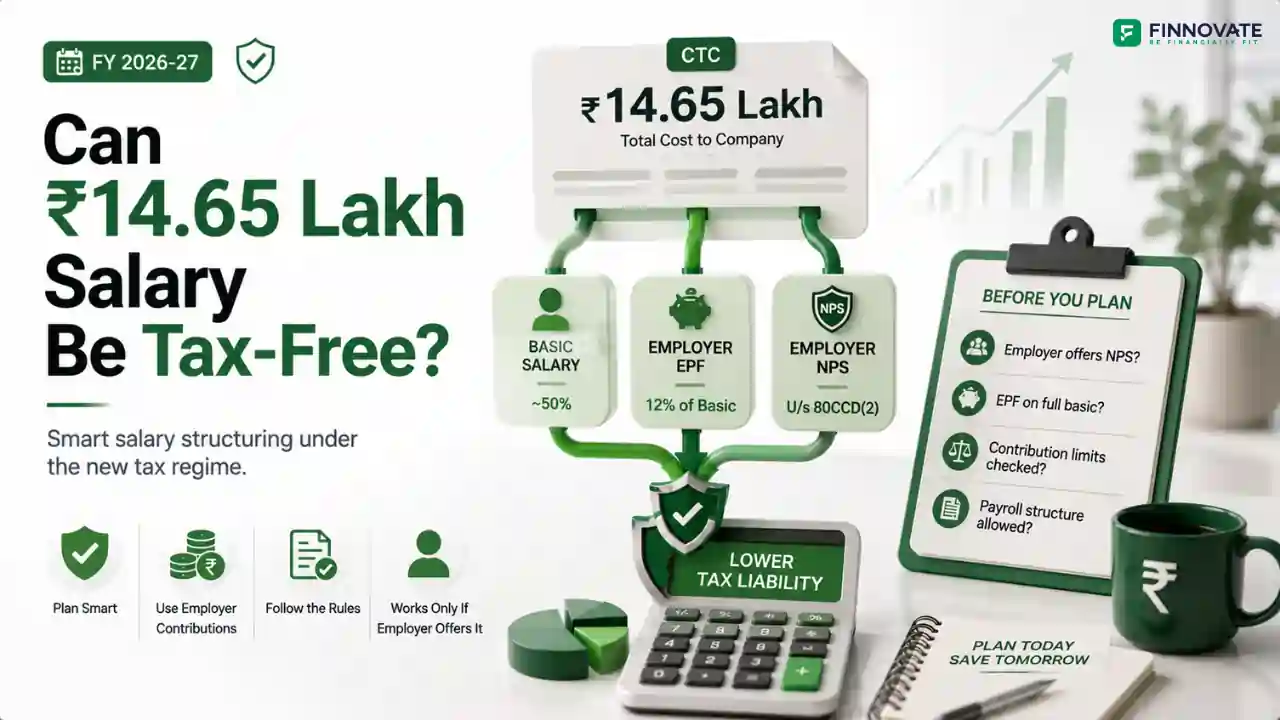
Zero tax on a ₹14.65 lakh salary is real, but only if your employer contributes EPF on f...

Changed jobs in FY 2025-26? See why combining two Form 16s can create a tax shortfall past...
Popular now

Learn how to easily download your NSDL CAS Statement in PDF format with our step-by-step g...

Looking for the best financial freedom books? Here’s a handpicked 2026 reading list with...
Learn what SIF investment means in India, SEBI rules, Rs 10 lakh minimum investment, avail...

Clear guide to mutual fund taxation in India for FY 2025–26 after July 2024 changes: equ...