

Why Hospital Stocks Fell Over Drug Pricing
Why did hospital stocks fall after Supreme Court scrutiny of medicine prices? Understand d...
01 October 2026
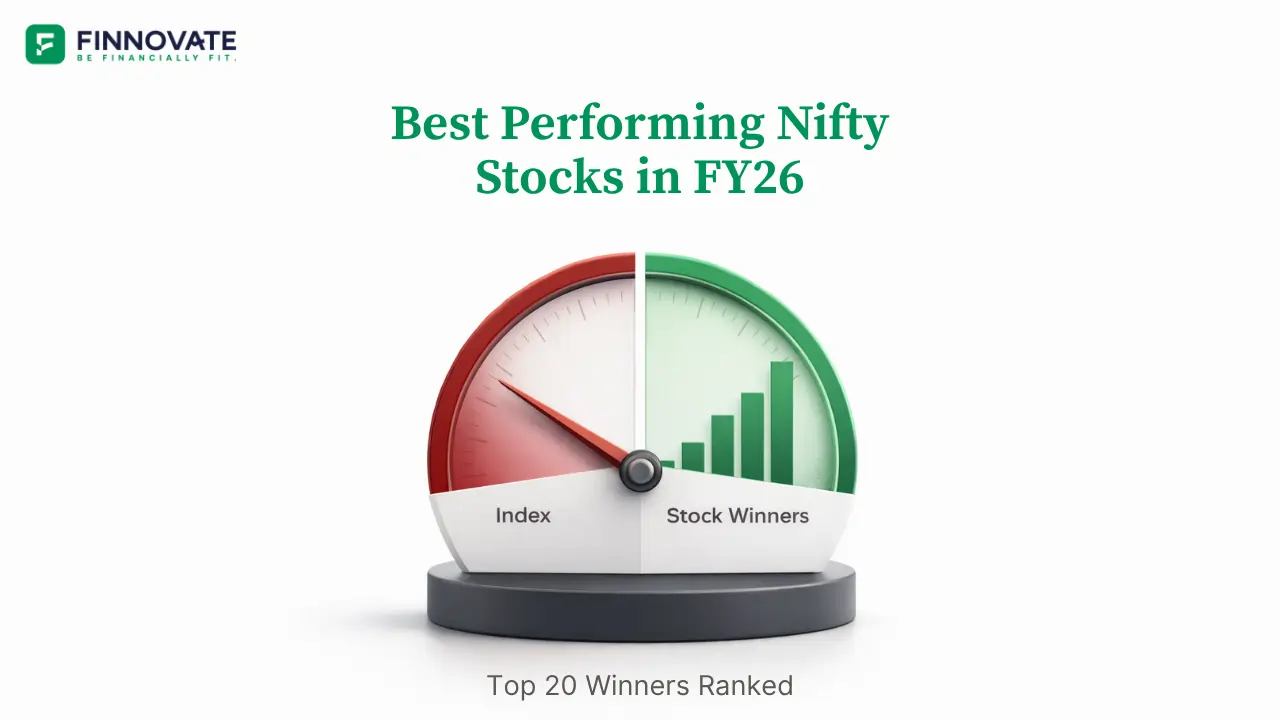
The Nifty 50 ended FY26 down 3.27%, snapping a two-year winning streak. From its 52-week peak of 26,373, the index fell approximately 13.5% to close around 22,820. Most of that damage came in March 2026, when the US-Iran conflict, a surge in crude oil prices, and record FPI selling combined to erase what had been a relatively stable year until then.
But within that difficult index performance, a different story was playing out at the stock level. Several Nifty constituents delivered strong positive returns even as the broader index declined. The difference between the best and worst performers within Nifty 50 in FY26 was stark, and the reasons behind that divergence tell investors something important about what kinds of businesses held up through the stress.
This article looks at the top 20 Nifty performers in FY26, ranked on a combined methodology of 1-year returns and proximity to 52-week highs, and breaks down the four categories of stocks that defined Nifty's winners this year.
Nifty began FY26 in reasonable shape. Q1 FY26 earnings were broadly supportive, domestic consumption remained resilient, and the index touched a 52-week peak of 26,373 in the first half of the year. The second half brought compounding pressure. FPI outflows that had begun in late 2025 accelerated sharply, the rupee weakened steadily, and earnings growth moderated across several large index constituents.
Then March 2026 delivered the sharpest single-month shock of the year. Three events drove it: the US-Iran conflict beginning 28 February, Brent crude crossing $100 per barrel, and FPI selling that reached a record ₹1,13,810 crore for the month. The index fell approximately 9% in March alone, and the India VIX hit its highest reading since June 2024 as market fear surged. That one month determined the full-year outcome for Nifty.
The top 20 list uses a two-parameter methodology to identify Nifty stocks that performed well on both absolute returns and resilience.
Two rankings were computed across all 50 Nifty constituents:
The combined rank is the average of both individual ranks. A stock that delivered strong returns but has fallen sharply from its peak gets penalised. A stock near its high but with low returns also gets penalised. The combined rank rewards stocks that have done both things well simultaneously.
| Company | Closing Price (₹) | 52-Week High (₹) | 1-Year Returns | Fall from Peak | Combined Rank |
|---|---|---|---|---|---|
| ONGC | 281.10 | 293.00 | 16.08% | -4.06% | 6.0 |
| TITAN | 3,982.10 | 4,378.40 | 28.97% | -9.05% | 6.0 |
| APOLLOHOSP | 7,547.00 | 8,099.50 | 16.25% | -6.82% | 7.0 |
| COALINDIA | 445.10 | 476.00 | 12.16% | -6.49% | 8.0 |
| TATASTEEL | 193.19 | 216.45 | 24.30% | -10.75% | 8.0 |
| BEL | 405.95 | 473.45 | 35.02% | -14.26% | 8.0 |
| DRREDDY | 1,281.10 | 1,379.70 | 10.23% | -7.15% | 11.0 |
| SBILIFE | 1,829.20 | 2,132.00 | 18.40% | -14.20% | 11.0 |
| SUNPHARMA | 1,794.00 | 1,851.20 | 3.61% | -3.09% | 13.0 |
| NTPC | 376.50 | 394.50 | 4.39% | -4.56% | 13.5 |
| BAJAJ-AUTO | 8,897.50 | 10,187.00 | 11.58% | -12.66% | 13.5 |
| HINDALCO | 865.00 | 1,029.80 | 24.76% | -16.00% | 13.5 |
| SBIN | 1,019.20 | 1,234.70 | 31.97% | -17.45% | 13.5 |
| EICHERMOT | 6,799.00 | 8,230.00 | 27.19% | -17.39% | 14.0 |
| SHRIRAMFIN | 903.00 | 1,108.00 | 33.09% | -18.50% | 14.0 |
| NESTLEIND | 1,194.10 | 1,340.40 | 6.52% | -10.91% | 15.5 |
| JSWSTEEL | 1,130.10 | 1,284.70 | 6.64% | -12.03% | 16.0 |
| ADANIPORTS | 1,339.90 | 1,584.00 | 11.96% | -15.41% | 16.5 |
| TATACONSUM | 1,043.70 | 1,220.90 | 7.21% | -14.51% | 17.5 |
| BHARTIARTL | 1,850.00 | 2,174.50 | 7.27% | -14.92% | 17.5 |
On 1-year returns, BEL led the top 20 at 35.02%, followed by Shriram Finance at 33.09% and SBI at 31.97%. All 20 stocks delivered positive 1-year returns despite a negative index year.
On proximity to 52-week highs, 7 of the 20 stocks were within single-digit percentage of their peaks. Sun Pharma was the closest at just 3.09% from its high. ONGC was next at 4.06%, followed by NTPC at 4.56%.
On the combined rank, ONGC and Titan both scored 6.0, the best in the top 20, meaning they delivered strong returns and remained close to their peaks simultaneously.
The top 20 performers fall into four overlapping categories. The table below maps each stock to its primary category.
| Category | Member Stocks |
|---|---|
| PSU plays | ONGC, Coal India, BEL, NTPC |
| Commodity plays | ONGC, Coal India, Tata Steel, Hindalco, Titan, JSW Steel |
| Defensive plays | Apollo Hospitals, Dr Reddy's, Sun Pharma, Nestle, Tata Consumer Products |
| Genuine profit growth | Titan, BEL, SBI, Bharti Airtel, Bajaj Auto, Eicher Motors, Adani Ports |
ONGC, Coal India, BEL, and NTPC led this group. PSU stocks benefited from two distinct tailwinds in FY26. Expectations of continued government capital expenditure and policy support kept institutional interest alive in this segment even as broader market sentiment weakened. The geopolitical backdrop of the US-Iran conflict added a specific boost to defence and energy PSUs. BEL saw its order book reach ₹73,015 crore as of January 2026 and delivered net profit growth of over 20% in Q3 FY26. ONGC benefited directly from elevated crude prices.
Rising commodity prices through FY26, accelerated by the Strait of Hormuz disruption, created a direct tailwind for Tata Steel, Hindalco, Coal India, JSW Steel, and ONGC. Metals and mining stocks benefited from both global price support and domestic demand from India's infrastructure push. Titan, which overlaps this category through its jewellery business, saw gold prices reach record levels in FY26. This category had some of the widest spread between peak and current prices, reflecting how volatile commodity tailwinds can be.
Healthcare and consumer staple names, including Apollo Hospitals, Dr Reddy's, Sun Pharma, Nestle, and Tata Consumer Products, held up through FY26's volatility because their businesses are less exposed to macro cycles. Sun Pharma's proximity to its 52-week high of just 3.09% reflects this resilience clearly. When equity markets are uncertain and FPI flows are volatile, defensives attract a flight-to-safety premium, which was visible through the second half of FY26.
Titan, BEL, SBI, Bharti Airtel, Bajaj Auto, Eicher Motors, and Adani Ports appeared in the top 20 on the back of actual earnings delivery. SBI's return of 31.97% in a year when several private sector banks underperformed reflects the strength of its earnings delivery. Bharti Airtel's ARPU growth and Bajaj Auto's export momentum are similarly earnings-driven stories rather than macro-positioning plays.
ONGC sits at the intersection of PSU plays and commodity plays. That double tailwind is why it led the combined ranking alongside Titan. BEL sits at the intersection of PSU plays and genuine profit growth, combining government support with actual earnings delivery, a pairing that proved particularly resilient in FY26.
Titan is perhaps the most interesting case. It appears in commodity plays through gold and jewellery, and in genuine profit growth through its consistent earnings record. That dual positioning produced the second-best combined rank in the top 20.
The stocks with the weakest combined rankings within the top 20, specifically Shriram Finance, SBI, and Eicher Motors, had high 1-year returns but significant drawdowns from their peaks. Their strong returns are real but the gap to their highs reflects the broader second-half market weakness.
FY26 was a year in which passive index exposure delivered a negative return while selective stock exposure within the same index delivered 10% to 35% positive returns. The index was pulled down by heavyweights that underperformed, particularly financial services names, IT, and consumer discretionary stocks that bore the brunt of FPI selling.
FY26 data suggests that stock-level composition within the index mattered more than the index return itself. Three observations from the data are worth carrying forward.
| Observation | What the FY26 Data Shows |
|---|---|
| Macro stress rewards recurring earnings | Healthcare, consumer staples, and government-contracted businesses dominated the top 20. Businesses priced on growth expectations underperformed when the macro environment deteriorated. |
| Commodity tailwinds reverse quickly | Several commodity and PSU names delivered strong 1-year returns but are still 15-18% below their 52-week highs, reflecting how fast these tailwinds can unwind when conditions shift. |
| Index return vs stock return gap was unusually wide | Passive Nifty exposure delivered -3.27% while selective exposure within the same index delivered 10-35% positive returns. Earnings profile and macro sensitivity of individual businesses mattered far more than the index level. |
The Nifty 50 ended FY26 down approximately 3.27%, closing around 22,820 against its 52-week high of 26,373. Most of the damage came in March 2026, driven by the US-Iran conflict, crude price surge, and record FPI selling.
Among the top 20 by combined ranking, BEL delivered the highest 1-year return at 35.02%, followed by Shriram Finance at 33.09% and SBI at 31.97%.
A stock close to its 52-week high has held its gains despite broader market weakness, signalling relative strength. Sun Pharma at 3.09% from its peak and ONGC at 4.06% are the clearest examples in FY26.
PSU stocks benefited from two tailwinds: policy support and government capex expectations sustained institutional interest, while the geopolitical backdrop specifically boosted defence PSUs like BEL and energy PSUs like ONGC through elevated order flows and commodity prices.
The index's negative return was driven by underperformance in financial services, IT, and consumer discretionary sectors, which carry high index weights and bore the brunt of FPI selling. Stocks with defensive characteristics, commodity exposure, PSU backing, or strong earnings were less affected by those pressures.
FY26 showed that macro stress widens the gap between index and individual stock returns significantly. Understanding the earnings profile and macro sensitivity of businesses within the index matters, particularly in years of geopolitical stress. Please consult a SEBI-registered investment adviser before making any investment decisions.
Disclaimer: This article is for general information and educational purposes only. It does not constitute investment advice, a recommendation, or an offer to buy or sell any securities or financial instruments. Stock prices, returns, and 52-week high data referenced in this article are based on Finnovate's internal research and publicly available NSE data, and are subject to change. Past performance of any stock or index is not indicative of future returns. Investors should not make any investment decision based solely on this article. Please consult a SEBI-registered investment adviser or qualified financial professional before making any investment decision. Equity investments are subject to market risks.
No spam. Only new posts, simple explainers, and practical money checklists for busy professionals.
Finnovate is a SEBI-registered financial planning firm that helps professionals bring structure and purpose to their money. Over 3,500+ families have trusted our disciplined process to plan their goals - safely, surely, and swiftly.
Our team constantly tracks market trends, policy changes, and investment opportunities like the ones featured in this Weekly Capsule - to help you make informed, confident financial decisions.
Learn more about our approach and how we work with you:
No comments yet. Start the conversation. What would you add?
No spam. Only new posts, simple explainers, and practical money checklists.
You may also like
Why did hospital stocks fall after Supreme Court scrutiny of medicine prices? Understand d...
Nifty Smallcap 100 rose 3.16% in August 2026. See which small-cap stocks led, what drove t...

Nifty Midcap 100 rose 2.15% in August 2026. See which mid-cap stocks led the rally, key se...
See the best-performing Nifty 50 stocks in August 2026, which sectors led the market, and ...
Popular now
Learn how to easily download your NSDL CAS Statement in PDF format with our step-by-step g...

Looking for the best financial freedom books? Here’s a handpicked 2026 reading list with...
Learn what SIF investment means in India, SEBI rules, Rs 10 lakh minimum investment, avail...

Clear guide to mutual fund taxation in India for FY 2025–26 after July 2024 changes: equ...