
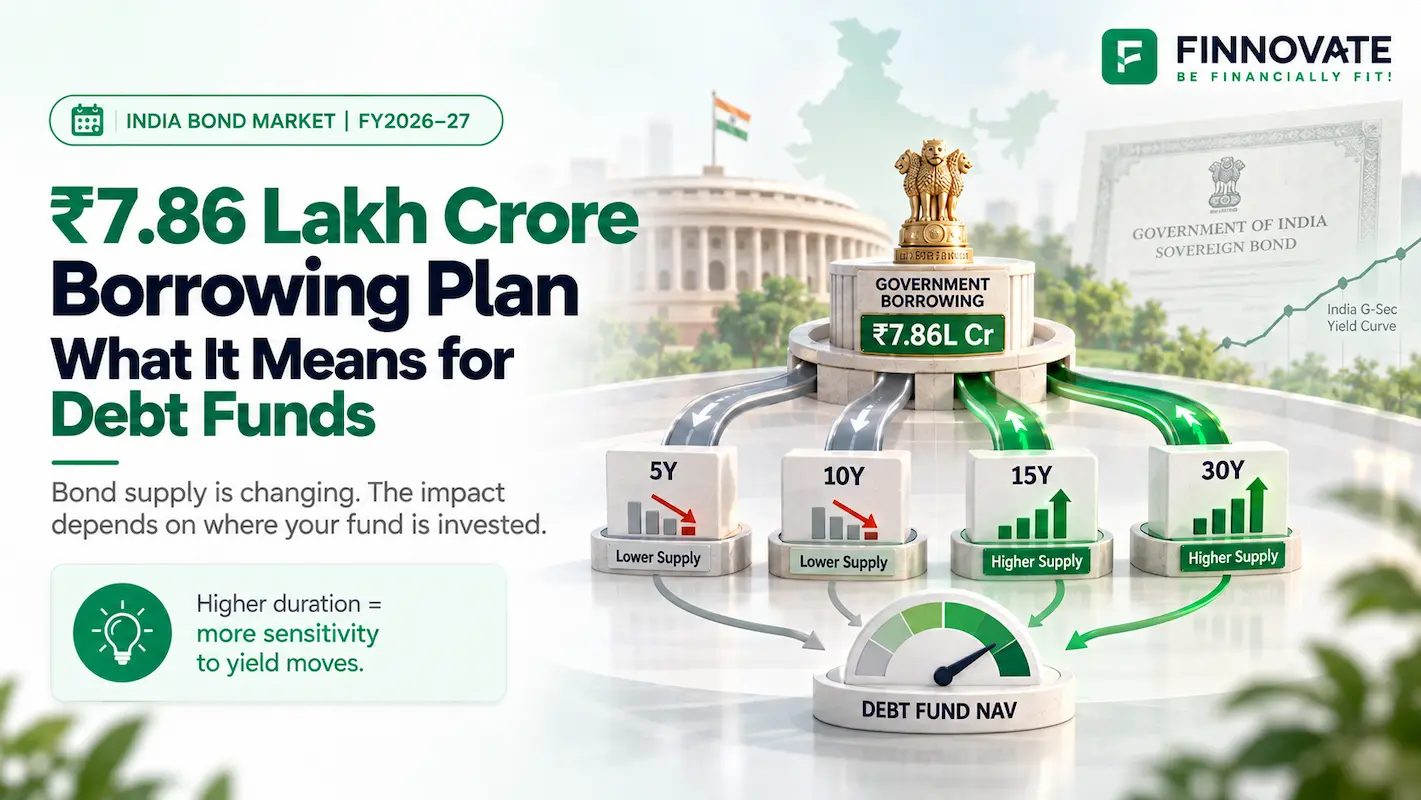
Government Borrowing Plan FY2026–27: Impact on Debt Funds
India plans to borrow ₹7.86 lakh crore in the second half of FY2026–27. Learn how the ...
28 September 2026

RBI amendment notified: June 24, 2026 | Source: RBI Scale-Based Regulation amendment, publicly available reporting
The day after the RBI issued its NBFC Upper Layer (UL) amendment, one set of headlines called it a relief for Tata Sons, while another predicted Tata Sons will now face stronger pressure toward a stock market listing. Both readings have something to them, and the gap between them comes down to one word in the amendment text: "may."
Quick read
Before this amendment, RBI classified NBFCs into the Upper Layer using a composite scoring model: asset size combined with interconnectedness, complexity of operations, and other systemic risk factors. The new framework replaces that multi-factor test with a single, absolute threshold: any NBFC with assets of ₹1 lakh crore or more becomes eligible for Upper Layer classification, subject to RBI specifically identifying it each year. The review cycle for the threshold itself has been set at three years, tighter than the five years proposed in the draft version of the amendment.
The amendment states that NBFCs crossing the threshold "may be considered for inclusion" in the Upper Layer list, based on the systemic risk they pose. This is not automatic classification. RBI retains discretion on whether to actually place a qualifying NBFC on the list. This is the basis for the "relief" reading: Tata Sons could, in principle, be excluded even after crossing the asset threshold, if RBI judges its systemic risk profile differently. It is also the basis for the "pressure" reading: the multi-factor arguments Tata Sons could previously raise (limited interconnectedness, simpler structure than a bank or large NBFC lender) carry less weight under a test that is now primarily about absolute asset size, which Tata Sons clearly exceeds.
Tata Sons is a registered Core Investment Company (CIC), the holding company structure for the Tata Group. It was the only CIC on RBI's January 2025 NBFC-UL list of 15 entities, placed there in 2022, with an expectation that it would move toward a stock market listing by 2025. Tata Sons' estimated standalone assets are between ₹1.75 lakh crore and ₹1.9 lakh crore, well above the new ₹1 lakh crore threshold.
| Factor | Reading 1: Relief | Reading 2: Pressure intensifies |
|---|---|---|
| The word "may" | Inclusion is discretionary, not automatic, leaving room for exclusion | RBI has not signalled it intends to exclude an entity of this size |
| No updated list yet | Old list still applies; new list could go either way | Old list already includes Tata Sons; nothing has formally changed yet |
| Asset-size test | Simpler test, easier to understand outcomes for everyone | Removes Tata Sons' multi-factor arguments against classification |
| CIC deregistration application | If approved, UL classification becomes irrelevant for Tata Sons | Still pending; no indication RBI will approve it |
Public statements from Tata Sons and Tata Group veterans suggest the company's objection has never been to stricter regulatory oversight itself. Tata Sons appears willing to accept enhanced disclosure, compliance, and supervision commensurate with its size. The objection is specifically to the mandatory stock exchange listing requirement that accompanies Upper Layer classification: a requirement the company's board does not see strategic value in.
In 2001, Tata Finance, then a listed group company, defaulted on deposits worth ₹615 crore following allegations of illegal speculative activity by its then CEO, Dilip Pendse. Tata Sons, despite not being listed itself at the time, provided full support to depositors through cash and guarantees to honour the obligations. The episode is cited by Tata veterans as evidence that the group's commitment to stakeholders does not depend on whether the parent holding company is listed.
Tata veterans, including former Tata Sons executive director Noshir Soonawala, have argued publicly that Tata Sons serves functions beyond being a financial holding company: it is the vehicle for the Tata Trusts' substantial charitable activities, and it has historically functioned as an incubator for long-gestation businesses such as airlines, semiconductors, and digital ventures. The argument is that public market shareholders, focused on quarterly and annual results, may not have the patience for businesses with multi-year payback periods, and that this could constrain Tata Sons' ability to continue that incubation role if forced to list.
The amendment carves out an explicit exemption: government-owned NBFCs that meet the ₹1 lakh crore threshold may be included in the Upper Layer category for regulatory purposes, but are not required to list on stock exchanges. This creates a visible asymmetry that sharpens the debate around Tata Sons. If systemic risk size is the basis for enhanced regulation, and government ownership is sufficient grounds to exempt an entity from the listing requirement specifically, the argument that listing itself improves systemic safety (rather than just disclosure and oversight) becomes harder to sustain as the sole rationale.
Stories like this rarely move a portfolio overnight, but they shape how large holding structures are valued and governed over time. If you want a second opinion on how your equity exposure is positioned, the FinnFit Financial Fitness Test takes 3 minutes and gives you a clear picture.
Take the FinnFit TestThe listing debate is not really about asset thresholds. It is about whether RBI continues to treat Upper Layer classification and mandatory listing as inseparable, or whether enhanced regulatory oversight, which Tata Sons has indicated it will accept, can be decoupled from a public listing the company's board has not chosen. That decision sits with RBI, not with the arithmetic of a balance sheet.
Effective June 24, 2026, RBI replaced its earlier multi-factor scoring system for identifying Upper Layer NBFCs with a single criterion: any NBFC with assets of ₹1 lakh crore or more becomes eligible for Upper Layer classification. RBI will specifically identify qualifying entities each year, and the threshold itself will be reviewed every three years. Entities classified as Upper Layer face enhanced regulatory oversight, stricter compliance, and additional disclosure requirements compared to other NBFCs.
Not automatically. Tata Sons' estimated assets of ₹1.75 to ₹1.9 lakh crore exceed the new ₹1 lakh crore threshold, but RBI's amendment uses the word "may" for inclusion in the Upper Layer list, meaning classification is not strictly automatic. No updated NBFC-UL list has been published since this amendment. The January 2025 list, which already includes Tata Sons, remains applicable until RBI issues an update. Separately, Tata Sons has a pending application to surrender its Core Investment Company registration entirely, which, if approved, would remove the basis for Upper Layer classification regardless of asset size.
Tata Sons has indicated it does not object to enhanced regulatory scrutiny commensurate with its size. Its stated objection is specifically to the mandatory stock exchange listing requirement that currently accompanies Upper Layer classification. Tata Group veterans have argued that Tata Sons functions as the vehicle for the Tata Trusts' charitable work and as an incubator for long-gestation businesses, roles they argue could be constrained by public market shareholders' expectations for near-term financial results.
Yes. The amendment specifies that government-owned NBFCs meeting the ₹1 lakh crore asset threshold may be classified as Upper Layer for regulatory oversight purposes, but are exempted from the mandatory stock exchange listing requirement that applies to other Upper Layer entities. This creates an asymmetry that has become part of the broader debate around whether listing should be a mandatory consequence of Upper Layer classification at all.
Two regulatory processes are running in parallel. First, RBI is expected to publish an updated NBFC-UL list reflecting the new asset-based criterion, which will clarify whether Tata Sons remains formally classified. Second, and more consequential, RBI has not yet ruled on Tata Sons' pending application to surrender its CIC registration. If that application is approved, the Upper Layer classification question for Tata Sons becomes moot. Until either of these is resolved, the January 2025 list, which includes Tata Sons, continues to apply.
Disclaimer: This article is for general information and educational purposes only. It does not constitute investment advice, a recommendation, or an offer to buy or sell any securities or financial instruments. Regulatory details referenced are from RBI's Scale-Based Regulation amendment notified June 24, 2026, and publicly available news reporting as of late June 2026. Asset figures for Tata Sons are estimates reported in public sources and have not been independently verified against audited financial statements. The status of Tata Sons' CIC deregistration application and any future NBFC-UL list are subject to regulatory decisions that may change after publication of this article. Please consult a SEBI-registered investment adviser before making any investment decision.
No spam. Only new posts, simple explainers, and practical money checklists for busy professionals.
Finnovate is a SEBI-registered financial planning firm that helps professionals bring structure and purpose to their money. Over 3,500+ families have trusted our disciplined process to plan their goals - safely, surely, and swiftly.
Our team constantly tracks market trends, policy changes, and investment opportunities like the ones featured in this Weekly Capsule - to help you make informed, confident financial decisions.
Learn more about our approach and how we work with you:
No comments yet. Start the conversation. What would you add?
No spam. Only new posts, simple explainers, and practical money checklists.
You may also like
India plans to borrow ₹7.86 lakh crore in the second half of FY2026–27. Learn how the ...

Proposed EU scrap export curbs could affect India’s metal supply and manufacturing costs...

FPIs net sold $1.47 billion in Indian equities during September 1–15, 2026. Explore sect...

Nearly 39% of India’s monitored coal power plants were critically low on fuel in Septemb...
Popular now

Learn how to easily download your NSDL CAS Statement in PDF format with our step-by-step g...

Looking for the best financial freedom books? Here’s a handpicked 2026 reading list with...
Learn what SIF investment means in India, SEBI rules, Rs 10 lakh minimum investment, avail...

Clear guide to mutual fund taxation in India for FY 2025–26 after July 2024 changes: equ...