

Why the AI Boom Could Make Your Next Phone More Expensive
AI demand is pushing up memory chip prices. Here's why the shortage could make smartphones...
08 October 2026

Finnovate’s editorial team researches and creates financial content using trusted sources, regulatory references and inputs from subject experts.
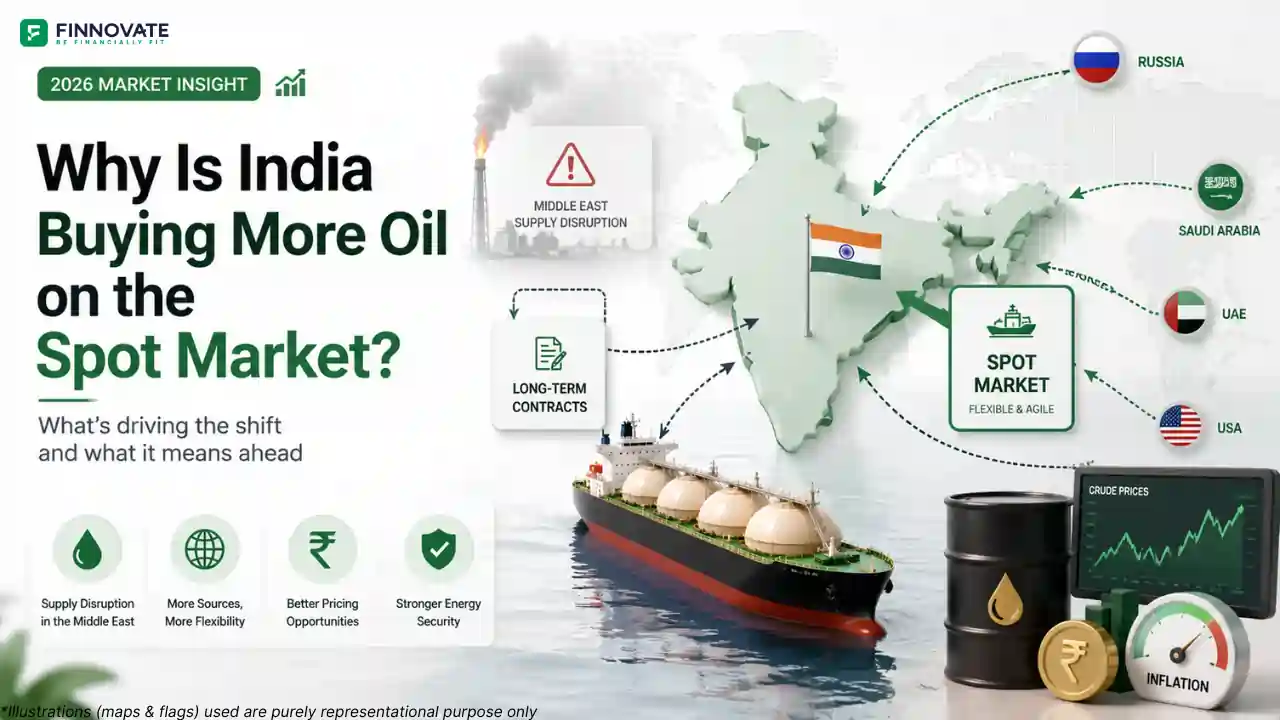
India's crude oil procurement has quietly changed shape since February 2026. When the Iran war disrupted the Strait of Hormuz, the corridor that normally carries about a fifth of the world's oil trade, Indian refiners had to find barrels wherever they could get them, fast. Nearly five months on, with the disruption easing but far from fully resolved, that emergency response is turning into something more permanent: a structural shift away from long-term supply contracts and toward spot market buying.
This isn't a small technical adjustment. State-run refiner Bharat Petroleum has confirmed it has largely moved to spot purchases this fiscal year, even though it had planned to source about 55% of its crude through annual contracts, similar to the year before. Indian Oil and Hindustan Petroleum are reported to be following a similar path.
This article looks at what actually happened over the last four months, why spot buying offers a genuine structural advantage beyond just crisis response, and what a shift like this could mean for a wider set of investors watching Indian markets.
Military strikes around February 28, 2026 triggered a severe disruption to tanker traffic through the Strait of Hormuz. India, which sources close to 90% of its crude from abroad and had historically routed roughly 40-50% of that supply through the strait, was one of the more exposed major importers. Total Indian crude imports fell around 13-14% in March as Gulf barrels stopped moving. (Source: IEA, Petroleum Planning and Analysis Cell)
Indian refiners responded by pulling in far more discounted Russian crude, helped by a temporary US sanctions waiver on Russian oil. Russian imports rose from roughly 1 million barrels a day in January-February to nearly 2 million barrels a day by March, and climbed further to a record 2.6-2.7 million barrels a day by June. Iraq and Saudi Arabia, previously India's largest suppliers, saw their combined share fall sharply over the same period, as the timeline below shows.
| Period | What Changed |
|---|---|
| January 2026 | Russia's share of India's crude imports around 20-22% |
| Late February 2026 | Iran war disrupts Strait of Hormuz tanker traffic |
| March 2026 | Indian crude imports fall around 13-14%; Russian barrels rise sharply |
| May 2026 | US-Iran interim agreement eases the blockage |
| June 2026 | Russia's share reaches roughly 52-54% |
| FY 2026 | Bharat Petroleum shifts heavily toward spot purchases |
Long-term contracts lock in supply, but they also lock in exposure. Spot purchases work differently, and several of the advantages are structural rather than situational.
A spot cargo is priced against the market on the day of the deal, so a buyer isn't tied to a price set months earlier that may no longer reflect actual conditions. Spot buying avoids being locked into older negotiated pricing formulas or term premia that may not reflect current market conditions.
Term contracts carry rollover risk each time they come up for renewal, since renewal terms depend on conditions at that future date. Spot deals are for immediate delivery, so this risk doesn't apply in the same way.
Large global oil traders such as Vitol, Trafigura, Glencore, and Gunvor collectively move an estimated 25 to 30 million barrels of oil each day, holding substantial floating cargoes and quoting buy and sell prices continuously. That combined depth of supply is what keeps spot spreads narrow and delivery windows short.
This shift also predates the current crisis. India's spot-purchase share had already risen from 27.6% in 2017-18 to 35.1% in 2022-23, according to a Parliamentary Standing Committee review of crude oil import policy. The Iran war didn't start this trend, it accelerated one that was already under way.
| Factor | Spot Buying | Long-Term Contracts |
|---|---|---|
| Pricing | Market-linked, immediate | Set through a negotiated formula |
| Flexibility | High | Lower |
| Supply certainty | Lower | Higher |
| Crisis response | Faster | Slower |
| Supplier dependence | Lower | Higher |
| Best suited for | Volatile, liquid markets | Stable supply planning |
The deeper risk in long-term contracts isn't pricing, it's that oil is a national resource, and national decisions about it can change with little warning.
This isn't a new problem. National priorities have shaped oil economics since the 1973 oil embargo, when a coordinated supply decision by producer nations reshaped global energy markets almost overnight. A spot purchase through a trading house can reduce direct dependence on one producer relationship, although the cargo still ultimately depends on physical supply, sanctions, shipping, and insurance conditions.
Scratch beneath India's own procurement decision and there's a bigger shift underneath it. Oil has historically been a seller's market, where producer nations set terms. The shift suggests buyer leverage may be improving, especially for large importers like India, China, and Japan, though this depends on crude availability, freight, sanctions, and geopolitical risk.
Part of this is simple math. Saudi Arabia, Iraq, Iran, Kuwait, and the UAE together hold approximately 835 billion barrels of proven oil reserves, a scale of reserves that isn't going anywhere. (Source: OPEC Annual Statistical Bulletin) But the demand side of that equation is shifting, as electric vehicle adoption and renewable energy investment slowly erode the long-run growth assumptions oil producers have built their economics around. A resource that isn't scarce and faces a demand ceiling gives buyers more room to negotiate than one where supply is genuinely tight.
Spot buying is a quieter, more transactional expression of the same dynamic. It's not a negotiating stance, it's simply buyers exercising the option to not commit long-term to a supplier relationship when the market offers better and more flexible alternatives.
The transmission from crude prices to Indian markets runs through a few well-established channels, and this shift changes how exposed India is to each one, without eliminating any of them.
Indian Oil, Bharat Petroleum, and Hindustan Petroleum control roughly 90% of India's retail fuel market. Their marketing margins compress when crude costs rise faster than retail fuel prices are adjusted, a dynamic that played out through a series of diesel and petrol price hikes in May 2026.
A $10 per barrel rise in crude prices has historically added an estimated $13-14 billion to India's import bill and widened the current account deficit by roughly 0.3% of GDP, per ICRA estimates, with a smaller but measurable pass-through to consumer inflation. (Source: ICRA)
Higher oil import costs increase demand for dollars, which historically has coincided with rupee weakness during periods of acute crude price stress, as seen when the rupee briefly weakened to around Rs 92.40 per dollar in March 2026. (Source: forex market data)
Faster, more flexible procurement doesn't remove India's exposure to global crude price swings, since the country still imports close to 90% of what it consumes. What it may do is shorten the lag between a supply shock happening and Indian refiners adapting to it, which historically has been where some of the sharpest, most disruptive price pressure has built up. Whether that shows up as steadier OMC margins or a calmer rupee over the next few quarters is something worth watching in the data as it comes in, rather than assuming in advance.
| Indicator to Watch | Why It Matters |
|---|---|
| Brent crude price | Affects India's import bill and OMC margins directly |
| Russian crude discount | Affects refiner margins on discounted barrels |
| INR/USD | Captures oil-driven dollar demand pressure |
| OMC gross marketing margins | Shows downstream stress at IOC, BPCL, HPCL |
| Current account deficit | Captures the broader macro impact |
| Retail fuel price revisions | Shows how much cost is being passed through to consumers |
The shift accelerated after the 2026 Iran war disrupted the Strait of Hormuz, but India's spot-purchase share had already been rising for years before this crisis, from 27.6% in 2017-18 to 35.1% in 2022-23.
Russia's share climbed to roughly 52-54% of India's crude imports in June 2026, up from about 20-22% in January.
Spot purchases offer real-time pricing without a forward premium, avoid the rollover risk that comes with renewing term contracts, and provide access to the large floating cargo inventories held by major global trading houses.
Crude price swings historically transmit into Indian markets through oil marketing company margins, consumer inflation, the current account deficit, and the rupee. Please consult a SEBI-registered investment adviser to understand how these dynamics may apply to a specific portfolio.
It has elements of both. Bharat Petroleum's near-term shift is tied to the current disruption, but the longer-run trend toward spot buying predates this crisis and may continue independent of how the current situation resolves.
Disclaimer: This article is for general information and educational purposes only. It does not constitute investment advice, a recommendation, or an offer to buy or sell any securities or financial instruments. Crude oil trade data, procurement figures, and macroeconomic estimates referenced in this article are based on publicly available information as of the date of writing, subject to revision. Past market behaviour and geopolitical developments are not indicative of future outcomes. Please consult a SEBI-registered investment adviser or qualified financial professional before making any investment decision.
No spam. Only new posts, simple explainers, and practical money checklists for busy professionals.
Finnovate is a SEBI-registered financial planning firm that helps professionals bring structure and purpose to their money. Over 3,500+ families have trusted our disciplined process to plan their goals - safely, surely, and swiftly.
Our team constantly tracks market trends, policy changes, and investment opportunities like the ones featured in this Weekly Capsule - to help you make informed, confident financial decisions.
Learn more about our approach and how we work with you:
No comments yet. Start the conversation. What would you add?
No spam. Only new posts, simple explainers, and practical money checklists.
You may also like
AI demand is pushing up memory chip prices. Here's why the shortage could make smartphones...

FPIs sold ₹35,861 crore in Indian equities in September 2026. See which sectors saw outf...
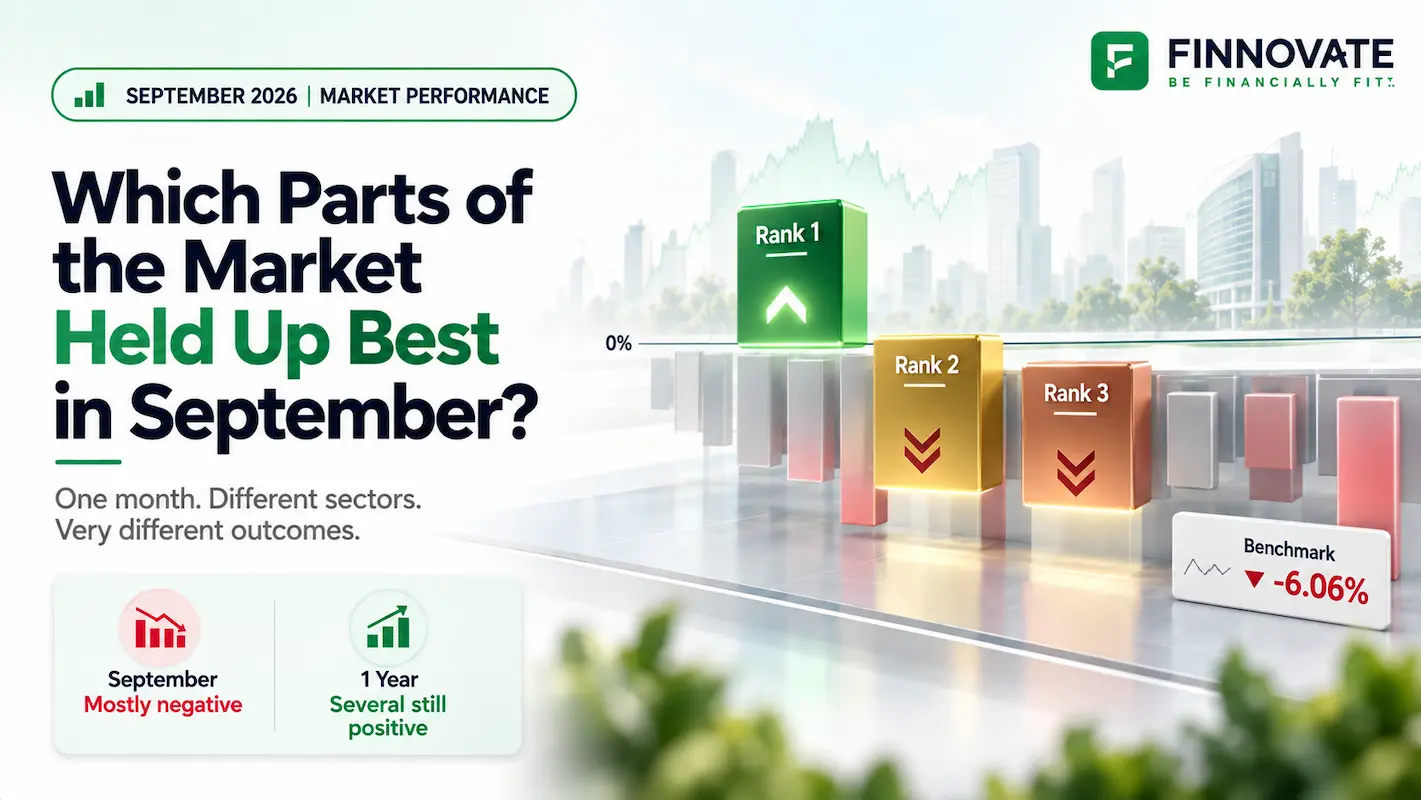
Compare 19 sector and thematic indices with Nifty 50 for September 2026, covering monthly ...

Understand the Growpital case, SEBI’s refund order, the LLP investment structure and wha...
Popular now

Learn how to easily download your NSDL CAS Statement in PDF format with our step-by-step g...

Looking for the best financial freedom books? Here’s a handpicked 2026 reading list with...
Learn what SIF investment means in India, SEBI rules, Rs 10 lakh minimum investment, avail...
Clear guide to mutual fund taxation in India for FY 2025–26 after July 2024 changes: equ...