

HDFC Bank: What Must Change to Win Back Investors?
Can HDFC Bank win back investors? Explore how deposit costs, profit margins, loan quality ...
12 October 2026
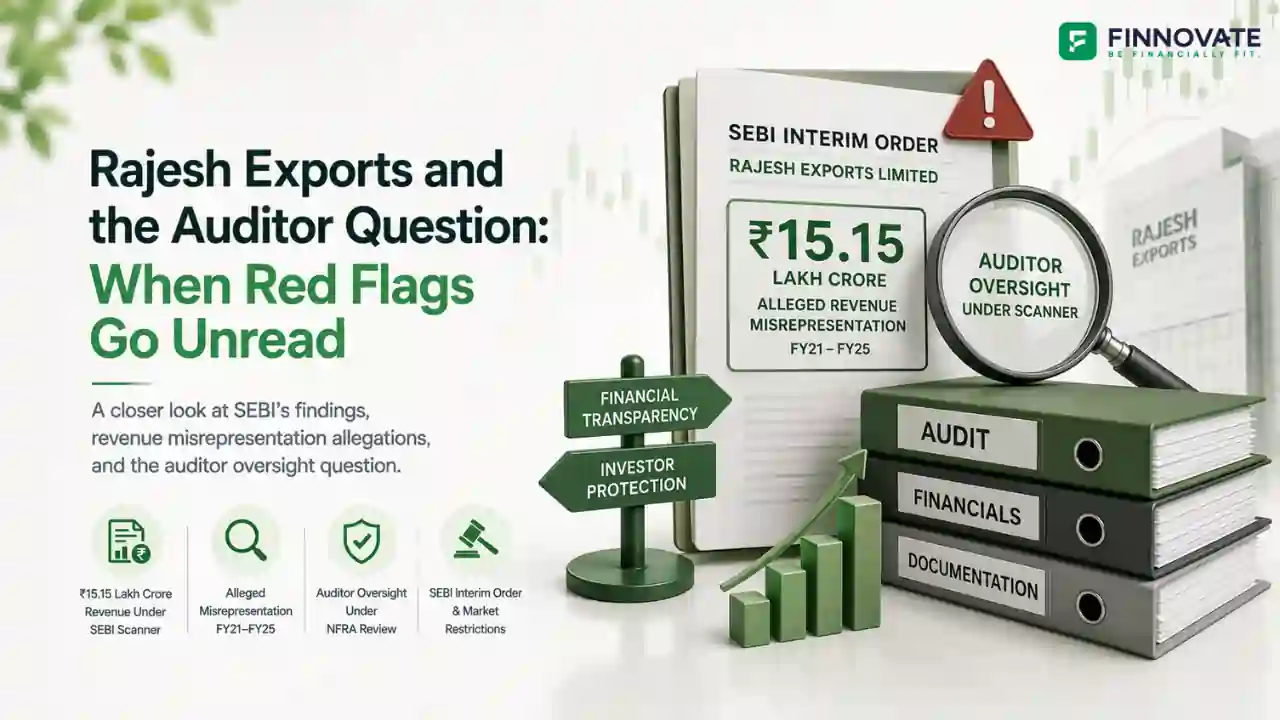
On June 3, 2026, SEBI issued a 109-page ex parte interim order against Rajesh Exports Limited and its executive chairman Rajesh Mehta, alleging that approximately ₹15.15 lakh crore in consolidated revenue over five financial years from FY21 to FY25 was prima facie misrepresented. The investigation began with a single shareholder complaint in 2024 about trade receivables outstanding for more than two years. What it uncovered, according to SEBI's interim order, was a structure in which nearly all of the company's reported revenues were attributed to overseas subsidiaries that could not provide documentation to support the numbers.
Rajesh Mehta has publicly stated the allegations are untrue. The SEBI order is interim and not a final adjudication. What is not disputed is the pattern it describes. And that pattern raises a question that goes beyond Rajesh Exports: where were the auditors?
Key context: SEBI's interim order alleges ₹15.15 lakh crore of revenue misrepresentation across FY21 to FY25, representing approximately 99.80% of the company's consolidated subsidiary revenues during that period. The order has barred Rajesh Mehta from buying or selling securities until further notice and referred the matter to the National Financial Reporting Authority (NFRA) for examination of the company's statutory auditors. All allegations are prima facie findings at the interim stage.
Rajesh Exports is not the first instance of auditors failing to flag problems that, in hindsight, were visible in the numbers. Three prior cases in the Indian context share a common thread: the problems were not sudden. They had been present in the financials for years before a market event or external complaint forced them into the open.
| Case | Nature of Fraud | How It Was Hidden | What Auditors Missed |
|---|---|---|---|
| Satyam (2009) | Fictitious cash balances; inflated profits | Forged bank statements; fake fixed deposit certificates | Independent bank confirmation not obtained; cash balances not reconciled with actual bank records |
| IL&FS (2018) | Hidden debt and liquidity crisis across 347 group entities | Maze of domestic subsidiaries masking actual debt levels | Consolidated debt picture not assessed; related-party exposures not adequately scrutinised |
| DHFL (2019) | Loan diversion through shell companies; fictitious borrowers | Loans booked against ghost borrowers in small towns | Sample-based auditing missed systematic loan book fabrication across branches |
| Rajesh Exports (2026) | Alleged revenue misrepresentation through overseas subsidiaries | Revenue booked at holding company (GGR) level without audit; Valcambi (audited) showed negligible revenue | Standalone vs consolidated gap not interrogated; subsidiary-level documentation not obtained |
In the Satyam and IL&FS cases, the fraud was structured through domestic entities. Verification of bank balances, inventory checks, and inter-company reconciliations (standard audit procedures) would have identified the discrepancies. The Rajesh Exports structure is more complex because the alleged misrepresentation was routed through foreign subsidiaries, which creates additional layers of difficulty for the statutory auditor of the Indian listed parent.
The structure as alleged by SEBI placed the Indian listed parent at the top and the actual operating entity (Valcambi) at the bottom, separated by two intermediate holding companies. The revenue that made Rajesh Exports appear to be a ₹7.78 lakh crore company in FY26 sat primarily at the GGR level, a holding company that was not independently audited. Valcambi, which was audited by KPMG, reported revenue of just ₹427 crore to ₹743 crore annually during the corresponding years, against consolidated revenues running into several lakh crore attributed to the group.
The case for auditor negligence rests not only on what was hidden but on what was openly visible in the financial statements. Any auditor examining the numbers with basic diligence would have encountered three metrics that are difficult to reconcile with a legitimate business of this scale.
Net profit margin on alleged FY26 consolidated revenue of ₹7,78,989 crore against net profit of ₹112 crore
Return on Equity, consistently over multiple years on a business claiming to be among India's largest by revenue
Standalone revenue as share of consolidated: the Indian parent's own business was just 1.2% of the group's claimed total
| Metric | FY26 Standalone | FY26 Consolidated | Standalone as % of Consolidated |
|---|---|---|---|
| Revenue | ₹9,291 crore | ₹7,78,989 crore | 1.2% |
| Source of gap | Indian operations only | Dominated by overseas subsidiaries | 98.8% from subsidiaries |
For the six financial years from FY21 to FY26, the standalone revenue of Rajesh Exports ranged between 0.8% and 2.6% of its consolidated revenue. This means the Indian listed entity's own documented business was effectively marginal. All of the scale that made Rajesh Exports appear to be one of India's largest companies by revenue resided in subsidiaries that were not providing adequate documentation to support the numbers.
SEBI's interim order has been referred to the National Financial Reporting Authority for examination of the company's statutory auditors. This referral is significant. It signals that the regulator does not view this as solely a promoter governance failure; it views the audit function as having failed in its primary responsibility to equity shareholders.
The specific audit failure alleged is not one of complexity. It is one of basic procedure. When between 97% and 99% of a listed company's consolidated revenue comes from overseas subsidiaries, the statutory auditor of the Indian parent is required to obtain sufficient appropriate audit evidence about those subsidiaries. This means requesting and reviewing subsidiary-level financial statements, verifying transactions against source documentation, and reconciling what subsidiaries report with what the consolidated accounts reflect. What SEBI's order alleges is that this evidence did not exist in verifiable form and was not obtained.
Under SA 600 (Using the Work of Another Auditor) and SA 500 (Audit Evidence), when a significant portion of a group's operations are conducted through subsidiaries audited by component auditors, the group auditor must obtain sufficient comfort on the reliability of those component audits. When subsidiaries are not audited (as in the case of GGR), or when the audited entity's (Valcambi's) numbers are a fraction of what the group claims, the group auditor cannot simply accept the consolidated figures. The gap between Valcambi's audited revenue and the group's reported consolidated revenue should have prompted immediate, direct inquiry.
The fact that a shareholder complaint, not an audit, surfaced these issues is the most damaging aspect of this story for the profession. The numbers that SEBI's forensic investigation found inconsistent were the same numbers that appeared in audited annual reports, signed off by the company's statutory auditors, year after year.
SEBI's interim order against Rajesh Exports is not a final verdict. Rajesh Mehta has denied the allegations and the adjudication process will continue. What the order does establish, at the prima facie stage, is that revenue figures of extraordinary scale, running into lakh crore, were being reported on the basis of subsidiaries that could not document those transactions when directly asked. If that finding survives full adjudication, the question of how it went undetected through multiple audit cycles will need a more direct answer than the profession has so far provided. NFRA now has that question formally before it. The answer will matter not just for this case but for the reliability of audited financial statements as a tool for equity investors in India.
Cases like Rajesh Exports illustrate why portfolio construction and stock selection require more than reading reported revenue figures. The FinnFit Financial Fitness Test takes 3 minutes and shows you whether your portfolio is appropriately diversified across sectors, market caps, and risk categories.
Take the FinnFit TestSEBI's June 2026 interim order alleges that approximately ₹15.15 lakh crore of consolidated revenue reported by Rajesh Exports over FY21 to FY25 was prima facie misrepresented. The regulator alleges the revenue was attributed to overseas subsidiaries that could not provide adequate documentation to support the figures. SEBI has barred Rajesh Mehta from dealing in securities until further notice. These are interim, prima facie findings. Rajesh Mehta has denied the allegations.
Valcambi SA is the actual operating gold refinery in Switzerland, audited by KPMG, and its annual revenues were ₹427 crore to ₹743 crore during the relevant period. GGR (Global Gold Refineries AG) is the holding company one level above Valcambi, also in Switzerland, and was not independently audited. According to SEBI, the vast majority of the group's consolidated revenues were reported at the GGR level, creating a massive discrepancy with Valcambi's audited standalone figures.
When 97% to 99% of a listed company's consolidated revenue comes from overseas subsidiaries, the statutory auditor is required to obtain adequate audit evidence about those subsidiaries. The case was not surfaced by an audit but by a shareholder complaint. SEBI's referral to NFRA signals that the regulator believes the audit function failed its core responsibility. If the revenue discrepancies were visible in the structure of the financial statements, basic audit procedures should have identified them.
In the Satyam case, fraud was hidden through forged bank statements; basic bank confirmation procedures would have detected it. In IL&FS, hidden debt was spread across 347 domestic group entities; consolidated group audit procedures should have identified the aggregate exposure. In Rajesh Exports, the alleged misrepresentation was routed through foreign subsidiaries, adding a layer of complexity. However, the gap between the audited subsidiary (Valcambi) and the group's claimed revenues was so large that it should have prompted direct investigation regardless of the cross-border structure.
SEBI's interim order is not final. Rajesh Exports and Rajesh Mehta have the right to respond and the adjudication process will continue. The NFRA will separately examine the role of the statutory auditors. SEBI's shareholder wealth erosion estimate linked to the alleged misconduct stands at approximately ₹12,726 crore. The final outcome depends on the adjudication process and the evidence presented by both sides.
Disclaimer: This article is for general information and educational purposes only. It does not constitute investment advice, a recommendation, or an offer to buy or sell any securities or financial instruments. The Rajesh Exports case referenced in this article is the subject of an ongoing SEBI investigation and the interim order of June 3, 2026 represents prima facie findings that are subject to final adjudication. All characterisations of alleged misconduct are based on SEBI's publicly available interim order and published news reporting. Rajesh Mehta has publicly denied the allegations. Readers should refer to official SEBI documents and consult a qualified financial or legal professional before drawing conclusions or making investment decisions based on this article. Past cases referenced (Satyam, IL&FS, DHFL) are based on established public record and judicial or regulatory findings in those matters.
No spam. Only new posts, simple explainers, and practical money checklists for busy professionals.
Finnovate is a SEBI-registered financial planning firm that helps professionals bring structure and purpose to their money. Over 3,500+ families have trusted our disciplined process to plan their goals - safely, surely, and swiftly.
Our team constantly tracks market trends, policy changes, and investment opportunities like the ones featured in this Weekly Capsule - to help you make informed, confident financial decisions.
Learn more about our approach and how we work with you:
No comments yet. Start the conversation. What would you add?
No spam. Only new posts, simple explainers, and practical money checklists.
You may also like
Can HDFC Bank win back investors? Explore how deposit costs, profit margins, loan quality ...

Only five Nifty 50 stocks rose in September 2026 as the index fell 6.06%. Compare monthly ...

Why did hospital stocks fall after Supreme Court scrutiny of medicine prices? Understand d...

Nifty Smallcap 100 rose 3.16% in August 2026. See which small-cap stocks led, what drove t...
Popular now

Learn how to easily download your NSDL CAS Statement in PDF format with our step-by-step g...

Looking for the best financial freedom books? Here’s a handpicked 2026 reading list with...
Learn what SIF investment means in India, SEBI rules, Rs 10 lakh minimum investment, avail...

Clear guide to mutual fund taxation in India for FY 2025–26 after July 2024 changes: equ...