

HDFC Bank: What Must Change to Win Back Investors?
Can HDFC Bank win back investors? Explore how deposit costs, profit margins, loan quality ...
12 October 2026

For NRIs investing in India, two problems repeat. First: every rupee deployed through an NRE or NRO account converts twice (in and out), with rupee depreciation over long periods quietly reducing foreign-currency-equivalent returns. Second: getting money out of an NRO account means Form 15CA/15CB filings, a CA certificate, and a $1 million annual ceiling. GIFT City addresses both: dollar denomination end-to-end, no repatriation ceiling on IBU accounts, and reduced NRO-style compliance friction. KYC, AML checks, FATCA/CRS declarations, and home-country tax obligations still apply to all investors.
Banking assets
(Dec 2025)
Registered entities
(Dec 2025)
Global financial centre rank
(GFCI 38, Oct 2025)
NRI diaspora invested
in GIFT City funds
Sources: IFSCA official dashboard, as on Dec 2025; GFCI 38, Z/Yen, October 2025; Union Budget 2026; IFSCA chairman K. Rajaraman, Institute of Internal Auditors event, March 4, 2025 (reported by Business Standard / PTI).
The account structure, LRS remittance process, and tax treatment are entirely different for resident Indians. That process is covered separately: GIFT City Investing for Resident Indians: LRS, Products and Tax Guide (2026).
GIFT City's IFSC is legally treated as a foreign jurisdiction under FEMA, even though it sits in Gandhinagar, Gujarat. That one legal fact drives three structural advantages for NRIs.
NRE/NRO route: convert to INR on entry, convert back on exit.
GIFT City: stays in USD, GBP, EUR, or AED throughout.
No round-trip conversion cost, no rupee depreciation drag.
NRO repatriation: $1M/year cap, Form 15CA/15CB, CA certificate, weeks of processing.
GIFT City IBU accounts: no ceiling, no paperwork.
Funds move like any international wire because they are legally already offshore under FEMA.
Most Indian AMCs block US and Canada NRIs due to FATCA compliance burden.
Many IFSC funds now accept NRI and OCI investors, subject to the fund's eligibility criteria, country restrictions, FATF/AML checks, and onboarding policy.
The 2024 regulatory change removed the NRI/OCI contribution cap for IFSC funds investing in Indian securities, but fund-level eligibility and AMC policies still apply.
Confirm with the specific fund or broker before proceeding.
NRIs and OCIs are the primary eligible categories for all GIFT City products. Persons of Indian Origin (PIOs) are eligible for most products. Foreign nationals may participate in certain fund structures depending on the specific fund's mandate.
One important distinction from the resident Indian route: NRIs do not use LRS. Resident Indians are capped at $250,000 per year under the Liberalised Remittance Scheme. NRIs wire directly from their overseas bank account. The LRS limit does not apply.
Before picking a product, one distinction matters more than anything else.
| Product | Minimum | Direction | Key facts |
|---|---|---|---|
| Foreign Currency FD | ~$1,000 | Banking | Interest generally exempt in India for eligible non-residents; no DICGC cover; tenor and rates vary by bank |
| Retail Mutual Fund | $500 (Tata) / $5,000 (DSP) | Inbound / Outbound | Fund structure and tax treatment vary; check KIM and official tax note before investing |
| PMS | $75,000 | Both | Investor owns securities directly; may be structurally cleaner for US NRIs than pooled funds, subject to US CPA review |
| AIF | Varies by scheme | Both | Pooled vehicle; lock-in, minimum, tax treatment, and eligibility depend on the scheme and PPM |
| Direct equity (UDR) | No fixed fund-style minimum | Outbound | US stocks via NSE International Exchange; transaction taxes and platform charges should be checked with broker |
PMS minimum $75,000 per IFSCA Fund Management Regulations 2025. AIF minimums vary by scheme type, investor category, and placement memorandum. Product availability, tax treatment, and eligibility should be confirmed from the AMC, broker, or fund documents before investing.
GIFT City IBUs at SBI, HDFC, ICICI, and Axis Bank offer USD fixed deposits with tenors from 7 days to 39 months. Rates have ranged between 4.5 and 5.5 percent p.a. depending on tenor and bank. Verify directly before investing, as rates move. Interest is exempt from Indian income tax with no TDS, making FDs a clean starting point for NRIs testing the system before committing to funds.
Two things to note before opening: IBU deposits are not covered by DICGC insurance (covered in the risks section), and existing NRE or NRO accounts cannot be used. A separate IBU account with the bank's GIFT City branch is required.
Both the Tata and DSP funds are structured as IFSCA-registered determinate irrevocable trusts. Under this structure, the trustee pays tax at the fund level. Capital gains on redemption may not be taxed again at the investor level, as the obligation has already been discharged by the fund.
The Tata India Dynamic Equity Fund is structured to be eligible under Section 10(4D), which exempts capital gains on specified IFSC securities for non-residents. PAN may not be mandatory for eligible transactions. Verify the exact tax treatment in the fund's Key Information Memorandum before investing.
AIF (Alternative Investment Fund)
PMS (Portfolio Management Services)
PMS carries a minimum of $75,000 per the IFSCA (Fund Management) Regulations 2025. The structure is fundamentally different from an AIF. In a PMS account, the NRI owns individual securities directly in their own name, managed by a registered portfolio manager under a Power of Attorney. Because it is not a pooled vehicle, it does not trigger PFIC classification at the account level. This makes PMS the structurally correct entry point for US-based NRIs, explained fully in the tax section below.
| Country / Region | India tax on eligible IFSC income | Home country tax | Net outcome | Critical point |
|---|---|---|---|---|
| UAE, Qatar, Bahrain, Kuwait, Oman | Generally exempt under Sections 10(4D)/10(4E) | Zero | Genuinely tax-free | Get Tax Residency Certificate upfront |
| Singapore, Netherlands | Generally exempt under Sections 10(4D)/10(4E) | Zero to minimal via DTAA | Near tax-free | Verify current DTAA terms |
| UK | Generally exempt under Sections 10(4D)/10(4E) | Full UK marginal rate | You pay UK rate | No FTC available; non-dom rules changed April 2025 |
| Canada | Generally exempt under Sections 10(4D)/10(4E) | Full Canadian rate | You pay Canadian rate | Worldwide income basis; FTC limited |
| US | Generally exempt under Sections 10(4D)/10(4E) | PFIC rules on pooled funds | Varies by structure | Use PMS not AIF/MF; mandatory US CPA consult |
Income Tax Act Sections 10(4D) and 10(4E); India-UAE DTAA; GOV.UK April 2025; IRS PFIC rules. Exemptions apply to eligible income streams and specified fund structures; not every GIFT City income type is automatically exempt for every non-resident. Verify all positions with a qualified adviser in your jurisdiction.
The best-case scenario. India levies zero tax on eligible GIFT City IFSC income for non-residents under Sections 10(4D) and 10(4E). The UAE has no personal income tax. Derivative income through GIFT City banking units is 100 percent exempt under Section 10(4E), a provision expanded by Finance Bill 2025 to include FPI transactions. Eligible IFSC transactions are exempt from STT, CTT, and stamp duty. The India-UAE DTAA provides additional treaty backup where relevant. The net result for qualifying structures: no Indian tax, no UAE tax, no transaction taxes on eligible trades.
One action before investing: get your Tax Residency Certificate from the UAE Ministry of Finance. If treaty benefits are ever questioned, you need it. Getting it retrospectively is slower. Get it upfront.
India side: zero tax, same as all non-residents. The issue is the UK side.
GIFT City pays zero TDS and zero withholding tax. That means no Indian tax is actually paid. Foreign Tax Credit Relief requires actual foreign tax to have been paid. With zero Indian tax, there is nothing to credit against UK liability. You cannot offset UK tax using GIFT City's Indian exemption.
From 6 April 2025, the UK's non-dom rules changed. All foreign income is now reportable on Self Assessment regardless of amount. The previous £2,000 annual exemption no longer exists (GOV.UK). A UK higher-rate taxpayer at 40 percent pays that rate on GIFT City gains with no offset available.
Verify your position with a UK-qualified tax adviser, especially in light of the April 2025 rule change.
The most complex picture of any NRI group. Two separate issues:
Issue 1: PFIC classification
Issue 2: FBAR reporting
The fix: use PMS, not pooled funds
PMS holds individual securities in the investor's own name. It is not a pooled vehicle and does not trigger PFIC at the account level. For US NRIs who meet the PMS minimum, PMS is generally the structurally correct entry point into GIFT City. Some AIFs structured as limited partnerships may avoid PFIC, but this requires specific US CPA verification before investing.
Canada: Indian tax is zero. Canada taxes residents on worldwide income, so GIFT City gains are reportable. FTC is available but limited since India charges zero. Dollar denomination and direct product access may still offer advantages over domestic Indian routes. Verify with a Canadian tax adviser.
Singapore: India-Singapore DTAA has historically offered favourable treatment on certain investment income. Singapore's territorial tax system exempts some foreign-sourced income. Current treaty terms should be verified, as treaties evolve.
Regardless of where you live, these apply:
Your GIFT City tax outcome depends on where you live, what product you hold, and how your DTAA applies. These interact differently for every NRI. Finnovate is a SEBI-registered fee-only adviser. We work through the full picture: Indian and home-country tax, without selling any products.
Book a free callMost NRIs start by comparing GIFT City against what they already hold. Here is the direct comparison.
| Feature | NRE Account | NRO Account | GIFT City IBU |
|---|---|---|---|
| Currency | INR | INR | USD, GBP, EUR, AED |
| Indian tax on interest | Exempt | 30% TDS | Exempt |
| Repatriation limit | Unlimited | $1M per year | No ceiling |
| Form 15CA/15CB | No | Yes | No |
| DICGC insurance | Yes, up to ₹5 lakh | Yes, up to ₹5 lakh | No |
| Who can hold | NRI/OCI only | NRI/OCI + residents | NRI/OCI only |
| Best for | Foreign earnings in India in INR | India-sourced income | USD investments and banking |
RBI guidelines; IFSCA regulations; FEMA provisions. Verify current terms with your bank.
All three can coexist, as they serve different purposes. NRO accounts are unavoidable for India-sourced income like rent, dividends, or pension; the $1M cap and Form 15CA/15CB apply only to NRO outflows. NRE accounts work when you want to park foreign earnings in India in INR with full repatriation flexibility and tax-free interest. GIFT City IBU accounts become relevant when dollar denomination is the priority, the NRO repatriation ceiling is a constraint, or you want access to IFSC investment products from the same banking relationship.
The process changed materially in July 2025 when IFSCA introduced video KYC. Most NRIs in major diaspora countries can now open accounts entirely remotely.
DTAA benefits can only be asserted with a current TRC as supporting documentation. Getting it retrospectively is possible but slow. Requesting it from your tax authority upfront, before opening the account, takes a few days and removes a compliance risk over the entire life of the investment.
NRIs in countries not on the V-CIP approved list need to submit physical documents: either Indian consulate attestation or local notarisation, which typically takes one to two weeks. Some institutions require physical verification for higher investment tiers regardless of country, so confirm before starting. Scheduling video KYC sessions during Indian business hours (10am to 4pm IST) generally speeds up processing.
IFSCA was established in 2020 and is a relatively young regulator. Rules have changed mid-cycle without extended notice: in 2024, IFSCA prohibited investments in certain US-based ETFs, disrupting strategies that some NRIs had already built around those products. The AIF minimum changed twice. Concentration limits of 33.33 percent per investee were introduced without a long runway. Building flexibility into your GIFT City strategy, rather than concentrating in a single product, reflects this reality.
Most GIFT City mutual funds launched between 2022 and 2025, giving a maximum of two to three years of performance data with no cross-market cycle. Track records this short are insufficient to evaluate how a fund behaves in a downturn, which is relevant when comparing a GIFT City fund against longer-established alternatives.
GIFT City manages the Indian side. Your country of residence manages the other side. For UAE NRIs, both sides are zero and the full benefit is captured. For UK, US, and Canada NRIs, home-country tax exposure is real and needs country-specific planning separate from the GIFT City account opening process. For US NRIs specifically, the PMS versus AIF structural decision carries tax consequences that are difficult to unwind after the fact. Getting the structure right at the outset matters.
GIFT City has matured into a primary route for NRIs investing in and from India: dollar denomination, no repatriation ceiling, retail entry at $500, and access for US and Canada NRIs excluded from domestic Indian funds. The account opens in 3 to 5 days remotely for most diaspora countries. The tax advantage is real but uneven: UAE NRIs capture it fully, while UK, US, and Canadian NRIs need home-country planning on top. The structure chosen at the outset is what makes or breaks the outcome.
The right product structure, Indian tax provisions, home-country tax treatment, and how GIFT City fits a broader financial plan interact differently for every NRI. Finnovate is a SEBI-registered fee-only adviser. We do not sell products. We work through the full picture.
Book a ConsultationIt depends on where you are tax-resident. India levies zero tax on most GIFT City IFSC income for non-residents under Sections 10(4D) and 10(4E). UAE NRIs pay zero on both sides: genuinely tax-free. UK NRIs owe full UK marginal tax on GIFT City gains since no Indian withholding tax exists to credit. US NRIs face PFIC complications on pooled fund structures regardless of India's zero-tax treatment.
Yes. The 2024 regulatory change removed the NRI/OCI contribution cap for IFSC funds investing in Indian securities, and many IFSC funds now accept NRI investors subject to the fund's eligibility criteria, country restrictions, and onboarding policy. However, pooled funds (mutual funds and AIFs) are likely classified as PFICs under US tax law, requiring annual Form 8621 filings and potentially triggering taxation on notional gains. PMS structures, where the NRI holds individual securities directly, are generally more tax-efficient for US-based NRIs. Consult a US CPA specialising in cross-border taxation before investing.
Foreign currency FDs start at approximately $1,000. The Tata India Dynamic Equity Fund (launched September 2025) has a $500 minimum. DSP Global Equity Fund has a $5,000 minimum. PMS minimum is $75,000 per the IFSCA (Fund Management) Regulations 2025. AIF minimums vary by scheme type and are stated in the fund's Private Placement Memorandum: confirm directly with the fund manager before investing. All minimums are subject to change.
GIFT City IBU accounts carry no annual repatriation ceiling, unlike NRO accounts which cap outward remittances at $1 million per year and require Form 15CA/15CB. Since GIFT City operates as a foreign jurisdiction under FEMA, funds repatriate through standard international wire without additional RBI documentation. Please consult a SEBI-registered investment adviser to confirm the repatriation process for your specific product and account structure.
PAN is required for certain products and investment thresholds. For retail mutual funds under Section 10(4D), such as the Tata India Dynamic Equity Fund, PAN may not be mandatory for eligible amounts. Requirements vary by product and broker. Confirm directly with the AMC or broker before applying.
GIFT City IBU accounts are for non-residents only under FEMA. On returning to India and becoming a resident, the account must be converted or closed and the bank notified promptly. Tax treatment of existing investments may also change depending on timing and product structure. A CA review before returning is advisable to understand implications for open positions.
Disclaimer: This article is for general information and educational purposes only. It does not constitute investment advice, a recommendation, or an offer to buy or sell any securities or financial instruments. Tax rules, IFSCA regulations, DTAA provisions, and product eligibility are subject to change and reflect publicly available information current as of mid-2026. Data on registered entities and banking assets sourced from IFSCA official dashboard as on Dec 2025; GFCI ranking from Z/Yen Global Financial Centres Index 38, October 2025; NRI fund investment figure from IFSCA chairman K. Rajaraman, Institute of Internal Auditors event, March 4, 2025, as reported by Business Standard/PTI. Tax treatment under DTAA varies by country of residence and individual circumstances. Please consult a SEBI-registered investment adviser, a qualified chartered accountant, and a tax adviser in your country of residence before making any investment decision. Investments are subject to market risks.
No spam. Only new posts, simple explainers, and practical money checklists for busy professionals.
Finnovate is a SEBI-registered financial planning firm that helps professionals bring structure and purpose to their money. Over 3,500+ families have trusted our disciplined process to plan their goals - safely, surely, and swiftly.
Our team constantly tracks market trends, policy changes, and investment opportunities like the ones featured in this Weekly Capsule - to help you make informed, confident financial decisions.
Learn more about our approach and how we work with you:
No comments yet. Start the conversation. What would you add?
No spam. Only new posts, simple explainers, and practical money checklists.
You may also like
Can HDFC Bank win back investors? Explore how deposit costs, profit margins, loan quality ...
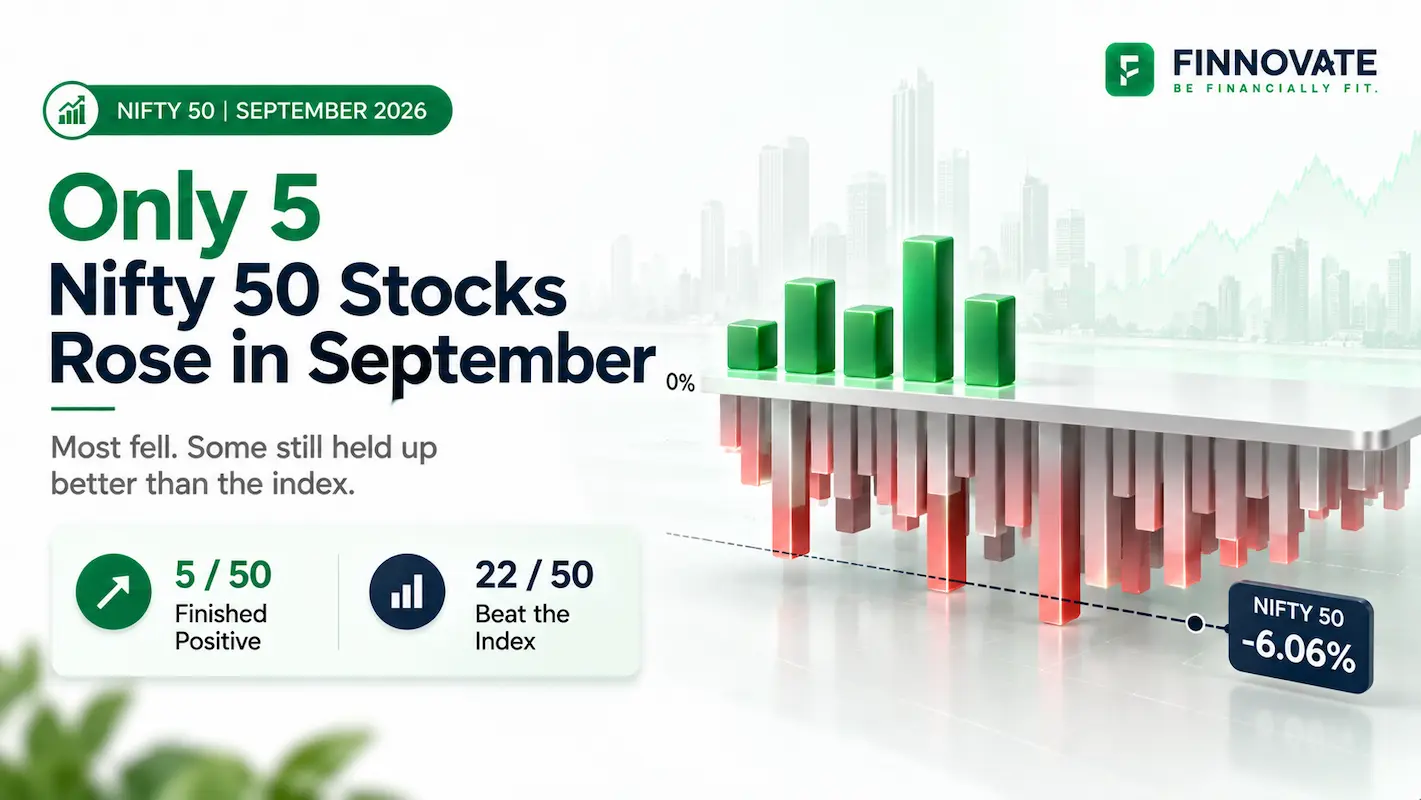
Only five Nifty 50 stocks rose in September 2026 as the index fell 6.06%. Compare monthly ...

Why did hospital stocks fall after Supreme Court scrutiny of medicine prices? Understand d...

Nifty Smallcap 100 rose 3.16% in August 2026. See which small-cap stocks led, what drove t...
Popular now
Learn how to easily download your NSDL CAS Statement in PDF format with our step-by-step g...

Looking for the best financial freedom books? Here’s a handpicked 2026 reading list with...
Learn what SIF investment means in India, SEBI rules, Rs 10 lakh minimum investment, avail...

Clear guide to mutual fund taxation in India for FY 2025–26 after July 2024 changes: equ...