

Tax Planning and Benefits for Married Couples in India: 2026 Guide
Tax planning for married couples in India explained for 2026. Compare tax regimes, deducti...
05 September 2026

Finnovate’s editorial team researches and creates financial content using trusted sources, regulatory references and inputs from subject experts.

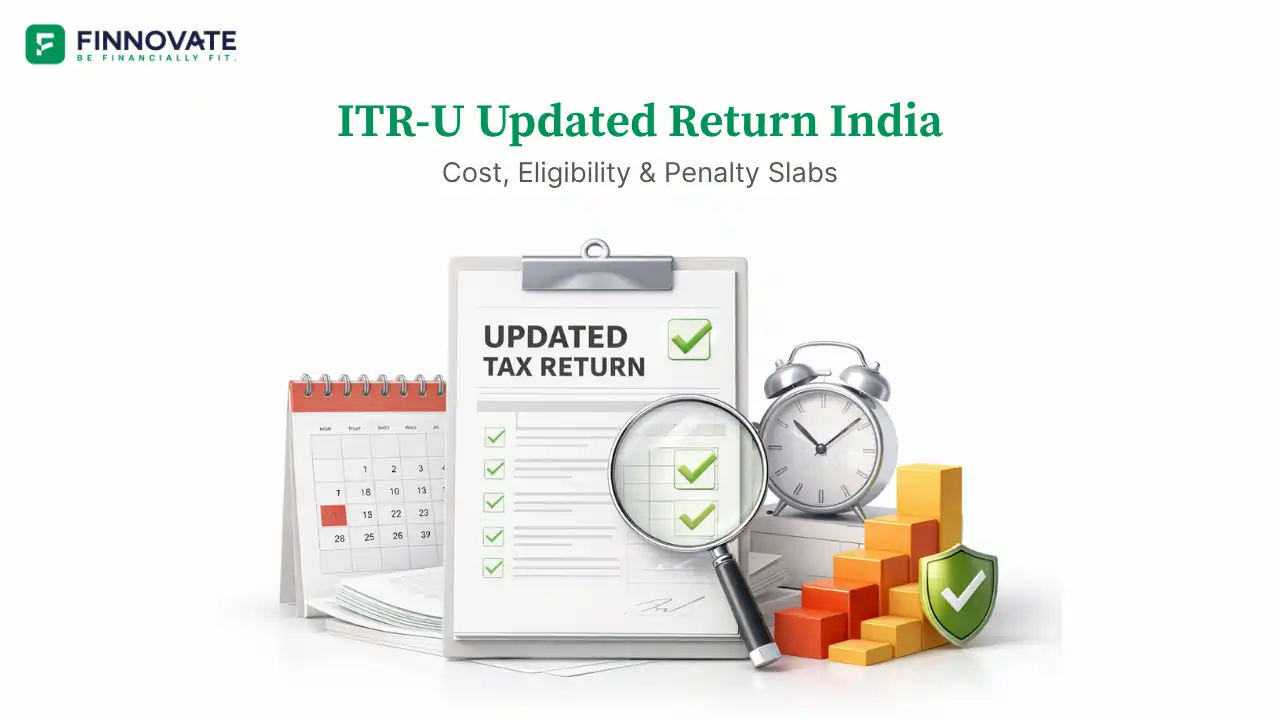
Missing a return deadline or forgetting to report an income is more common than most people admit. The government has always known this. That is why, in 2022, it introduced ITR-U, a structured voluntary mechanism to correct past returns and come clean without waiting for a notice.
But ITR-U is not a soft exit. It comes with a graded penalty that starts at 25% and scales to 70% of the additional tax owed, depending on how long you wait. And it only works in one direction: it can only increase your tax liability, never reduce it. Used correctly, it is a valuable compliance tool. Used carelessly or at the wrong time, it can cost significantly more than the original error.
This guide explains exactly what ITR-U is, who can use it, what it costs, what it cannot do, and the situations where filing it makes genuine sense.
Quick Answer: ITR-U (Updated Return) under Section 139(8A): key facts (Finance Act 2025)
| When ITR-U is filed | Additional tax rate | Calculated on |
|---|---|---|
| Within 12 months from end of relevant Assessment Year | 25% | Additional tax + interest payable |
| After 12 months, within 24 months | 50% | Additional tax + interest payable |
| After 24 months, within 36 months | 60% | Additional tax + interest payable |
| After 36 months, within 48 months | 70% | Additional tax + interest payable |
Filing window: 48 months from the end of the relevant Assessment Year (extended from 24 months by Finance Act 2025, effective 1 April 2025).
Three rules that never change: (1) ITR-U can only increase tax liability, never reduce it. (2) It can be filed only once per Assessment Year. There is no second chance. (3) It cannot result in a refund or increase an existing refund.
Governing section: 139(8A) of the Income Tax Act, 1961. Additional tax governed by Section 140B. Extended window introduced by Finance Act 2025.
ITR-U, or Updated Income Tax Return, is a form introduced under Section 139(8A) of the Income Tax Act. It lets you go back and correct a previously filed return or file a return you missed entirely, up to four years after the end of the relevant Assessment Year.
The government introduced it to reduce litigation and encourage voluntary compliance. Instead of waiting for the Income Tax Department to issue a notice for underreported income, a taxpayer can proactively disclose it, pay the additional tax plus a premium, and regularise the record. That premium is what the additional tax under Section 140B represents. It is not a penalty in the traditional legal sense, but a cost for using the self-correction window.
ITR-U can be filed for any of the following reasons, provided it results in additional tax payable:
Any taxpayer (individual, HUF, firm, LLP, company, AOP, or BOI) is eligible to file ITR-U, as long as the filing results in additional tax payable and none of the blocking conditions apply.
The time limit for filing ITR-U is 48 months from the end of the relevant Assessment Year, effective April 1, 2025. The table below shows the last date to file ITR-U for each Assessment Year:
| Financial Year | Assessment Year | Last Date to File ITR-U | Status |
|---|---|---|---|
| FY 2020–21 | AY 2021–22 | March 31, 2026 | Window closed |
| FY 2021–22 | AY 2022–23 | March 31, 2027 | Open |
| FY 2022–23 | AY 2023–24 | March 31, 2028 | Open |
| FY 2023–24 | AY 2024–25 | March 31, 2029 | Open |
| FY 2024–25 | AY 2025–26 | March 31, 2030 | Open |
| FY 2025–26 | AY 2026–27 | March 31, 2031 | Open (ITR filing window for this AY starts in 2026) |
ITR-U operates strictly in one direction. There are clear legal bars on when it cannot be used. Understanding these is as important as knowing when it can be used.
| Situation | Why ITR-U Is Blocked |
|---|---|
| The updated return reduces your tax liability | ITR-U is a one-way mechanism. It cannot be used to lower what you owe. |
| The updated return results in a refund or increases an existing refund | Refund claims are not permitted under this provision. |
| The updated return creates a fresh loss or increases a reported loss | Loss returns are not permitted. Reducing an existing loss is allowed from March 2026. |
| No additional income tax is payable after adjusting TDS and advance tax | Section 140B requires actual additional tax to be paid. A Section 234F late fee alone is not sufficient. If TDS credits fully cover the income tax liability and only a filing fee is due, ITR-U cannot be filed. |
| You have already filed an ITR-U for that Assessment Year | Only one updated return is permitted per year. There are no second attempts. |
| A search under Section 132 or survey under Section 133A has been initiated | Active enforcement proceedings block the voluntary disclosure route. |
| Books, documents, or assets have been seized or called for under Section 132A | Enforcement action has already begun. |
| An assessment, reassessment, or revision is pending or completed for that year | The department is already examining that year. ITR-U is not available, except in the Budget 2026 post-Section 148 notice scenario described below. |
| The Assessing Officer has received specific information under PMLA, Benami law, or income tax agreements (Section 90/90A) | Prior information held by the department disqualifies the voluntary disclosure route. |
Filing ITR-U is not free. The government has structured a graded additional tax under Section 140B that increases progressively the longer you wait. This additional tax is levied on the sum of the extra tax and interest payable on the additional income being declared.
| When ITR-U Is Filed | Additional Tax Rate | Calculated On |
|---|---|---|
| Within 12 months from end of relevant Assessment Year | 25% | Additional tax + interest payable |
| After 12 months but within 24 months from end of Assessment Year | 50% | Additional tax + interest payable |
| After 24 months but within 36 months from end of Assessment Year | 60% | Additional tax + interest payable |
| After 36 months but within 48 months from end of Assessment Year | 70% | Additional tax + interest payable |
In addition, if the original return was never filed at all, a late filing fee under Section 234F may also apply: Rs 5,000 for income above Rs 5 lakh and Rs 1,000 for income up to Rs 5 lakh. Interest under Sections 234A, 234B, and 234C on the unpaid tax is included in the base on which the additional tax is calculated.
Suppose Arjun, a salaried professional, forgot to report Rs 3,00,000 in freelance income for FY 2023–24 (AY 2024–25). He is in the 30% tax bracket. He discovers this in January 2026, which falls within the first 12 months from the end of AY 2024–25 (which ended March 31, 2025).
| Particulars | Amount |
|---|---|
| Additional income to be declared | Rs 3,00,000 |
| Tax on additional income at 30% slab | Rs 90,000 |
| Interest under Sections 234A/B/C (approximate) | Rs 13,500 |
| Base for additional tax calculation (tax + interest) | Rs 1,03,500 |
| Additional tax at 25% (filing within 12 months) | Rs 25,875 |
| Total additional outgo to file ITR-U | Rs 1,29,375 |
Illustrative only. Surcharge and cess not included. Interest calculation is approximate. Consult a CA for the exact computation before filing.
If Arjun had waited until year three (between 24 and 36 months), the same disclosure would have cost him 60% additional tax on the same base, adding approximately Rs 62,100 more to his total outgo. Filing early is materially cheaper.
These three options often get confused. They serve different purposes and have different timelines and costs.
| Feature | Revised Return | Belated Return | ITR-U (Updated Return) |
|---|---|---|---|
| Governing section | Section 139(5) | Section 139(4) | Section 139(8A) |
| Who can use it | Anyone who has already filed a return | Anyone who missed the original deadline | Anyone, whether filed or not filed earlier |
| Last date | December 31 of the Assessment Year | December 31 of the Assessment Year | 48 months from end of Assessment Year |
| Can claim refund? | Yes | Yes | No |
| Can reduce tax liability? | Yes | Yes | No |
| Additional tax payable? | No (only regular late interest) | Late fee under 234F applies | Yes: 25% to 70% extra |
| Number of times allowed | Multiple times within the deadline | Once | Once only per Assessment Year |
Despite the steep cost, there are situations where filing ITR-U is genuinely the right call.
A salaried professional who earned consulting fees on the side and forgot to include them in the original return can use ITR-U to disclose that income. Paying 25% additional tax within the first year is significantly less damaging than having the department detect the mismatch through AIS data and initiate proceedings under Section 148, where the penalties under Section 270A can be 50% of the tax for under-reporting or 200% for misreporting if the department determines the income was deliberately concealed.
Small amounts of dividend income or fixed deposit interest are easy to overlook, especially when spread across multiple banks or companies. If these have been captured in the AIS but not declared in your return, a mismatch notice is likely. Filing ITR-U proactively is cleaner and cheaper than responding to a notice. Our guide on tax on dividend income in India covers what to declare and how.
If TDS was deducted by a payer but not reflected correctly in your return, either due to a data entry error or a mismatch with Form 26AS, and this resulted in an understatement of income, ITR-U provides a way to align your return with the actual data.
Using the wrong schedule in the ITR (for example, reporting capital gains as business income or vice versa) can have tax implications. Where the correction leads to additional tax payable, ITR-U is the appropriate correction vehicle after the revised return window has closed.
Traders or small business owners who realise that digital sales or GST turnover does not match the income declared in their ITR can use ITR-U to align both records before the department flags the discrepancy through data matching with GSTN.
The ITR-U framework has changed significantly in the past year. Two updates are particularly relevant:
The Finance Act 2025 extended the ITR-U window from 24 months to 48 months from the end of the relevant Assessment Year, effective April 1, 2025. This gives taxpayers four full years to self-correct. The additional tax slabs were also updated to cover the new 36 to 48 month window at 60% and 70% respectively.
Two changes were proposed in Budget 2026 that expand the scope of ITR-U further:
Whether you missed a return deadline, forgot to report income, or have a mismatch in your AIS, deciding whether to file ITR-U and calculating the cost correctly requires careful analysis. A Finnovate advisor can help you assess your specific situation before you commit to filing.
Book a Tax Planning Call| Mistake | What to Do Instead |
|---|---|
| Filing ITR-U to claim a missed deduction | ITR-U cannot reduce tax liability. If the revised return window is open, use that instead. |
| Assuming a 48-month window means there is no urgency | Filing in year one costs 25%. Filing in year four costs 70%. Earlier is always cheaper. |
| Not reconciling AIS before filing | If third-party data already shows the income, use the AIS figures as your baseline to avoid another mismatch. |
| Paying the additional tax after submitting the form | Payment must be made and the challan attached before submission. The form is invalid otherwise. |
| Assuming ITR-U can be filed when only a 234F fee is due | Section 140B requires additional income tax to be payable after adjusting TDS and advance tax. A late filing fee alone does not qualify. If TDS fully covers your tax liability, ITR-U cannot be filed. |
| Filing ITR-U when a notice or proceedings are already in progress | Check the portal for any active proceedings before filing. ITR-U is blocked except in the narrow Budget 2026 post-Section 148 scenario. |
| Filing ITR-U with incorrect income figures to correct later | Only one ITR-U is permitted per year. There is no correction mechanism after submission. |
| Confusing ITR-U with a revised return | A revised return can be filed until December 31 of the AY at no additional cost. Always check if the revised return window is still open first. |
ITR-U is a well-designed mechanism for taxpayers who want to self-correct without waiting for the department to come to them. The extended four-year window introduced by Budget 2025 gives genuine taxpayers more time to identify and fix past errors. But the progressive penalty structure is deliberate. The government wants you to file early, not late.
The most important thing to internalise about ITR-U is its one-way, one-shot nature. It only increases your liability. It can only be filed once. And it cannot be corrected after submission. That combination means the bar for preparation before filing should be high. Reconcile your AIS, calculate the full cost across all slabs, exhaust other options first, and work with a CA for any meaningful amount.
Used correctly and early, ITR-U is a legitimate path to a clean tax record. Used carelessly or at the wrong time, the cost can easily exceed the benefit.
If you are also reviewing your broader tax position, understanding how dividend income, capital gains, and other sources are taxed can help you make sure your future returns are filed correctly from the start. Our dividend income tax guide and capital gains tax guide cover those areas in detail.
ITR-U is an Updated Income Tax Return under Section 139(8A) of the Income Tax Act. It allows taxpayers to voluntarily correct errors, report missed income, or file a return they missed entirely, up to 48 months from the end of the relevant Assessment Year. It requires payment of an additional tax premium on top of the regular tax and interest owed.
48 months from the end of the relevant Assessment Year, effective April 1, 2025. For FY 2024–25 (AY 2025–26), the last date is March 31, 2030. For FY 2021–22 (AY 2022–23), the last date is March 31, 2027. The window for AY 2021–22 (FY 2020–21) permanently closed on March 31, 2026.
25% of the additional tax and interest payable if filed within the first 12 months from the end of the Assessment Year. This increases to 50% in year two, 60% in year three, and 70% in year four. Filing early is significantly cheaper. The additional tax is calculated on the combined base of extra tax plus interest, not on the income itself.
No. ITR-U only allows corrections that result in additional tax payable. Claiming a missed deduction reduces tax liability, which is not permitted under this provision. If the revised return window (December 31 of the AY) is still open, use that instead.
Yes. ITR-U can be filed even if no original return was filed. A late filing fee under Section 234F will apply: Rs 5,000 for income above Rs 5 lakh and Rs 1,000 for income up to Rs 5 lakh, in addition to the regular additional tax under Section 140B.
No. Section 140B requires that additional income tax is payable after adjusting TDS and advance tax. If TDS credits fully cover your income tax liability and the only outgo is a Section 234F late filing fee, ITR-U cannot be filed. The portal error "net amount payable must be more than 0" reflects this requirement. In this situation, consult a CA to assess whether any other compliance path applies.
Before March 1, 2026, ITR-U could not be a return of loss in any circumstances. From March 1, 2026, ITR-U can be filed to reduce a carried-forward loss, even if the updated return still shows a loss. The loss in the updated return simply has to be smaller than what was originally declared. This route is available only where the original loss return was filed within the due date under Section 139(1). Belated loss returns do not qualify. ITR-U still cannot create a fresh loss, increase a reported loss, or result in a refund.
ITR-U can only be filed once per Assessment Year. There is no provision to revise or correct a submitted updated return. This is the strongest reason to get the filing right the first time, ideally with a CA's help for any material disclosure.
Not automatically. Voluntary disclosure through ITR-U typically demonstrates good faith and can help avoid scrutiny proceedings. Filing ITR-U before the department detects a mismatch is almost always better than responding to a notice, where Section 270A penalties apply: 50% of tax for under-reporting and 200% for misreporting if the income is deemed deliberately concealed.
A revised return (Section 139(5)) can be filed until December 31 of the Assessment Year, can reduce your tax liability, and does not attract any additional tax beyond normal interest. ITR-U has a 48-month window but can only increase liability, requires additional tax payment, and can only be filed once. If the revised return window is still open, that is almost always the better option.
From Budget 2026 onwards, yes. An additional 10% levy under proposed Section 140B(3A) applies on top of the applicable slab rate. Income on which this additional tax is paid is excluded from penalty computation under proposed Section 270A(11A). However, filing ITR-U does not close the reassessment proceedings. The Assessing Officer may still complete the assessment in accordance with law. The practical benefit is penalty protection, not ending the proceedings. Work with a CA before exercising this option.
Disclaimer: This article is for informational purposes only and does not constitute tax, legal, or investment advice. Tax rules change frequently, including through budget amendments and CBDT notifications. Please consult a qualified Chartered Accountant before filing ITR-U or making any tax-related decisions.
No spam. Only new posts, simple explainers, and practical money checklists for busy professionals.
Finnovate is a SEBI-registered financial planning firm that helps professionals bring structure and purpose to their money. Over 3,500+ families have trusted our disciplined process to plan their goals - safely, surely, and swiftly.
Our team constantly tracks market trends, policy changes, and investment opportunities like the ones featured in this Weekly Capsule - to help you make informed, confident financial decisions.
Learn more about our approach and how we work with you:
No comments yet. Start the conversation. What would you add?
No spam. Only new posts, simple explainers, and practical money checklists.
You may also like
Tax planning for married couples in India explained for 2026. Compare tax regimes, deducti...
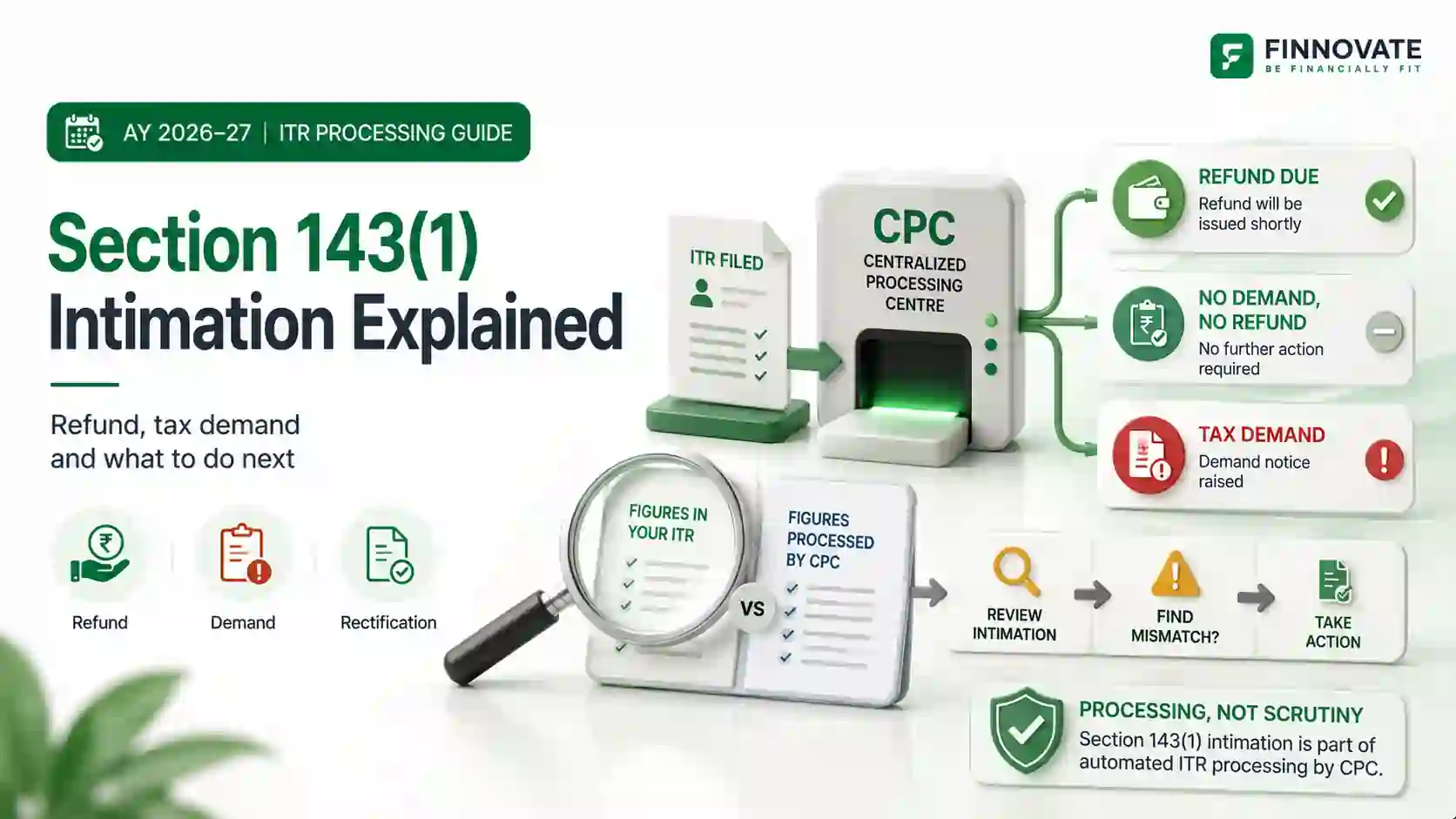
Received a Section 143(1) intimation? Understand CPC adjustments, refunds, tax demands, re...
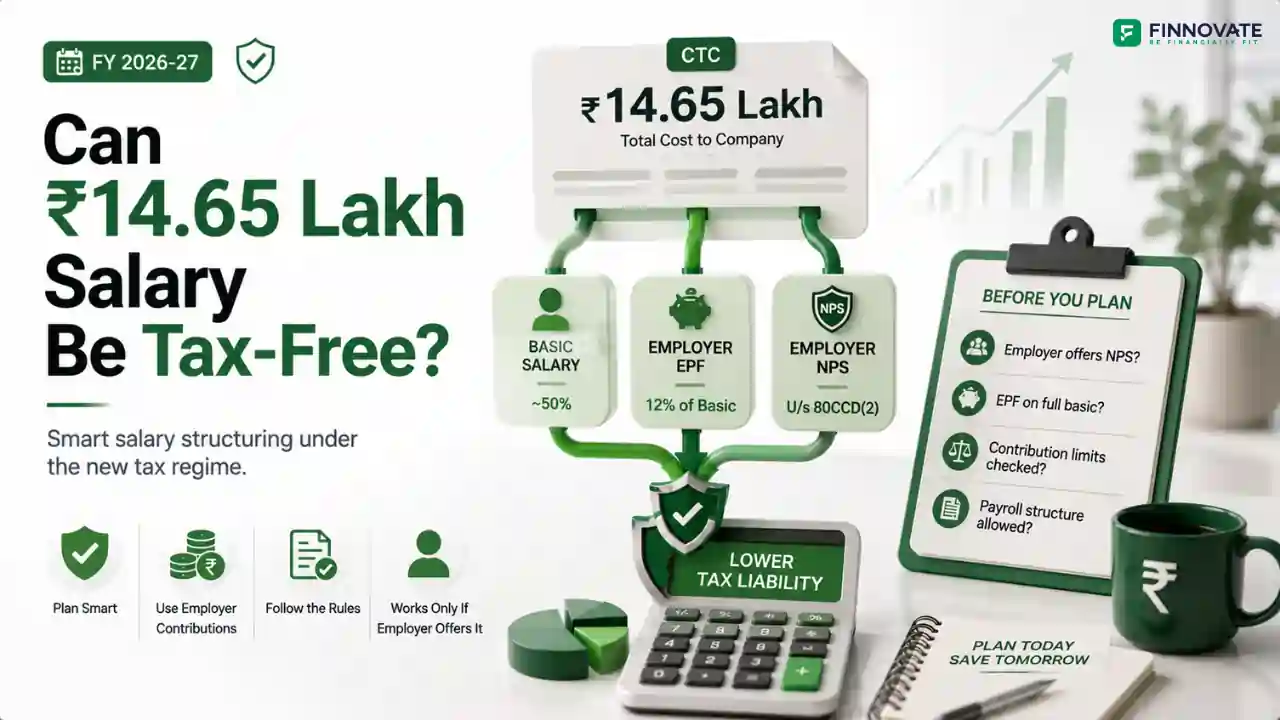
Zero tax on a ₹14.65 lakh salary is real, but only if your employer contributes EPF on f...

Changed jobs in FY 2025-26? See why combining two Form 16s can create a tax shortfall past...
Popular now

Learn how to easily download your NSDL CAS Statement in PDF format with our step-by-step g...

Looking for the best financial freedom books? Here’s a handpicked 2026 reading list with...

Learn what SIF investment means in India, SEBI rules, Rs 10 lakh minimum investment, avail...

Clear guide to mutual fund taxation in India for FY 2025–26 after July 2024 changes: equ...