

The Great Economic Decoupling of 2026: Oil, AI & India
Rising oil prices and booming AI investment are shaping an uneven global economy in 2026. ...
24 October 2026

Finnovate’s editorial team researches and creates financial content using trusted sources, regulatory references and inputs from subject experts.
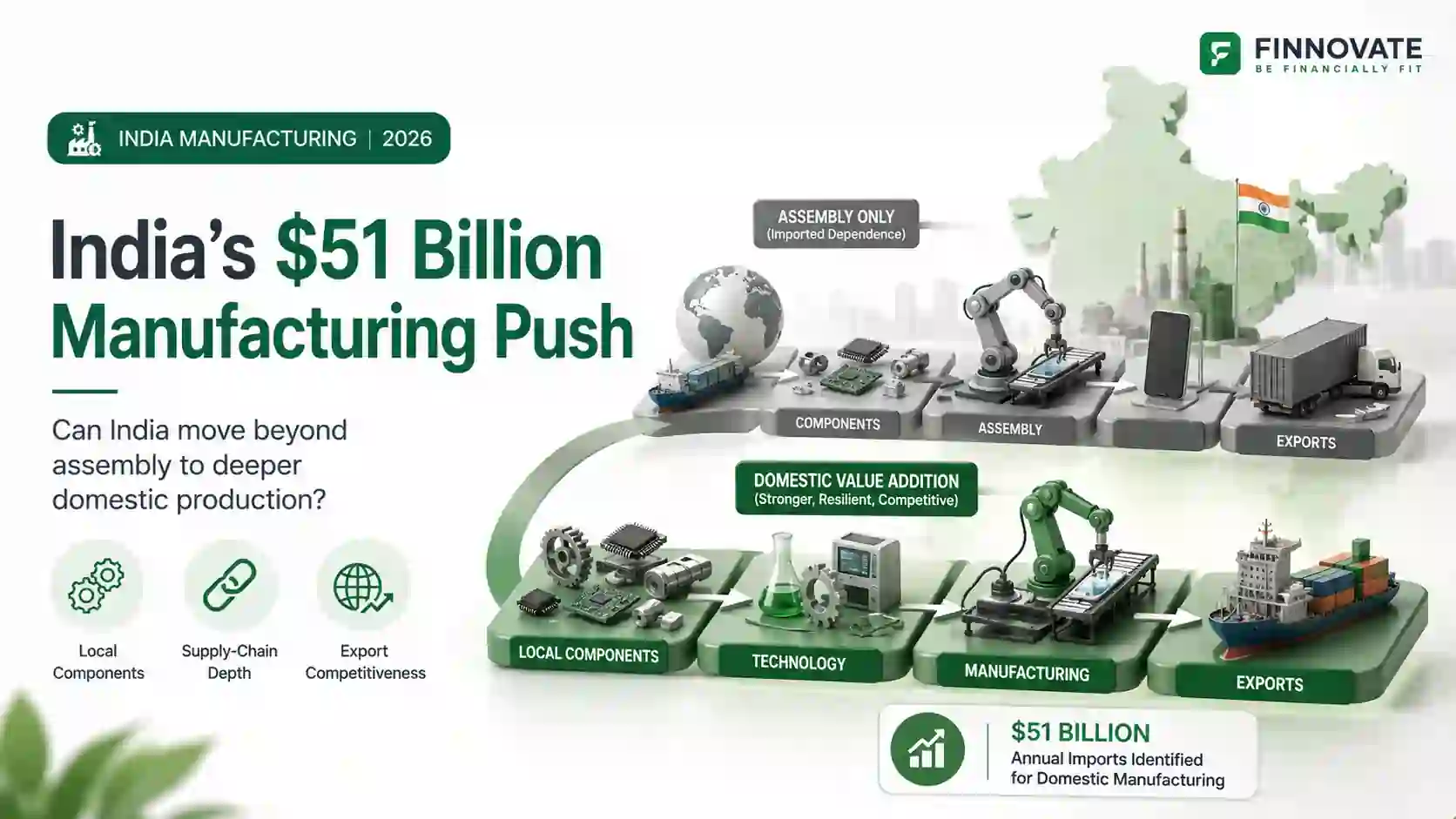
India has reportedly identified around $51 billion of annual imports for an immediate domestic manufacturing push. The exercise covers approximately 100 products across sectors including footwear, textiles, electric vehicles and solar equipment.
The number is part of a wider internal government assessment of India's $775 billion merchandise import bill in FY2025-26. According to the reported exercise, goods worth around $398 billion may have some potential to be manufactured domestically over time.
The $51 billion figure should not, however, be interpreted as an announced import ban or a promise that an equivalent amount will quickly disappear from India's trade bill. The complete product list, implementation framework and sector-wise targets have not yet been released publicly.
The larger question is whether India can use this programme to build competitive supply chains rather than simply replacing imported finished products with locally assembled ones.
India's manufacturing push is taking place in a less predictable global environment.
Wars, trade restrictions, shipping disruptions and export controls have shown how dependence on one country or supply route can affect domestic production. India imported nearly $132 billion of goods from China in FY2025-26, including machinery, components and industrial inputs required by Indian factories. This creates a more complex form of dependence than the import of finished consumer goods.
Our earlier analysis of India's FY26 trade data explains how rising electronics exports can coexist with continued dependence on imported components, machinery and industrial inputs.
A product may carry a "Made in India" label while its chips, chemicals, machinery, battery cells or specialised components continue to come from overseas. In such cases, final assembly may create jobs and exports, but a disruption at an earlier stage of the supply chain can still interrupt production.
The current programme therefore appears to combine three objectives:
The focus is closer to strategic resilience than complete self-sufficiency. India does not need to manufacture every product it currently imports. It needs credible alternatives in areas where external dependence could disrupt important industries.
India's manufacturing ambition is not new.
Make in India sought to attract investment and expand industrial production across broad sectors. Atmanirbhar Bharat placed greater emphasis on domestic capacity and supply-chain security. Production-linked incentive schemes later tied government support more directly to incremental production and sales.
Official data shows that PLI schemes across 14 sectors had attracted investment of more than ₹2.16 lakh crore by December 2025. They had supported more than ₹20.41 lakh crore in production and sales, over ₹8.3 lakh crore in exports, and more than 14.39 lakh direct and indirect jobs.
These numbers demonstrate manufacturing activity at scale. They do not, by themselves, show how much imported content has been replaced or how much domestic value is added to each product.
The reported $51 billion exercise appears more product-specific. Instead of supporting an entire sector broadly, the government is identifying particular products and examining why domestic manufacturers remain slower, more expensive or technologically dependent.
That distinction could make the programme more focused, provided each product receives a policy suited to its actual constraint.
Mobile phones provide the strongest example of targeted manufacturing policy producing visible results.
Official figures indicate that mobile-phone imports have declined by nearly 77% since FY2020-21. More than 99% of domestic demand is now met through locally produced phones. India has also developed into an important smartphone export base, supported by global manufacturers and their contract-manufacturing partners.
This experience shows that India can build large-scale production when several conditions come together:
But the mobile-phone experience also shows why final production is only one stage of industrial development.
Competitive smartphone production still depends on access to imported semiconductors, displays, specialised machinery and other components. India recently removed duties on selected electronic parts to reduce manufacturing costs, reflecting the continuing importance of globally sourced inputs.
The next stage is therefore not to dismiss assembly. Assembly creates scale, skills, supplier relationships and export credibility. The challenge is to use that foundation to localise progressively more components, engineering and intellectual property.
This becomes more important as global companies reassess supply chains across the US, China and other manufacturing centres. Our analysis of what India must do to strengthen its manufacturing position examines why assembly scale must eventually translate into technology, supplier depth and higher domestic value addition.
Different industries face different constraints.
A smartphone is a standardised global product supported by large multinational manufacturers and established international supply chains. Footwear moulds, textile machinery, solar cells and electric-vehicle components operate under different economics.
For example, India imported approximately $483 million of footwear sole moulds in FY2025-26. According to the internal assessment reported by Reuters, producing a mould can take about two weeks in India compared with three to five days in China.
The gap is not explained by factory subsidies alone. It may reflect:
An incentive may make investment more attractive. It cannot immediately recreate an industrial cluster that has accumulated skills, suppliers and operating speed over several decades.
India's solar-manufacturing sector provides a current example of what can happen when downstream localisation rules move faster than upstream capacity.
India has developed around 200 GW of solar-panel manufacturing capacity. However, government estimates place installed solar-cell capacity at approximately 27 GW, while effective operating capacity is estimated at only 16-18 GW.
India also remains dependent on China for around 95% of its imported solar cells.
Rules requiring domestically made cells for specified projects took effect in June 2026. The shortage of eligible domestic cells has left some module manufacturers facing waits of six to eight months. Nearly one-third of India's small and medium-sized panel makers had reportedly halted production, while others reduced operating cycles.
The policy objective is to build a domestic solar supply chain. The immediate difficulty is that module-making capacity expanded much faster than cell-making capacity.
This does not make solar localisation unnecessary. It shows that the sequence matters.
When restrictions on imported inputs begin before domestic suppliers can deliver sufficient volume, quality and technology, the result can be:
Import replacement is therefore more durable when domestic capacity is built before imported alternatives are restricted.
The same policy instrument will not work for every product.
Products where India already has technology but lacks scale may need production incentives, affordable credit and government procurement.
Products where India lacks specialised technology may require joint ventures, foreign investment and technology partnerships. The reported programme is considering partnerships with firms from countries including Taiwan, South Korea, Germany and Italy.
Products assembled locally but dependent on imported components may need incentives directed at suppliers rather than final manufacturers.
Other products may remain structurally cheaper to import. In such cases, permanent protection could raise costs for Indian consumers and downstream industries without creating a globally competitive domestic business.
The objective should not be to replace imports regardless of cost. It should be to build domestic capability where India can eventually compete on productivity, quality, technology and delivery speed.
A decline in imports is not sufficient evidence of successful industrial policy.
Imports can also fall because domestic demand weakens, tariffs make products expensive or companies cannot access required inputs.
A stronger scorecard would examine five outcomes.
How much of the product's final value is created in India, and how much still depends on imported components and machinery?
Can Indian manufacturers compete on price, quality and delivery without depending indefinitely on protection or subsidies?
Can the product succeed in international markets, or does it survive only because the domestic market is protected?
Are local suppliers able to provide the materials, components, tools and technical services required for production?
Is the programme creating skilled jobs, engineering capabilities and intellectual property that can support other industries?
These measures would distinguish genuine manufacturing depth from a simple shift in the location of final assembly.
India's $51 billion manufacturing exercise has the potential to be more focused than earlier programmes because it begins with specific products and identifiable supply-chain gaps.
Mobile phones show that targeted incentives can create production scale, exports and employment. They also show that assembly must eventually lead to deeper component localisation.
Solar manufacturing provides the other side of the lesson. Domestic-content rules can create shortages and higher costs when upstream capacity is not ready.
The success of the new programme will therefore depend less on how many imports disappear and more on what replaces them.
A durable manufacturing strategy would create Indian suppliers that are productive enough to serve both domestic and international markets. It would reduce dependence in genuinely critical areas while continuing to use global trade where imports remain efficient and reliable.
Self-reliance does not require India to manufacture everything at home. It requires the country to have sufficient capability, diversification and negotiating strength to avoid being dependent on any single supplier for what matters most.
It is a reported government exercise covering around 100 products responsible for approximately $51 billion of annual imports. These products have reportedly been identified for immediate domestic manufacturing action. A complete official product list and final implementation framework have not yet been published.
No. The figure represents the current import value of selected products. Building domestic technology, suppliers and production capacity can take several years, and some imports may continue even after local manufacturing expands.
Reported sectors include footwear, textiles, electric vehicles and solar equipment. The full product-wise list is not yet publicly available.
India has substantially reduced finished mobile-phone imports, meets most domestic demand through local production and has become an important export base. The next challenge is increasing domestic production of components and technology.
Solar shows the importance of sequencing. India developed large module-making capacity before sufficient domestic cell capacity became operational. Restrictions on imported cells have therefore created shortages and higher costs for some downstream manufacturers.
Not necessarily. Domestic manufacturers may continue importing machinery, raw materials and components. The trade impact depends on domestic value addition, export growth, pricing and the import content of local production.
Disclaimer: This article is for general information and educational purposes only. It does not constitute investment, financial or policy advice, and the reported import-substitution programme may change as official details are released.
No spam. Only new posts, simple explainers, and practical money checklists for busy professionals.
Finnovate is a SEBI-registered financial planning firm that helps professionals bring structure and purpose to their money. Over 3,500+ families have trusted our disciplined process to plan their goals - safely, surely, and swiftly.
Our team constantly tracks market trends, policy changes, and investment opportunities like the ones featured in this Weekly Capsule - to help you make informed, confident financial decisions.
Learn more about our approach and how we work with you:
No comments yet. Start the conversation. What would you add?
No spam. Only new posts, simple explainers, and practical money checklists.
You may also like
Rising oil prices and booming AI investment are shaping an uneven global economy in 2026. ...

Explore FPI equity flows for October First Half, 2026: ₹47,955 crore in net outflows, th...
Understand the India–Mauritius tax treaty’s Principal Purpose Test, its August 2026 ef...

Explore India’s AI hardware opportunity through the proposed Adani–Jabil venture, from...
Popular now

Learn how to easily download your NSDL CAS Statement in PDF format with our step-by-step g...

Looking for the best financial freedom books? Here’s a handpicked 2026 reading list with...

Learn what SIF investment means in India, SEBI rules, Rs 10 lakh minimum investment, avail...

Clear guide to mutual fund taxation in India for FY 2025–26 after July 2024 changes: equ...