

Tax Planning and Benefits for Married Couples in India: 2026 Guide
Tax planning for married couples in India explained for 2026. Compare tax regimes, deducti...
05 September 2026

Finnovate’s editorial team researches and creates financial content using trusted sources, regulatory references and inputs from subject experts.

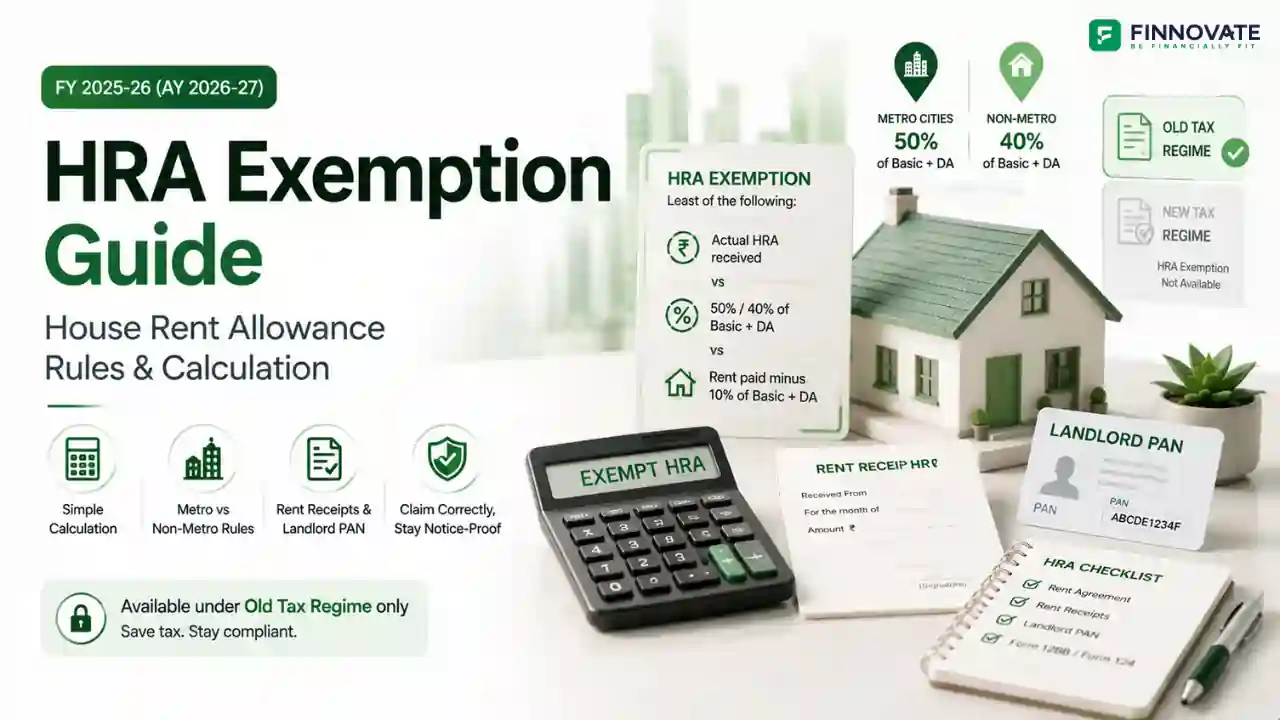
If you are salaried and pay rent, the House Rent Allowance (HRA) exemption is one of the simplest ways to lower your tax bill. But it works only under the old tax regime, and only if you claim it correctly. This guide covers the exact formula, the metro-city rules (including the change coming in FY 2026-27), paying rent to parents, combining HRA with a home loan, and the documents you need to stay notice-proof.
Table of Contents
Two things trip most people up. First, the whole HRA is not tax-free. Only a calculated portion is exempt, and the rest is added to your taxable salary. Second, the "salary" used in the calculation is Basic + Dearness Allowance (where DA forms part of retirement benefits), plus any commission fixed as a percentage of turnover. It is not your full CTC.
In practice, three conditions must all hold: HRA appears as a line in your salary, you actually pay rent, and the home is not owned by you. Miss any one and the exemption does not apply. For example, if you live rent-free in a family home, or your salary bundles everything into "special allowance" with no HRA component, you cannot claim it. If you are self-employed or have no HRA line, you may qualify under Section 80GG instead.
Whichever of the three is smallest is your tax-free HRA. Here is a worked example for someone renting in a metro city.
| Detail (per year) | Amount |
|---|---|
| Basic salary (Basic+DA) | Rs 6,00,000 |
| HRA received | Rs 2,40,000 |
| Rent paid (Rs 18,000 x 12) | Rs 2,16,000 |
| The three limits | Working | Value |
|---|---|---|
| 1. Actual HRA | As received | Rs 2,40,000 |
| 2. 50% of Basic (metro) | 50% x 6,00,000 | Rs 3,00,000 |
| 3. Rent minus 10% of Basic | 2,16,000 minus 60,000 | Rs 1,56,000 |
| Exempt HRA (least of three) | Lowest value | Rs 1,56,000 |
| Taxable HRA | 2,40,000 minus 1,56,000 | Rs 84,000 |
In a non-metro city, Limit 2 would use 40% (Rs 2,40,000), but here Limit 3 is still the smallest, so the exempt figure stays Rs 1,56,000. That is why running your own numbers matters.
This is the single most common mistake for FY 2025-26 filings. People in Bengaluru or Pune assume they get 50%. They do not, yet. The metro list expands only from 1 April 2026 under the Income Tax Rules, 2026.
| Rate | FY 2025-26 (file by Jul 2026) | FY 2026-27 onwards |
|---|---|---|
| 50% (metro) | Delhi, Mumbai, Kolkata, Chennai | The 4 metros plus Bengaluru, Hyderabad, Pune, Ahmedabad |
| 40% (non-metro) | Every other city, including Bengaluru, Hyderabad, Pune, Ahmedabad | Every city outside the 8 above |
So for the current filing season, use the four-city rule. For your FY 2026-27 tax planning, the eight-city rule applies.
Since the new regime is now the default, this decides the regime choice for many renters. The old regime is worth it only if your HRA exemption plus other deductions (80C, 80D, home loan interest) outweigh the new regime's lower slab rates and Rs 75,000 standard deduction.
The break-even depends on your rent, salary and city. A high metro rent with a strong 80C can tip the balance to the old regime; a modest rent usually does not. As a rough guide, a metro renter earning around Rs 15 lakh often needs total old-regime deductions (HRA exemption plus 80C, 80D and home loan interest) of roughly Rs 5 to 6 lakh before the old regime wins, so HRA alone rarely decides it.
HRA, regime choice, and rent structuring interact with your full deduction picture. Our advisory team can help you plan it before the financial year ends.
Book a Tax Planning CallMost real-world HRA confusion lives in these scenarios. Here is where you stand on each.
To keep it clean and notice-proof: put a simple rent agreement in place, pay by bank transfer rather than cash, pay a reasonable, market-rate rent, and make sure your parents declare that rent as income in their own ITR (they get a 30% standard deduction on it).
There is a genuine tax efficiency here when done right. If you pay Rs 20,000 a month to a retired parent in a low tax bracket, you claim the exemption while they pay little or no tax on that rent after the 30% deduction. But note the co-ownership trap: if you are even a part-owner of that home, you cannot claim HRA on rent paid for it.
| Your situation | Can you claim both? |
|---|---|
| Own house in another city, renting where you work | Yes, straightforward |
| Own house in the same city but genuinely rent elsewhere (distance, job, family) | Yes, keep a genuine reason on record |
| Own house is let out; you live on rent | Yes, but declare the rental income you earn |
Generally not advisable. Tax authorities typically treat a shared marital home as a single household, so a spouse-to-spouse rent claim is likely to be challenged. Rent to parents is the accepted route.
What matters is that you pay rent for a home you occupy, not the location of your office. Keep proof of the arrangement, such as a work-from-home confirmation, rent agreement and payment trail, in case it is questioned.
| Document | When it is needed |
|---|---|
| Rent receipts | Always, unless rent is Rs 3,000 or less per month |
| Rent agreement | Recommended; often asked by employers |
| Bank transfer proof | Strongly recommended over cash |
| Landlord's PAN | Mandatory if annual rent is above Rs 1,00,000 |
| Declaration form to employer | Form 12BB (Form 124 from 1 April 2026) |
If your landlord refuses to share their PAN, you have legitimate options. You can claim the exemption directly in your ITR while keeping your rent proof ready, or ask for a signed landlord declaration (Form 60) if they genuinely have no PAN. Do not borrow someone else's PAN. A mismatched PAN is a fast route to an income-tax notice.
The 80GG deduction is the least of: Rs 5,000 per month; 25% of your total income; or rent paid minus 10% of total income. You cannot claim 80GG if you (or your spouse or minor child) own a home in the city where you live and work. For example, on a Rs 8 lakh income paying Rs 15,000 rent a month, the three limits are Rs 60,000, Rs 2,00,000 and Rs 1,00,000, so your deduction is capped at Rs 60,000.
If your employer did not record your HRA exemption, you can still claim it yourself while filing your return. Enter the exempt amount under the salary and allowances section of the ITR and keep your receipts on file. You do not lose the benefit just because payroll missed it.
No. Only the portion calculated as the least of the three limits is exempt. Any HRA above that amount is added to your taxable salary.
Yes, in most cases. Receipts are not required only if your monthly rent is Rs 3,000 or less. If annual rent exceeds Rs 1 lakh, you also need the landlord's PAN.
You can claim it in your ITR with your rent proof ready, and request a Form 60 declaration if the landlord genuinely has no PAN. Never use someone else's PAN, as it invites a notice.
Yes. You can file a revised return before the deadline and claim the exemption you missed, as long as you have valid rent proof.
No. If you live in a home you own and pay no rent, there is no HRA exemption. The benefit exists only for rent actually paid on a home you do not own.
Yes, if both receive HRA, both genuinely pay rent, and the rent is split. For example, each paying their share under a shared agreement with a clear payment trail.
There is no fixed cap, but it should reflect a realistic market rent for the property. An unusually high rent to a low-income parent draws scrutiny, so keep it reasonable and ensure they report it in their ITR.
No. Section 80GG is only for taxpayers who receive no HRA. If HRA is part of your salary, you claim under Section 10(13A), not 80GG.
It can, but cash weakens your paper trail. Bank transfers are strongly preferred, and for rent above Rs 1 lakh a year you still need the landlord's PAN regardless of payment mode. Please consult a qualified tax professional for guidance specific to your situation.
Disclaimer: This article is for general information and educational purposes only. It does not constitute tax or investment advice. HRA rules described here are based on the Income-tax Act as amended, applicable for FY 2025-26 (AY 2026-27), with noted changes taking effect from FY 2026-27. Metro-city classification, form requirements, and thresholds may change in subsequent budgets or notifications. Please consult a qualified Chartered Accountant or tax professional for guidance specific to your situation.
No spam. Only new posts, simple explainers, and practical money checklists for busy professionals.
Finnovate is a SEBI-registered financial planning firm that helps professionals bring structure and purpose to their money. Over 3,500+ families have trusted our disciplined process to plan their goals - safely, surely, and swiftly.
Our team constantly tracks market trends, policy changes, and investment opportunities like the ones featured in this Weekly Capsule - to help you make informed, confident financial decisions.
Learn more about our approach and how we work with you:
No comments yet. Start the conversation. What would you add?
No spam. Only new posts, simple explainers, and practical money checklists.
You may also like
Tax planning for married couples in India explained for 2026. Compare tax regimes, deducti...
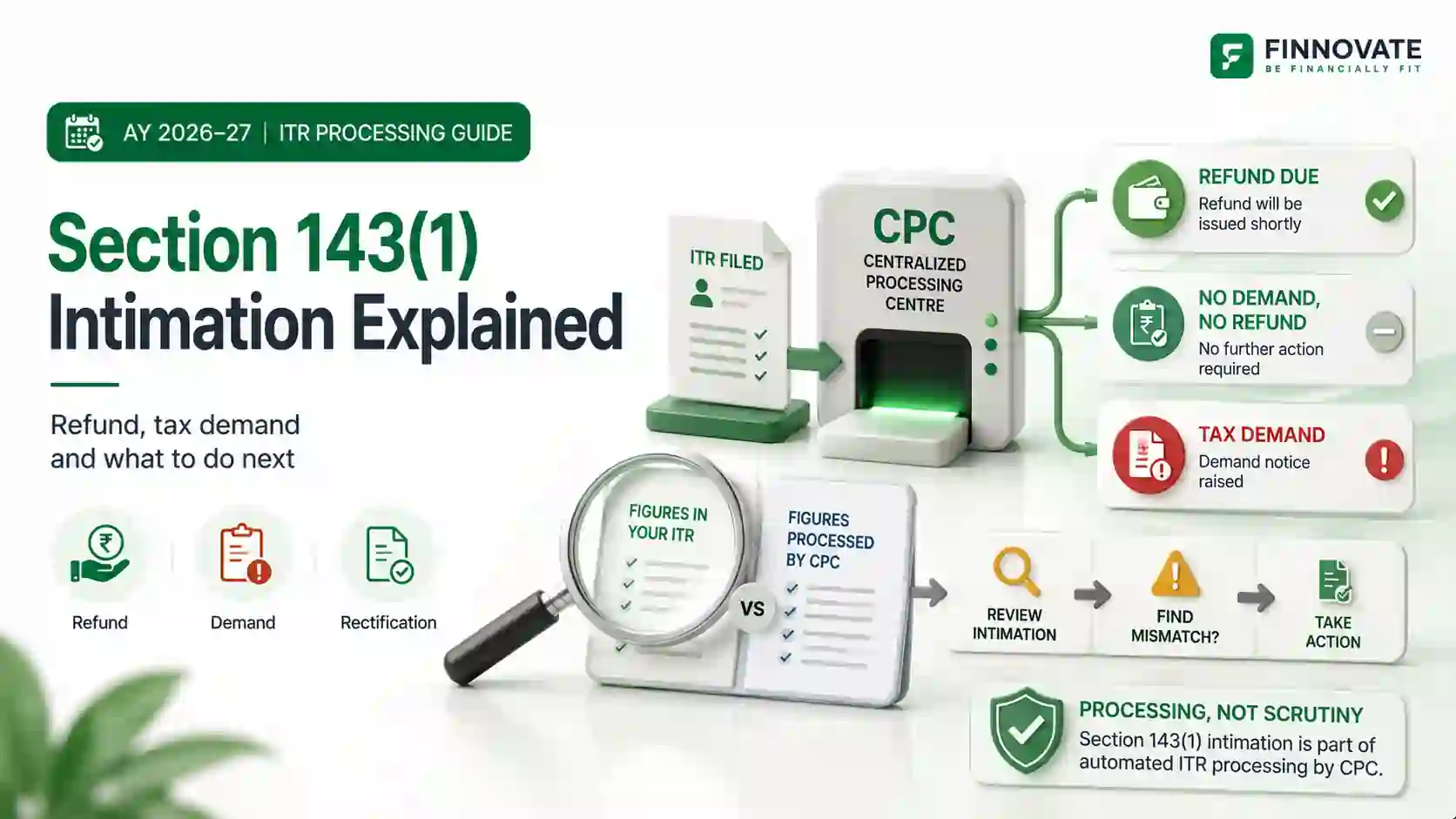
Received a Section 143(1) intimation? Understand CPC adjustments, refunds, tax demands, re...
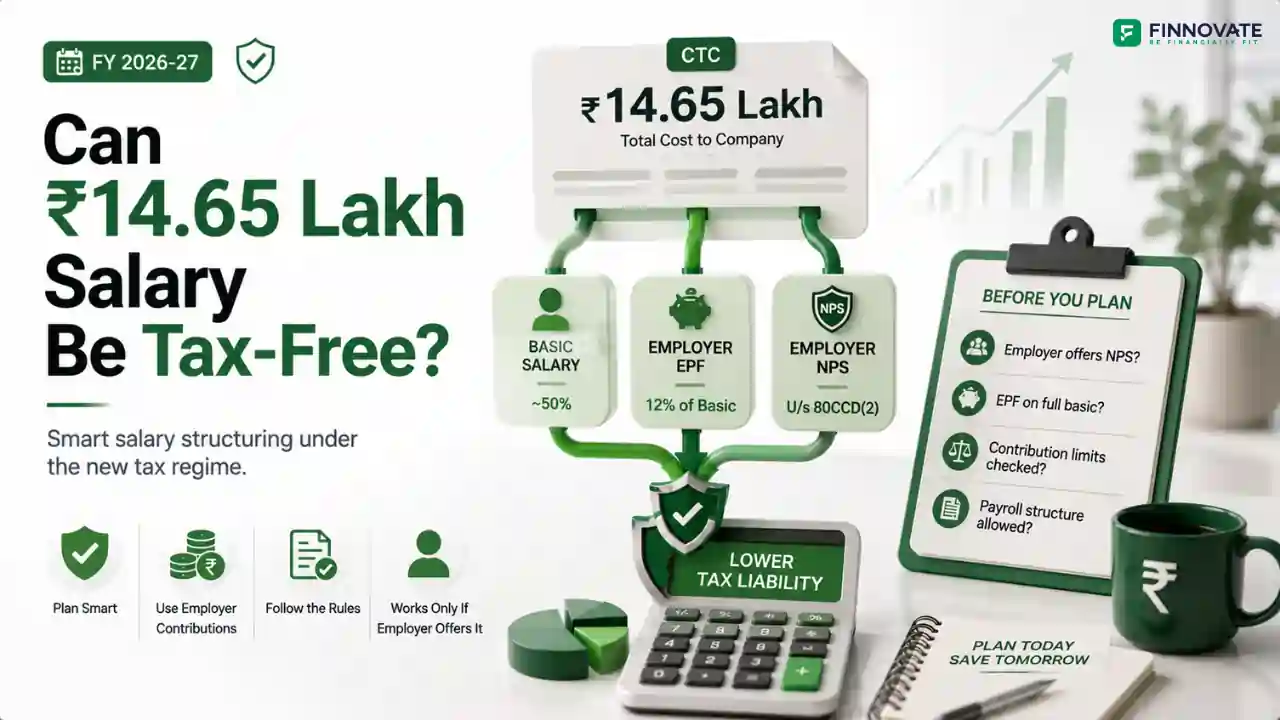
Zero tax on a ₹14.65 lakh salary is real, but only if your employer contributes EPF on f...
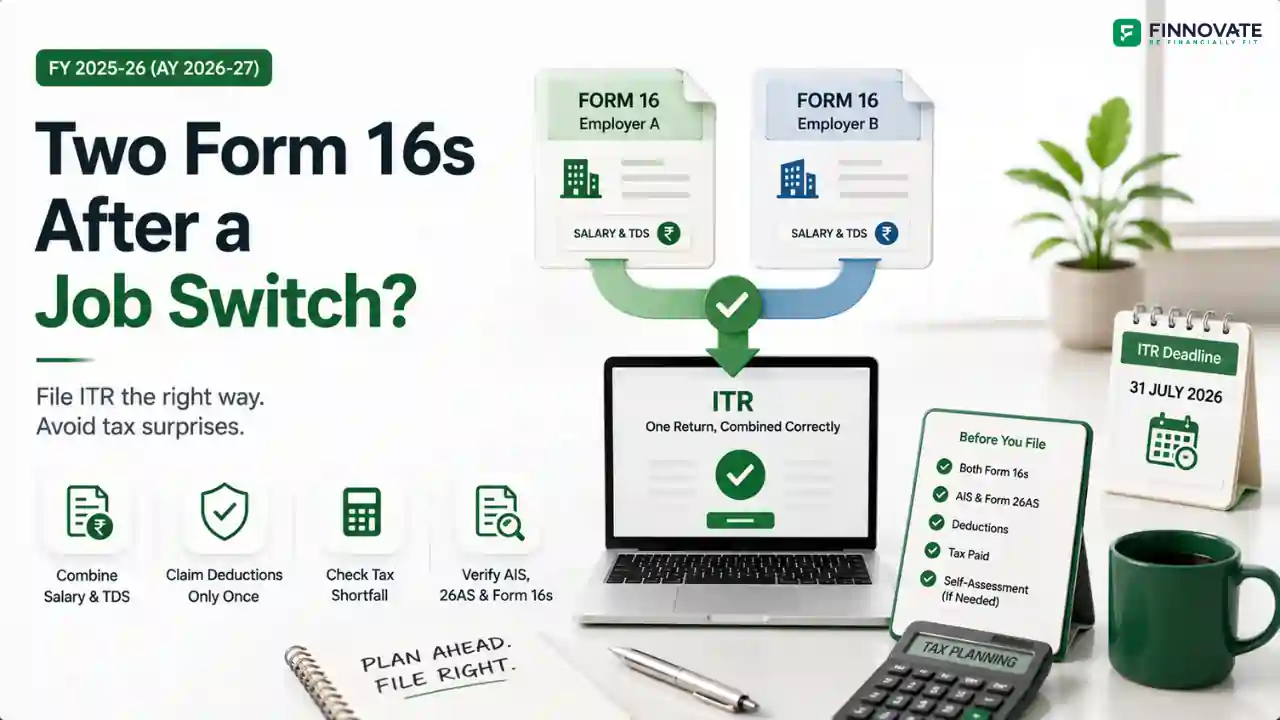
Changed jobs in FY 2025-26? See why combining two Form 16s can create a tax shortfall past...
Popular now

Learn how to easily download your NSDL CAS Statement in PDF format with our step-by-step g...

Looking for the best financial freedom books? Here’s a handpicked 2026 reading list with...

Learn what SIF investment means in India, SEBI rules, Rs 10 lakh minimum investment, avail...
Clear guide to mutual fund taxation in India for FY 2025–26 after July 2024 changes: equ...