

Tax Planning and Benefits for Married Couples in India: 2026 Guide
Tax planning for married couples in India explained for 2026. Compare tax regimes, deducti...
05 September 2026

House Rent Allowance exemption is one of the more consequential tax claims for salaried employees, and also one of the most error-prone. The mistakes are rarely deliberate. They tend to arise from incorrect documentation, missed employer declarations, or misunderstanding the formula. Each one can reduce the eligible exemption or, in some cases, trigger a post-filing query.
This article covers the HRA exemption formula, seven common filing errors, the documentation required, and how HRA fits into the regime comparison decision for FY 2025-26 (AY 2026-27).
Table of Contents
HRA is a salary component provided by employers to help cover rent expenses. The tax exemption is governed by Section 10(13A) of the Income Tax Act and applies only under the old tax regime. Under the new regime, HRA is fully taxable as part of gross salary regardless of rent paid.
Three conditions must be met simultaneously to claim the exemption: the employee must receive HRA as a salary component, must be living in rented accommodation, and must actually be paying rent. An employee who owns the property they live in cannot claim HRA exemption, even if HRA appears in their salary slip.
The exempt portion of HRA is the lowest of three amounts. All three are calculated and the smallest figure is what can be claimed as exempt.
| Component | How It Is Calculated |
|---|---|
| Actual HRA received | The HRA amount shown in the salary slip for the year |
| Rent paid minus 10% of salary | Annual rent paid less 10% of (basic salary + DA + commission as % of turnover) |
| Percentage of salary | 50% of salary for metro cities; 40% for non-metro cities |
Rent receipts are the primary documentation for any HRA claim. Many employees assume the employer's acceptance of an HRA declaration is sufficient, but at the time of ITR filing or during scrutiny, the Income Tax Department may ask for physical or digital proof of rent paid.
Rent receipts should include: landlord name, address of the rented property, rent amount, period covered, and the landlord's signature. For payments made in cash exceeding ₹5,000 per receipt, a revenue stamp is required. Bank transfer is the cleaner approach and eliminates the need for revenue stamps entirely.
Where total annual rent paid to a single landlord exceeds ₹1,00,000, the landlord's PAN is required to be submitted to the employer for processing the HRA claim. Without it, the employer may disallow the exemption and deduct TDS at a higher rate.
If the landlord does not have a PAN or declines to share it, a self-declaration from the landlord stating this fact may be accepted by some employers, though the claim may still face scrutiny. Paying rent via bank transfer and maintaining a clear digital trail strengthens the position in either case.
A common situation: the employee forgets or delays submitting the HRA declaration to HR at the start of the year. The employer deducts TDS without the HRA exemption factored in. The employee then claims the full HRA exemption at ITR filing time.
This is permissible. The ITR allows the correct exemption to be claimed regardless of what the employer processed. However, the mismatch between Form 16 and the ITR return will be visible in the AIS and may result in a clarification notice. Keeping rent receipts, the rent agreement, and bank statements covering the full year makes responding to any such query straightforward.
Paying rent to parents and claiming HRA is legally permissible. The rent must genuinely be paid, must flow through a bank account, and must be declared as rental income in the parents' ITR. A written rent agreement between the employee and parent is required.
From FY 2026-27 onwards under the Income Tax Rules 2026, employees are required to disclose their relationship with the landlord in Form 124 (the new investment declaration form replacing Form 12BB). For FY 2025-26 returns, the relationship disclosure requirement is not yet mandated in the old form, but maintaining documentation of the arrangement is advisable regardless.
Cash rent payments to parents with no bank trail, no rent agreement, and no declaration in the parent's ITR are the three factors that draw scrutiny most frequently in this arrangement. Each one independently weakens the claim.
Employees who also invest in mutual funds or equity occasionally see inflated income figures in AIS and miscalculate their salary base for HRA purposes. HRA exemption is calculated on basic salary plus DA, not on total income or gross AIS values. Capital gains, dividends, and other non-salary income do not affect the HRA formula.
Claiming both HRA exemption and home loan interest deduction under Section 24(b) is permissible where the taxpayer owns a house but lives in rented accommodation due to genuine reasons such as distance from workplace. Both claims can coexist even in the same city.
The critical requirement is documentation of why the owned property is not being occupied. A letter from the employer confirming work location, or other evidence that the workplace is materially distant from the owned property, supports the dual claim. Where documentation is absent, one of the two claims may be disallowed during assessment.
When an ITR is selected for scrutiny, the assessing officer may ask for the full documentation trail for HRA: rent receipts for each month, the rent agreement, bank statements showing rent transfers, and the landlord's PAN if rent exceeded ₹1 lakh annually. Collecting these documents after a notice arrives is considerably harder than maintaining them through the year.
Starting a dedicated folder in April, physical or digital, and filing documents as they are generated eliminates this problem entirely. Bank transfer records are automatically retrievable; rent receipts and the agreement need to be actively stored.
| Document | When Required | Notes |
|---|---|---|
| Monthly or quarterly rent receipts | Always | Must include landlord name, address, amount, period, signature |
| Rent agreement | Recommended in all cases | Especially important for rent paid to parents or relatives |
| Landlord PAN | Annual rent exceeds ₹1,00,000 | Mandatory for employer processing; required at ITR stage if queried |
| Bank statements showing rent transfers | Scrutiny or notice | Bank transfer eliminates cash payment risk entirely |
| Parent's ITR (if paying rent to parents) | Scrutiny or notice | Rental income must be declared in parent's return |
| Employer's HRA declaration form | Start of financial year | Form 12BB for FY 2025-26; replaced by Form 124 from FY 2026-27 |
HRA exemption is available only under the old regime. The regime comparison for an employee paying significant rent is not just about HRA in isolation. It involves the combined value of all deductions available under the old regime weighed against the lower slab rates of the new regime.
| Factor | Old Regime | New Regime |
|---|---|---|
| HRA exemption | Available under Section 10(13A) | Not available |
| Section 80C deductions | Available, up to ₹1,50,000 | Not available |
| Section 80D deductions | Available | Not available |
| Home loan interest (Section 24b) | Up to ₹2,00,000 | Not available |
| Standard deduction | ₹50,000 | ₹75,000 |
| Employer NPS (80CCD(2)) | Available | Available |
| Section 87A rebate | Up to ₹12,500 (income up to ₹5L) | Up to ₹60,000 (income up to ₹12L) |
Our advisory team can review your salary structure, HRA component, and deduction set to help you understand which regime produces a lower tax outcome for FY 2025-26.
Book a Free SessionYes, provided the rent is actually paid via bank transfer, a written rent agreement exists between you and your parents, and your parents declare the rental income in their own ITR. The arrangement is legitimate when properly documented. From FY 2026-27 onwards, the relationship with the landlord must also be disclosed in Form 124.
Yes. Both can be claimed simultaneously if there is a genuine reason for not occupying the owned property, such as the owned property being in a different city or at a significant distance from the workplace. Documentation establishing this reason is important in case the dual claim is queried during assessment.
The HRA exemption can still be claimed at the time of ITR filing, even if it was not declared to the employer and does not appear in Form 16. The ITR allows the correct exemption to be computed and applied. The resulting difference between the employer's TDS and the actual liability will typically generate a refund. Maintaining full documentation is advisable as the mismatch may be visible in AIS.
No. HRA exemption under Section 10(13A) is available only under the old tax regime. Under the new regime, the entire HRA received from the employer is taxable as salary income. Employees who receive significant HRA and pay substantial rent may find the old regime more beneficial overall, depending on their full deduction profile.
For FY 2025-26 (AY 2026-27), the four metro cities qualifying for the 50% rate are Delhi, Mumbai, Chennai, and Kolkata. All other cities, including Bengaluru, Hyderabad, Pune, and Ahmedabad, apply the 40% rate for this year. From FY 2026-27 onwards, Bengaluru, Hyderabad, Pune, and Ahmedabad are added to the metro list under the Income Tax Rules 2026. Please consult a SEBI-registered investment adviser or qualified tax professional for guidance specific to your salary structure and city.
Section 80GG is a deduction available to individuals who pay rent but do not receive HRA as part of their salary. It is available under the old regime only. The deduction is the lowest of: ₹5,000 per month, 25% of total income, or rent paid minus 10% of total income. It is relevant for self-employed individuals, freelancers, or salaried employees whose salary structure does not include an HRA component.
Disclaimer: This article is for general information and educational purposes only. It does not constitute investment advice, a recommendation, or an offer to buy or sell any securities or financial instruments. HRA exemption rules, metro city classifications, and documentation requirements referenced here are based on publicly available Income Tax Department notifications applicable for FY 2025-26 (AY 2026-27). Rules may change in subsequent notifications or budgets. Please consult a SEBI-registered investment adviser or qualified tax professional before making any tax filing or financial decision.
No spam. Only new posts, simple explainers, and practical money checklists for busy professionals.
Finnovate is a SEBI-registered financial planning firm that helps professionals bring structure and purpose to their money. Over 3,500+ families have trusted our disciplined process to plan their goals - safely, surely, and swiftly.
Our team constantly tracks market trends, policy changes, and investment opportunities like the ones featured in this Weekly Capsule - to help you make informed, confident financial decisions.
Learn more about our approach and how we work with you:
No comments yet. Start the conversation. What would you add?
No spam. Only new posts, simple explainers, and practical money checklists.
You may also like
Tax planning for married couples in India explained for 2026. Compare tax regimes, deducti...
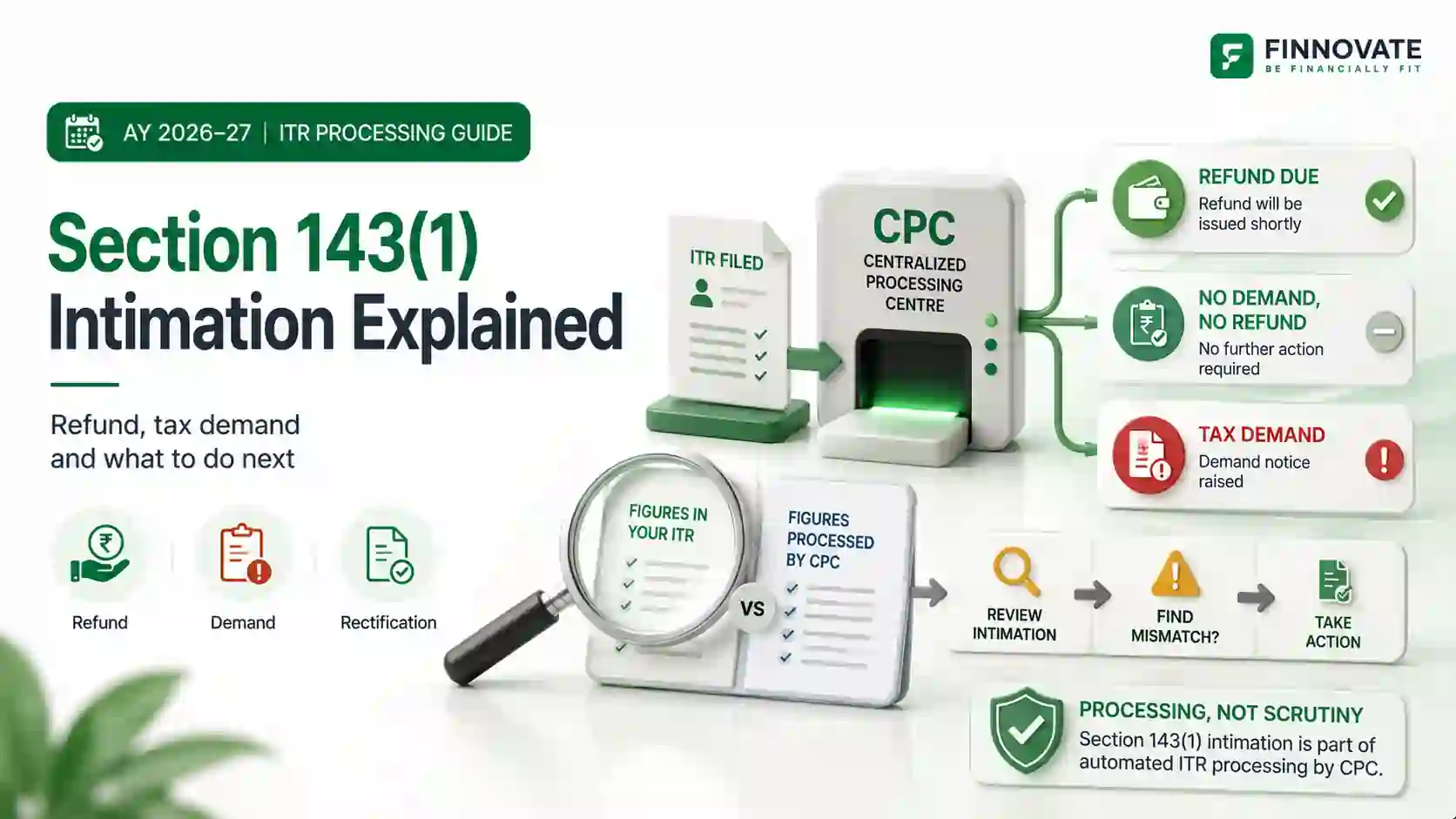
Received a Section 143(1) intimation? Understand CPC adjustments, refunds, tax demands, re...
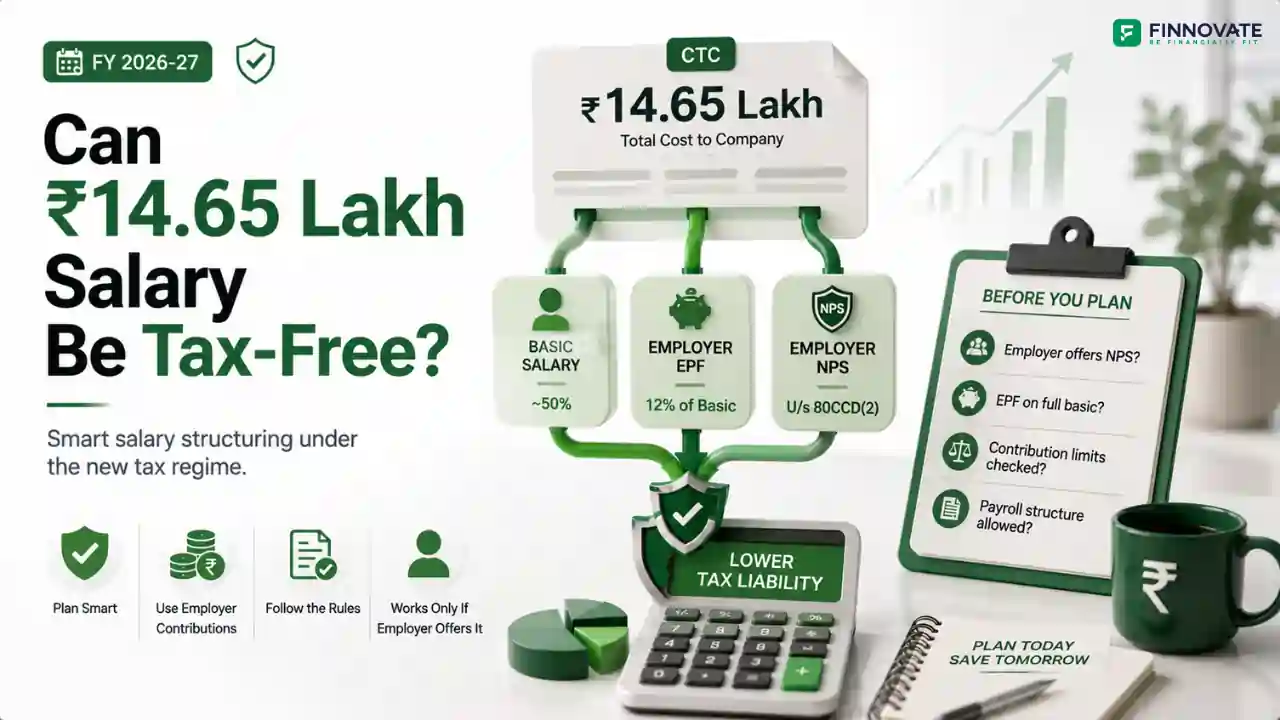
Zero tax on a ₹14.65 lakh salary is real, but only if your employer contributes EPF on f...
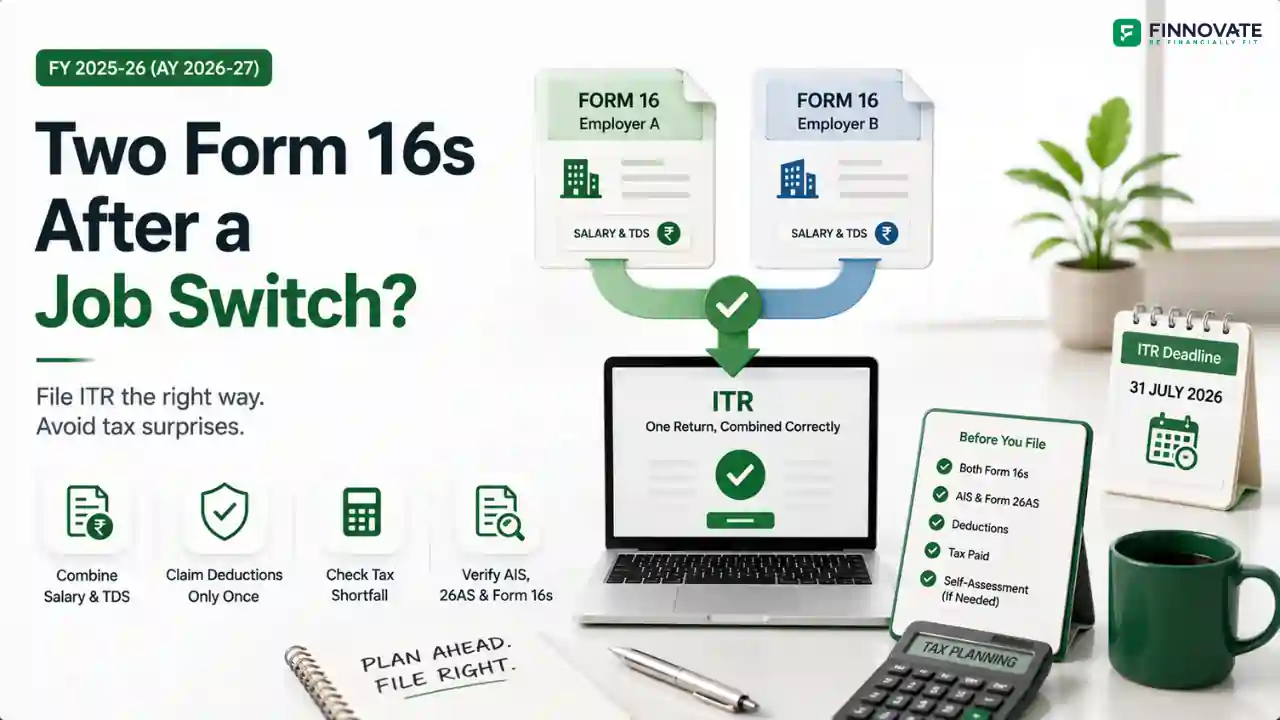
Changed jobs in FY 2025-26? See why combining two Form 16s can create a tax shortfall past...
Popular now

Learn how to easily download your NSDL CAS Statement in PDF format with our step-by-step g...

Looking for the best financial freedom books? Here’s a handpicked 2026 reading list with...

Learn what SIF investment means in India, SEBI rules, Rs 10 lakh minimum investment, avail...
Clear guide to mutual fund taxation in India for FY 2025–26 after July 2024 changes: equ...