

The Great Economic Decoupling of 2026: Oil, AI & India
Rising oil prices and booming AI investment are shaping an uneven global economy in 2026. ...
24 October 2026

Finnovate’s editorial team researches and creates financial content using trusted sources, regulatory references and inputs from subject experts.
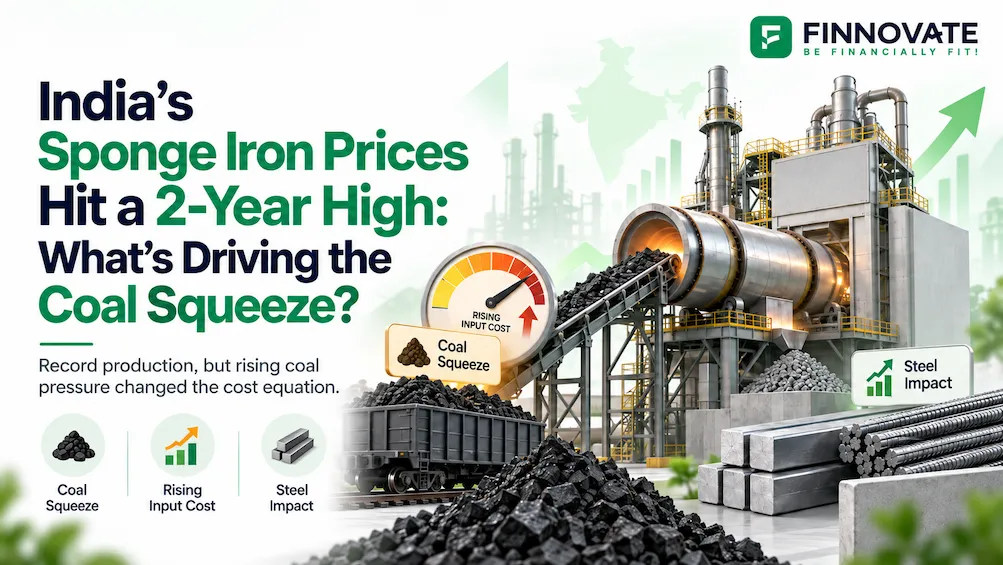
India makes more sponge iron than any other country in the world.
In FY2025-26, domestic production reached a record 60.3 million tonnes. On a calendar-year basis, India produced 58.9 million tonnes of Direct Reduced Iron, or DRI, in 2025, equivalent to roughly 38.5% of global production.
Yet in August 2026, benchmark Indian sponge-iron prices climbed to around ₹29,700 per tonne, their highest level in two years. That sounds contradictory. If India produces so much sponge iron, why should its price suddenly become a problem?
The answer therefore begins one step earlier in the supply chain. Imported coal became more expensive, suitable domestic coal became harder for some industrial users to access, and demand for sponge iron was already strengthening. The result was a squeeze from both sides.
Table of Contents
Sponge iron is another name for Direct Reduced Iron, or DRI. Iron ore is converted into metallic iron without first being completely melted in a blast furnace. In India's coal-based plants, high-grade iron ore is reduced using non-coking coal inside rotary kilns.
Its economic role is more important than the name suggests. Sponge iron can substitute for steel scrap in electric steelmaking and is fed into Electric Arc Furnaces and Induction Furnaces, where it is converted into steel.
How coal-based sponge iron becomes construction steel
A simplified process map for first-time readers. Scrap can also be added at the furnace stage depending on mill economics.
The simplified chain is therefore:
iron ore + non-coking coal → DRI → electric or induction furnace → billet → TMT bars and structural steel.
That takes us from an unfamiliar commodity to products used across housing, infrastructure and industrial construction.
India's steelmaking system relies heavily on electric routes.
World Steel Association data shows that 57.7% of India's crude steel production in 2025 came through electric furnaces, compared with 42.3% through the oxygen-furnace route.
The secondary-steel ecosystem is particularly important. The Ministry of Steel says the secondary sector contributes almost 47% of India's total steel production, which makes DRI an important raw material for a large network of electric and induction-furnace mills.
| Financial Year | Sponge Iron Production |
|---|---|
| FY2021-22 | 39.20 MT |
| FY2022-23 | 43.62 MT |
| FY2023-24 | 51.56 MT |
| FY2024-25 | 55.76 MT |
| FY2025-26 | 60.30 MT |
India's sponge-iron production has increased by more than 50% in four years. So the August price spike cannot be explained by a lack of domestic production capacity alone.
This is the first vulnerability. For April to December FY2025-26, India produced 37.87 MT of coal-based sponge iron and 6.68 MT of gas-based sponge iron, which means roughly 85% of output during the period came from coal-based plants.
| DRI Route | Production, Apr-Dec FY2025-26 |
|---|---|
| Coal-based | 37.87 MT |
| Gas-based | 6.68 MT |
| Total | 44.55 MT |
The raw-material relationship is direct. If suitable non-coking coal becomes more expensive or harder to obtain, sponge-iron production costs rise.
This distinction is worth making because the two are often mixed together in steel-market discussions. Integrated blast-furnace producers use coking coal, while most Indian coal-based DRI plants use suitable grades of non-coking coal.
Two different coal routes can affect Indian steel
Both routes ultimately produce steel, but they depend on different coal inputs and different production systems.
Indian steel is therefore dealing with two different coal-cost pressures. Integrated producers are affected by coking-coal prices, while coal-based sponge-iron producers are affected by non-coking coal availability and cost. The stories meet downstream, but they should not be treated as the same input problem.
India produces large quantities of coal domestically, but sponge-iron plants still use imported non-coking coal when its quality and economics make sense. That imported option became considerably more expensive from May onward.
| Coal Origin | Reported Increase Since May |
|---|---|
| Indonesia | 18%–20% |
| South Africa | 19% |
| Russia | 14% |
Higher shipping and marine-insurance costs linked to Middle East tensions added another layer to the landed cost of imported coal. Steel and sponge-iron producers reacted by cutting purchases, with thermal-coal imports by the sector falling 11% in June and another 19% in July.
So imported coal became less attractive precisely when manufacturers still needed large quantities of fuel. The obvious question then becomes: why not simply switch to more domestic coal?
This is where the story becomes more interesting.
India's overall coal production did not collapse. In July 2026, national coal production rose 7.51% year-on-year to 69.75 million tonnes, while coal dispatch also increased strongly.
Coal supplies to thermal power plants rose too. That means describing the situation as an “India coal shortage” would be misleading. The issue was much more specific to the type of coal, its destination and its availability to industrial consumers.
Why rising national coal output can still coexist with an industrial squeeze
A tonne of coal is not interchangeable with every other tonne. Sponge-iron plants need suitable quality delivered to the right location at a workable cost.
Sponge-iron plants need coal with appropriate calorific value, ash levels, fixed carbon and other characteristics. Location matters too. A tonne of suitable coal sitting far from a sponge-iron cluster is not economically identical to a tonne available nearby.
From May onward, domestic coal availability for some industrial consumers tightened as supplies were prioritised toward electricity generation during strong summer demand. Then the monsoon disrupted mining conditions and transportation.
Coal India's average daily production was only about 1.36 million tonnes during September 1–3, before rising to around 1.83 million tonnes on September 6 as rainfall receded and mining conditions improved. This is important because it suggests part of the pressure was logistical and seasonal rather than a permanent national supply deficit.
That explains the supply side. But it still does not fully explain why sponge-iron prices reacted so sharply, because demand for DRI itself had also been strengthening.
At the beginning of 2026, scrap and sponge iron were priced fairly close together for many secondary steelmakers. By June, the gap had widened significantly, making DRI relatively more attractive.
| Metallic Input | January 2026 | June 2026 |
|---|---|---|
| HMS scrap | ₹33,300/t | ₹35,800/t |
| Sponge iron | ₹33,100/t | ₹32,500/t |
| Scrap premium over DRI | ~₹200/t | ~₹3,200/t |
BigMint estimates that major steelmakers increased sponge iron to around 30%–35% of their metallic charge, from roughly 15%–20% earlier. Smaller mills increased DRI usage to around 40%–45% from approximately 20%–25%.
That combination is what made the August price response much sharper than a simple coal-cost story would suggest.
Secondary steelmakers buy metallic inputs such as scrap and DRI and convert them into billets and finished long-steel products. If sponge-iron costs rise, mills can absorb part of the increase, alter their scrap-to-DRI mix, reduce production or pass some of the cost downstream.
The Ministry of Steel reported that the average price of 10 mm TMT increased from ₹56,698 per tonne in July to ₹58,003 in August, a 2.3% monthly rise. But we should not conclude that sponge iron alone caused that increase because steel prices are also influenced by demand, scrap, coking coal, imports, inventories and electricity costs.
The more defensible economic conclusion is that sustained DRI inflation can raise input costs for smaller steelmakers and, if enough of that cost is passed through, eventually affect the economics of construction and infrastructure steel.
India imported 246.37 million tonnes of coal in FY2025-26, including about 180.04 million tonnes of non-coking coal. At first glance, those numbers can look like a simple failure of domestic supply, but the actual issue is more complicated.
Coal is not one standardised commodity. Different industries need different grades, quality characteristics and supply locations. Import decisions also depend on freight, domestic auction prices, long-term contracts and plant design.
That is a wider lesson for India's import-substitution strategy too. Building domestic capacity is only the first step; supply-chain capability and economics matter just as much.
The August peak does not mean prices will continue rising indefinitely. Industry participants expect prices to remain elevated in the near term, but several forces now point in different directions.
Imported coal remains more expensive than it was a few months ago, while DRI demand remains supported by India's expanding secondary-steel industry.
Monsoon disruption is receding, Coal India production is recovering, logistics are improving and mills can alter their scrap-to-DRI mix if relative prices change.
Sponge-iron prices have already eased from their August high. So the better question is not whether ₹29,700 becomes the new normal, but whether coal costs and DRI demand remain strong enough to keep the market tighter than it was earlier in 2026.
India has built the world's largest DRI industry largely around coal. That has helped the country expand steel production without relying entirely on blast furnaces or imported scrap, but it also creates an environmental and energy challenge.
The Ministry of Steel's decarbonisation roadmap identifies a transition from coal-based DRI toward natural-gas and eventually hydrogen-based DRI as one route to lower-emission steel. India has green-hydrogen pilot projects underway, including work on hydrogen-based DRI, but the technology is not yet commercially viable at scale.
Indonesia and South Africa remain important reference points for industrial coal users in India.
Continued post-monsoon recovery should improve domestic availability and transport conditions.
A rebound would suggest imported coal has become economically viable again for industrial consumers.
A narrower price gap could reduce mills' incentive to keep increasing sponge-iron consumption.
These will show how much raw-material pressure secondary steelmakers are actually passing downstream.
Watching these together is more useful than watching the sponge-iron price alone, because the market is being shaped by both fuel economics and substitution between metallic inputs.
India's problem was not that it suddenly forgot how to make sponge iron. It produced a record 60.3 million tonnes in FY2025-26, and its share of global DRI production is unmatched.
The vulnerability sat one step earlier. Imported coal became more expensive, suitable domestic coal became harder for some industrial users to access as power-sector requirements and monsoon disruption tightened availability, and secondary steelmakers were already consuming more DRI because scrap had become relatively expensive.
There is also a broader lesson. India can be a global leader in producing a commodity and still remain exposed to the economics of the raw materials required to make it. In sponge iron, the real bottleneck was not production capacity. It was the fuel behind it.
Sponge iron, also called Direct Reduced Iron or DRI, is metallic iron produced by reducing iron ore without fully melting it. It is commonly used as an alternative to steel scrap in Electric Arc Furnaces and Induction Furnaces.
Benchmark prices hit a two-year high as imported coal became more expensive, domestic industrial coal availability tightened and monsoon conditions disrupted mining and logistics. Demand for DRI was also strong because it had become cheaper relative to scrap.
Yes. India produced 58.9 million tonnes of DRI in calendar 2025, around 38.5% of global production, according to World Steel Association data.
Most Indian coal-based sponge-iron plants use non-coking coal, not the coking coal typically associated with blast-furnace steelmaking.
Different industries require different coal qualities, calorific values, ash levels and supply locations. Imports can therefore remain economical or technically necessary even when overall domestic coal production is high.
No. Higher DRI prices increase raw-material costs for secondary steelmakers, but the final effect on TMT depends on demand, scrap prices, other inputs, inventories and how much of the cost mills can pass on.
Technically, hydrogen-based DRI is possible and India has pilot projects underway. However, the Ministry of Steel says the technology is not yet commercially viable in India at scale.
Disclaimer: This article is for educational and informational purposes only. References to commodities, steel prices, industries or market trends are not investment recommendations or advice to buy, sell or hold any security. Commodity prices can change quickly due to supply, demand, logistics, regulation and global events.
No spam. Only new posts, simple explainers, and practical money checklists for busy professionals.
Finnovate is a SEBI-registered financial planning firm that helps professionals bring structure and purpose to their money. Over 3,500+ families have trusted our disciplined process to plan their goals - safely, surely, and swiftly.
Our team constantly tracks market trends, policy changes, and investment opportunities like the ones featured in this Weekly Capsule - to help you make informed, confident financial decisions.
Learn more about our approach and how we work with you:
No comments yet. Start the conversation. What would you add?
No spam. Only new posts, simple explainers, and practical money checklists.
You may also like
Rising oil prices and booming AI investment are shaping an uneven global economy in 2026. ...

Explore FPI equity flows for October First Half, 2026: ₹47,955 crore in net outflows, th...
Understand the India–Mauritius tax treaty’s Principal Purpose Test, its August 2026 ef...

Explore India’s AI hardware opportunity through the proposed Adani–Jabil venture, from...
Popular now

Learn how to easily download your NSDL CAS Statement in PDF format with our step-by-step g...

Looking for the best financial freedom books? Here’s a handpicked 2026 reading list with...
Learn what SIF investment means in India, SEBI rules, Rs 10 lakh minimum investment, avail...

Clear guide to mutual fund taxation in India for FY 2025–26 after July 2024 changes: equ...