

The Great Economic Decoupling of 2026: Oil, AI & India
Rising oil prices and booming AI investment are shaping an uneven global economy in 2026. ...
24 October 2026
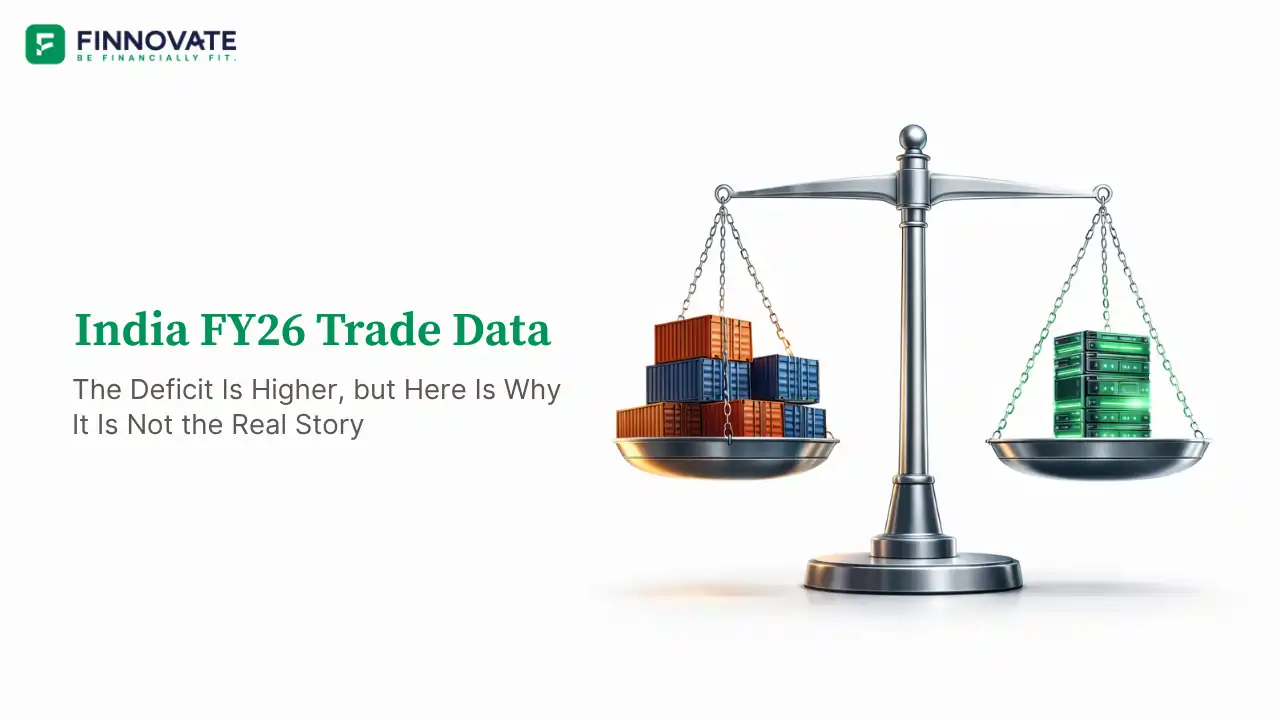
Published: April 2026 | Data: Ministry of Commerce and Industry / DGFT, April 15, 2026
India's overall trade deficit widened to $119.30 billion in FY26, up 26% from $94.66 billion in FY25. That headline number looks alarming. It is not.
The widening is almost entirely explained by two factors: a surge in gold imports driven by price appreciation rather than volume, and electronic component imports rising in line with India's expanding manufacturing base. Petroleum imports, historically the dominant driver of India's trade deficit, actually fell. The war in the Middle East arrived only in March 2026, the final month of the financial year. Its full impact on India's trade will be a FY27 story, not a FY26 one.
The more important story in the FY26 data is structural. India's services exports, at $418.31 billion, are now 94.7% of merchandise exports at $441.78 billion. That ratio, approaching parity, is reshaping how India's external account is understood.
| Trade Variable | FY26 ($bn) | FY25 ($bn) | YOY (%) |
|---|---|---|---|
| Merchandise Exports | 441.78 | 437.70 | +0.93% |
| Merchandise Imports | 774.98 | 721.20 | +7.46% |
| Merchandise Trade Deficit | −333.20 | −283.50 | +17.53% |
| Services Exports | 418.31 | 387.55 | +7.94% |
| Services Imports | 204.42 | 198.72 | +2.87% |
| Services Trade Surplus | +213.89 | +188.83 | +13.27% |
| Combined Exports | 860.09 | 825.26 | +4.22% |
| Combined Imports | 979.40 | 919.92 | +6.47% |
| Overall Trade Volume | 1,839.49 | 1,745.17 | +5.40% |
| Overall Trade Deficit | −119.31 | −94.66 | +26.03% |
India's trade account has three distinct layers, each telling a different story about the health of the external sector.
The merchandise trade deficit widened 17.5% to $333.20 billion in FY26. But petroleum imports, historically India's largest import category, fell 6.4%. The widening deficit is explained by gold imports rising 24.1% to $71.98 billion (driven entirely by price appreciation, not volume. Quantity actually fell from 757 tons to 721 tons) and electronic goods imports rising 17.8% to $116.2 billion, reflecting input demand from India's expanding mobile and electronics manufacturing base. Neither is the same structural problem as oil dependency.
Services exports grew 7.94% to $418.31 billion in FY26, generating a surplus of $213.89 billion. This services surplus offset 64.2% of the merchandise goods deficit. In FY25, that offset ratio was slightly higher at 66.7%, meaning the merchandise deficit grew faster than the services surplus in FY26. But the absolute size of the services surplus, now approaching a quarter trillion dollars, is a structural buffer that makes India's external position significantly more resilient than the headline merchandise deficit number suggests.
The net overall trade deficit of $119.30 billion represents a 26% increase over FY25. In the context of India's GDP of approximately $3.8 trillion, it remains around 3.1%. Crucially, trade excluding petroleum and gems and jewellery ran a surplus of $75.00 billion in FY26, down only marginally from $78.74 billion in FY25. This is the cleanest measure of India's underlying trade health, and it remains firmly positive.
India's merchandise exports grew 0.93% to $441.78 billion against two headwinds: US reciprocal tariffs on Indian goods and the West Asia war disrupting trade routes in March 2026. The near-flat growth is not a failure given those constraints.
| Export Category | FY26 ($bn) | YOY |
|---|---|---|
| Petroleum Products | 53.9 | −15.0% |
| Electronic Goods | 48.0 | +24.4% |
| Pharma Products | 31.1 | +2.1% |
| Chemicals | 28.7 | −0.1% |
Electronic goods exports at $48.0 billion with 24.4% growth are the standout. This category is dominated by smartphone exports, driven by the production-linked incentive scheme for mobile manufacturing. India is becoming a meaningful exporter of assembled electronics, reducing its dependence on petroleum re-exports as the primary driver of merchandise export value.
Petroleum product exports fell 15.0% despite strong refining capacity, reflecting lower global crude prices through most of FY26 reducing per-unit realisation on refined product exports. Pharma and chemicals were broadly stable, largely insulated from US tariff impacts compared to textiles and gems and jewellery.
| Import Category | FY26 ($bn) | YOY |
|---|---|---|
| Petroleum Products | 174.0 | −6.4% |
| Electronic Goods | 116.2 | +17.8% |
| Gold | 71.98 | +24.1% |
| Machinery | 61.7 | +15.6% |
Petroleum imports fell 6.4% to $174.0 billion, reflecting the benefit of discounted Russian crude through most of FY26. The West Asia war arrived too late in the year to affect the full-year petroleum import bill.
Gold imports rising 24.1% to $71.98 billion is a price story, not a volume story. Quantity fell from 757 tons to 721 tons. The unit value rose from $76,617 per kg to $99,825 per kg. This price-driven spike will moderate as precious metals prices correct.
Electronic goods imports rose 17.8% to $116.2 billion alongside electronic goods exports growing 24.4% to $48.0 billion. This is India's manufacturing paradox in one set of numbers. India is assembling and exporting smartphones at scale, but the components and sub-assemblies are imported almost entirely from China. Until India builds a domestic component supply chain, growth in electronics exports will be accompanied by parallel growth in electronics imports. The net electronics trade balance remains deeply negative.
| Direction | Partner | Key Detail |
|---|---|---|
| Top export destination #1 | United States | $87.31bn; surplus with US fell to $34.41bn from $40.88bn in FY25 |
| Top export destination #2 | UAE | $37.37bn; petroleum and jewellery primary drivers |
| Top export destination #3 | China | $19.48bn; fastest-growing at +36.7% YOY |
| Top import source #1 | China | $131.63bn; electronics, machinery, chemicals; record deficit of $112.16bn |
| Top import source #2 | UAE | Petroleum and precious metals primary driver |
| Top import source #3 | Russia | Discounted crude oil dominant; imports fell YOY |
| Top import source #4 | United States | Imports rose sharply; bilateral surplus narrowed significantly |
China's emergence as India's largest trade partner in FY26, displacing the US after a four-year gap, is the most structurally significant development in the trading partner data. Bilateral trade with China reached $151.1 billion versus $140.2 billion with the US.
India's trade deficit with China hit a record $112.16 billion in FY26. Exports to China grew 36.7% to $19.48 billion, mainly in chemicals, minerals, and engineering equipment. But this is still a fraction of the $131.63 billion India imports from China. The concentration in electronics, machinery, chemicals, and battery components underscores the depth of India's manufacturing input dependency on China.
India's surplus with the US, historically a key external balance support, narrowed to $34.41 billion from $40.88 billion in FY25 as US tariffs constrained export growth and imports from the US rose sharply.
March 2026, the first month of the West Asia war, captured the initial trade impact. Merchandise exports fell 7.44% in March to $38.92 billion. India's exports to the West Asia region dropped sharply, and the Commerce Secretary warned that April 2026 will also be a challenging month due to port disruptions.
Three variables will shape India's FY27 trade trajectory.
Petroleum imports fell 6.4% in FY26 on discounted Russian crude. With the Strait of Hormuz disrupted and crude above $100 per barrel, that dynamic reverses in FY27. Higher crude prices and potential supply constraints will simultaneously widen the petroleum import bill and reduce petroleum export realisations, widening the merchandise deficit from both sides.
India's merchandise exports to the US grew just 0.92% in FY26 against reciprocal tariffs. Any further escalation in US tariff rates, or a slowdown in US domestic demand, will directly pressure merchandise export growth. Electronics and pharma, two of India's fastest-growing export categories, are both exposed to US trade policy.
Services exports growing 7.94% in FY26 maintained the structural offset against the merchandise deficit. The risk in FY27 is AI-driven disruption to global IT services demand, which could moderate services export growth and reduce the cushion services provides. This is the least certain of the three risks, but the most structurally consequential if it materialises.
For context on how India's nine-month trade picture tracked through FY26, see the article on India's trade deficit: higher but manageable (9-month FY26 data).
India's overall trade deficit (merchandise and services combined) was $119.30 billion in FY26, up 26% from $94.66 billion in FY25. The merchandise trade deficit alone was $333.20 billion, partially offset by a services trade surplus of $213.89 billion. Data is from the Ministry of Commerce and Industry / DGFT, April 15, 2026 (provisional).
India's combined merchandise and services exports reached a record $860.09 billion in FY26, up 4.22% from $825.26 billion in FY25. Merchandise exports were $441.78 billion (+0.93%) and services exports were $418.31 billion (+7.94%). The $860 billion mark is the highest combined export figure India has recorded.
India's services trade surplus was $213.89 billion in FY26, up 13.27% from $188.83 billion in FY25. It offsets 64.2% of the merchandise trade deficit. Dominated by IT and IT-enabled services exports, this surplus is the most important buffer in India's external account and is why the headline trade deficit remains manageable despite the wide merchandise gap.
Gold import value rose 24.1% to $71.98 billion in FY26, but the quantity of gold imported actually fell from 757 tons to 721 tons. The increase is price-driven: the unit value of gold rose from $76,617 per kg in FY25 to $99,825 per kg in FY26. This is not a structural demand increase and will moderate as precious metals prices correct.
China displaced the US as India's largest trade partner in FY26, with bilateral trade of $151.1 billion versus $140.2 billion with the US. However, the US remained India's top export destination at $87.31 billion. India's trade deficit with China hit a record $112.16 billion in FY26, driven by electronics, machinery, chemicals, and battery component imports.
The war began in early March 2026, affecting only the final month of FY26. Merchandise exports fell 7.44% in March 2026 alone. In FY27, the primary risks are higher petroleum import costs with crude above $100 per barrel, disruption to West Asia trade routes affecting both exports and imports through Middle East ports, and secondary commodity price effects on chemicals and pharma inputs. The Commerce Secretary indicated April 2026 will also be a challenging month for trade.
Disclaimer: This article is for general information and educational purposes only. It does not constitute investment advice, a recommendation, or an offer to buy or sell any securities or financial instruments. All trade data is sourced from the Ministry of Commerce and Industry / DGFT press release dated April 15, 2026, and is provisional and subject to revision. Individual commodity-level export and import figures are from provisional DGFT data; final commodity breakdowns may differ. Gold import value and quantity figures verified from Ministry of Commerce data, April 2026. Past trade trends are not indicative of future outcomes. Investors should not make any investment decision based solely on this article. Please consult a SEBI-registered investment adviser or qualified financial professional before making any investment decision.
No spam. Only new posts, simple explainers, and practical money checklists for busy professionals.
Finnovate is a SEBI-registered financial planning firm that helps professionals bring structure and purpose to their money. Over 3,500+ families have trusted our disciplined process to plan their goals - safely, surely, and swiftly.
Our team constantly tracks market trends, policy changes, and investment opportunities like the ones featured in this Weekly Capsule - to help you make informed, confident financial decisions.
Learn more about our approach and how we work with you:
No comments yet. Start the conversation. What would you add?
No spam. Only new posts, simple explainers, and practical money checklists.
You may also like
Rising oil prices and booming AI investment are shaping an uneven global economy in 2026. ...

Explore FPI equity flows for October First Half, 2026: ₹47,955 crore in net outflows, th...
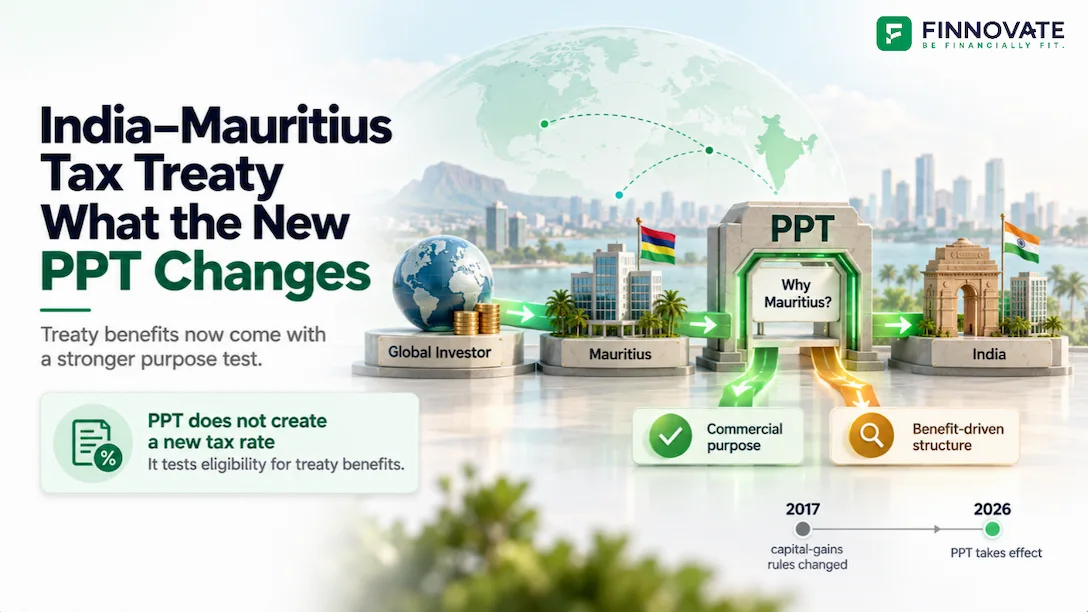
Understand the India–Mauritius tax treaty’s Principal Purpose Test, its August 2026 ef...

Explore India’s AI hardware opportunity through the proposed Adani–Jabil venture, from...
Popular now

Learn how to easily download your NSDL CAS Statement in PDF format with our step-by-step g...

Looking for the best financial freedom books? Here’s a handpicked 2026 reading list with...

Learn what SIF investment means in India, SEBI rules, Rs 10 lakh minimum investment, avail...

Clear guide to mutual fund taxation in India for FY 2025–26 after July 2024 changes: equ...