
Shiller CAPE Ratio Above 40: Is the US Stock Market Overvalued?
The Shiller CAPE ratio is near its 1999 peak. Explore what it means for US stock valuation...
09 October 2026
Last reviewed: May 2026
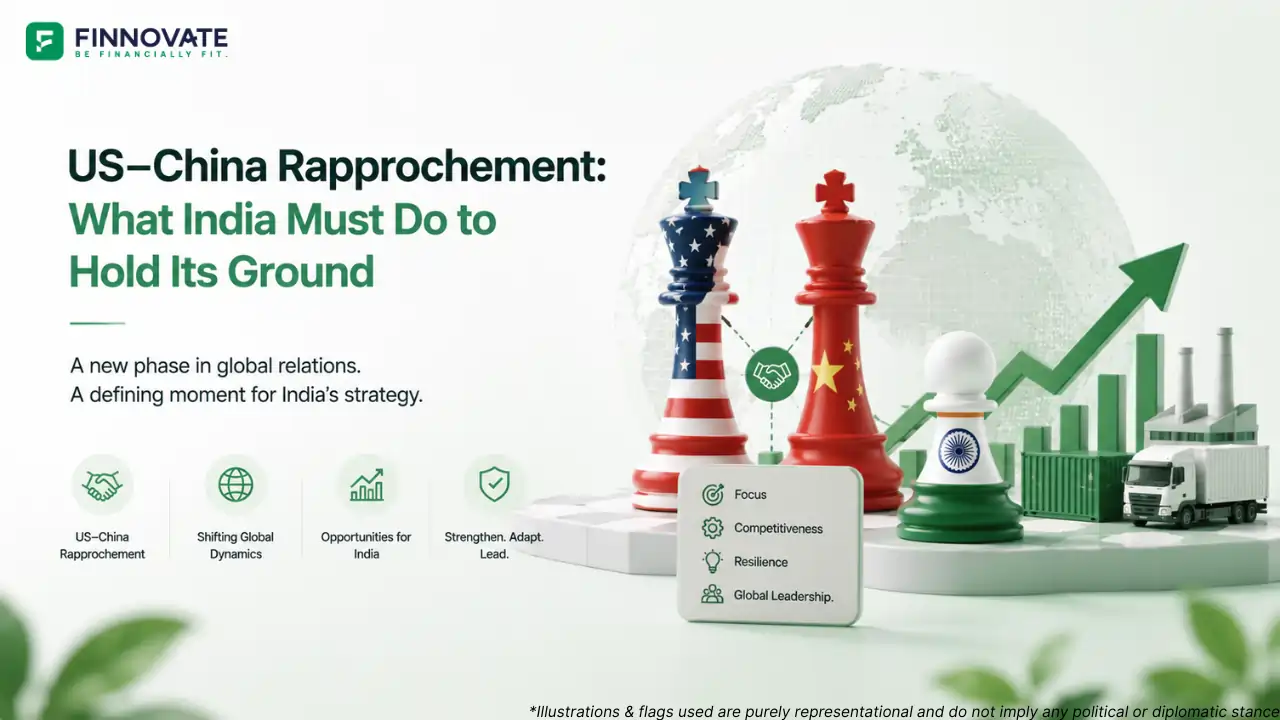
Trump's two-day summit with Xi Jinping in Beijing concluded on May 15, 2026, with both sides describing the meetings as historic. The visit strengthened the fragile trade truce struck in October 2025 at Busan and set up a follow-on meeting in the US in September. Xi and Trump agreed to a "strategic stability" framework for the next three years. Tim Cook of Apple and Elon Musk of Tesla were among the senior business executives accompanying Trump, which signals the trip was as much about commerce as diplomacy.
For India, this development carries real significance. The China Plus One policy has been one of the most consequential geopolitical tailwinds for Indian manufacturing in a decade. If US-China relations stabilise materially, the question is whether that tailwind weakens. The honest answer is: partially, and selectively. The full picture is more nuanced than either the pessimistic or optimistic reading.
This article examines what the Trump-Xi summit actually agreed to, what it means for India's manufacturing position, where India's genuine competitive advantages lie, and what the strategic response for India and Indian businesses should be.
The Beijing summit was significant but not a full reset. Several points are worth understanding clearly before drawing conclusions about India's exposure.
| Area | What Was Agreed | What Was Not Resolved |
|---|---|---|
| Trade framework | Three-year "strategic stability" framework; Board of Trade mechanism to oversee purchase commitments; strengthened October 2025 truce | No new tariff rate announcements; no formal extension of tariff schedule beyond current truce period |
| Tariff baseline | October 2025 Busan truce remains in effect: US tariffs on Chinese goods lowered from 57% to 47%; China resumes US agricultural purchases | No further tariff reductions announced at Beijing; Busan-level rates remain the floor |
| Technology | Preliminary discussions on AI risk and safety frameworks; further cooperation on rare earth supply; fentanyl precursor blocking | Semiconductor export controls not lifted; technology decoupling largely unchanged |
| Taiwan | Xi warned mishandling Taiwan would create "great jeopardy"; Trump described $14 billion Taiwan arms deal as "a very good negotiating chip" held in abeyance | No structural shift in US Taiwan policy; arms deal not cancelled |
| Next steps | Xi invited to visit the US on September 24, 2026; leaders to meet before expiration of the one-year truce | No binding commitments beyond existing truce; implementation will be tracked by the new Board of Trade |
What this means: This is a managed, transactional relationship, not a strategic alliance. Structural tensions over Taiwan, technology, and military presence in the Pacific have not been resolved. They have been managed for a three-year window.
The China Plus One tailwind for India has two distinct components that need to be assessed separately.
US tariffs on Chinese goods made manufacturing in India or Vietnam cheaper for US-market supply chains. This component is partially affected by the diplomatic thaw. As US-China tariff differentials narrow, pure cost arbitrage plays between China and India become less compelling at the margin. Companies evaluating new manufacturing investments in 2026 and 2027 may weigh China more favourably than they would have two years ago.
This is the more durable driver and is largely unaffected by diplomatic normalisation. COVID demonstrated what happens when a single country controls critical supply chains. Apple's goal of assembling most US-bound iPhones in India by end-2026 is a supply chain resilience play, not a tariff arbitrage play. This strategic motivation does not reverse because of a three-year trade truce.
This level of embedded investment and supplier ecosystem development does not reverse quickly. The more realistic risk for India is at the margin: companies evaluating fresh manufacturing investments may weigh China more favourably than before, making it more important that India competes on its own merits rather than relying on China being structurally unavailable.
The most important strategic insight is this: India's strongest competitive positions are not tariff-dependent. They are built on capability, knowledge intensity, and process expertise that China does not easily replicate downward in price. Three sectors stand out.
India's specialty chemicals market was valued at $64.5 billion in 2024 and is projected to reach $92.6 billion by 2033. India ranks 6th globally in chemical production. The competitive advantage here is built on process engineering capability, a skilled workforce, cost-competitive manufacturing, and proven reliability with global buyers. Global manufacturers have been reducing dependence on single-country sourcing in chemicals since well before the US-China trade war, and India has been the primary beneficiary of that structural shift. This advantage does not depend on US-China tariff differentials.
India supplies over 50% of the world's vaccines and is the global leader in generic pharmaceuticals. This is a structural, knowledge-based advantage built over decades of investment in regulatory capability, manufacturing quality systems, and scientific talent. Post-COVID, the importance of India as a reliable supplier of generic medicines has been reinforced rather than reduced. No US-China trade agreement changes this positioning. The India-UK Free Trade Agreement, which came into effect in July 2025 and removed tariffs on 99% of Indian exports, is one example of how India can build independent trade relationships.
India's automobile sector, including the rapidly growing EV component manufacturing base, has genuine export strength built on quality, cost balance, and a diversified customer base across Europe, the US, and Southeast Asia. Auto component exports have grown steadily and are not primarily tariff-arbitrage plays. The deeper competitive moat is the supplier ecosystem that has developed around India's auto manufacturing hubs, which creates switching costs for global OEMs that have integrated Indian suppliers into their production networks.
What this means: India's three strongest export sectors compete on capability, not on China being expensive. A US-China trade truce does not change the competitive dynamics in these sectors. The risk is in sectors that relied primarily on tariff-driven cost differentials.
India cannot and should not try to replicate China's manufacturing model. China's scale, supplier ecosystem density, and infrastructure depth took four decades to build. Competing with China on breadth is a losing strategy for a country at India's current stage of industrial development.
The mandate is to build deeper moats in sectors of genuine and defensible advantage: specialty chemicals where process capability creates switching costs, pharmaceuticals where regulatory credibility creates entry barriers, auto components where quality and cost balance creates OEM dependencies, and software services where talent density creates genuine stickiness.
The PLI scheme, extended to 2030, is a structural support instrument. But PLI subsidies are a floor, not a ceiling. Long-term competitive advantage will come from companies that use the subsidy period to build world-class operational capabilities rather than from subsidy dependency alone.
One additional strategic priority deserves specific attention: accelerating the India-US bilateral trade agreement negotiations. A formal bilateral trade architecture would create a more durable foundation for India's trade relationship with the US that does not depend on the US-China relationship remaining adversarial. India's trade diplomacy is as important a strategic lever as its manufacturing competitiveness.
For investors in Indian equities, the US-China rapprochement creates a more nuanced environment than a straightforward positive or negative read. The impact is sector-specific.
| Sector | Exposure to US-China Normalisation | Reason |
|---|---|---|
| Pharmaceuticals and generics | Low | Capability-based advantage; post-COVID supply chain imperative unchanged; independent of tariff environment |
| Specialty chemicals | Low | Process engineering moat; structural shift from China diversification underway regardless of US-China tariffs |
| Software services / IT | Low | Talent-density advantage; US-China relationship is not a driver of IT outsourcing decisions |
| Auto and auto components | Low to Medium | Supplier ecosystem stickiness; EV component push is domestic and Europe-driven, not tariff-arbitrage |
| Electronics manufacturing (PLI) | Medium | Some tariff-arbitrage component; new FDI decisions may weigh China more favourably at the margin; embedded investments provide buffer |
| Logistics and supply chain | Potential benefit | Global supply chain normalisation reduces systemic friction costs; broad positive for trade volumes |
US-China trade dynamics affect different parts of an Indian equity portfolio in different ways. Whether your sector exposure is calibrated to this environment is worth reviewing. We can walk through the implications for your specific portfolio in a 30-minute call.
Book a free callThe May 14-15, 2026 summit strengthened the October 2025 trade truce, which had lowered US tariffs on Chinese goods from 57% to 47% in exchange for Chinese agricultural purchases and rare earth cooperation. The two sides agreed to a three-year "strategic stability" framework and a Board of Trade to oversee purchase commitments. A follow-on Xi visit to the US is planned for September 2026. No new major tariff announcements were made at Beijing.
Partially and selectively. Companies that moved manufacturing to India primarily to avoid Chinese tariffs may reassess some decisions at the margin. However, the more structural driver of India's manufacturing gains, supply chain diversification as a risk management imperative, is largely unaffected by diplomatic normalisation. Apple's India investment of this scale is driven by resilience, not just tariff arbitrage, and does not reverse quickly.
Electronics manufacturing and smartphone assembly PLI beneficiaries face the most direct uncertainty, as the tariff differential that made Chinese manufacturing relatively more expensive has narrowed. Sectors built on capability rather than tariff advantage, including pharmaceuticals, specialty chemicals, and auto components, are considerably less exposed to the diplomatic thaw.
Pharmaceuticals and generics, specialty chemicals, software services, and auto components. These sectors compete on process capability, regulatory expertise, scientific talent, and quality standards that exist independently of the US-China tariff environment and are not quickly replicated even if US-China trade relations continue to improve.
Deepening competitive advantages in sectors of genuine strength rather than competing with China on manufacturing breadth. Simultaneously, accelerating India-US bilateral trade agreement negotiations to build a durable trade architecture independent of US-China dynamics. This is not investment advice. Please consult a SEBI-registered investment adviser for portfolio decisions.
The impact is sector-specific. Pharmaceuticals, specialty chemicals, and software services carry low exposure. Electronics manufacturing companies may face some headwind on new FDI flows at the margin. Globally, reduced US-China trade friction benefits supply chain normalisation and may reduce systemic costs across logistics and commodity-linked sectors. This is not investment advice. Please consult a SEBI-registered investment adviser before making any portfolio decisions.
Disclaimer: This article is for general information and educational purposes only. It does not constitute investment advice, a recommendation, or an offer to buy or sell any securities or financial instruments. Information on the Trump-Xi summit sourced from publically available news sources, published May 2026. India manufacturing and trade data sourced from IBEF, publicly available government data, and verified news reporting. The sector impact assessments represent the views of the author based on publicly available information and are not investment recommendations. Past market behaviour and geopolitical developments are not indicative of future outcomes. No investment decision should be made based solely on the contents of this article. Please consult a SEBI-registered investment adviser or qualified financial professional before making any investment decision. Equity investments are subject to market risks.
No spam. Only new posts, simple explainers, and practical money checklists for busy professionals.
Finnovate is a SEBI-registered financial planning firm that helps professionals bring structure and purpose to their money. Over 3,500+ families have trusted our disciplined process to plan their goals - safely, surely, and swiftly.
Our team constantly tracks market trends, policy changes, and investment opportunities like the ones featured in this Weekly Capsule - to help you make informed, confident financial decisions.
Learn more about our approach and how we work with you:
No comments yet. Start the conversation. What would you add?
No spam. Only new posts, simple explainers, and practical money checklists.
You may also like
The Shiller CAPE ratio is near its 1999 peak. Explore what it means for US stock valuation...

Can Starlink change internet access in India? Explore why Jio and Airtel signed deals, how...

AI demand is pushing up memory chip prices. Here's why the shortage could make smartphones...

FPIs sold ₹35,861 crore in Indian equities in September 2026. See which sectors saw outf...
Popular now

Learn how to easily download your NSDL CAS Statement in PDF format with our step-by-step g...

Looking for the best financial freedom books? Here’s a handpicked 2026 reading list with...
Learn what SIF investment means in India, SEBI rules, Rs 10 lakh minimum investment, avail...

Clear guide to mutual fund taxation in India for FY 2025–26 after July 2024 changes: equ...