

How India Saves and Invests: Where Household Money Goes
See how Indian households save and invest across deposits, insurance, mutual funds and sto...
07 October 2026

Finnovate’s editorial team researches and creates financial content using trusted sources, regulatory references and inputs from subject experts.
You have ₹10 lakh to invest.
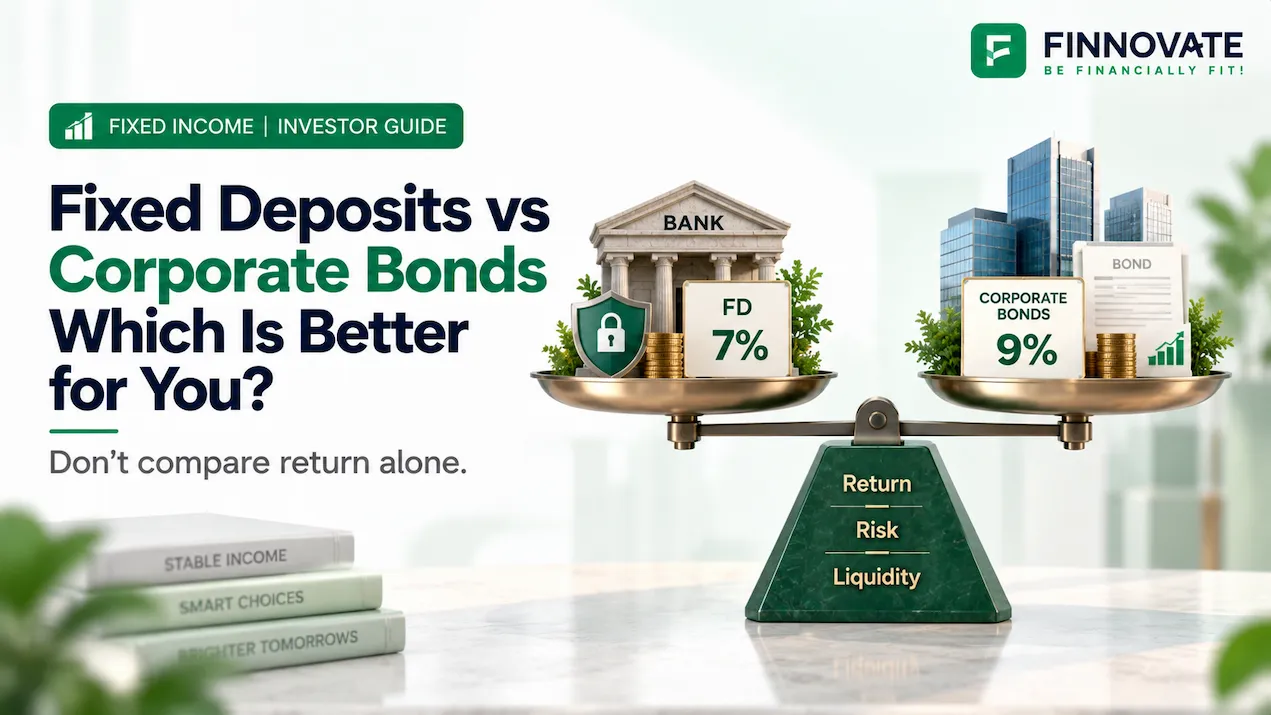
A bank fixed deposit is offering around 7%, while a corporate bond is offering around 9%.
At first glance, the choice may look simple. If both are fixed-income investments, why not choose the one offering the higher return?
Because that extra return does not come free.
With a bank FD, you are placing money with a bank at a predetermined interest rate. With a corporate bond, you are lending money to a company. The borrower is different, the risks are different, and even the number shown as the “return” may mean something different.
So the right question is not:
“Which one gives a higher return?”
It is:
“Which one gives me the right combination of return, risk, liquidity and predictability for the money I am investing?”
The Verdict: Neither is automatically better.
A bank FD is generally simpler and offers predictable returns, along with DICGC deposit insurance within the applicable limit.
A corporate bond can offer a higher yield, but you take additional risks such as issuer default risk, price fluctuations and lower liquidity.
The better choice depends on when you need the money, how much risk you can take and whether the additional yield is worth that additional risk.
Table of Contents
A bank Fixed Deposit (FD) is money deposited with a bank for a chosen period at a predetermined interest rate. Depending on the FD, interest may be paid periodically or accumulated and paid at maturity.
A corporate bond is a debt instrument issued by a company. When you buy one, you are effectively lending money to that company. In return, the company promises to make interest payments according to the bond terms and repay the principal on maturity.
For example, suppose a bond has:
The ₹90 is the scheduled annual interest on the bond's face value.
But unlike an FD, the price at which you buy or sell a bond can be higher or lower than its face value. That means the coupon rate is not always the same as the return you may actually earn.
| Factor | Bank FD | Corporate Bond |
|---|---|---|
| Who receives your money? | Bank | Company issuing the bond |
| Interest | Predetermined FD rate | Coupon as per bond terms |
| Actual return | Usually straightforward from FD terms | Depends on coupon, purchase price, maturity value and YTM |
| Market price | Does not fluctuate like a traded bond | Can rise or fall |
| Credit risk | Exposure to the bank, with DICGC protection for eligible deposits within limits | Depends on the issuer's ability to repay |
| DICGC insurance | Available for eligible deposits up to applicable limits | Not available |
| Early exit | Usually possible subject to bank terms and premature withdrawal rules | May require selling in the secondary market |
| Liquidity | Generally simpler, subject to FD terms | Depends on buyers and market activity |
| Complexity | Relatively simple | Requires understanding credit quality, YTM, maturity and bond terms |
| May suit investors seeking | Predictability and simplicity | Potentially higher yield with willingness to take additional risk |
One important distinction: this article is comparing corporate bonds with bank FDs.
Corporate or NBFC fixed deposits are different. Deposits mobilised by NBFCs are not covered by DICGC deposit insurance.
Bank FDs are widely used when investors want a known interest rate and a defined maturity date.
But saying that “FDs are completely risk-free” would be inaccurate.
Eligible deposits with an insured bank are covered by the Deposit Insurance and Credit Guarantee Corporation (DICGC) up to ₹5 lakh per depositor per bank in the same right and same capacity, including principal and accrued interest.
This ₹5 lakh limit is not calculated separately for every FD.
For example, if you have with the same bank in your individual name:
your deposits are aggregated for DICGC purposes. The insurance limit does not become ₹5 lakh for each account.
Deposits held with different insured banks are considered separately for the insurance limit.
So when evaluating a large FD allocation, look beyond the interest rate and understand how much of your total deposit is actually covered.
Because investors usually expect to be compensated for taking additional risk.
Suppose:
That extra 2 percentage points should not be viewed simply as a bonus.
The bond investor may be taking additional:
The higher yield is partly the market's way of compensating investors for taking those risks.
And generally, the more attractive a bond's yield looks relative to comparable alternatives, the more carefully you should understand why that yield is higher.
This is one of the most important concepts to understand before comparing corporate bonds with FDs.
The coupon rate tells you the scheduled interest payment on the bond's face value.
Suppose a bond has:
The scheduled annual coupon is:
If the bond pays annually and you hold it for three years, the scheduled coupon payments total:
But this still does not tell you the complete return from buying the bond.
Why?
Because you may not have paid ₹10 lakh for it.
Suppose the same bond has:
You pay ₹9.50 lakh today.
If the issuer makes all payments as scheduled, you receive ₹90,000 each year and ₹10 lakh at maturity.
So apart from the coupon payments, you also receive ₹50,000 more than your original purchase price when the principal is repaid.
That is why simply saying:
“This is a 9% bond”
does not tell you its complete return.
Yield to Maturity (YTM) estimates the annualised return implied by a bond's current purchase price and its future scheduled cash flows if:
Unlike the coupon rate, YTM takes into account the price you actually pay for the bond.
In the earlier example, where a 9% coupon bond with a ₹10 lakh face value is purchased for ₹9.50 lakh with three years remaining, the YTM is approximately 11.05%, assuming annual coupon payments and full repayment at maturity.
Why a 9% Coupon Can Have an 11.05% YTM
A simplified cash-flow view. YTM considers what you pay today and the scheduled cash flows you receive until maturity.
Coupon = 9%
YTM ≈ 11.05%
The difference exists because the bond is being purchased below its ₹10 lakh face value.
It is also why comparing a 7% FD directly with a bond carrying a 9% coupon can be misleading.
For a better comparison, look at the FD's effective return and the bond's YTM, and then compare the risks, liquidity and tax treatment.
A higher yield may look attractive, but the first question should be:
Where is that extra yield coming from?
This is credit or default risk.
When you buy a corporate bond, you depend on the issuer to make interest and principal payments.
If the company's financial position deteriorates, it may face difficulty meeting those obligations.
That is why investors often look at factors such as:
No.
Credit ratings provide an assessment of credit risk, but they are not a guarantee of repayment.
Ratings can also change if the issuer's financial position changes.
A high credit rating can be one input in your assessment. It should not be the only input.
A secured bond has identified assets or security backing the borrowing according to the terms of the issue.
An unsecured bond does not have specific collateral backing the borrowing.
But “secured” should not be read as “guaranteed.”
If a company defaults, actual recovery can depend on the value of the security, priority of claims, documentation and the recovery process.
Corporate bonds can also experience market-price movements.
Generally:
Why?
Suppose you own an existing bond paying 7%, but similar new bonds begin offering 8%.
A buyer may find your 7% bond less attractive at the old price.
Its market price may therefore have to fall for its effective yield to become competitive.
The reverse can happen when prevailing yields fall.
This matters particularly when you need to sell a bond before maturity.
This is liquidity risk.
A bond may be listed on an exchange and technically available for trading. That does not necessarily mean you can sell a large quantity immediately at the price you expect.
You may face difficulty selling if:
An FD works differently.
Banks generally allow premature withdrawal of many FDs, but the interest paid may be lower and a premature-withdrawal penalty may apply according to the bank's terms.
If this money may be needed for an emergency, liquidity deserves more weight than an additional percentage point of expected return.
It can reduce the importance of temporary market-price fluctuations, provided you genuinely do not need to sell the bond before maturity.
If the issuer makes all scheduled payments, temporary movements in the market price do not change the contractual maturity amount.
But holding until maturity does not remove:
Some bonds are callable.
This means the issuer may have the right to repay the bond before its original maturity date according to specified terms.
Suppose you hold a high-coupon bond and interest rates fall sharply.
If the issuer exercises a call option, you may receive your money earlier than expected and then have to reinvest it at lower prevailing rates.
Let us now make a simple like-for-like comparison.
Assume:
Annual interest:
Over three years:
| FD Calculation | Amount |
|---|---|
| Amount invested | ₹10,00,000 |
| Annual interest | ₹70,000 |
| Interest over 3 years | ₹2,10,000 |
| Principal returned | ₹10,00,000 |
| Total cash received | ₹12,10,000 |
Annual coupon:
Over three years:
| Corporate Bond Calculation | Amount |
|---|---|
| Amount invested | ₹10,00,000 |
| Annual coupon | ₹90,000 |
| Coupons over 3 years | ₹2,70,000 |
| Principal repaid at maturity | ₹10,00,000 |
| Total cash received | ₹12,70,000 |
The bond generates ₹60,000 more scheduled income over the three-year period in this simplified example.
But that does not mean the bond is automatically better.
That is the real comparison.
Tax can materially change your final return.
Interest earned from a bank FD is generally taxable according to your applicable income-tax slab.
TDS rules may also apply, but TDS is only tax deducted at source. It is not necessarily your final tax liability.
Coupon or interest income from a corporate bond is also generally taxable according to the investor's applicable tax provisions.
So if you are comparing an FD interest rate with a corporate bond yield, do not assume the higher pre-tax number will automatically translate into the same additional post-tax return.
Capital-gains rules may apply where there is a difference between your acquisition cost and the amount received on transfer or redemption.
Under the tax rules currently applicable:
| Bond Situation | Broad Tax Treatment |
|---|---|
| Listed bond held for 12 months or less | Generally treated as a short-term capital asset |
| Listed bond held for more than 12 months | Generally treated as a long-term capital asset |
| LTCG on listed bonds for transfers on or after 23 July 2024 | Generally taxable at 12.5% without indexation |
| Unlisted bonds covered by Section 50AA and transferred, redeemed or matured on or after 23 July 2024 | Gain is deemed short-term irrespective of holding period |
The important takeaway is simple:
A fixed-income return should also be looked at in purchasing-power terms.
Suppose an investment earns 7% while inflation averages 5%.
Your money may still grow, but the increase in what that money can actually buy is much smaller than the headline 7%.
This becomes increasingly important for long-term goals such as retirement, where simply preserving the number of rupees may not be enough.
A bank FD may be more suitable when:
For investors with several future cash requirements, it may also make sense to spread FDs across different maturity dates rather than locking the entire amount into a single maturity.
A corporate bond may warrant evaluation when:
The last point deserves attention.
A bond can look attractive on its own and still be unsuitable if too much of your portfolio depends on a single company's ability to repay.
Consider two investors.
Rahul plans to use ₹10 lakh toward a house-related payment in about two years.
He cannot afford a meaningful loss or a delay in accessing the money close to the payment date.
For him, the highest available yield may not be the main priority.
The possibility of having to sell a corporate bond before maturity, facing weak liquidity or dealing with an issuer-related problem can matter more than earning an additional return.
A suitable bank FD structure may therefore be better aligned with this type of requirement.
Praveen already has a separate emergency fund and does not expect to need this money for the next three to five years.
He understands credit risk, is comfortable evaluating the issuer and can potentially hold a bond until maturity.
For an investor in this situation, selected corporate bonds may warrant evaluation if the additional yield sufficiently compensates for the additional risk.
But even here, choosing the bond with the highest YTM is not automatically the right approach.
Before evaluating an individual corporate bond, ask:
| Question | What to Check |
|---|---|
| Who is borrowing my money? | Issuer's business and financial position |
| How strong is its repayment ability? | Cash flows, debt levels, credit rating and outlook |
| How much could I earn? | YTM, not just coupon |
| What price am I paying? | Market price relative to face value |
| When will I get my principal back? | Maturity date |
| Could the issuer repay early? | Call provisions |
| Can I exit before maturity? | Trading activity and liquidity |
| What if interest rates change? | Possible market-price movement |
| Is the bond secured? | Security, collateral and terms |
| What happens if there is a default? | Claim priority and recovery provisions |
| What could I keep after tax? | Tax on interest and applicable capital gains |
| How much am I putting into one issuer? | Concentration risk |
| When will I actually need this money? | Match maturity with your financial goal |
That final question is often more important than the headline return.
An investment can be attractive in isolation and still be the wrong fit if its risk or maturity does not match the purpose of your money.
Choosing between an FD and a corporate bond is one decision. The bigger question is how your debt allocation works alongside equity, cash, retirement goals, taxes and future withdrawals.
Finnovate's Wealth Management approach brings these decisions together through goal-linked portfolio allocation, ongoing reviews and rebalancing based on your overall financial needs.
Explore Finnovate Wealth ManagementThere is no universal winner.
If your priority is:
a bank FD may fit the requirement better.
If you are willing to take:
in exchange for potentially higher yields, selected corporate bonds may deserve consideration.
But do not make the decision by comparing only:
7% FD vs 9% bond.
A better comparison is:
Corporate bonds and FDs can both have a role in a portfolio, but they solve different needs.
The best investment is not necessarily the one showing the highest return.
It is the one where you understand where the return comes from, what can go wrong, when you will get your money back and whether those terms match what you need the money for.
And before deciding how much to hold in either, look at the larger portfolio. Your overall allocation across equity, debt, gold, cash and other assets should be connected to your goals, time horizon and ability to take risk.
Tax rules and regulatory provisions referenced in this article are based on the rules applicable at the time of publication. Investors should check the latest provisions before making a decision.
Disclaimer: This article is for educational and informational purposes only and should not be considered investment, tax or legal advice or a recommendation to buy or sell any security. Corporate bonds are subject to credit, liquidity, interest-rate and other risks. Returns or repayment are not guaranteed merely because a bond carries a credit rating or is secured. Tax treatment depends on the instrument and investor circumstances and may change over time. Please evaluate your individual requirements and consult an appropriate professional where required.
No spam. Only new posts, simple explainers, and practical money checklists for busy professionals.
Finnovate is a SEBI-registered financial planning firm that helps professionals bring structure and purpose to their money. Over 3,500+ families have trusted our disciplined process to plan their goals - safely, surely, and swiftly.
Our team constantly tracks market trends, policy changes, and investment opportunities like the ones featured in this Weekly Capsule - to help you make informed, confident financial decisions.
Learn more about our approach and how we work with you:
No comments yet. Start the conversation. What would you add?
No spam. Only new posts, simple explainers, and practical money checklists.
You may also like
See how Indian households save and invest across deposits, insurance, mutual funds and sto...

Received a ₹10 lakh bonus? Learn how to decide between spending, debt repayment, near-te...
Should your emergency fund stay in a savings account? Learn how to split it across savings...

Financial planning for DINK couples in India covering cash flow, emergency funds, investme...
Popular now

Learn how to easily download your NSDL CAS Statement in PDF format with our step-by-step g...

Looking for the best financial freedom books? Here’s a handpicked 2026 reading list with...
Learn what SIF investment means in India, SEBI rules, Rs 10 lakh minimum investment, avail...
Clear guide to mutual fund taxation in India for FY 2025–26 after July 2024 changes: equ...