
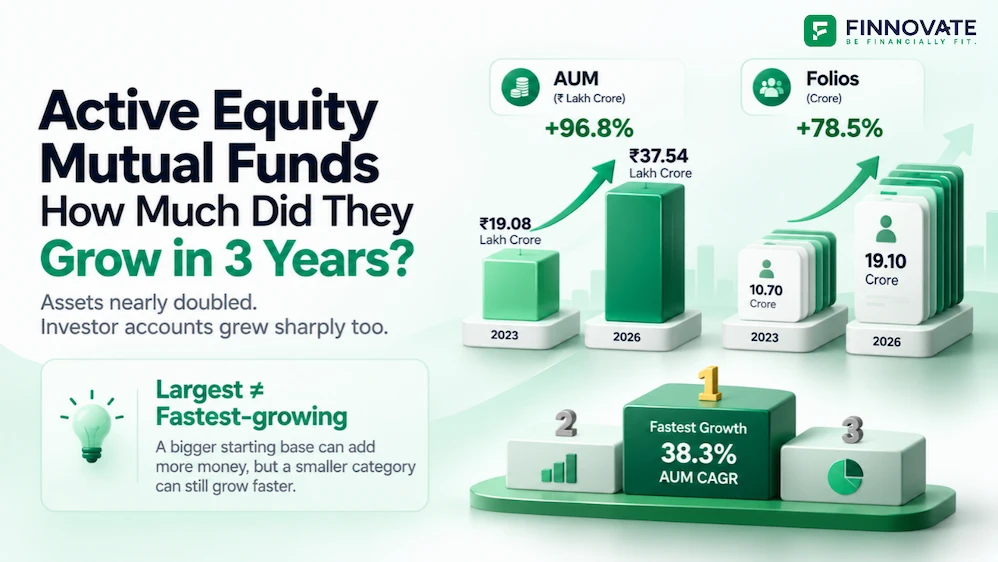
Active Equity Fund Growth 2023–2026: AUM & Folio Rankings
Compare active equity mutual fund growth from September 2023 to September 2026, with categ...
21 October 2026

In December 2025, the RBI cut the repo rate by 25 basis points (one basis point equals 0.01%, so 25 basis points means a 0.25% reduction), completing a cumulative cut of 125 basis points, or 1.25%, over the year. For most investors, a rate cut is good news. Cheaper borrowing, lower EMIs, a boost to economic activity. Many who held debt mutual funds expected their fund values to rise.
Some were confused when their long-duration debt fund NAVs did not move the way they anticipated, or moved differently from their short-duration ones. Others noticed that even within the same rate-cut cycle, bond yields on the 10-year government security were rising rather than falling.
Both experiences point to the same underlying gap: most investors who hold debt funds do not have a working model of how bond prices actually behave. This article builds that model from the ground up, using India's bond market as the context throughout.
RBI cut rates 125 bps across 2025, yet the 10-year G-Sec yield climbed to a 16-month high of 6.89% by March 2026, widening the gap to ~160 bps.
Sources: RBI monetary policy statements (2025-2026); Trading Economics, March 2026
In April 2020, Franklin Templeton shut six of its debt mutual fund schemes in India. The immediate cause was a liquidity problem in credit markets during the early pandemic period. But for millions of investors who had assumed debt funds were safe and stable, the episode raised a more basic question: how could a fund that holds bonds, not stocks, lose value?
The answer is not unique to Franklin. It sits at the heart of how all fixed-income instruments are priced. A bond is not a fixed deposit. Its market value changes every single day, in response to interest rate movements in the economy. And the direction of that change is always opposite to the direction of the rate move.
To understand why bond prices move opposite to interest rates, start with a situation that is easy to picture.
Imagine you hold a bond that guarantees you a 7% return on your ₹1,000 every year. That is ₹70 annually, fixed for the life of the bond.
The reverse works the same way. When rates fall to 6%, your 7% bond is suddenly the better deal. Buyers are willing to pay more than ₹1,000 for it. The price rises.
When new bonds offer higher coupons, existing bonds become less attractive. Their price must fall to bring the yield in line with current market rates.
Toggle between modes to see the inverse relationship in both directions.
A debt mutual fund holds a portfolio of bonds. Its NAV, calculated daily, reflects the current market value of all those bonds. When bond prices fall because interest rates have risen, the NAV of the fund falls. When bond prices rise because rates have fallen, the NAV rises.
The scale matters here. If a fund holds ₹100 crore of bonds and those bonds fall 1% in market value, that is ₹1 crore wiped from the fund's assets in one day, before any coupon income is counted. For a large debt fund, even small yield moves translate into significant rupee swings on the NAV.
This is why debt funds are not the same as fixed deposits, even though both involve lending money and receiving interest. An FD's stated value does not fluctuate. It accrues at the promised rate and the principal is returned intact at maturity. A debt fund's NAV moves daily, because the bonds inside it are continuously marked to their current market price.
The daily NAV move has two components:
On most days, both work together and the NAV ticks up quietly. On days when rates move sharply, the capital change component can overwhelm the accrual, pulling the NAV down even though the fund is still earning coupon income.
In a falling rate environment, the capital appreciation component adds to returns and NAV moves up. In a rising rate environment, capital depreciation can offset the yield accrual component, and NAV can fall even though the fund is still earning coupons every day.
On a quiet day when rates hold steady, a debt fund earns a small amount from its bonds' coupons. If the fund holds ₹100 crore in bonds paying 7% annually, it earns roughly ₹19,178 that day just from coupon income. This is the accrual component, and it nudges NAV up slightly every single day regardless of what markets do.
On a day when the RBI signals a rate hike and bond yields jump sharply, the market value of those same bonds falls. That capital loss can be larger than one day's accrual, pulling the NAV down for the day. The coupon income did not stop, but the price drop overwhelmed it. Both effects appear in the same daily NAV number.
Not every debt fund reacts to the same rate move in the same way. A short-duration fund and a long-duration fund can hold bonds with similar credit quality, yet one barely moves while the other drops sharply in response to the same interest rate change.
The variable that determines sensitivity to rate moves is duration. Duration, in its practical form called modified duration, measures how much a bond's price will change for every 1% change in interest rates. It is expressed in years. A bond with a modified duration of 2 years will see its price fall by approximately 2% if interest rates rise by 1%. A bond with a modified duration of 7 years will see its price fall by approximately 7% for the same rate move.
The implication is direct. Longer-duration funds carry more interest rate risk. They have higher potential for capital gain when rates fall, and higher potential for capital loss when rates rise. Shorter-duration funds are less sensitive in both directions.
The scale of difference is larger than most investors expect:
| Fund type | Typical modified duration | NAV fall if rates rise 1% | NAV gain if rates fall 1% |
|---|---|---|---|
| Liquid / overnight | ~0.1 years | ~0.1% | ~0.1% |
| Short duration | ~1.5 to 2 years | ~1.5 to 2% | ~1.5 to 2% |
| Long duration / gilt | ~6 to 7 years | ~6 to 7% | ~6 to 7% |
Typical modified duration ranges per SEBI debt fund category. Modified duration equals approximate NAV sensitivity to a 1% rate change. Actual fund duration varies.
Sources: SEBI fund categorisation norms; AMFI factsheet disclosures.
As of late March 2026, the modified duration of a corporate bond fund in the medium duration category is approximately 3.4 years, meaning a 1% rise in yields would translate to roughly a 3.4% fall in NAV, partially offset by ongoing accrual.
When the RBI cuts or raises the repo rate, it is changing the overnight borrowing rate: the rate at which banks borrow from the RBI for one day. This rate anchors the short end of the interest rate curve. Longer-term bond yields, such as the 10-year government security yield, are set by the market and reflect a different set of factors.
Think of it this way: the RBI controls the cost of borrowing money overnight. But the yield on a 10-year government bond is set by thousands of buyers and sellers in the market every day, and they are weighing up a much longer list of considerations.
If investors expect inflation to be higher over the next decade, they demand a higher yield to compensate for the erosion of purchasing power. A rate cut today does not automatically change long-term inflation expectations.
When the government borrows heavily by issuing large volumes of bonds, more supply enters the market. More supply with the same demand pushes prices down and yields up, regardless of what the RBI does with the repo rate.
Indian bond yields do not move in isolation. When US Treasury yields rise, global investors reallocate, and emerging market bonds including India's face selling pressure. This pushes Indian yields higher even if domestic policy is easing.
FPIs are significant buyers of Indian debt. When they exit, bond prices fall and yields rise. Geopolitical stress, a weaker rupee, or higher yields abroad can all trigger FPI outflows from Indian bonds, pushing domestic yields upward.
These factors can push long-term yields in a different direction from the repo rate. India witnessed exactly this during the 2025 rate-cut cycle. The RBI reduced the repo rate by 125 basis points across the year, taking it from 6.50% to 5.25%. Yet the 10-year government bond yield climbed to 6.87-6.90% by late March 2026, reaching a 16-month high.
The two rates diverged because heavy government borrowing, elevated fiscal pressure, and geopolitical stress around oil prices pushed long-term yields higher even as the policy rate came down. Investors who assumed that RBI rate cuts would automatically lift the NAV of their long-duration gilt funds found themselves watching those funds move sideways or slightly negative instead.
This gap between the repo rate and the 10-year yield, currently around 160 basis points, is an important number. It reflects the market pricing in supply-side pressure and uncertainty, even as the central bank has eased policy considerably.
For further context on how foreign portfolio flows have shaped Indian market conditions through this period, see the FPI outflows analysis for early March 2026 on this blog.
As of late March 2026, the RBI's April 8 monetary policy meeting approaches with unusual uncertainty. Goldman Sachs has forecasted a 50 basis point rate hike to defend the rupee amid rising oil prices. HSBC has called for a hold. The street is split.
What does that mean in plain terms for someone holding a debt fund?
Bond yields will move upward. A fund with a modified duration of 6 years could see its NAV fall roughly 3% if yields rise 0.5%. A fund with a modified duration of 1 year would see a fall closer to 0.5%. The longer the duration, the harder the NAV gets hit by a hike. The impact is temporary if you hold long enough, but it is real in the short term.
Bond yields are likely to stay elevated, as they are already pricing in pressure from high oil prices and government borrowing. The fund continues earning coupon income every day. Short-duration funds will feel relatively stable. Long-duration funds stay exposed to any fresh yield movement.
Understanding modified duration does not tell you what the RBI will do. But it does tell you exactly how your fund will respond to whichever outcome arrives. Check your factsheet before April 8, note your fund's modified duration, and you will know the approximate NAV sensitivity to a 1% rate move in either direction.
Every debt mutual fund factsheet discloses three numbers that carry most of the information needed to assess interest rate risk.
The sensitivity measure. It tells how much the NAV will move for a 1% change in yields. A modified duration of 3.42 years means the NAV falls approximately 3.4% if yields rise 1%, and rises approximately 3.4% if yields fall 1%.
Think of it as the average number of years before the fund gets its money back from its bonds. A fund with an average maturity of 4 years has bonds that, on average, return the principal in about 4 years. It is always longer than modified duration for regular coupon-paying bonds, because the fund receives coupon payments along the way before the principal comes back at the end.
The return the fund would earn if all its bonds were held to maturity and coupons were reinvested. It is the fund's running yield before expenses. For investors with a long horizon who plan to hold through a rate cycle, YTM is the return that matters. For shorter-horizon investors, NAV volatility driven by duration is the more relevant variable.
Hypothetical illustration only. Not a real fund. Values are representative of a medium duration category fund.
Source: SEBI fund categorisation norms; AMFI factsheet disclosure requirements.
Reading these three numbers together gives a more complete picture than any single figure alone. A fund with high YTM and high modified duration offers potential upside if rates fall, but carries meaningful NAV risk if rates rise. A fund with moderate YTM and low modified duration offers more stable NAV behaviour but less capital appreciation potential.
Higher modified duration means higher sensitivity to interest rate changes, which cuts both ways. In a falling rate environment, a higher-duration fund will gain more. In a rising rate environment, it will lose more. Whether that constitutes more risk depends on the investor's time horizon and rate environment. Please consult a SEBI-registered investment adviser to understand which duration profile suits your specific goals.
Average maturity is the weighted average time until the bonds in a fund mature and return principal. Modified duration is the measure of price sensitivity to interest rate changes. For coupon-paying bonds, modified duration is always lower than average maturity because coupons are received before the maturity date, shortening the weighted life of the cash flows. Zero-coupon bonds are the exception: their modified duration equals their maturity.
Modified duration is disclosed in every debt mutual fund's monthly factsheet, which fund houses are required to publish under SEBI norms. It is also available on the AMFI website and on most mutual fund research platforms. Look for it under the portfolio characteristics or risk metrics section of the factsheet.
Yes, to a meaningful degree. Here is why: when rates rise, the NAV dips immediately because bond prices fall. But those same higher rates mean the fund now reinvests its coupon income at better rates going forward. Over time, the extra reinvestment income broadly offsets the initial price loss.
A rough rule: if a fund has a modified duration of 3 years and rates rise 1%, the NAV falls roughly 3%. But if you stay invested for approximately 3 years, the higher reinvestment rate broadly recovers that loss. This is the principle behind target maturity funds, which are structured to be held to a defined maturity date. For actively managed debt funds the same principle applies, though less precisely.
Yield to maturity (YTM) is the annualised return a fund would earn if all its underlying bonds were held to maturity and all coupons were reinvested at the same rate. It represents the fund's running yield before expenses. For long-horizon investors who plan to hold through interest rate cycles, YTM is the most relevant return indicator. For shorter-horizon investors, the NAV volatility implied by modified duration matters more than YTM alone. Please consult a SEBI-registered investment adviser before making any investment decision.
Disclaimer: This article is for general information and educational purposes only. It does not constitute investment advice, a recommendation, or an offer to buy or sell any securities or financial instruments. Bond yield data, RBI policy rate information, and debt mutual fund metrics referenced in this article are based on publicly available sources including Trading Economics (March 2026), RBI monetary policy statements, SEBI-mandated fund disclosures, and publicly available debt fund factsheets, and are subject to revision. Past market behaviour and bond price patterns are not indicative of future outcomes. Investors should not make any investment decision based solely on this article. Please consult a SEBI-registered investment adviser or qualified financial professional before making any investment decision. Mutual fund investments are subject to market risks. Please read all scheme-related documents carefully before investing.
No spam. Only new posts, simple explainers, and practical money checklists for busy professionals.
Finnovate is a SEBI-registered financial planning firm that helps professionals bring structure and purpose to their money. Over 3,500+ families have trusted our disciplined process to plan their goals - safely, surely, and swiftly.
Our team constantly tracks market trends, policy changes, and investment opportunities like the ones featured in this Weekly Capsule - to help you make informed, confident financial decisions.
Learn more about our approach and how we work with you:
No comments yet. Start the conversation. What would you add?
No spam. Only new posts, simple explainers, and practical money checklists.
You may also like
Compare active equity mutual fund growth from September 2023 to September 2026, with categ...

Explore September 2026 ETF and index fund flows, with category-wise inflows, outflows, AUM...

Equity fund net inflows rose 30.61% to ₹38,306.55 crore in September 2026. Compare 13 ca...

Equity mutual funds received ₹29,329 crore in August 2026. See which categories saw the ...
Popular now

Learn how to easily download your NSDL CAS Statement in PDF format with our step-by-step g...

Looking for the best financial freedom books? Here’s a handpicked 2026 reading list with...
Learn what SIF investment means in India, SEBI rules, Rs 10 lakh minimum investment, avail...

Clear guide to mutual fund taxation in India for FY 2025–26 after July 2024 changes: equ...