

How India Saves and Invests: Where Household Money Goes
See how Indian households save and invest across deposits, insurance, mutual funds and sto...
07 October 2026


Finnovate’s editorial team researches and creates financial content using trusted sources, regulatory references and inputs from subject experts.
Choosing a financial advisor is not simply about finding someone who knows which mutual fund or stock to recommend.
A financial advisor may influence decisions involving your retirement, children’s education, insurance, taxes, debt, investments and the transfer of wealth to your family. The wrong advice can create unsuitable investments, unnecessary costs, tax problems or risks that become visible only after several years.
The right advisor, on the other hand, should help you organise your finances, connect your investments to specific goals, manage risks and make better decisions during both rising and falling markets.
But how do you identify the right person?
This guide provides a step-by-step framework to help you compare, verify and select a financial advisor in India.
Define the type of help you need, identify whether the professional is an adviser, distributor, agent or broker, verify the relevant registration, understand every fee and commission, review the service scope and examine the advisor’s process before paying.
A professional title, social-media following, award or referral should not replace this verification process.
The term “financial advisor” is commonly used for several different types of professionals. However, these professionals may operate under different regulations, offer different services and earn money in different ways.
Under SEBI regulations, a person providing investment advice in securities for a fee generally needs to be registered as an Investment Adviser, unless a specific exemption applies. SEBI’s definition of investment advice also covers financial planning when it includes advice relating to securities or investment products.
Official source: SEBI Investor: Caution to Investors.
Before hiring anyone, identify which category the person belongs to.
| Professional | Main role | How the professional may earn | Verification |
|---|---|---|---|
| SEBI Registered Investment Adviser | Provides personalised investment advice and financial planning. | Fees paid by the client. | SEBI intermediary database. |
| Mutual Fund Distributor | Distributes mutual fund schemes. | Commission received through mutual fund products. | AMFI ARN database. |
| Insurance Agent or Broker | Recommends and distributes insurance products. | Commission or permitted remuneration from insurers. | Relevant IRDAI registration. |
| Pension Adviser | Advises on specified pension products. | Fees or permitted remuneration. | Relevant PFRDA registration. |
| Stockbroker | Executes securities transactions and may provide incidental guidance to broking clients. | Brokerage and other permitted charges. | SEBI and stock exchange records. |
| Chartered Accountant | Taxation, accounting, audit and related financial matters. | Professional fees. | ICAI membership details. |
| Portfolio Manager | Manages an investment portfolio under a portfolio management agreement. | Management and other permitted fees. | SEBI registration. |
A mutual fund distributor registered with AMFI can provide basic advice that is incidental to the mutual fund products being distributed. However, wider personalised advice covering shares, bonds, derivatives, REITs, AIFs or other securities may require registration as an Investment Adviser.
Official source: SEBI FAQs for Registered Investment Advisers.
Do not begin with, “Who is the best financial advisor?” Begin with, “What type of regulated professional do I need?”
Start by writing down the problem you want the advisor to solve.
Financial advice can cover very different requirements:
Someone who mainly sells mutual funds may not be suitable for estate planning. Similarly, a stock specialist may not be the right choice for a family that needs insurance, debt management, retirement planning and cash-flow support.
This prevents the first meeting from becoming a general product discussion.
One of the most important decisions is whether you need independent advice, product distribution or both through appropriately separated arrangements.
In an advice-led relationship, the client directly pays for financial planning or investment advice.
A SEBI Registered Investment Adviser is expected to provide personalised recommendations after understanding the client’s goals, financial position, risk profile and capacity to absorb losses. SEBI describes Investment Advisers as professionals who charge clients for personalised financial guidance, while mutual fund distributors generally earn through product commissions.
Finnovate follows a fee-only, goal-based financial planning process in which recommendations are built after understanding the client’s goals, financial position, risk profile and capacity to absorb losses.
Official source: SEBI Investor: Investment Advisers.
This model may be suitable when you need:
A distributor helps you select and purchase products that the distributor is authorised to distribute.
This may work when your requirement is limited to a specific product category, you understand that the distributor may receive a commission, you prefer assisted transactions and servicing, and the product cost and commission structure have been disclosed.
The problem begins when a product seller presents the service as independent advice without clearly explaining how money is earned.
Never depend only on a registration number displayed on a website, brochure, WhatsApp profile or social-media page.
Verify it independently.
Use SEBI’s official intermediary registration facility and search for the person or entity. SEBI advises investors to verify the registration status of market intermediaries before investing.
Official source: SEBI Investor Support.
You should also review a firm’s background, advisory philosophy, qualifications and regulatory disclosures. Finnovate provides details about its financial planning team and advisory approach on its company page.
Do not assume that a company is registered merely because one employee, founder or related company has some form of financial registration.
Use AMFI’s “Locate a Mutual Fund Distributor” facility and search using the distributor’s name or ARN.
The AMFI database also provides access to information relating to suspended, terminated or invalid ARNs and reported cases of mis-selling or misconduct.
Official source: AMFI: Locate a Mutual Fund Distributor.
A valid registration confirms that the person or entity operates within a regulatory framework. It does not guarantee investment returns, service quality, competence in every area or the success of the financial plan.
SEBI specifically states that registration should not be treated as an assurance about the quality or outcome of the advice.
Official source: SEBI FAQs for Registered Investment Advisers.
Registration should be the beginning of your evaluation, not the end.
Ask the advisor a direct question:
You pay a fixed amount for a defined scope of work. This could cover data collection, goal planning, risk assessment, insurance review, investment planning, retirement planning, written recommendations and a fixed number of review meetings.
You pay a recurring amount for ongoing advice, portfolio monitoring, updates and periodic reviews.
The fee is calculated as a percentage of the assets for which the advisor provides advice. Ask which assets are included in the calculation and whether the fee rises automatically as your portfolio grows.
The distributor receives compensation linked to the financial products purchased by the client. The cost may not appear as a separate invoice, but it can still affect product expenses and recommendations.
Some financial groups provide advisory, distribution, broking, insurance, lending, tax or other financial services through different departments or entities.
SEBI requires relevant segregation between advisory and distribution activities. In the case of non-individual Investment Advisers, the same client cannot simultaneously be treated as both an advisory and distribution client at the group level under the applicable client-level segregation rules.
Official source: SEBI FAQs for Registered Investment Advisers.
You should be able to understand the advisor’s total financial benefit from the relationship.
When comparing firms, review a written fee schedule covering one-time planning, ongoing advisory and specialist services. Finnovate publishes its advisory fees and service inclusions for this purpose.
Qualifications are useful, but they must be relevant to the work being offered.
Depending on the service, useful qualifications may include:
Do not evaluate an advisor only by the number of certificates shown on a profile.
A doctor with irregular income, practice-related expenses, professional liability concerns and several sources of income may require a different planning approach from a salaried employee with a stable monthly income.
Ask for a written document explaining exactly what is included.
Effective tax planning for investors should take place throughout the year and consider capital gains, investment structure, tax regime and cash-flow decisions together.
A comprehensive financial plan should also include estate planning for Wills, nominations and wealth transfer.
SEBI requires Investment Advisers to complete risk profiling and assess suitability before providing investment advice. Advice should consider factors such as income, age, investment experience, objectives, risk appetite and loss-bearing capacity.
Official source: SEBI FAQs for Registered Investment Advisers.
An advisor who recommends products before collecting detailed financial information is skipping an important part of the process.
The cheapest advisor is not necessarily the best. The most expensive advisor is not necessarily the most capable.
Compare the total cost against the services provided.
| Possible cost | What to check |
|---|---|
| One-time planning fee | The exact deliverables and follow-up included. |
| Annual advisory fee | Review frequency, reporting and ongoing access. |
| Assets Under Advice fee | Assets included, valuation method and future fee changes. |
| Mutual fund expense ratios | Regular versus direct plan cost. |
| Brokerage | Transaction charges and trading frequency. |
| Portfolio management charges | Management, performance and exit-related fees. |
| Insurance-related costs | Premium structure, commissions and product suitability. |
| Platform charges | Account, transaction and service charges. |
| Taxes and exit charges | GST, capital-gains impact and termination costs. |
SEBI regulates the permitted fee structure and fee limits for registered Investment Advisers. The framework recognises fixed-fee and Assets Under Advice arrangements, subject to applicable conditions.
Official source: SEBI Guidelines for Investment Advisers, January 2025.
Ask what you will pay in the first year, what you will pay from the second year, what happens if your portfolio doubles, whether review meetings are included, whether implementation costs extra, whether related entities will earn from your investments and whether GST is charged separately.
A written fee illustration is easier to evaluate than a percentage quoted verbally.
A good financial-planning process should usually follow this sequence:
The advisor should understand your financial position before recommending what to buy.
If the advisor mainly discusses products, recent returns and market predictions, the engagement may be sales-led rather than planning-led.
Ask the advisor to explain how investment decisions are made. A sensible investment philosophy should be understandable without advanced financial knowledge.
How will money be divided between equity, debt, gold, cash and other assets?
How will the portfolio avoid excessive dependence on one company, sector, fund house, country or investment style?
What factors are used to select or reject a product?
What happens if equity markets fall sharply, interest rates change or your income is disrupted?
When and why will the portfolio be returned to its target asset allocation? A proper investment portfolio review should come before rebalancing because it also examines performance, overlap, goal alignment, costs and non-investment gaps.
Which benchmark will be used, and over what period?
How will transaction frequency, capital gains and product structure be considered?
Will the advisor help you follow the plan, or frequently change recommendations based on short-term market forecasts?
A good advisor should be able to explain the process without promising a specific return.
Financial advice is an ongoing relationship. Technical knowledge alone is not enough.
Investors who need continuing portfolio monitoring may require an ongoing wealth management relationship rather than a one-time financial plan.
The advisor should explain both good and bad outcomes.
Results may ignore weak or exited holdings.
The number cannot be evaluated properly without duration.
You cannot judge whether performance was reasonable for the risk taken.
Selective reporting can create a misleading impression.
Selected dates may make results look stronger.
The investor’s actual outcome may be materially lower.
Performance reporting should help you understand whether you are progressing towards your goals, not merely whether one product outperformed in the recent past.
Use this scorecard when comparing two or three advisors.
| Evaluation area | Maximum score |
|---|---|
| Correct and verifiable registration | 15 |
| Transparent compensation and conflicts | 15 |
| Relevant qualifications and experience | 10 |
| Detailed financial-planning process | 15 |
| Written scope and deliverables | 10 |
| Risk profiling and suitability process | 10 |
| Investment philosophy and product selection | 10 |
| Reporting and review process | 5 |
| Data protection and operational controls | 5 |
| Complaint handling and exit terms | 5 |
| Total | 100 |
A high score does not guarantee investment performance. It helps you compare the quality and structure of the advisory relationship.
A written response is easier to compare, revisit and rely on than a verbal assurance.
Market-linked investments cannot be made risk-free through a promise. SEBI prohibits Investment Advisers from presenting advice as providing assured, minimum, target or risk-free returns.
Statements such as “the opportunity closes today” or “pay now before the market moves” are warning signs.
Product advice should follow the collection of financial information, risk profiling and suitability assessment.
Do not transfer advisory fees or investment money into the personal account of an employee, salesperson, social-media personality or unrelated company.
Do not share passwords, PINs, OTPs or unrestricted access to bank, demat or trading accounts.
A strong recent track record does not show whether the strategy matches your goals and risk capacity.
You should know whether recommendations create financial benefits for the advisor or related entities.
Phrases such as “SEBI recognised”, “SEBI compliant”, “registered professional” or “certified market expert” should not be accepted without verification of the exact registration category.
High transaction activity may increase costs and taxes without improving your financial outcome.
Client testimonials do not replace registration, process, suitability, written disclosures and transparent fees.
Official sources: SEBI FAQs for Registered Investment Advisers and SEBI Investor: Caution to Investors.
Read the advisory agreement carefully.
You should also understand your rights and responsibilities as an advisory client. Finnovate’s SEBI Investor Charter for Investment Advisers explains the services, fees, investor rights, responsibilities and grievance process.
Do not sign blank forms or documents that you do not understand.
A registered Investment Adviser should provide a clear method for submitting complaints.
Before engaging an advisor, review the firm’s documented complaint-redressal and escalation process.
SEBI requires Investment Advisers to display important registration and contact information, provide access to their Investor Charter and publish prescribed complaint-status information on their websites and applications.
Official source: SEBI FAQs for Registered Investment Advisers.
SCORES is SEBI’s online grievance-redressal platform for complaints against regulated securities-market entities. SEBI advises investors to first approach the concerned entity before escalating the complaint through SCORES.
Official source: SEBI SCORES.
The complaint route should not become visible only after a dispute starts.
Where available, also examine the advisor’s published monthly complaints status rather than relying only on testimonials.
May offer direct access, personal attention, greater continuity and a closer understanding of your family situation.
Assess what happens during illness, leave, retirement or incapacity.
May offer a larger research team, defined operational processes, technology, specialist support and better service continuity.
Check whether you will continue speaking with a qualified advisor or be moved to a general service team after onboarding.
The right choice depends on process quality, accountability, expertise and service continuity rather than the size of the organisation.
Professional advice may be useful when:
The need for advice is usually driven by the importance and complexity of your decisions, not only by the size of your portfolio.
Choosing a financial advisor should be treated like selecting a long-term professional partner, not buying a financial product.
Begin with your goals. Identify the type of professional you need. Verify the registration independently. Understand every source of compensation. Examine the advisor’s process, experience, investment philosophy, reporting standards and complaint mechanism.
The most important question is not whether the advisor can predict the next market movement.
It is whether the advisor can help you make suitable, disciplined and well-documented financial decisions over many years.
Disclaimer: This article reflects publicly available regulatory information reviewed up to July, 2026. Financial regulations and fee requirements may change. Readers should verify the latest requirements through the relevant regulator before making a decision. This article is for general information and education only. It does not constitute personal investment, tax or legal advice.
No spam. Only new posts, simple explainers, and practical money checklists for busy professionals.
Finnovate is a SEBI-registered financial planning firm that helps professionals bring structure and purpose to their money. Over 3,500+ families have trusted our disciplined process to plan their goals - safely, surely, and swiftly.
Our team constantly tracks market trends, policy changes, and investment opportunities like the ones featured in this Weekly Capsule - to help you make informed, confident financial decisions.
Learn more about our approach and how we work with you:
No comments yet. Start the conversation. What would you add?
No spam. Only new posts, simple explainers, and practical money checklists.
You may also like
See how Indian households save and invest across deposits, insurance, mutual funds and sto...

Received a ₹10 lakh bonus? Learn how to decide between spending, debt repayment, near-te...

Should your emergency fund stay in a savings account? Learn how to split it across savings...
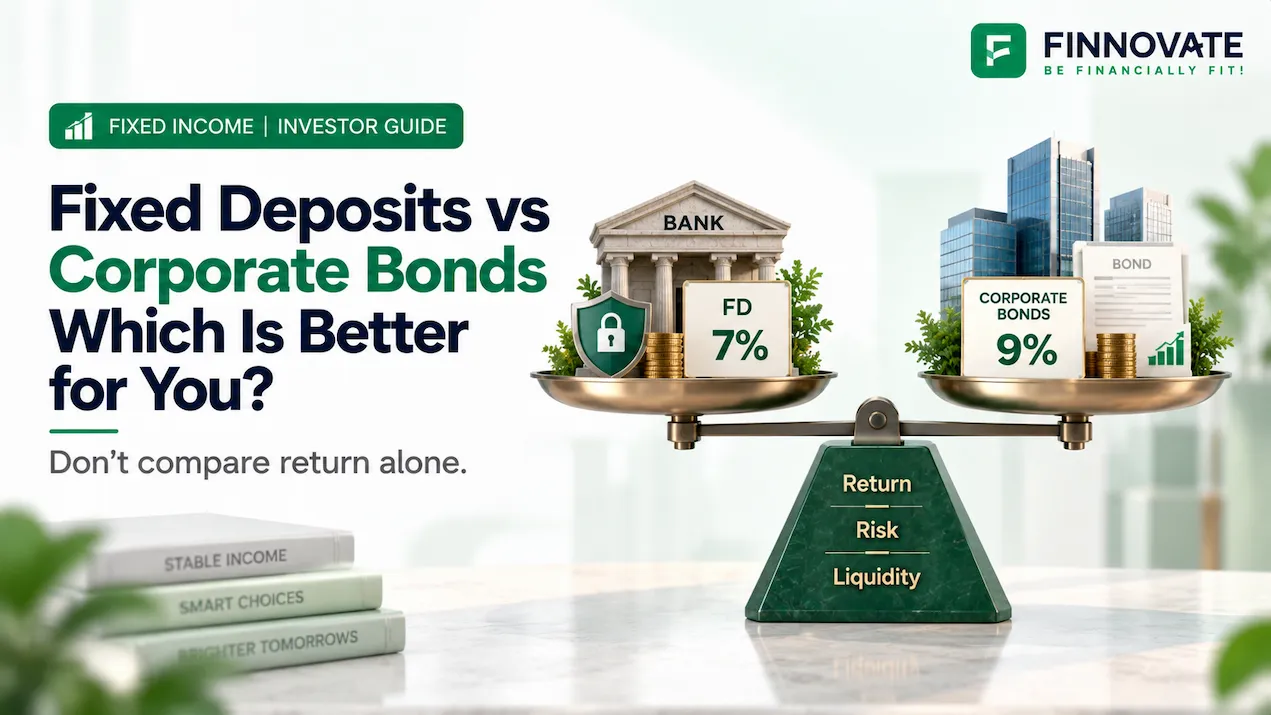
FD vs corporate bonds: compare returns, YTM, safety, liquidity, tax and credit risk to und...
Popular now
Learn how to easily download your NSDL CAS Statement in PDF format with our step-by-step g...

Looking for the best financial freedom books? Here’s a handpicked 2026 reading list with...
Learn what SIF investment means in India, SEBI rules, Rs 10 lakh minimum investment, avail...

Clear guide to mutual fund taxation in India for FY 2025–26 after July 2024 changes: equ...