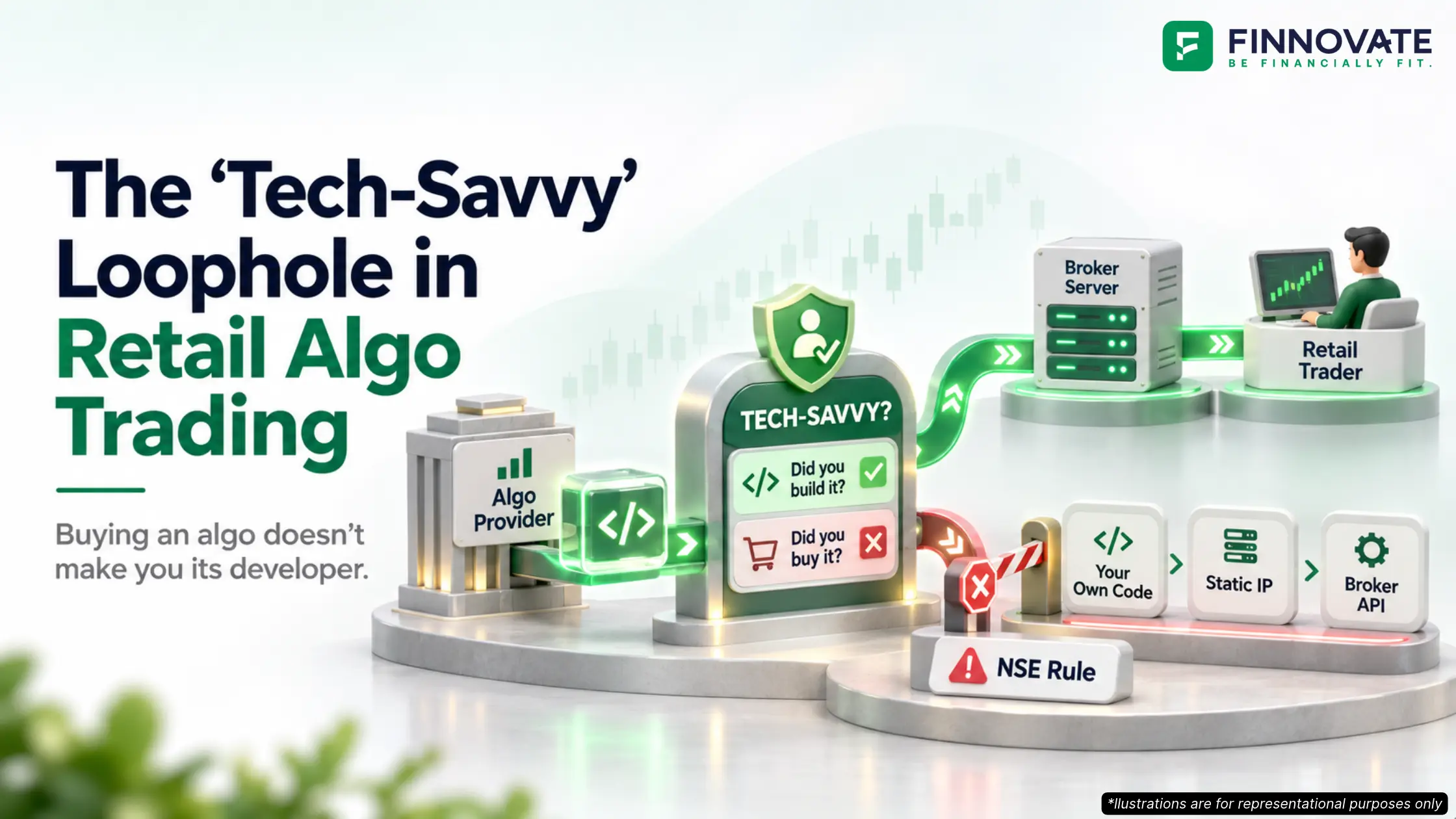
The 'Tech-Savvy' Loophole in Retail Algo Trading

Finnovate’s editorial team researches and creates financial content using trusted sources, regulatory references and inputs from subject experts.
Imagine you're a regular retail trader. You don't know Python from a garden snake, and the closest you've come to coding is changing the font size in an Excel sheet.
You trade options in the evenings after work, with mixed results. Then you find a platform selling an automated strategy. The backtest chart climbs neatly from left to right. Subscribe, link your broker account, and the algo trades for you while you sit in meetings.
There's just one odd step. You're asked to register a "static IP" with your broker and sign a form saying you're a tech-savvy investor who wrote your own algorithm.
You haven't written a single line of code. But support says everyone signs it, and the strategy is live by lunch.
And just like that, on paper, you became a programmer.
On November 20, the National Stock Exchange (NSE) issued a circular about exactly this. It said that after India's new retail algo rules came into force on April 1, 2026, it received complaints that some empanelled algo providers (firms the exchange had formally approved) were giving static IP access to ordinary retail clients and presenting them as "tech-savvy".
NSE called this a violation and told brokers and providers to stop, with immediate effect.
It sounds like technical plumbing. It isn't. That one label decides who controls the strategy, who carries the risk when it goes wrong, and where you can complain if it does.
First, How Are the Rules Meant to Work?
In February 2025, SEBI set out a framework for retail algo trading. From April 1, 2026, it became mandatory for every stockbroker. In short:
- If you use someone else's strategy, the firm selling it must be empanelled with the exchange, each strategy needs exchange approval, and it runs on your broker's servers. If the logic is hidden from you (a "black box"), the provider must also be registered with SEBI as a Research Analyst.
- Every automated order is tagged, so it can be traced back through an audit trail.
- Orders through a broker's API (a digital bridge that lets software place trades automatically) need a two-step login, plus a fixed internet address registered with the broker when your own program connects. That fixed address is the static IP.
SEBI didn't want to punish genuine do-it-yourself coders. So the framework has a sensible carve-out. If you're a "tech-savvy retail investor", meaning you write your own algo using programming knowledge, you can run it from your own computer or server through a registered static IP. If it stays under 10 orders per second, you don't have to register the strategy with the exchange, and your orders carry a generic algo ID.
The reasoning is fair. If you built it, you know how it works, and you own the result. If you're buying it, the product gets checked.
And that right there is where the loophole opened.
Why the Shortcut Was Tempting
NSE hasn't named any provider, said how many complaints it received, or said how widespread the practice is. A complaint is not proof against any firm.
But the rules themselves show why the static IP route could look attractive to someone selling strategies:
| Broker-server route (empanelled provider) | Static IP route ("tech-savvy" client) | |
|---|---|---|
| Where the strategy runs | On the broker's server | At the client's own end |
| Exchange approval | Needed for each algo, and again when the logic changes | Not needed below 10 orders per second |
| How orders are tagged | Algo-specific ID | Generic ID below the threshold |
| Hidden ("black box") logic | Provider must be a SEBI-registered Research Analyst | Not applicable |
| Monthly mock trading sessions | Required | Exempt |
| Losses from the algo's logic | Broker handles algo-related complaints | Client signs away exchange grievance recourse |
Scroll horizontally to view the full table.
Compliance is slow and expensive. The left-hand column means approvals, hosting on each broker's systems, and a fresh approval whenever the strategy changes. The right-hand column means none of that. The strategy stays on the provider's own servers, can be changed overnight, and works with any broker's API.
Brokers have their own incentive too. More active API clients usually means more orders, and more orders means more brokerage.
The Fine Print That Moves the Risk
Here's the part that should make every casual trader pause before clicking "I agree".
Under the new circular, a broker that registers a tech-savvy client must get a signed undertaking. It confirms the client meets SEBI's definition, meaning they write their own algos.
It also states that, because the client develops their own algo, the client has no recourse to the exchange's investor grievance mechanism for losses caused by the algo's logic.
Now read that from the point of view of our trader. He didn't write the strategy. If it misfires because of a flaw in its logic, he has signed a document saying the logic was his.
That's the real story. The label quietly moves accountability from the seller of the strategy to the buyer.
How such an undertaking would hold up if a client later showed he never wrote any code is ultimately a legal question. But the person who signs it starts with the burden.
What NSE Has Now Done
The circular is short and blunt:
- brokers and algo providers may not give static IP access to retail clients who don't meet the tech-savvy definition, "under any circumstances",
- brokers must obtain the signed undertaking before registering a tech-savvy client,
- a broker that fails to obtain it pays ₹5,000 per client, capped at ₹1 lakh, for the first instance, with the amount rising by 50% for a second instance and by 100% from the third onwards, and
- providers that don't comply will have their empanelment reviewed, which can lead to suspension or revocation.
For a large broker, ₹1 lakh is not much money. The real pressure falls on providers. Empanelment is what lets them place orders through brokers at all, and NSE's list had only about 17 names as of mid-October 2026. Losing it means losing access to brokers' systems.
This Isn't About Killing Automation
It would be easy to read this as a crackdown on retail algo trading. It isn't.
Look at it from a broader angle. Across finance, the category you sign up under decides which protections you get. A product bought from a regulated seller comes with checks and a complaint route. A tool you build yourself comes with freedom, and with responsibility for your own mistakes.
NSE is drawing a bright line between the two. If you're buying a strategy, the seller has to be approved and answerable. If you're building one, you're free to experiment, with a thinner safety net. What you can't do is buy a product and sign up as its builder.
The stakes are real. SEBI's latest study found that 87.7% of individual traders in equity derivatives lost money in FY26, with total losses of about ₹91,685 crore. In that market, a strategy promising to take emotion out of trading is an easy sell. That's exactly why the regulator wants anything sold to retail traders checked before it trades their money.
Questions Worth Asking Before You Switch On an Algo
Who wrote it? If the answer isn't you, you don't meet SEBI's definition of tech-savvy, whatever a form says.
Is the provider empanelled? NSE publishes its list of empanelled algo providers on its website. The name on your platform should appear there.
Where does it run? A legitimate third-party strategy runs on your broker's server. If someone else's strategy needs a static IP from you, that is the exact pattern NSE's circular describes.
Is the logic disclosed or hidden? For a black-box strategy, the provider has to be registered with SEBI as a Research Analyst. SEBI's website lists registered intermediaries.
What exactly are you signing? An undertaking that says you developed the algo is not a formality. It decides where you stand if things go wrong.
Where would a complaint go? For strategies from empanelled providers, your broker is responsible for handling algo-related complaints. For self-coded algos, the exchange route is closed for losses caused by the logic.
Strategies come and go. A plan is built to outlast them. Before money goes into any trading product, it helps to know what role that money plays in your larger goals. If you'd like a second pair of eyes on yours, the Finnovate team is one conversation away.
The Bottom Line
Our trader's strategy may even work. But NSE isn't asking whether it works. It's asking whose it is. Since November 20, the answer on paper has to match the truth.
After all, in the stock market, pretending to be tech-savvy is easy. Paying for a bug in someone else's code isn't.
FAQs
1. Who is a tech-savvy retail investor under SEBI rules?
A retail client who develops their own trading algos using programming knowledge. The category comes from SEBI's February 4, 2025 circular on retail algo trading.
2. What is a static IP in algo trading?
It is a fixed internet address registered with your broker and linked to your API key. Under NSE's rules, static IP access is reserved for tech-savvy clients who run their own algo logic at their own end.
3. Can retail traders still use third-party algo strategies?
Yes. They have to come through an exchange-empanelled algo provider, with the strategy running on the broker's server.
4. What is the penalty for brokers under the new NSE circular?
For a first instance of not obtaining the undertaking, ₹5,000 per client, capped at ₹1 lakh. The penalty rises by 50% for a second instance and by 100% from the third onwards.
5. Can a tech-savvy client complain to the exchange about algo losses?
The undertaking states that the client has no recourse to the exchange's investor grievance mechanism for losses caused by the algo's logic.
6. What happens to algo providers that misuse static IPs?
NSE will review their empanelment, which can be suspended or revoked.
Sources
- NSE Circular NSE/INSP/77559: Compliance with retail algo guidelines for tech-savvy retail investors (November 20, 2026)
- SEBI: Safer participation of retail investors in algorithmic trading (February 4, 2025)
- SEBI: Extension of timeline for the retail algo trading framework (September 30, 2025)
- NSE: FAQs on safer participation of retail investors in algorithmic trading
- NSE: List of empanelled algo providers
- SEBI: Profitability of individual traders in the equity derivatives segment (FY25 to FY26)
Disclaimer: This article is for information and awareness only. It is not a recommendation to buy, sell or hold any security, derivative or trading product, and it is not a legal opinion. Derivatives trading carries a high risk of loss. No algo provider or broker is named or implied in connection with the practices described in NSE's circular.