

Tax Planning and Benefits for Married Couples in India: 2026 Guide
Tax planning for married couples in India explained for 2026. Compare tax regimes, deducti...
05 September 2026

Finnovate’s editorial team researches and creates financial content using trusted sources, regulatory references and inputs from subject experts.
An investor sells listed shares on a recognised stock exchange after holding them for several years. Securities Transaction Tax, or STT, applies to the sale. If the investment has earned a taxable long-term gain, capital gains tax follows too.
Both reduce the amount the investor keeps. But each works differently, which makes the debate over tax relief more complicated than it first appears.
That debate gathered momentum after Finance Minister Nirmala Sitharaman’s October 13, 2026 remarks. She acknowledged investors’ concerns about long-term capital gains tax and STT and expressed willingness to hear their views as Budget preparations began. Her remarks left the discussion open, with no commitment to a rate cut.
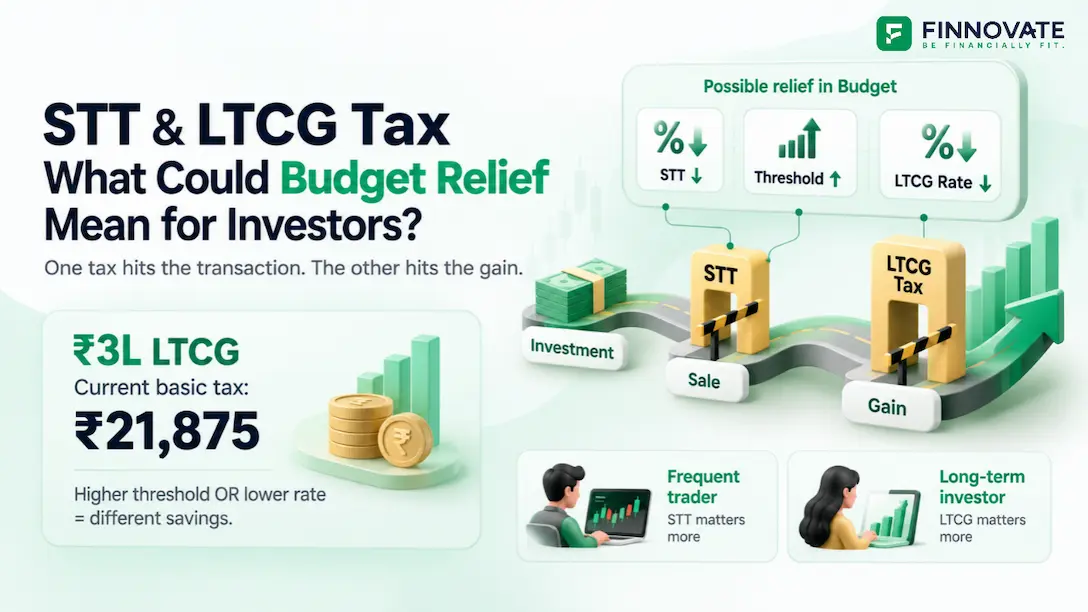
For investors, the useful question is what different forms of relief would actually achieve. A lower transaction tax, a higher tax-free gains threshold and a lower capital gains tax rate would benefit investors in different ways.
STT is linked to specified securities transactions. The amount depends on the transaction type, its taxable value and the applicable rate.
Capital gains tax depends on the gain realised when an investment is sold, along with the asset type, holding period and relevant tax rules.
| Tax | What it applies to | What matters for the investor |
|---|---|---|
| STT | Specified securities transactions | It can apply even when the transaction results in a loss |
| Short-term capital gains tax | Taxable gains on assets held for a shorter period | Qualifying equity-related gains generally attract a 20% base rate |
| Long-term capital gains tax | Taxable gains on assets meeting the relevant holding period | Qualifying equity-related LTCG above the aggregate annual ₹1.25 lakh threshold generally attracts a 12.5% base rate |
↔ Scroll horizontally to view the full table.
The equity capital gains rates are subject to the relevant conditions. Applicable surcharge and cess are additional. Other assets can have different treatment.
The distinction matters because an investor who sells occasionally and a trader who transacts frequently face different patterns of tax costs.
A reduction in STT would lower the cost of the transactions covered by that change. The benefit would depend on how much the investor trades and which instruments they use.
The latest derivatives increases took effect from April 1, 2026:
| Transaction | Earlier STT rate | Current STT rate |
|---|---|---|
| Sale of futures | 0.02% of traded value | 0.05% of traded value |
| Sale of options | 0.10% of option premium | 0.15% of option premium |
| Exercise of options | 0.125% of intrinsic value | 0.15% of intrinsic value |
↔ Scroll horizontally to view the full table.
The applicable payer differs by transaction. Futures and options sales attract the levy on the seller; exercised options attract it on the purchaser.
Consider a hypothetical futures sale with a taxable value of ₹10 lakh. STT at 0.05% is ₹500. At the earlier 0.02% rate, it would have been ₹200.
The ₹300 difference relates to that transaction alone. Repeated transactions add to the total cost, making the rate particularly relevant to active participants.
For someone investing through an equity mutual fund SIP, a rollback limited to derivatives would have a much less direct effect on their personal tax bill. The instruments covered by any relief matter as much as the headline rate.
Long-term investors are more directly affected by the tax due when they realise gains.
Two possible approaches are to raise the annual tax-free threshold or reduce the tax rate. The difference becomes easier to see with an example.
Assume an investor realises ₹3 lakh in qualifying equity LTCG during a year. For simplicity, assume no capital-loss adjustments or other reliefs apply.
Under the current ₹1.25 lakh threshold, the taxable amount is ₹1.75 lakh. At a 12.5% base rate, the tax is ₹21,875.
Here is how two hypothetical changes would affect that amount:
| Scenario | Taxable gain | Base tax | Saving against current rules |
|---|---|---|---|
| Current threshold and rate | ₹1,75,000 | ₹21,875 | — |
| Threshold rises to ₹2 lakh; rate stays at 12.5% | ₹1,00,000 | ₹12,500 | ₹9,375 |
| Rate falls to 10%; threshold stays at ₹1.25 lakh | ₹1,75,000 | ₹17,500 | ₹4,375 |
↔ Scroll horizontally to view the full table.
The alternative thresholds and rates above are illustrations, not announced Budget measures. Calculations exclude surcharge and cess.
A higher threshold gives proportionately greater relief to investors with smaller realised gains. In this example, raising it by ₹75,000 would reduce base tax by up to ₹9,375.
A rate reduction produces larger rupee savings as taxable gains increase. That makes the choice between the two a question of who the government wants to benefit and how much revenue it is prepared to forgo.
The annual equity LTCG threshold is shared across eligible gains. It is not a separate allowance for each fund, stock or investment account.
These taxes generate substantial receipts.
STT collections reached ₹40,214.36 crore between April 1 and September 17, 2026, compared with ₹26,305.72 crore in the corresponding earlier period. Separately, the government disclosed equity LTCG tax collections of about ₹1.29 lakh crore for assessment year 2025–26.
The figures cover different periods and tax bases, so adding them together would offer little useful insight.
They do explain why relief involves a meaningful fiscal decision. The government must weigh the immediate revenue cost against possible benefits such as lower investment costs and greater market participation.
Receipts also depend on behaviour. STT collections respond to taxable transaction activity, while capital gains receipts depend on investors realising taxable gains.
A tax cut could influence those decisions. The size of that response, and whether it would offset the lower rate, remains uncertain. Simply projecting part-year collections into a full-year figure would miss these moving parts.
Financial planning involves money for retirement, near-term expenses and unexpected needs. Different goals require different levels of risk.
That brings debt investments into the tax debate.
For specified debt-oriented mutual fund units acquired on or after April 1, 2023, the relevant rules treat gains as short-term regardless of holding period. For individuals, applicable slab rates generally determine the tax. Fund classification and acquisition date therefore matter.
The impact varies across investors. Someone in a higher tax bracket may face a higher base tax rate on such gains than on qualifying equity gains. Someone in a lower bracket can have a different outcome.
This raises a policy question: Should holding an eligible debt investment for several years receive different tax treatment from a short holding period?
Any change would need clear eligibility rules. It would also need to distinguish genuine long-term savings from products structured mainly to obtain a tax advantage.
For investors, the portfolio question remains practical. Money needed soon has a different purpose from money invested for retirement. Tax is one part of the expected outcome, alongside risk, access to funds and the investment horizon.
For a category-wise explanation of equity, debt and other fund rules, read our guide to mutual fund taxation in India.
There is another issue beyond headline rates.
STT paid on securities transactions is not deductible when calculating capital gains. A deduction can be available when the corresponding income is assessed as business income, subject to the relevant conditions.
Allowing an eligible deduction against capital gains would reduce the taxable gain by the permitted amount.
The saving would equal the deduction multiplied by the applicable tax rate. For example, a hypothetical ₹1,000 deduction at a 12.5% base rate would save ₹125 before cess and surcharge.
That is different from abolishing STT or refunding it. It offers a more specific policy option, although the government would still need to assess its cost and administration.
The effect of any announcement will depend on four details:
For long-term investors, predictable rules also have value. They help households estimate how much will remain after tax when an investment is sold to fund a goal.
The Budget debate can therefore reach beyond the size of a tax cut. It can examine how consistently the system treats different investments and how easily investors can plan around it.
In her October 13, 2026 remarks, the Finance Minister expressed openness to investors’ views without committing to a rate cut. Any change would need to be checked against the relevant legislation and effective date.
The threshold applies to aggregate eligible equity-related long-term capital gains during the year. It is shared across qualifying investments, rather than being available separately for every scheme or account.
Yes. STT is based on the applicable securities transaction, so it can arise even when that transaction produces a loss. Capital gains taxation follows the separate rules for gains, losses and permitted adjustments.
Disclaimer: This article is for information and education only and does not constitute investment or tax advice. Tax treatment depends on the investment, transaction dates and individual circumstances. Hypothetical tax changes are illustrations, not forecasts or announced measures.
No spam. Only new posts, simple explainers, and practical money checklists for busy professionals.
Finnovate is a SEBI-registered financial planning firm that helps professionals bring structure and purpose to their money. Over 3,500+ families have trusted our disciplined process to plan their goals - safely, surely, and swiftly.
Our team constantly tracks market trends, policy changes, and investment opportunities like the ones featured in this Weekly Capsule - to help you make informed, confident financial decisions.
Learn more about our approach and how we work with you:
No comments yet. Start the conversation. What would you add?
No spam. Only new posts, simple explainers, and practical money checklists.
You may also like
Tax planning for married couples in India explained for 2026. Compare tax regimes, deducti...
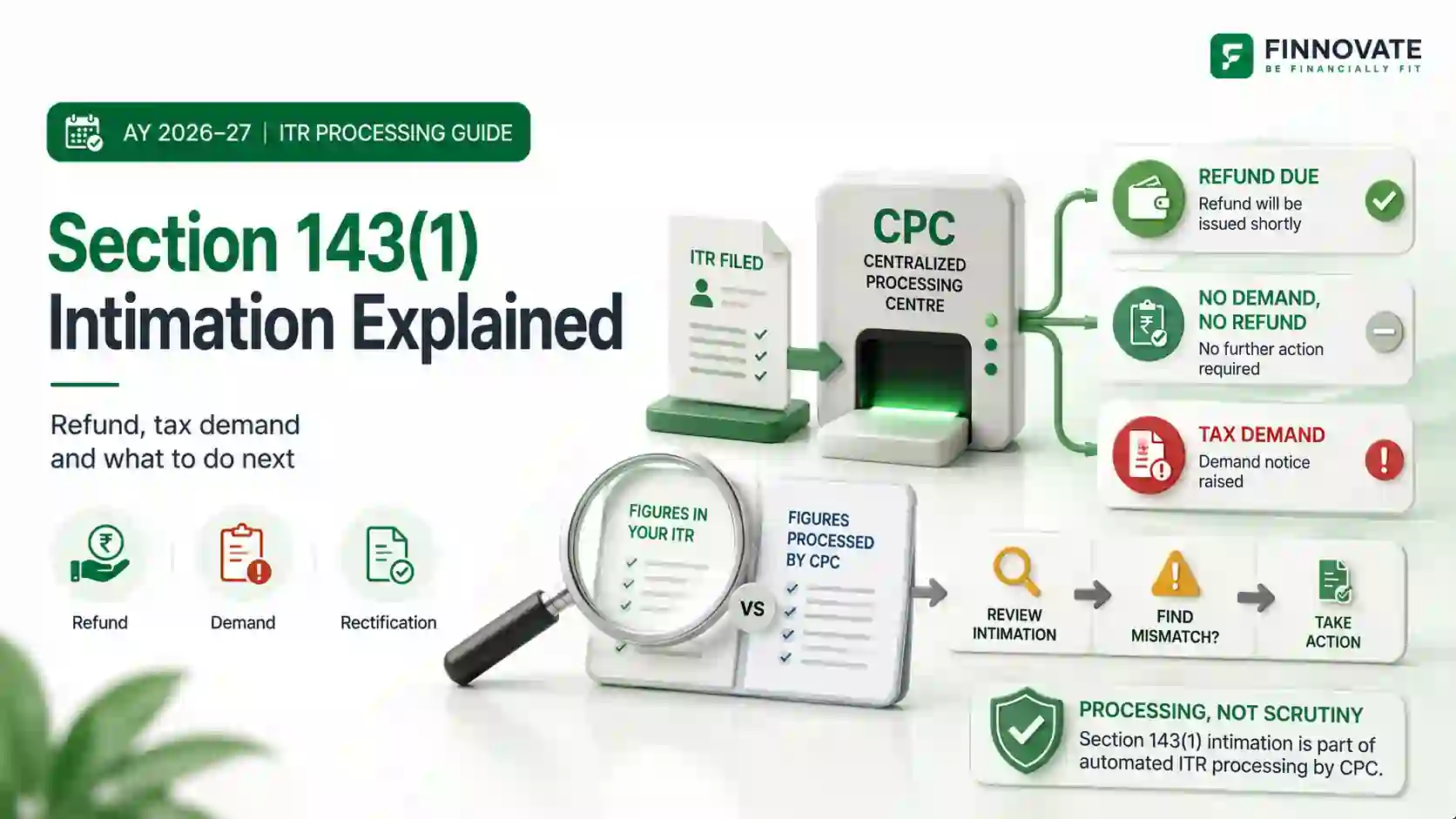
Received a Section 143(1) intimation? Understand CPC adjustments, refunds, tax demands, re...
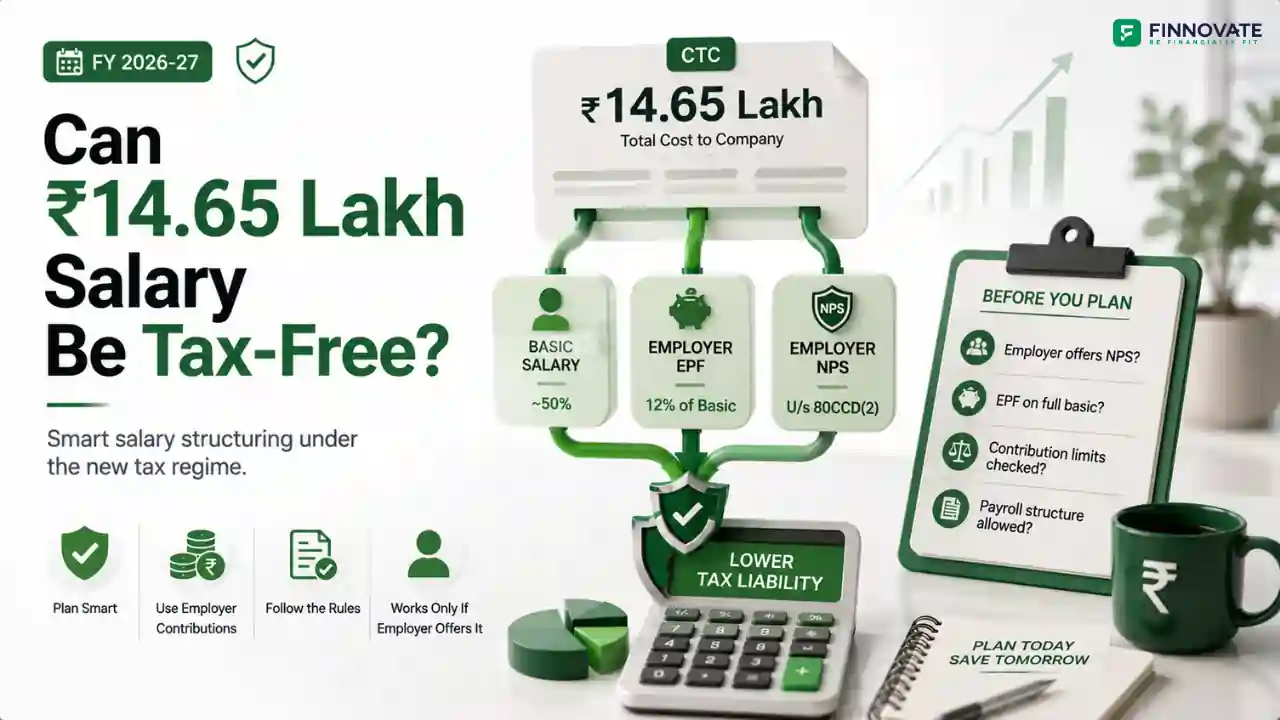
Zero tax on a ₹14.65 lakh salary is real, but only if your employer contributes EPF on f...

Changed jobs in FY 2025-26? See why combining two Form 16s can create a tax shortfall past...
Popular now

Learn how to easily download your NSDL CAS Statement in PDF format with our step-by-step g...

Looking for the best financial freedom books? Here’s a handpicked 2026 reading list with...
Learn what SIF investment means in India, SEBI rules, Rs 10 lakh minimum investment, avail...
Clear guide to mutual fund taxation in India for FY 2025–26 after July 2024 changes: equ...