
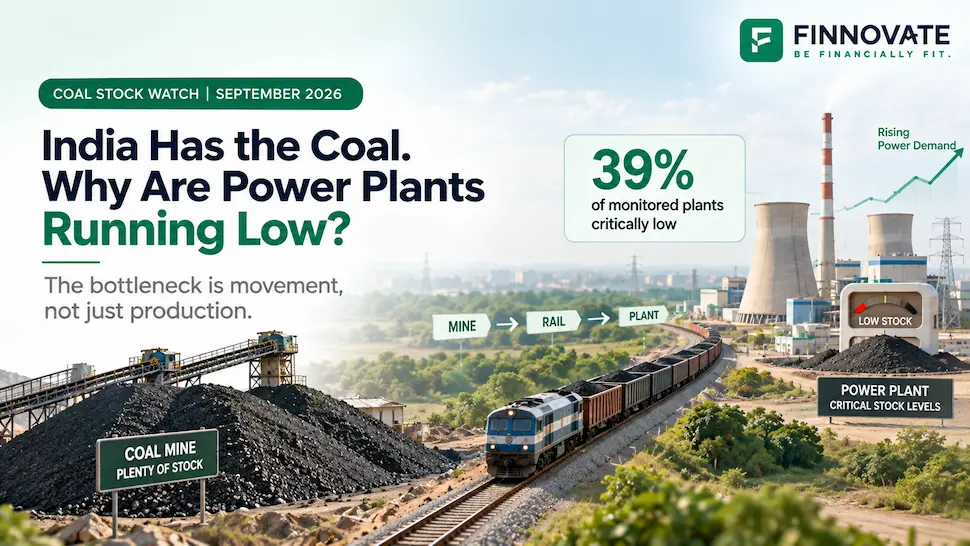
India Coal Stocks 2026: Why 39% of Power Plants Are Critically Low
Nearly 39% of India’s monitored coal power plants were critically low on fuel in Septemb...
22 September 2026

Finnovate’s editorial team researches and creates financial content using trusted sources, regulatory references and inputs from subject experts.
Tata Sons' September 17 board meeting brought three difficult questions into the same room.
Who should lead Tata Sons after February 2027?
Can Tata Sons continue to remain a private company after the Reserve Bank of India rejected its deregistration request?
And how does the Shapoorji Pallonji Group get liquidity from an 18.4% holding in a company whose shares cannot be freely traded?
The immediate trigger was the Tata Sons board's decision to back N Chandrasekaran for another five-year term as Executive Chairman. Noel Tata opposed the proposal, and Tata Trusts subsequently said the resolution was invalid under Tata Sons' Articles of Association.
At the same meeting, the future listing of Tata Sons was discussed only six days after the RBI rejected the company's attempt to surrender its Core Investment Company registration. Noel Tata also placed a proposal on the table that could provide the SP Group with at least ₹25,000 crore by monetising part of its Tata Sons holding.
These may look like separate disputes.
They are not.
And until those four pieces are separated, the dispute can easily be reduced to a Noel Tata-versus-Chandrasekaran battle when the underlying problem is much bigger.
Table of Contents
The current dispute makes more sense when the events are seen together.
| Date | What Happened |
|---|---|
| August 12, 2026 | N Chandrasekaran informed Tata Sons that he would not seek reappointment after his term ends on February 20, 2027 |
| August 13 | Sir Dorabji Tata Trust accepted the decision and said the process of setting up a Selection Committee should begin |
| August 18 | Tata Sons' AGM was adjourned after the required quorum could not be established |
| September 11 | Tata Sons received the RBI's decision rejecting its request to surrender its CIC registration |
| September 17 | Tata Sons' board backed another five-year term for Chandrasekaran; the listing question and an SP liquidity proposal were also discussed |
| September 20 | Tata Trusts publicly reiterated that it considers Chandrasekaran's reappointment invalid |
Chandrasekaran's August decision had appeared to put Tata Sons on a succession path. Tata Trusts said it respected his decision and wanted a Selection Committee formed under Tata Sons' Articles.
Then the regulatory situation changed.
The RBI rejected Tata Sons' deregistration request, bringing the listing issue back to the centre of the discussion. Days later, the board revisited Chandrasekaran's future.
At the September 17 meeting, the Tata Sons board recorded four votes in favour of Chandrasekaran's reappointment and Noel Tata's vote against it.
Chandrasekaran did not participate in the discussion on his own reappointment. Business Standard reported that independent director Harish Manwani chaired that part of the meeting, while Tata Trusts nominee Venu Srinivasan supported Chandrasekaran and Noel Tata opposed him.
Normally, a 4-1 result would appear decisive.
But Tata Sons is not governed only by a simple majority of directors.
Its Articles of Association give Tata Trusts, which owns around 66% of Tata Sons, specific rights through directors nominated by the Trusts.
There are currently two Tata Trusts nominee directors on the Tata Sons board:
Srinivasan supported Chandrasekaran.
Noel Tata did not.
Tata Trusts' argument is based on Tata Sons' Articles of Association.
The Trusts say Article 121 requires decisions to receive not only the necessary support at the overall board level, but also affirmative support from a majority of Tata Trusts' nominee directors.
There are two nominee directors.
According to Tata Trusts:
Because Noel Tata voted against Chandrasekaran's reappointment, the Trusts argue that this separate condition was not fulfilled, irrespective of the overall 4-1 result.
The casting vote has become another point of disagreement.
Business Standard reported that Harish Manwani used a casting vote during the process. Tata Trusts argues that a casting vote can resolve an equality of votes at the overall board level, but cannot replace the affirmative support required separately from Tata Trusts' nominee directors.
Tata Trusts therefore says the resolution has no legal effect.
There is another side to the legal argument.
Business Standard reported that Tata Sons had obtained a separate legal opinion supporting the view that the chairman's casting vote could operate in the circumstances created by the split between the two nominee directors.
Tata Trusts, meanwhile, submitted a legal opinion from former Chief Justice of India D Y Chandrachud supporting its position.
So the disagreement is deeper than whether one side had more votes.
It is about how Tata Sons' own constitution should be interpreted.
Tata Sons' published documents have historically given Tata Trusts unusual protections in the chairman-selection process. Its 2021-22 annual report, while explaining Article 118, specifically linked appointment of the chairman to the affirmative-voting protections under Articles 104B and 121.
That makes the issue difficult to reduce to a conventional board-majority question.
Unless both sides arrive at a common interpretation, the dispute could ultimately require a legal resolution.
The second big issue is completely different.
The push towards a Tata Sons listing did not begin with the September 17 board meeting.
It comes from RBI regulation.
Under the RBI's Scale Based Regulation framework, NBFCs placed in the Upper Layer face enhanced regulation.
One of those requirements is explicit:
The RBI introduced this framework in October 2021.
Tata Sons was classified as an Upper Layer NBFC in 2022.
And it has continued to remain within that framework. In the RBI's 2024-25 Upper Layer list, Tata Sons Private Limited was specifically identified as a Core Investment Company.
This distinction matters.
The question is not simply whether Tata Trusts or the Tata Sons board likes the idea of an IPO.
There is a regulatory requirement that Tata Sons has been trying to address.
Tata Sons did not simply ignore the listing requirement.
It applied to surrender its registration as a Core Investment Company.
If Tata Sons could cease to be regulated as the CIC that sits within the Upper Layer framework, the basis for the mandatory listing requirement could change.
But that route suffered a major setback in September.
Reuters reported that the RBI rejected Tata Sons' deregistration application and subsequently filed a caveat before the Bombay High Court so that the regulator would be heard if the company challenged its decision.
That changed the position materially.
Tata Sons could still hope that deregistration would provide a route to remaining private.
That route became much harder after the RBI rejected the application.
This is why the listing question resurfaced so sharply at the September 17 board meeting.
Tata Trusts' opposition to listing did not begin after the RBI's September decision.
According to Tata Trusts, the Tata Sons board had already considered the listing question in March 2024, when Ratan Tata was still involved, and unanimously concluded that Tata Sons should remain unlisted.
The Sir Dorabji Tata Trust and Sir Ratan Tata Trust then passed resolutions in July 2025 supporting the same position.
The Trusts' argument is tied to Tata Sons' unusual ownership structure.
Around 66% of Tata Sons is held by philanthropic trusts. Dividends received by these trusts support work in areas such as healthcare, education and social development.
Tata Trusts argues that this structure allows Tata Sons to take decisions with a longer horizon than a conventional listed holding company.
Whether listing would actually weaken that model is a matter of debate.
But the Trusts' opposition is not merely about keeping Tata Sons away from public-market scrutiny.
It is based on their view of how ownership, control and philanthropy have historically worked together inside the Tata structure.
There is another shareholder in this story.
The Shapoorji Pallonji Group owns approximately 18.4% of Tata Sons, making it the second-largest shareholder after Tata Trusts.
That holding is enormously valuable.
But Tata Sons is private, which makes the stake difficult to monetise.
At the same time, the SP Group has substantial debt.
Reuters reported that SP has more than ₹500 billion, or ₹50,000 crore, of high-interest debt, with Tata Sons shares being used as security in parts of its financing structure.
For SP, therefore, Tata Sons is not simply a strategic investment.
It is also a major pool of value sitting inside an illiquid asset.
A Tata Sons listing would make that stake much easier to monetise over time.
The September 17 meeting produced a potentially important alternative.
Noel Tata tabled a proposal that Tata Trusts said originated from discussions involving Noel Tata, Chandrasekaran and Shapoor Mistry.
The proposal involves Tata Sons acquiring enough of the SP Group's shares to provide the SP Group with gross proceeds of at least:
The transaction could take place in two tranches over 18 months through a selective capital reduction process involving the National Company Law Tribunal.
Possible funding routes outlined in the proposal include:
The proposal is significant because it attempts to solve one of the strongest commercial arguments behind a Tata Sons listing.
SP needs liquidity.
Tata Trusts wants Tata Sons to remain private.
A structured buyout could potentially give SP some liquidity without requiring Tata Sons shares to trade publicly.
But there is an important distinction.
The SP problem and the RBI problem are not the same problem.
How can an 18.4% shareholder monetise a valuable but illiquid stake?
Can Tata Sons continue to remain private while it remains subject to a regulatory framework requiring Upper Layer NBFCs to list?
Buying some or even all of SP's holding could reduce shareholder pressure for an IPO.
It would not automatically change Tata Sons' regulatory classification.
That is why the ₹25,000 crore proposal, even if successfully executed, cannot by itself settle the listing dispute.
That is one of the most important distinctions in the entire Tata Sons story.
The September 17 meeting also exposed a split within Tata Trusts' representation on the Tata Sons board.
Noel Tata and Venu Srinivasan are both Trust nominee directors.
But they did not vote the same way on Chandrasekaran.
Noel Tata opposed the reappointment.
Venu Srinivasan supported it.
That matters for two reasons.
First, it created the legal dispute over whether the Trust nominee voting condition had been satisfied.
Second, it shows that the current Tata governance dispute cannot simply be described as Tata Trusts versus the Tata Sons board.
Important people within the wider Tata governance structure are themselves taking different positions.
A separate regulatory issue has complicated the Tata Trusts' ability to act.
In May 2026, the Maharashtra Charity Commissioner directed that a proposed meeting of the Sir Ratan Tata Trust be deferred while issues relating to the composition of its board were under examination.
Tata Trusts itself said at the time that it understood the direction to apply specifically to the Sir Ratan Tata Trust.
That restriction later affected Tata Sons.
The company's August 18 AGM was adjourned after the necessary quorum could not be established. Business Standard reported that SRTT's inability to take the necessary decision for joint shareholder representation was at the centre of the problem.
This is why what may initially look like an issue under charity law has consequences for the governance of Tata Sons.
The Sir Ratan Tata Trust owns roughly 23.56% of Tata Sons.
The present dispute also brings back an issue from Tata's previous major boardroom battle.
When Cyrus Mistry's removal from Tata Sons led to litigation, some of the special governance rights given to Tata Trusts under Tata Sons' Articles were challenged.
Tata Sons defended those provisions.
The Supreme Court eventually set aside the NCLAT's finding that the relevant Articles were oppressive.
Tata Trusts is now using that history as part of its argument.
Its position is essentially that Tata Sons cannot defend the Trusts' affirmative voting rights when those provisions are challenged by one shareholder, and then interpret those same rights narrowly when they prevent a board resolution from passing.
But it explains why the 2016 Mistry battle is relevant again in 2026.
There is a temptation to ask a simpler question:
Corporate governance does not normally work that way.
Under Section 166 of the Companies Act, directors are expected to act according to the company's Articles, exercise independent judgement and act in the interests of the company and its stakeholders.
So a director is not merely a messenger for the shareholder that nominated him or her.
But Tata Sons has an additional layer.
Its Articles give Tata Trusts explicit governance rights.
That produces two principles that have to coexist:
The board must be capable of exercising independent judgement.
The board must operate within Tata Sons' Articles, including rights specifically granted to Tata Trusts.
The current dispute is about where one ends and the other begins.
That is much more useful than framing the situation as a question of whether Noel Tata should simply assert control over the board.
The current situation involves at least four separate decisions.
The board has backed Chandrasekaran for another five years.
Tata Trusts says that resolution is invalid.
Before Tata Sons can have stable leadership, the validity of that decision needs to be settled.
There is an additional complication because the August AGM, which was due to consider shareholder matters including Chandrasekaran's directorship, was adjourned. Legal experts cited by Business Standard have said an unresolved directorship issue could create procedural risk, although it would not automatically invalidate every board action.
The RBI has rejected deregistration.
The RBI framework says an Upper Layer NBFC must list.
Tata Trusts wants Tata Sons to explore every permissible alternative.
This now needs a definitive answer rather than another internal preference.
₹25,000 crore is substantial.
The proposed structure also requires legal and regulatory processes and would affect Tata Sons' capital allocation.
The fact that a proposal exists does not mean the transaction is completed.
The SRTT issue has already contributed to the adjournment of Tata Sons' AGM.
Until the Trusts can exercise their shareholder rights through a stable governance process, similar difficulties can recur.
Tata Sons is not an ordinary holding company.
It sits above businesses spanning technology, automobiles, steel, airlines, power, consumer products, hotels, electronics and several newer areas of investment.
Reuters put the Tata Group's annual revenue at about $185 billion and the market capitalisation of its listed companies at around $277 billion in September 2026.
The group is simultaneously committing capital to areas such as:
That means stability at Tata Sons matters beyond the holding company itself.
Leadership uncertainty can affect long-term planning.
A listing could change the financial and disclosure structure of the holding company.
A large SP buyout could influence how Tata Sons deploys capital.
And a prolonged dispute over board authority can make major decisions harder to execute.
That does not mean the Tata operating companies stop functioning. Tata itself notes that each group company operates under the supervision of its own board.
The September 17 meeting did not create Tata Sons' problems.
It brought them together.
The leadership issue had already begun in August when Chandrasekaran said he would not seek another term.
The listing issue had existed since Tata Sons entered the RBI's Upper Layer regulatory framework.
The SP Group had been seeking liquidity from its Tata Sons holding for years.
And the Charity Commissioner issue had already made decision-making inside one of the key Tata Trusts more difficult.
What changed in September was that all four pressures converged.
The board backed Chandrasekaran.
Tata Trusts challenged the legal validity of that decision.
The RBI shut the deregistration route Tata Sons had been pursuing.
And Noel Tata brought forward a concrete proposal to address at least part of SP's liquidity problem.
That leaves Tata Sons with a difficult but much more clearly defined set of questions.
Can the chairman dispute be resolved within the Articles?
Can Tata Sons find a legally acceptable route to remain private, or does the RBI framework ultimately force a listing?
Can SP receive meaningful liquidity without using an IPO as the exit route?
Can Tata Trusts restore a governance structure capable of exercising its controlling shareholding effectively?
Those questions matter more than deciding which individual has "won" the September 17 board meeting.
The Tata Sons board backed N Chandrasekaran for another five-year term as Executive Chairman. Noel Tata opposed the reappointment, and Tata Trusts subsequently argued that the resolution was invalid under Tata Sons' Articles of Association. The board also discussed Tata Sons' response to the RBI's September 11 communication and the future listing question.
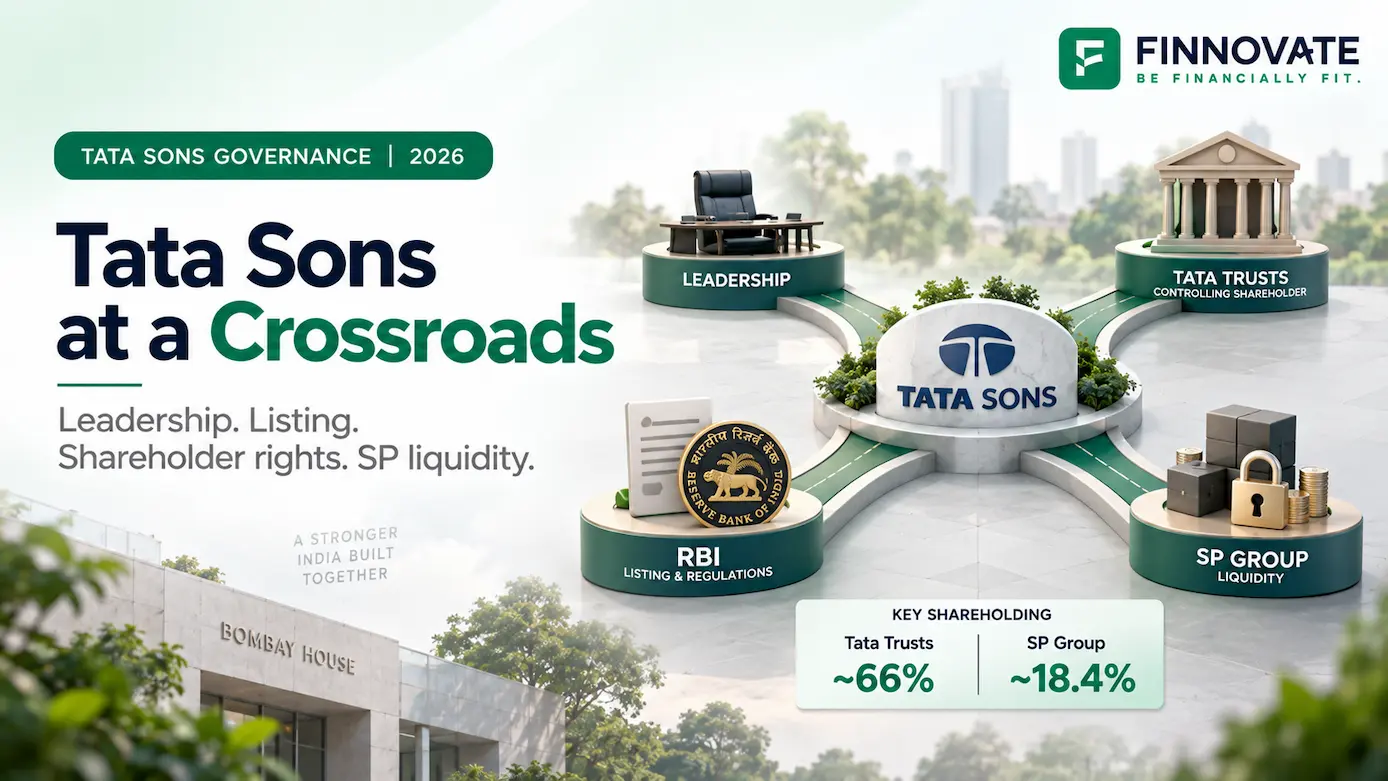
Philanthropic Tata Trusts collectively hold around 66% of Tata Sons' equity. The Shapoorji Pallonji Group is the second-largest shareholder with approximately 18.4%.
Tata Trusts argues that Tata Sons' Articles require affirmative support from a majority of the directors nominated by Tata Trusts. Noel Tata and Venu Srinivasan are the two Trust nominee directors, and they split 1-1 on the reappointment. Tata Trusts therefore says the required condition was not met. The interpretation remains disputed.
The RBI's Scale Based Regulation framework requires NBFCs identified as Upper Layer entities to list within three years. Tata Sons was classified as an NBFC-UL in 2022 and remains regulated as a Core Investment Company.
The RBI rejected Tata Sons' application to surrender its NBFC/CIC registration in September 2026, according to Reuters. The RBI also filed a caveat with the Bombay High Court to ensure it would be heard in any challenge relating to the decision.
Tata Trusts says the private ownership structure is central to the Tata model because the majority owner is philanthropic and uses dividends to fund charitable work. It has also said that Tata Sons and the principal Trusts had previously resolved that the company should remain private.
Noel Tata tabled a proposal under which the SP Group could monetise part of its Tata Sons shareholding for gross proceeds of at least ₹25,000 crore, potentially in two tranches over 18 months through a selective capital reduction process.
Not automatically. An SP transaction could solve part of the minority shareholder's liquidity problem, but Tata Sons would separately need to resolve the RBI requirement linked to its NBFC-Upper Layer status.
Disclaimer: This article is for educational and informational purposes only. The validity of N Chandrasekaran's reappointment, the interpretation of Tata Sons' Articles of Association and the future regulatory path for Tata Sons remain disputed or unresolved as of September 22, 2026. Statements made by Tata Trusts and other parties have been identified as their respective positions. This article does not constitute legal or investment advice.
No spam. Only new posts, simple explainers, and practical money checklists for busy professionals.
Finnovate is a SEBI-registered financial planning firm that helps professionals bring structure and purpose to their money. Over 3,500+ families have trusted our disciplined process to plan their goals - safely, surely, and swiftly.
Our team constantly tracks market trends, policy changes, and investment opportunities like the ones featured in this Weekly Capsule - to help you make informed, confident financial decisions.
Learn more about our approach and how we work with you:
No comments yet. Start the conversation. What would you add?
No spam. Only new posts, simple explainers, and practical money checklists.
You may also like
Nearly 39% of India’s monitored coal power plants were critically low on fuel in Septemb...
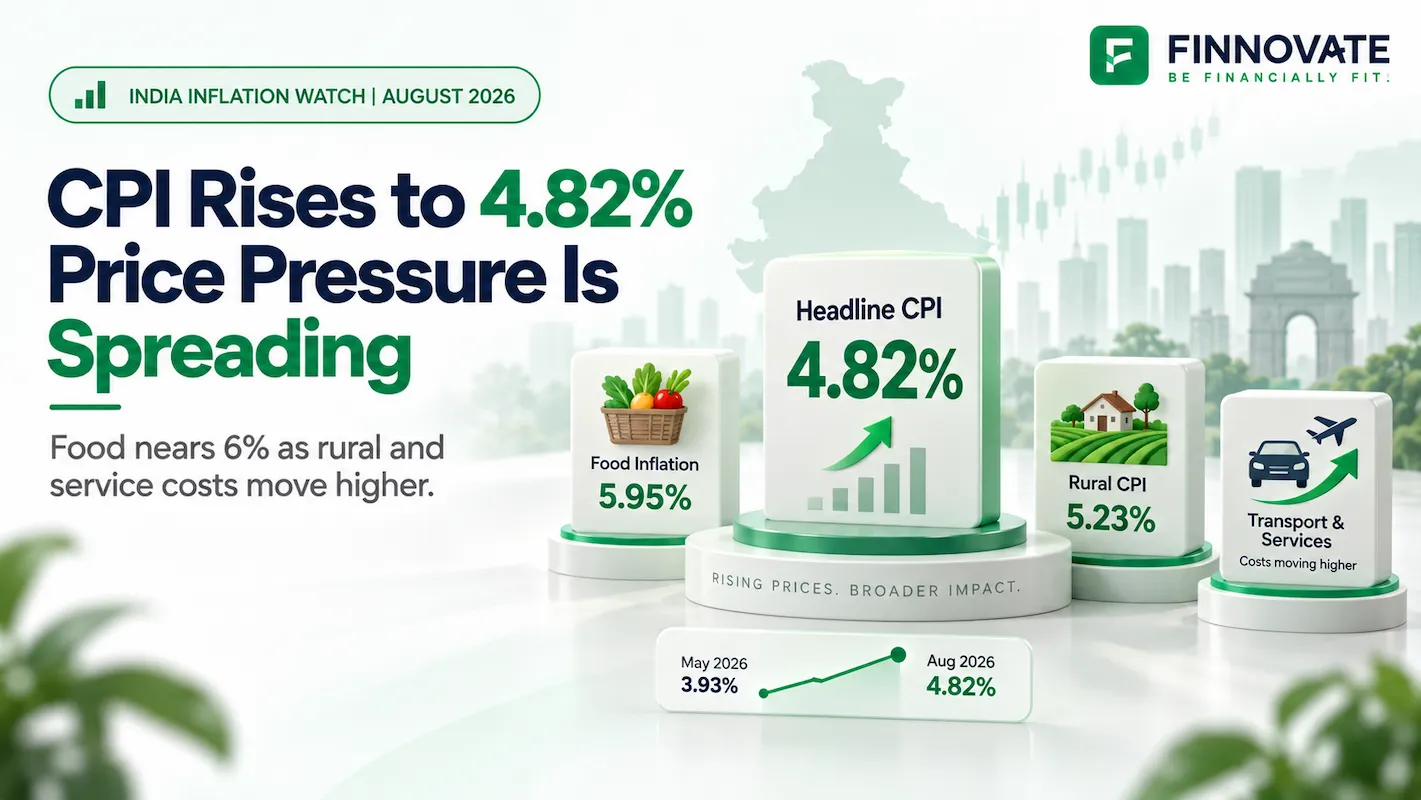
India’s CPI inflation rose to 4.82% in August 2026 as food inflation neared 6% and rural...
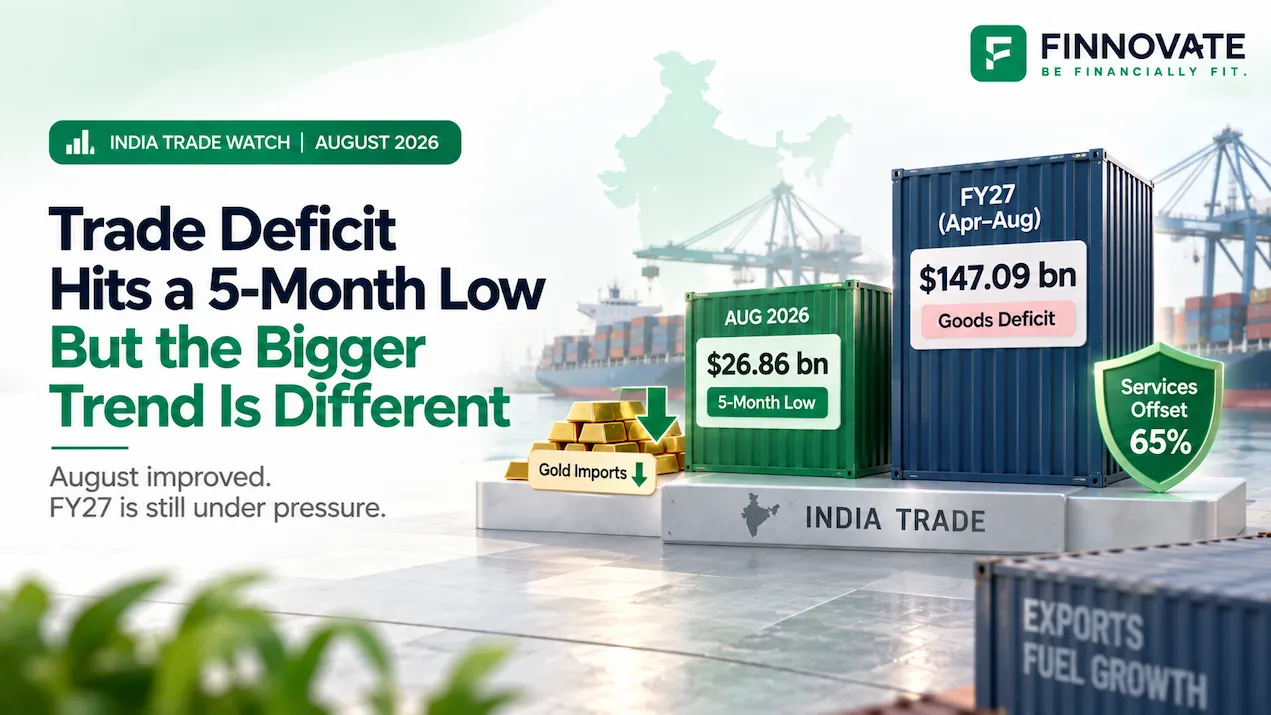
India’s trade deficit narrowed to $26.86 billion in August 2026. See what drove the impr...
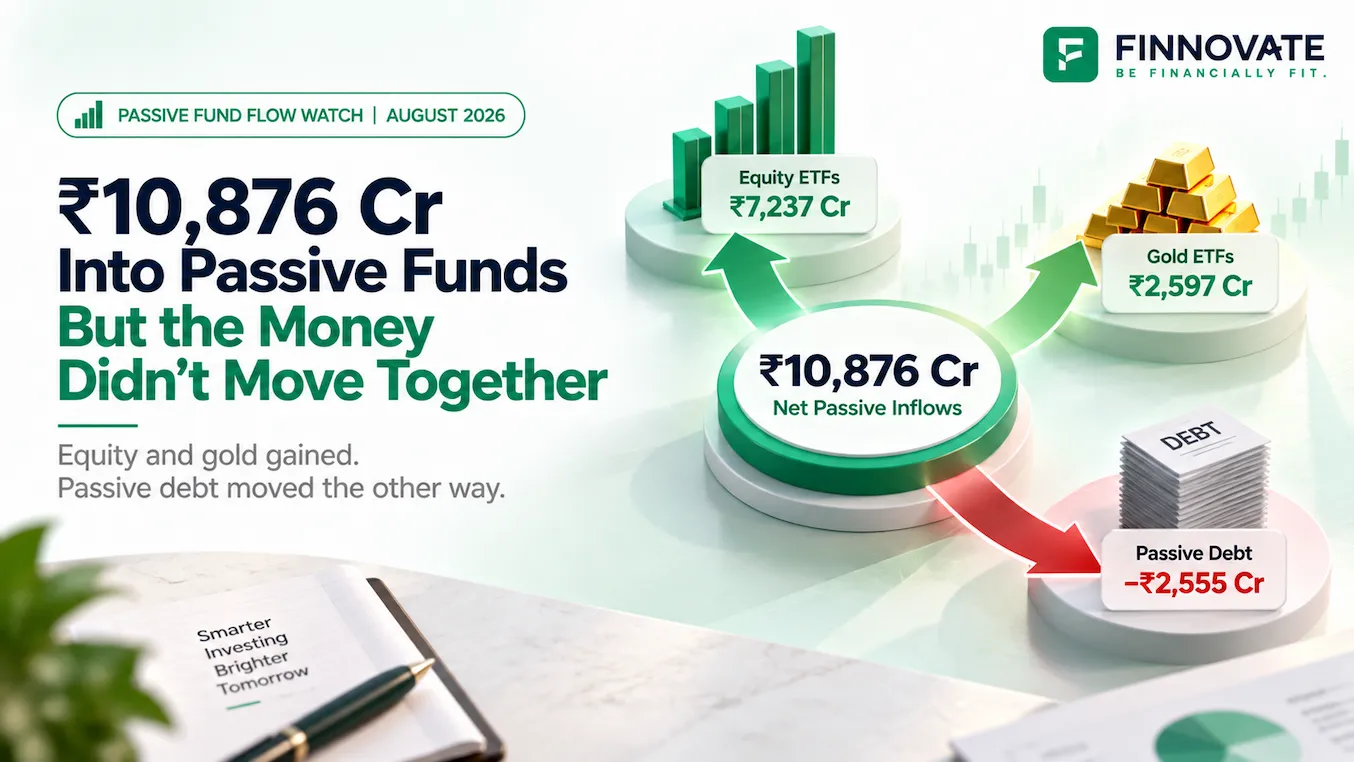
Passive funds saw ₹10,876 crore of net inflows in August 2026. See which categories led,...
Popular now

Learn how to easily download your NSDL CAS Statement in PDF format with our step-by-step g...

Looking for the best financial freedom books? Here’s a handpicked 2026 reading list with...
Learn what SIF investment means in India, SEBI rules, Rs 10 lakh minimum investment, avail...
Clear guide to mutual fund taxation in India for FY 2025–26 after July 2024 changes: equ...