

NSE IPO Review 2026: Price, GMP, Financials, Valuation & Risks
After a 10-year wait, the NSE IPO is finally here. Get a complete review of the National S...
16 September 2026

Finnovate’s editorial team researches and creates financial content using trusted sources, regulatory references and inputs from subject experts.
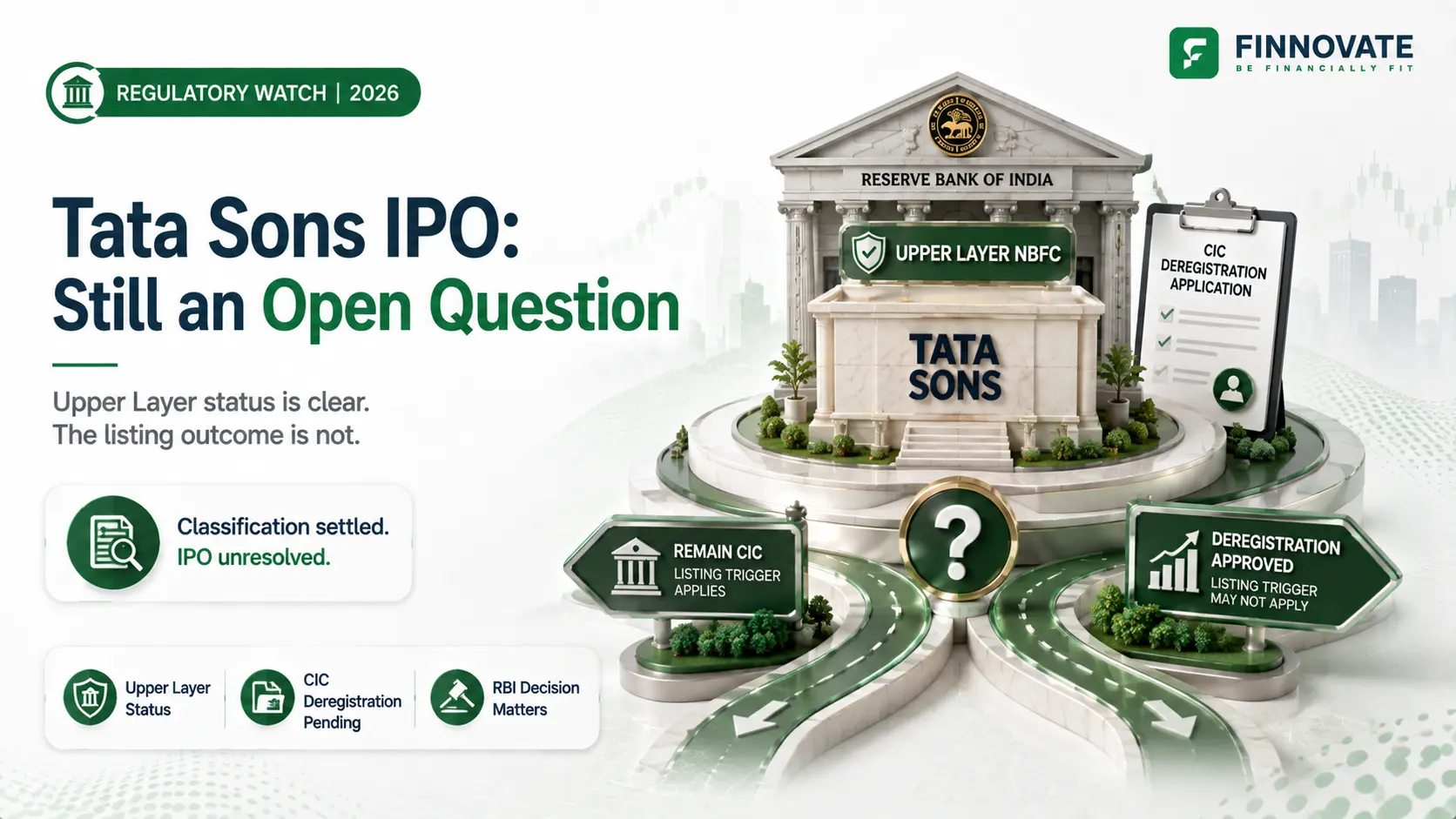
The Reserve Bank of India has once again placed Tata Sons in the Upper Layer of its NBFC regulatory framework.
Normally, that classification comes with a straightforward consequence: an Upper Layer NBFC is required to list its shares within three years of being identified.
For Tata Sons, however, things are far less straightforward.
Tata Sons was first classified as an Upper Layer NBFC in September 2022. Its original three-year listing timeline has therefore already passed. At the same time, an application filed by Tata Sons to surrender its Core Investment Company registration remains pending with RBI.
Table of Contents
| Question | Current position |
|---|---|
| Is Tata Sons an RBI-registered NBFC? | Yes, as a Core Investment Company |
| Is Tata Sons in the Upper Layer? | Yes |
| Why does it qualify? | Its asset size exceeds the ₹1 lakh crore threshold |
| Does NBFC-UL normally require listing? | Yes |
| Was Tata Sons originally expected to list by September 2025? | Yes |
| Has Tata Sons listed? | No |
| Has Tata Sons asked to surrender its CIC registration? | Yes |
| Has RBI approved that request? | Not yet |
| Is a Tata Sons IPO therefore confirmed? | No |
RBI regulates NBFCs through a Scale-Based Regulation framework.
Instead of treating every NBFC alike, the framework places companies into different layers depending on their size, activities and potential risk to the financial system.
Primarily smaller and lower-risk NBFCs.
Larger NBFCs facing stronger capital, governance and risk-management requirements.
The largest or most systemically significant NBFCs, which face enhanced regulation.
Reserved for NBFCs where RBI sees a substantial increase in systemic risk. It is ordinarily expected to remain empty.
Earlier, RBI used a combination of size, leverage, interconnectedness, complexity and supervisory judgement to identify Upper Layer NBFCs.
In June 2026, RBI simplified the framework substantially.
An NBFC with assets of ₹1 lakh crore or more, based on its latest audited balance sheet, can now fall into the Upper Layer under the simplified asset-based framework. The rule also applies to government-owned entities.
The latest set of qualifying NBFCs spans several parts of the financial system.
| NBFC category | Number |
|---|---|
| Investment & Credit Companies | 10 |
| Infrastructure Finance Companies | 4 |
| Housing Finance Companies | 2 |
| Core Investment Companies | 1 |
| Total qualifying now | 17 |
Tata Sons is the unusual one.
It is the only Core Investment Company, or CIC, in this group.
A Core Investment Company primarily holds shares and investments in companies belonging to the same group.
That is very different from a conventional NBFC that may make personal, vehicle, housing, business or infrastructure loans.
Tata Sons is primarily the principal holding and promoter company of the Tata Group.
It owns important stakes in listed businesses such as TCS and Tata Steel while also controlling major unlisted businesses including Air India, Tata Digital and Tata Electronics.
The simplest answer is size.
Under the revised framework, the key threshold is ₹1 lakh crore. Tata Sons comfortably exceeds it.
CRISIL estimated the market value of Tata Sons’ investment portfolio at around ₹13.2 lakh crore as of April 20, 2026. Its FY26 financials also showed the market value of listed investments at approximately ₹11.68 lakh crore as of March 31, 2026.
This is the measure relevant for regulatory classification.
This shows the economic scale of Tata Sons’ listed and unlisted holdings.
Tata Sons sits at the centre of a corporate ecosystem much larger than the holding company itself.
Its investments connect it to technology, automobiles, steel, power, financial services, consumer businesses, retail, aviation, electronics and digital businesses.
Tata Trusts collectively own approximately two-thirds of Tata Sons, while the Shapoorji Pallonji Group is its largest minority shareholder.
That combination of size, ownership and corporate interconnectedness explains why regulators may want enhanced governance and oversight even though Tata Sons itself is not a conventional lender.
Tata Sons has taken steps to substantially reduce its reliance on debt and sought permission from RBI to surrender its Core Investment Company registration.
The company applied for voluntary surrender of its CIC registration in 2024.
Its FY26 financials showed no borrowings as of March 31, 2026.
No.
Submitting an application is not enough.
RBI’s procedure for voluntary surrender of an NBFC Certificate of Registration makes clear that submitting an application does not itself cancel the registration.
Until RBI formally approves the surrender and communicates the cancellation, the NBFC must continue following the applicable regulatory and supervisory requirements.
Yes.
RBI’s Scale-Based Regulation framework says an NBFC in the Upper Layer must be mandatorily listed within three years of being identified as an NBFC-UL.
The rule is meant to bring the largest non-bank financial institutions closer to listed-company standards of disclosure, governance, market scrutiny and accountability.
Yes.
Tata Sons was initially identified as an Upper Layer NBFC in September 2022.
The three-year period therefore pointed to a listing deadline around September 2025. That timeline passed without Tata Sons launching an IPO.
However, Tata Sons’ application to surrender its CIC registration was already pending before the deadline passed.
That is not the same as RBI formally waiving the requirement.
A Tata Sons IPO would not be a routine stock-market transaction.
Tata Sons sits at the centre of the Tata Group’s ownership structure.
A public listing could introduce:
Tata Trusts own roughly 66% of Tata Sons and use dividend income from Tata Sons to support philanthropic activities.
Reported opposition to listing has included concerns around preserving Tata Sons’ long-term role, its relationship with Tata Trusts and its ability to incubate and support new businesses.
The other side of the debate is equally important.
The Shapoorji Pallonji Group, Tata Sons’ second-largest shareholder, has supported a path that could allow it to monetise or exit part of its holding.
The market would determine an observable value for Tata Sons shares.
Existing shareholders would have a transparent mechanism to buy or sell shares.
Listed-company reporting would make financial position and capital allocation more visible.
Public shareholders, analysts and institutional investors would bring another layer of oversight.
RBI has a strong case for placing a company of Tata Sons’ scale under enhanced regulatory oversight.
That can include stronger governance, board oversight, risk-management systems, capital standards, related-party controls, disclosure requirements and supervisory reporting.
But public listing is a different step.
Conceptually, yes. Under the existing rules, however, the two are connected because mandatory listing is one of the requirements attached to Upper Layer classification.
Separating them would therefore require regulatory relief, a rule change or approval of Tata Sons’ deregistration.
| RBI decision | Possible consequence |
|---|---|
| Approves Tata Sons’ CIC deregistration | The basis for applying NBFC-UL requirements could change, potentially removing the listing trigger subject to RBI’s final terms |
| Rejects the deregistration request | Tata Sons remains a registered CIC and the unresolved listing requirement becomes much harder to avoid |
| Provides a specific regulatory solution | Enhanced supervision could potentially continue through a tailored framework, but such an outcome would require RBI action |
RBI has designed the framework to prevent companies from moving in and out of tighter regulation every year because of temporary changes in balance-sheet size.
Entities that cease to meet the identification criteria can continue under enhanced regulation for a prescribed period.
For Tata Sons, however, the issue is not simply falling below ₹1 lakh crore. Its current asset size comfortably exceeds that threshold.
No.
Debt repayment strengthens Tata Sons’ argument, but it does not settle the regulatory question by itself.
RBI still has to determine whether Tata Sons meets the conditions required for becoming an unregistered CIC and whether surrendering the Certificate of Registration is appropriate.
No.
But neither can it be dismissed.
The regulatory basis for forcing Tata Sons to list as an Upper Layer NBFC may fall away, subject to the precise terms of RBI’s decision.
The listing issue becomes considerably more difficult to defer because the original three-year timeline has already elapsed.
The Tata Sons issue tests a larger principle in financial regulation.
Should regulation focus mainly on what an entity does and the risks it creates?
Or should size alone justify a common package of regulatory obligations even when two entities have very different business models?
A ₹1.5 lakh crore lending company and a ₹1.5 lakh crore investment holding company may have similar balance-sheet size but very different customers, funding structures, credit risks, liquidity risks and business models.
RBI’s latest Upper Layer list gives one clear answer.
Under today’s classification rules, Tata Sons is large enough to belong in the Upper Layer.
Tata Sons has eliminated borrowings, applied to surrender its CIC registration and allowed its original three-year listing timeline to pass while that application remains unresolved.
Until RBI rules on Tata Sons’ deregistration application, the latest Upper Layer list settles the classification question.
It does not settle the Tata Sons IPO question.
Yes. RBI’s latest classification continues to place Tata Sons in the Upper Layer of the NBFC framework.
Its asset size exceeds RBI’s ₹1 lakh crore threshold for Upper Layer classification under the revised framework.
No. Tata Sons is registered as a Core Investment Company. Its primary role is holding investments in Tata Group companies rather than operating as a conventional retail or corporate lender.
Under RBI’s existing Scale-Based Regulation rules, an NBFC-UL must be mandatorily listed within three years of identification.
Tata Sons was first classified as an Upper Layer NBFC in September 2022, putting its original three-year timeline around September 2025. That timeline has already passed.
Tata Sons has applied to surrender its CIC registration, and RBI has not yet decided that application. The treatment of the listing requirement while the application remains pending has therefore remained unresolved.
Tata Sons reported no borrowings as of March 31, 2026.
No. Submitting an application for voluntary surrender does not itself cancel the Certificate of Registration. The company remains subject to applicable regulation until RBI formally approves and communicates the cancellation.
No. The outcome depends heavily on RBI’s pending decision on Tata Sons’ application to surrender its CIC registration.
RBI’s final decision on whether Tata Sons can cease to be a registered Core Investment Company. That decision could determine whether the listing requirement remains applicable.
Disclaimer: This article is for general information and educational purposes only. Regulatory requirements and the Tata Sons deregistration process may evolve based on subsequent RBI decisions. References to a potential IPO are discussion of regulatory scenarios and should not be treated as confirmation that Tata Sons will list its shares.
No spam. Only new posts, simple explainers, and practical money checklists for busy professionals.
Finnovate is a SEBI-registered financial planning firm that helps professionals bring structure and purpose to their money. Over 3,500+ families have trusted our disciplined process to plan their goals - safely, surely, and swiftly.
Our team constantly tracks market trends, policy changes, and investment opportunities like the ones featured in this Weekly Capsule - to help you make informed, confident financial decisions.
Learn more about our approach and how we work with you:
No comments yet. Start the conversation. What would you add?
No spam. Only new posts, simple explainers, and practical money checklists.
You may also like
After a 10-year wait, the NSE IPO is finally here. Get a complete review of the National S...

NSE has filed for its long-awaited IPO. Before applying, understand its valuation, F&O dep...
SBI Funds Management IPO: RHP-based review of price band, GMP, financials & risks, and why...

NSE filed its DRHP on June 17, 2026. Expected IPO size ₹30,000 crore, 100% OFS, valuatio...
Popular now
Learn how to easily download your NSDL CAS Statement in PDF format with our step-by-step g...

Looking for the best financial freedom books? Here’s a handpicked 2026 reading list with...
Learn what SIF investment means in India, SEBI rules, Rs 10 lakh minimum investment, avail...

Clear guide to mutual fund taxation in India for FY 2025–26 after July 2024 changes: equ...