

NSE IPO Review 2026: Price, GMP, Financials, Valuation & Risks
After a 10-year wait, the NSE IPO is finally here. Get a complete review of the National S...
16 September 2026
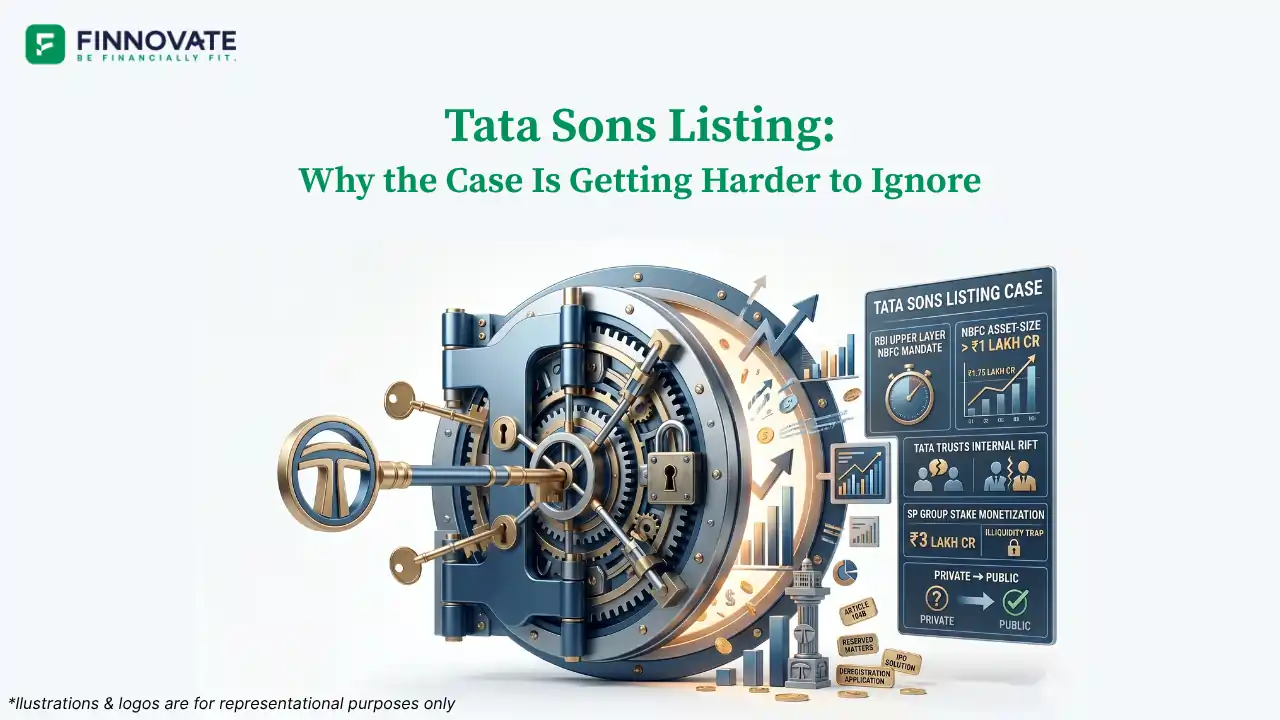
Tata Trusts, the entity that controls India's most valuable unlisted holding company, is no longer the quiet, consensus-driven body it once was. In the year since Ratan Tata's passing in October 2024, differences among the trustees have moved from private disagreement to public confrontation. The battle is ultimately about Tata Sons: who controls it, who has a say in it, and whether it should remain private.
The listing question sits at the centre of all of it. A Tata Sons IPO would resolve the SP Group's decade-long exit dilemma, address the RBI's stalled regulatory mandate, and bring governance transparency to a holding company that sits atop one of India's largest conglomerates. The argument for staying private is getting harder to make.
Tata Sons is not listed on any exchange. Its shareholding is known from court filings and financial disclosures but is not published in the manner of listed companies. Based on FY24 filings and publicly available records, the structure is as follows.
| Shareholder | Stake | Notes |
|---|---|---|
| Sir Dorabji Tata Trust | 27.98% | Largest single trust |
| Sir Ratan Tata Trust | 23.56% | Second largest trust |
| JRD Tata Trust | 4.01% | Smaller Tata Trust |
| Tata Education Trust | 3.73% | Smaller Tata Trust |
| Tata Social Welfare Trust | 3.73% | Smaller Tata Trust |
| Other smaller Tata Trusts | ~2.89% | Including Sarvajanik Seva Trust, MK Tata Trust |
| All Tata Trusts (combined) | ~65.9% | Dominant controlling bloc |
| Shapoorji Pallonji Group | 18.37% | Largest non-Trust shareholder |
| Other shareholders | ~15.73% | Listed Tata group companies and individuals |
The Sir Dorabji Tata Trust and Sir Ratan Tata Trust together hold approximately 51.54% of Tata Sons. This is the controlling bloc.
But control at Tata Sons is not simply a function of share percentage. Under Article 104B(b) of Tata Sons' Articles of Association, these two Trusts have the right to nominate one-third of the company's directors. Under Article 121, a defined set of reserved matters requires the affirmative consent of the Trusts' nominee directors. These reserved matters include changes in shareholding, appointment or removal of the chairman, and any investment above ₹100 crore.
The Supreme Court affirmed in 2021 that these protective rights exist to ensure prudent governance and oversight of the Tata Group. In practical terms, no major decision at Tata Sons can proceed without the Trusts' nominee directors voting in favour. This is why the composition and internal alignment of the Tata Trusts board matters so much, and why the current rift among trustees has immediate consequences for the group's strategic direction.
In September 2022, the RBI classified Tata Sons as an "Upper Layer" NBFC under its scale-based regulatory framework. The classification came with a statutory obligation: Tata Sons had to list on Indian exchanges within three years, by September 30, 2025.
That deadline passed. Tata Sons did not list.
In the preceding two years, Tata Sons had worked to sidestep the requirement through an alternative route: paying off all its NBFC-related debt and applying to the RBI to surrender its Certificate of Registration as a Core Investment Company. The argument was that if Tata Sons no longer met the NBFC criteria, the listing obligation would fall away.
The RBI confirmed in January 2025 that it was reviewing the application. As of April 2026, no final decision has been issued. Tata Sons continues to appear on the RBI's official upper-layer NBFC list.
On April 10, 2026, the RBI released draft amendment directions proposing to replace the current multi-parameter scoring system with a simpler asset-size threshold. Under the proposed norms, any NBFC with assets of ₹1 lakh crore or more would automatically qualify as upper layer. Tata Sons reported standalone assets of ₹1.75 lakh crore as of March 2025. If finalised as proposed, this framework would keep Tata Sons in the upper layer regardless of its deregistration application. Public comments close May 4, 2026.
The governance tension at Tata Trusts predates the listing debate but has intensified around it. After Ratan Tata's death in October 2024, Noel Tata was appointed Chairman of Tata Trusts. Unlike his predecessor, Noel has faced closer scrutiny from fellow trustees and has not yet consolidated the same authority Ratan Tata held.
The fault lines became visible in September 2025. At a Tata Trusts meeting, trustees Mehli Mistry, Pramit Jhaveri, and Darius Khambata voted against the reappointment of Vijay Singh as a Tata Sons nominee director. Singh subsequently resigned. In October 2025, Noel Tata, Venu Srinivasan, and Vijay Singh voted against the reappointment of Mehli Mistry as trustee, the first time a trustee had been voted out in the institution's history.
The family connections add another dimension. Noel Tata is married to Aloo Mistry, sister of the late Cyrus Mistry who had chaired the SP Group. Mehli Mistry is a cousin of the late Cyrus Mistry. Both were aligned, at different points, with the SP Group's interests within the Trust structure.
In July 2025, Tata Trusts under Noel Tata had passed a resolution to keep Tata Sons private and instructed Tata Sons Chairman N. Chandrasekaran to examine all options for remaining unlisted. By April 2026, that resolution has been directly contradicted from within. Venu Srinivasan, Vice-Chairman of Tata Trusts, has publicly called listing "inevitable" if the RBI maintains the upper-layer classification. Vijay Singh has expressed the same view. This is the first time sitting vice-chairmen have openly broken with the official Trust position. The internal consensus that made Tata Trusts powerful is fractured.
The Shapoorji Pallonji Group's 18.37% stake in Tata Sons is worth approximately ₹3 lakh crore based on the cumulative market value of Tata Sons' listed subsidiaries. It is the group's most valuable asset. It is also completely illiquid.
When Tata Sons converted to a private limited company in 2017, it placed strict transfer restrictions on its shares. All transfers require prior approval under the Articles of Association. When SP Group attempted to pledge its shares as collateral for debt, Tata Trusts blocked the move. When the group explored a direct stake sale to third parties, no buyer could transact without Tata Trusts' consent.
The group's debt burden is substantial. Total borrowings are estimated at ₹55,000 to ₹60,000 crore. A significant portion is collateralised against the illiquid Tata Sons stake. The group has resorted to high-yield private credit, including a $3.35 billion bond at 19.75% annual yield secured partly against its Tata Sons holding.
SP Group holds an asset worth ₹3 lakh crore that it cannot sell, cannot pledge freely, and cannot monetise without the consent of the counterpart in a decade-long corporate dispute. A public listing of Tata Sons resolves all three constraints simultaneously. In a listed environment, shares are freely tradeable, no approval is required for market transactions, and price discovery is real time. For SP Group, a Tata Sons IPO is not a preference. It is the only structural solution to a problem that has compounded for a decade.
The objections to listing have been articulated in general terms: confidentiality, governance complexity, loss of strategic flexibility. None have been spelled out with specificity. The case in favour, by contrast, is concrete on multiple fronts.
Several Indian conglomerates operate their principal holding companies as listed entities. Bajaj Holdings and Investment Ltd, JSW Holdings, and Pilani Investments are all listed on Indian exchanges. Their listing has not compromised strategic confidentiality or created operational disruption. The argument that holding companies cannot or should not list is not borne out by the Indian market record.
Tata Sons' portfolio includes defence, semiconductors, and aviation, sectors where strategic confidentiality genuinely matters. Yet TCS, Tata Technologies, and other Tata entities with sensitive operations are already listed. A listing of the holding company adds a consolidated financial disclosure layer, not operational transparency into classified programmes. Listed companies in defence globally manage this without compromising strategic operations.
The Tata Group's identity is built on institutional trust. A listing would formalise that trust through the disclosure requirements of a public company: quarterly financials, board composition, related party transactions, and dividend policy. Venu Srinivasan has noted publicly that listing would enable the group to raise large capital for capital-intensive new-age sectors including aviation, defence, semiconductors, batteries, and electronics, areas where internal resource generation has its limits.
A Tata Sons IPO resolves the SP Group's exit dilemma through the market, removes the RBI regulatory overhang, provides Tata Trusts with a more predictable dividend stream to fund their philanthropic obligations, and creates a direct investment vehicle for retail investors seeking exposure to the full breadth of the Tata Group. The listing debate has continued for three years without resolution. The case against listing has not improved with time. The case for it has only accumulated more weight.
Tata Trusts collectively hold approximately 65.9% of Tata Sons, with the Sir Dorabji Tata Trust (27.98%) and Sir Ratan Tata Trust (23.56%) being the two largest. The Shapoorji Pallonji Group holds 18.37% via Cyrus Investments and Sterling Investment Corporation, making it the largest minority shareholder outside the Trusts. The remaining stake is held by listed Tata group companies and individuals.
Tata Sons applied to de-register as a Core Investment Company with the RBI in 2024, arguing that by retiring its NBFC-related debt it no longer met the threshold for NBFC classification. The RBI confirmed it was reviewing the application in January 2025 but has issued no final decision. Tata Sons continues to appear on the RBI's upper-layer NBFC list as of April 2026, and a new draft framework would keep it there on asset-size grounds alone.
SP Group holds an 18.37% stake in Tata Sons worth approximately ₹3 lakh crore, but strict transfer restrictions make it completely illiquid. The group carries an estimated ₹55,000–₹60,000 crore in total debt, much of it collateralised against this stake. A listing would convert the holding into freely tradeable shares, giving the group the market-driven exit it has been unable to achieve through private transactions.
The dispute involves three interconnected issues: the composition of the Tata Sons board and which trustees should hold nominee director seats, the relationship with SP Group and how their exit should be managed, and whether Tata Sons should be listed. After Ratan Tata's death in October 2024, Noel Tata became Chairman of Tata Trusts but has faced open disagreement from fellow trustees. In October 2025, a trustee was voted out for the first time in the institution's history.
A listing would create a direct investment vehicle giving retail investors exposure to the Tata holding company, which owns controlling stakes in TCS, Tata Motors, Tata Steel, Tata Power, and other group entities. Governance changes at the holding level could also influence capital allocation and dividend policies across the group. Please consult a SEBI-registered investment adviser before making any investment decision based on this or any related corporate development.
On April 10, 2026, the RBI released draft directions proposing to replace the current multi-parameter NBFC classification system with a simpler asset-size threshold. NBFCs with assets of ₹1 lakh crore or more would be classified as upper-layer entities. Tata Sons reported standalone assets of ₹1.75 lakh crore as of March 2025, well above that threshold. If finalised, this framework would keep Tata Sons in the upper layer regardless of its deregistration application. Public comments close May 4, 2026.
Disclaimer: This article is for general information and educational purposes only. It does not constitute investment advice, a recommendation, or an offer to buy or sell any securities or financial instruments. Shareholding data is sourced from news sources. Tata Sons is a private limited company and does not publish exchange filings; all figures are based on the most recent publicly available information and may vary from current actuals. RBI regulatory data is from the RBI's April 10, 2026 draft amendment directions. Past corporate governance and structural changes are not indicative of future outcomes. Investors should not make any investment decision based solely on this article. Please consult a SEBI-registered investment adviser or qualified financial professional before making any investment decision. This article reflects publicly available information as of April 2026 and does not represent the views of Finnovate Financial Services on the investment merits of any Tata Group listed entity.
No spam. Only new posts, simple explainers, and practical money checklists for busy professionals.
Finnovate is a SEBI-registered financial planning firm that helps professionals bring structure and purpose to their money. Over 3,500+ families have trusted our disciplined process to plan their goals - safely, surely, and swiftly.
Our team constantly tracks market trends, policy changes, and investment opportunities like the ones featured in this Weekly Capsule - to help you make informed, confident financial decisions.
Learn more about our approach and how we work with you:
No comments yet. Start the conversation. What would you add?
No spam. Only new posts, simple explainers, and practical money checklists.
You may also like
After a 10-year wait, the NSE IPO is finally here. Get a complete review of the National S...

NSE has filed for its long-awaited IPO. Before applying, understand its valuation, F&O dep...
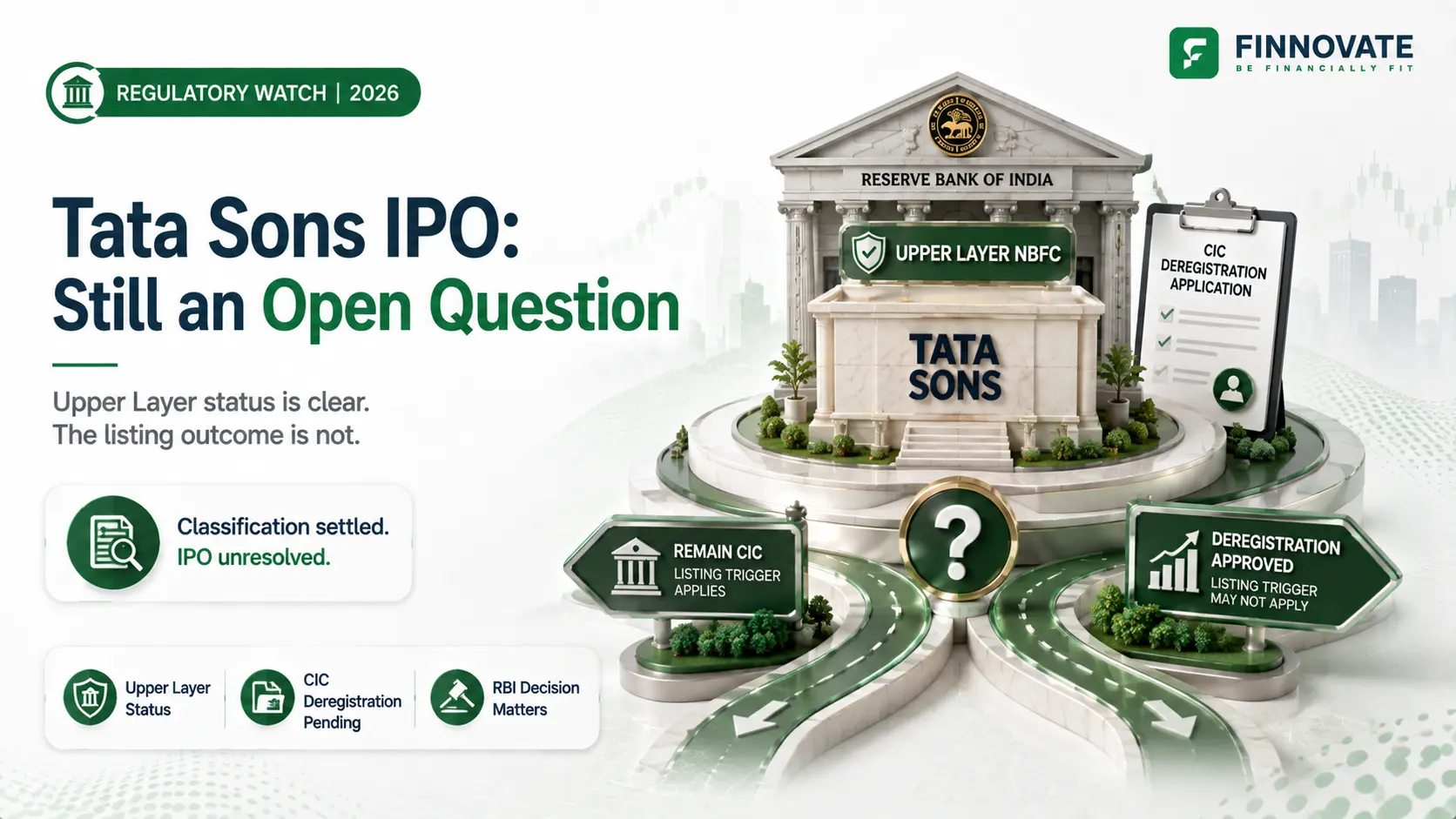
Tata Sons remains an Upper Layer NBFC in 2026. Understand RBI listing rules, CIC deregistr...
SBI Funds Management IPO: RHP-based review of price band, GMP, financials & risks, and why...
Popular now
Learn how to easily download your NSDL CAS Statement in PDF format with our step-by-step g...

Looking for the best financial freedom books? Here’s a handpicked 2026 reading list with...
Learn what SIF investment means in India, SEBI rules, Rs 10 lakh minimum investment, avail...
Clear guide to mutual fund taxation in India for FY 2025–26 after July 2024 changes: equ...