
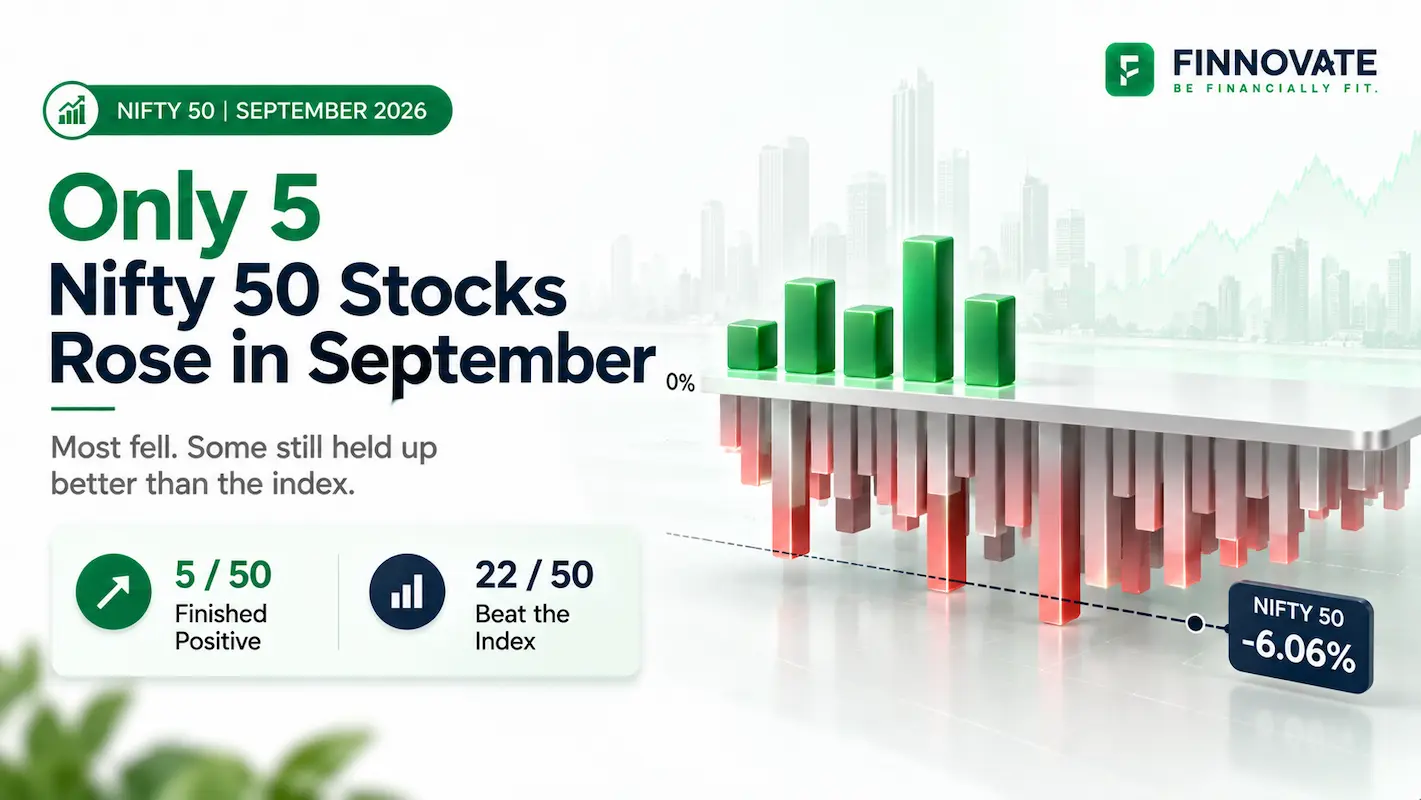
Top Performing Nifty 50 Stocks in September 2026
Only five Nifty 50 stocks rose in September 2026 as the index fell 6.06%. Compare monthly ...
08 October 2026

Finnovate’s editorial team researches and creates financial content using trusted sources, regulatory references and inputs from subject experts.
A bank can attract more deposits, give out more loans and earn a larger profit. Yet investors may still hesitate to pay more for its shares.
They want to know what it costs to produce that growth, how much profit the bank keeps and whether it can repeat the performance.
Those questions will follow Anup Bagchi when he takes over as HDFC Bank’s managing director and CEO on October 27, 2026. His appointment has received RBI approval, with shareholder approval required under the bank’s disclosure.
Bagchi brings decades of experience across banking, capital markets and insurance. But a leadership change can only begin the conversation.
For HDFC Bank to earn a stronger valuation, investors need to see a business that can grow profitably and consistently.
The first place to look is something familiar to almost every bank customer: the deposit account.
When you leave money in a savings account or open a fixed deposit, you provide the bank with funding.
The bank pays for that money, lends or invests it, and earns interest. The difference between interest earned and interest paid is its net interest income. Staff, branches, technology, loan losses and taxes still have to be paid for.
So the cost of attracting deposits matters.
Current accounts generally do not pay interest. Savings accounts typically cost banks less than fixed deposits. Together, current and savings account deposits are called CASA.
A bank with a strong base of these accounts can have a funding advantage. Customers may keep balances because their salaries arrive there, their businesses make payments through the bank, or they use it for everyday transactions.
That advantage becomes especially useful when the bank has a large loan book to fund.
HDFC Ltd merged with HDFC Bank in July 2023. The combination brought the mortgage lender’s assets and funding obligations into the bank. In its first post-merger quarterly disclosures, HDFC Bank identified the cost of debt-funded liquidity and merger management as a drag on its reported interest margin.
The task was therefore bigger than combining two organisations. The bank also needed to improve how it funded the enlarged business.
The latest business update shows progress in deposit growth.
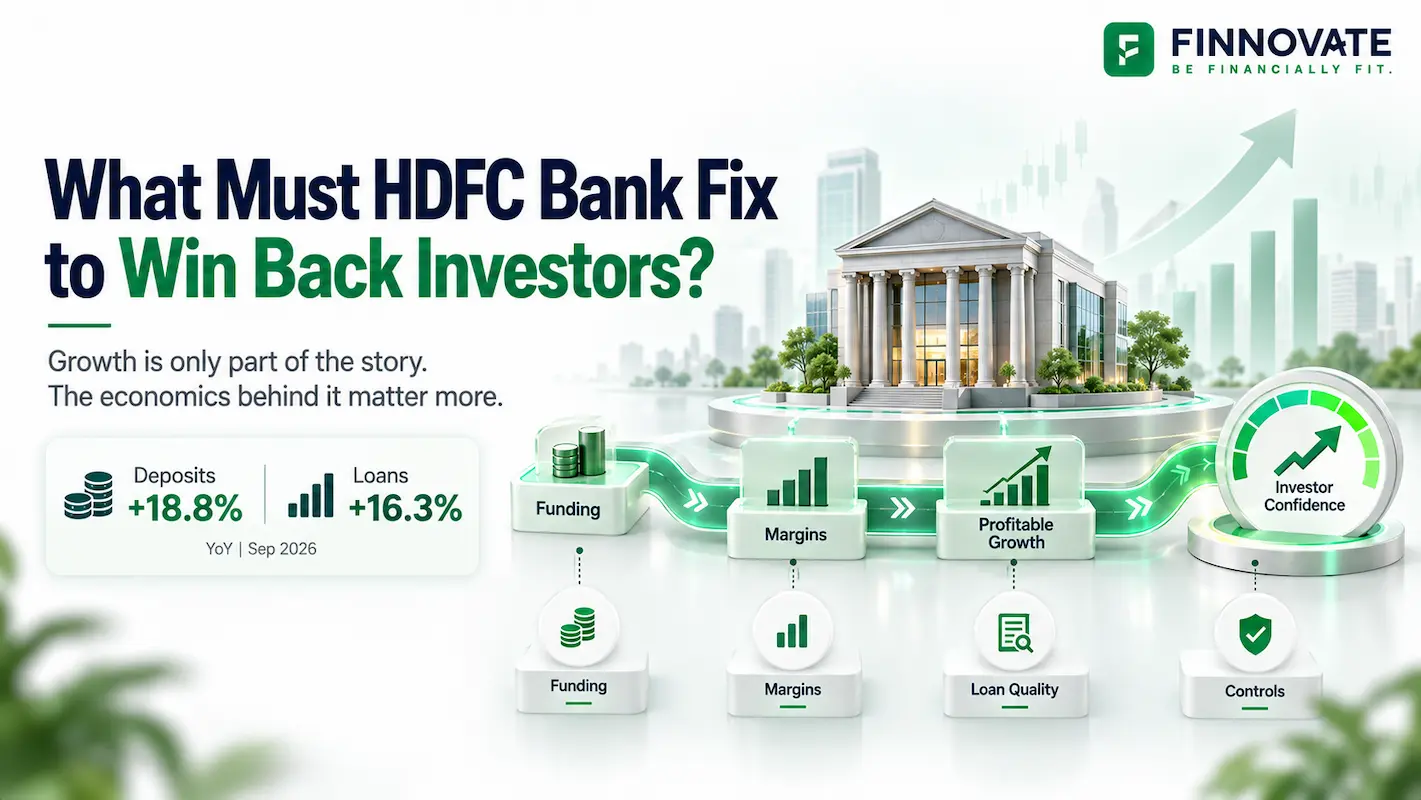
At September 30, 2026, HDFC Bank’s provisional period-end deposits were up 18.8% year-on-year, while gross advances, broadly its loans before provisions, grew 16.3%.
But the deposit mix tells another part of the story.
| Period-end measure | Year-on-year growth at September 30, 2026 |
|---|---|
| Total deposits | 18.8% |
| Current and savings account deposits | 10.8% |
| Term deposits | 22.8% |
| Gross advances | 16.3% |
Term deposits grew faster than current and savings account balances. The bank also disclosed that it had raised US$11.5 billion in foreign-currency deposits under the RBI’s FCNR(B) swap facility. These figures are from its provisional business update, rather than the full September-quarter financial results.
Attracting more money helps fund the business. The price paid for that money helps determine its profitability.
Fixed deposits are a normal and necessary source of funding. Their value depends on their cost, maturity and how the bank uses the money.
The same applies to foreign-currency deposits, where associated lending and hedging arrangements also matter.
For investors, the question is whether this larger funding base will support better earnings after all those costs.
That brings us to net interest margin, or NIM.
It measures net interest income relative to an asset base. HDFC Bank reports it on both total assets and interest-earning assets, so comparisons need to use the same basis.
For the June 2026 quarter, its NIM was 3.26% on total assets and 3.40% on interest-earning assets. Net interest income grew 6.7% year-on-year.
Think of a bank funding a loan at one interest rate and lending at another. If its funding gets cheaper while the lending rate holds steady, the spread improves.
But both sides can move.
Some loans may reset to lower rates before older, expensive deposits mature. Competition may force the bank to offer attractive deposit rates. A shift towards different types of lending can also change what it earns.
That is why deposit growth and margin improvement do not always arrive together.
Bagchi’s challenge will be to translate a growing customer and funding base into stronger earnings. Raising lending rates or chasing higher-yielding borrowers is not a simple shortcut, because those choices can affect demand and credit risk.
A bank can earn more interest by taking more risk. The difficulty may only become visible later, when borrowers struggle to repay.
That makes lending discipline central to any recovery.
HDFC Bank’s gross non-performing assets stood at 1.17% of gross advances in June 2026, compared with 1.40% a year earlier and 1.15% in March 2026. Net non-performing assets were 0.41%.
Those figures provide a starting point for assessing loan quality. They do not tell investors how every newly issued loan will perform.
As lending expands, investors need to watch whether fresh defaults and the provisions made for loan losses remain manageable.
A higher margin loses some of its appeal if more of the resulting income must be set aside against bad loans.
The valuable outcome is growth that leaves the bank with better profits after credit costs.
Financial performance is only part of the task.
The resignation of former chairman Atanu Chakraborty in March 2026, the MSRDC deposit arrangement and restrictions on the bank’s Dubai International Financial Centre branch have brought governance and controls into focus.
These matters need to be considered separately.
After the chairman’s departure, the RBI said on March 19 that the bank remained well-capitalised and had sufficient liquidity. It also said its periodic assessment showed no material concerns on record regarding conduct or governance at that time.
In July, HDFC Bank disclosed the findings of its internal review of arrangements to attract MSRDC deposits. Its board concluded that the conduct involved business overreach rather than improper motive or personal enrichment. However, it issued warnings and imposed ₹1 lakh penalties on three senior executives, citing potential divergence from RBI directions. These were findings of the bank’s internal process.
Separately, the Dubai regulator’s public register records restrictions imposed in September 2025 on the DIFC branch’s dealings with new clients in specified financial services.
For investors, the useful questions are what controls have changed, how responsibilities are enforced and whether regulatory issues are resolved.
An incoming CEO’s reputation can help start that process. Confidence becomes more durable when disclosures and subsequent conduct support it.
A bank’s valuation reflects what investors expect it to earn in the future and the risks involved in earning it.
One useful measure is return on equity: the profit generated from shareholders’ capital.
Consider two hypothetical banks with ₹100 of shareholder capital each. One earns ₹15 a year; the other earns ₹10. If their risks and growth prospects were otherwise similar, investors could reasonably value them differently despite their identical capital bases.
This is why bank investors often examine price-to-book value alongside return on equity, growth and asset quality.
A lower valuation alone does not prove that a bank is a bargain. Equally, a bank does not automatically deserve its previous valuation because it once traded there.
For HDFC Bank, the evidence to watch falls into four areas:
The September business update answers part of the growth question. The board meeting scheduled for October 17 to consider the quarter’s financial results should provide a fuller view of profitability. It falls before Bagchi’s scheduled start, making those results a baseline for the business he will inherit.
A new CEO can change expectations quickly. Improving funding costs, lending performance and organisational controls takes sustained execution.
HDFC Bank’s next chapter will be judged by how much dependable profit it can earn from the money customers entrust to it. That is what could give investors a reason to pay more for the business again.
Disclaimer: This article is for information and education only and does not constitute investment advice or a recommendation to buy, sell or hold any security.
No spam. Only new posts, simple explainers, and practical money checklists for busy professionals.
Finnovate is a SEBI-registered financial planning firm that helps professionals bring structure and purpose to their money. Over 3,500+ families have trusted our disciplined process to plan their goals - safely, surely, and swiftly.
Our team constantly tracks market trends, policy changes, and investment opportunities like the ones featured in this Weekly Capsule - to help you make informed, confident financial decisions.
Learn more about our approach and how we work with you:
No comments yet. Start the conversation. What would you add?
No spam. Only new posts, simple explainers, and practical money checklists.
You may also like
Only five Nifty 50 stocks rose in September 2026 as the index fell 6.06%. Compare monthly ...

Why did hospital stocks fall after Supreme Court scrutiny of medicine prices? Understand d...

Nifty Smallcap 100 rose 3.16% in August 2026. See which small-cap stocks led, what drove t...

Nifty Midcap 100 rose 2.15% in August 2026. See which mid-cap stocks led the rally, key se...
Popular now

Learn how to easily download your NSDL CAS Statement in PDF format with our step-by-step g...

Looking for the best financial freedom books? Here’s a handpicked 2026 reading list with...
Learn what SIF investment means in India, SEBI rules, Rs 10 lakh minimum investment, avail...

Clear guide to mutual fund taxation in India for FY 2025–26 after July 2024 changes: equ...