

Shiller CAPE Ratio Above 40: Is the US Stock Market Overvalued?
The Shiller CAPE ratio is near its 1999 peak. Explore what it means for US stock valuation...
09 October 2026

Finnovate’s editorial team researches and creates financial content using trusted sources, regulatory references and inputs from subject experts.
Elon Musk wants to bring satellite internet to India. You might expect Jio and Airtel, which have spent years building networks on the ground, to treat that as a competitive threat.
Yet both have signed agreements with SpaceX to bring Starlink to their customers, subject to the required authorisations. Airtel announced its agreement in March 2025. Jio followed the next day.
Why would India’s telecom giants help bring a potential competitor to their customers?
The answer starts with two people who want exactly the same thing: a reliable internet connection.
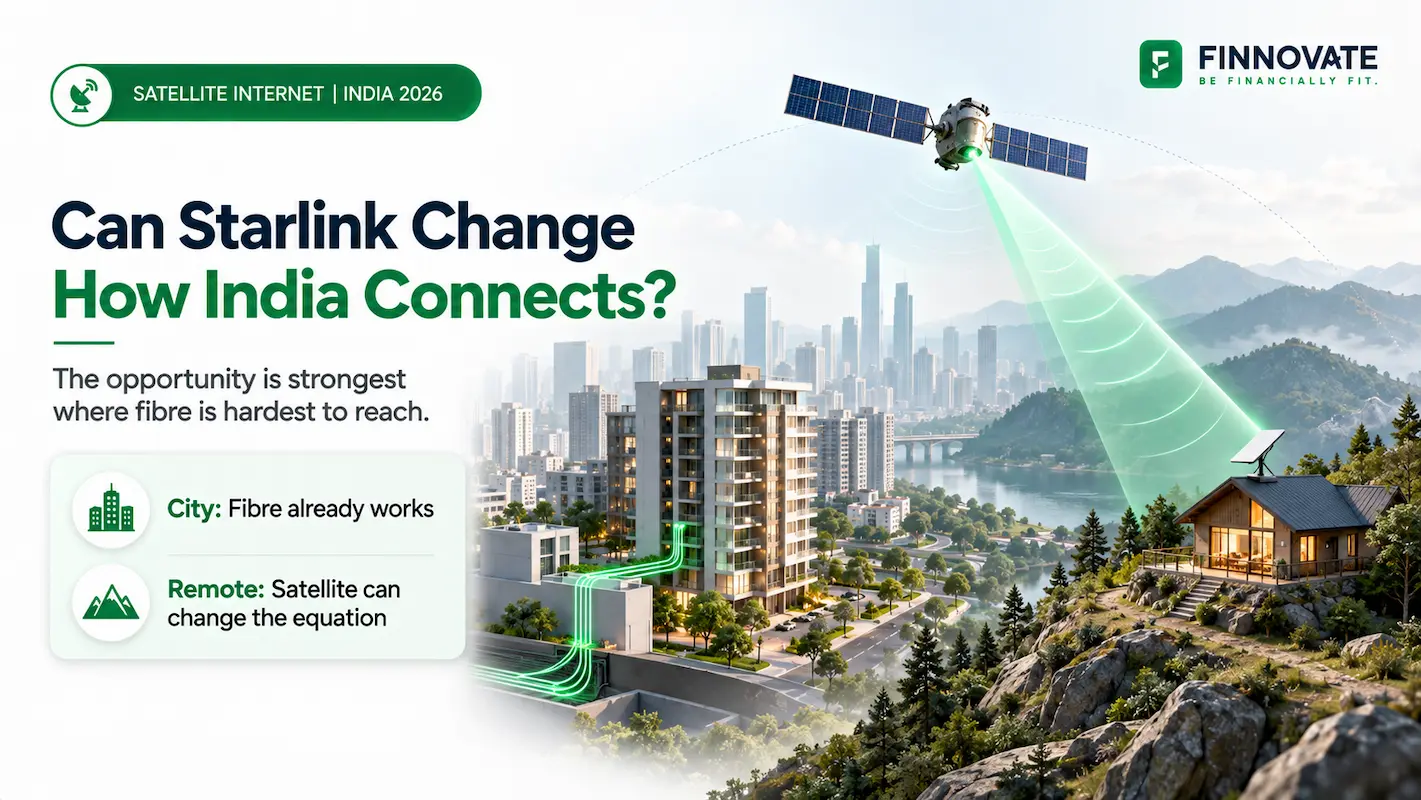
One lives in a city apartment. The other runs a lodge in the mountains.
Connecting them involves very different costs.
The Starlink broadband service covered by these partnerships needs a physical terminal installed outdoors, with a clear view of the sky. That terminal connects to satellites, while a router provides Wi-Fi for devices inside the property.
Your phone connects to that Wi-Fi much as it would at home today. This is different from a satellite connecting directly to your handset.
That distinction matters because this is a decision about installing and paying for a broadband connection. Customers need suitable space, electricity and equipment.
So where would that extra equipment be worth having?
Picture an apartment building in Bengaluru.
Getting fibre to the building costs money. The provider may need permissions, civil work, equipment and technicians. But once the connection reaches the building, it can potentially serve dozens of households.
If enough families subscribe, the provider spreads that investment across many paying customers. Nearby buildings offer more opportunities to use the same local network.
Having customers close together makes the economics easier.
Now picture a lodge several kilometres away from the nearest suitable network connection.
Reaching it could involve difficult terrain, a long cable route and maintenance trips whenever something goes wrong. Wireless alternatives may help, but those depend on coverage, terrain and available infrastructure too.
The lodge owner may be willing to pay. The problem is whether that payment justifies the cost of reaching the property.
Starlink changes this calculation. A satellite connection can avoid the need to extend a cable all the way to the lodge.
It still depends on substantial infrastructure, including satellites, ground facilities and equipment at the customer’s premises. But the customer’s distance from the nearest fibre route becomes less of an obstacle.
For the apartment, an existing fibre connection may already do the job well. For the lodge, satellite broadband could make a previously difficult connection practical.
The lodge owner still has to pay the bill.
There is equipment to purchase, a suitable installation to arrange and an ongoing subscription. The total cost matters, especially where household budgets are limited.
This is a central difficulty in connecting underserved areas: the places that are expensive to reach do not necessarily have customers who can afford an expensive service.
TRAI recognised that problem in its May 2025 satellite spectrum recommendations. It highlighted the cost of user terminals and suggested targeted subsidies to support adoption in underserved and unserved areas. That was a recommendation, rather than an automatic subsidy available to every prospective customer.
A household and a business can also value the same connection differently.
For the lodge, unreliable internet could mean missed booking enquiries, delayed payments and guests unable to work during their stay. A better connection could therefore justify a higher monthly expense.
A remote construction site or bank branch might make a similar calculation. The relevant comparison includes what interrupted connectivity costs the business.
That makes such locations plausible customers. Whether they subscribe will depend on the actual Indian price, service quality and alternatives available at their address.
Satellite coverage alone cannot answer those questions.
Return to Jio and Airtel.
A telecom company wants to serve customers across different locations. Building every connection itself is one way to do that. Offering another provider’s technology is another.
Where its existing network works well, it can continue selling that service. Where extending the network is difficult, satellite broadband could give it an additional product to offer.
The announced agreements reflect that possibility.
Airtel’s agreement includes exploring equipment sales through its stores, services for business customers and connectivity for communities, schools and health centres. It also covers potential cooperation involving Airtel’s ground network.
Jio’s announcement includes distributing Starlink equipment through its retail and online channels, alongside support for installation and activation. It positions the service as complementary to JioFiber and JioAirFiber in difficult-to-reach locations.
The commercial logic is to serve customers whom the existing network cannot easily reach.
SpaceX could gain access to established sales channels and local support capabilities. The Indian operators could broaden their offerings without building a new terrestrial connection to every remote property.
How much either side earns will depend on commercial arrangements and customer demand. A distribution agreement by itself does not establish the size or profitability of that opportunity.
But it explains why cooperation can make sense even where some competition remains.
The partnerships do not remove the need for regulatory clearance.
On October 8, 2026, the government said three satellite communications providers had received telecom licences and that security assessments were underway for all three. It said they were at broadly the same regulatory stage and could seek spectrum assignment after completing the required security process.
The statement also rejected allegations that the approval framework was discriminatory.
A telecom licence, therefore, is one step in the process. Completing security requirements and obtaining spectrum remain essential before the service can reach paying customers.
For someone considering a connection, the practical questions remain the launch date, availability at their location and the final price.
Satellite broadband also has constraints that a coverage map cannot show on its own.
Coverage does not mean unlimited capacity. Customers in an area share available network resources. When demand is high, congestion can affect speeds. Adding satellites can expand capacity, but it does not make that capacity infinite.
Installation matters too. Trees or buildings that obstruct the terminal’s view can interrupt the connection. The equipment is designed for outdoor weather, but heavy rain can still reduce performance or cause temporary outages.
These constraints help explain why satellite broadband can be valuable in remote locations without becoming the preferred connection for every city household.
A family with a dependable fibre service already has a strong alternative. Starlink would need to give that family a reason to switch.
The lodge owner could face a very different choice.
For investors, this makes the Starlink story more interesting than a contest over who owns the most impressive technology.
The questions are commercial: which customers need the service, what alternatives they have, how much they will pay and what it costs to serve them.
A large population without satisfactory connectivity represents a need. Turning that need into a sustainable business requires an affordable offer for customers and workable economics for the provider.
Actual Indian pricing and service performance will determine how far Starlink can bridge that gap.
Back at the apartment, a satellite dish may offer little reason to change an existing connection.
At the lodge, it could help the owner take bookings, receive payments and offer guests a service that was previously unreliable.
The same connection can look expensive at one address and worth paying for at another. That difference helps explain both Starlink’s opportunity in India and why Jio and Airtel want a part in it.
Disclaimer: This article is for information and education only and does not constitute investment advice.
No spam. Only new posts, simple explainers, and practical money checklists for busy professionals.
Finnovate is a SEBI-registered financial planning firm that helps professionals bring structure and purpose to their money. Over 3,500+ families have trusted our disciplined process to plan their goals - safely, surely, and swiftly.
Our team constantly tracks market trends, policy changes, and investment opportunities like the ones featured in this Weekly Capsule - to help you make informed, confident financial decisions.
Learn more about our approach and how we work with you:
No comments yet. Start the conversation. What would you add?
No spam. Only new posts, simple explainers, and practical money checklists.
You may also like
The Shiller CAPE ratio is near its 1999 peak. Explore what it means for US stock valuation...

AI demand is pushing up memory chip prices. Here's why the shortage could make smartphones...

FPIs sold ₹35,861 crore in Indian equities in September 2026. See which sectors saw outf...

Compare 19 sector and thematic indices with Nifty 50 for September 2026, covering monthly ...
Popular now

Learn how to easily download your NSDL CAS Statement in PDF format with our step-by-step g...

Looking for the best financial freedom books? Here’s a handpicked 2026 reading list with...

Learn what SIF investment means in India, SEBI rules, Rs 10 lakh minimum investment, avail...

Clear guide to mutual fund taxation in India for FY 2025–26 after July 2024 changes: equ...