
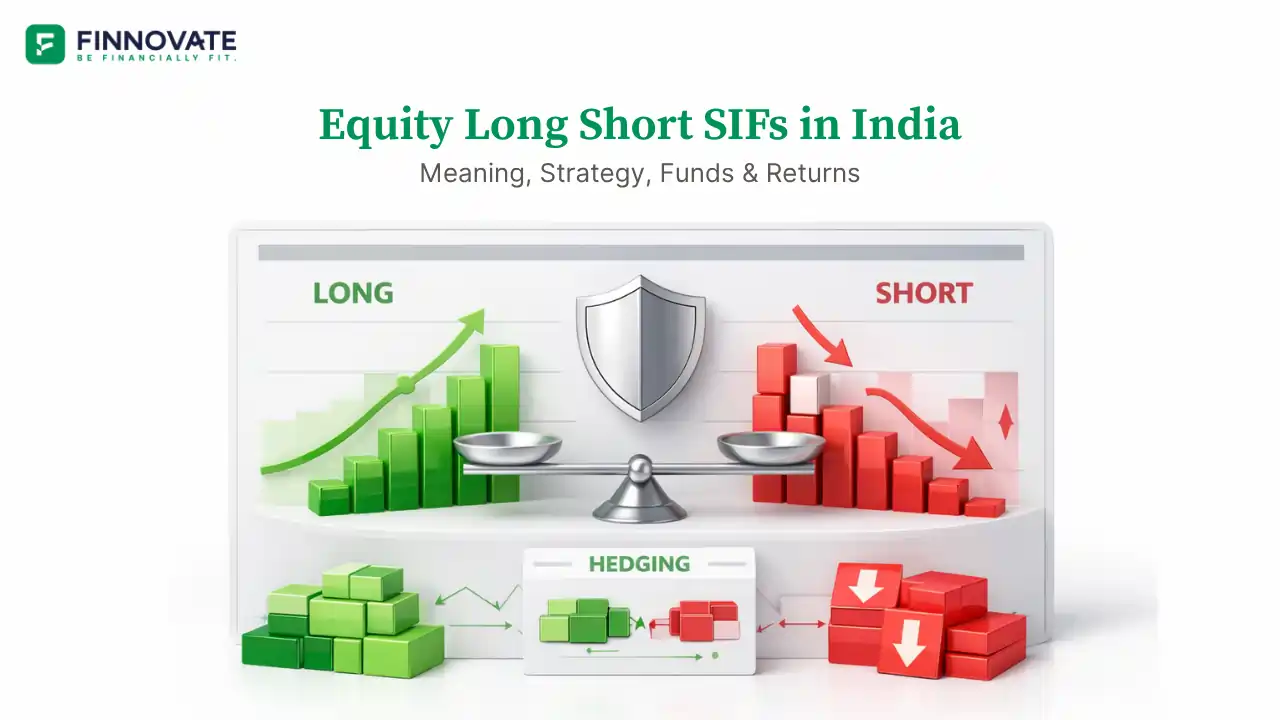
SIF Equity Long-Short Funds India: Strategy, Funds & Returns
What is a SIF Equity Long-Short Fund? Explore 2 sub-categories, 4 live funds, latest NAV d...
27 March 2026


Finnovate’s editorial team researches and creates financial content using trusted sources, regulatory references and inputs from subject experts.
Suppose you invest ₹10 lakh in a Specialised Investment Fund (SIF). Eighteen months later, your investment is worth ₹12 lakh, and you decide to redeem it.
You have made a gain of ₹2 lakh.
How much tax would you pay?
It could be ₹9,375. Or it could be ₹60,000 if you fall in the 30% income-tax slab.
The investment amount is the same. So is the gain and the holding period. Yet the tax bill can be very different.
These figures assume a resident investor who has fully used their basic exemption limit, has no other eligible long-term equity gains and has no losses to set off. They also exclude cess and surcharge.
The difference comes from the type of SIF you invested in.
SEBI introduced Specialised Investment Funds in 2025, allowing asset managers to offer strategies that can combine stocks, bonds and derivatives in ways not ordinarily available to conventional mutual funds. The minimum investment requirement is generally ₹10 lakh, subject to SEBI's conditions.
But SIF is an investment category, not a separate tax category.
An equity-oriented SIF, a debt-heavy SIF and a hybrid long-short SIF can follow different tax rules. And a fund's strategy name does not necessarily tell you which rules apply.
SIFs generally follow the tax framework applicable to mutual funds. Capital gains tax depends on the SIF's qualifying investments, how long you hold its units and whether the conditions for a particular tax treatment are satisfied.
For resident individual investors, there are three main possibilities.
| SIF tax classification | Short-term capital gains (STCG) | Long-term capital gains (LTCG) |
|---|---|---|
| Equity-oriented SIF | 20% when held for up to 12 months | 12.5% on aggregate eligible gains exceeding ₹1.25 lakh, when held for more than 12 months |
| Specified debt-oriented SIF | Taxed at applicable income-tax slab rates | Gains are treated as short-term regardless of holding period |
| Other non-equity SIF, including qualifying hybrid strategies | Taxed at applicable slab rates | Generally 12.5% after more than 24 months for unlisted units, without indexation |
← Scroll horizontally on mobile →
Rates exclude applicable cess and surcharge. Equity rates assume the relevant Securities Transaction Tax (STT) requirements are met. Listed non-equity units generally have a 12-month rather than a 24-month long-term holding threshold.
The distinction is important because a SIF that fails the equity-oriented test does not automatically become a specified debt fund.
Some hybrid strategies can fall between these classifications and qualify for general non-equity capital gains treatment.
To understand why, we first need to look at the fund's underlying assets.
A SIF's tax classification is not established simply by reading the words equity, debt or hybrid in its name.
The Income-tax Act prescribes specific investment thresholds and methods for measuring them.
For the usual equity-oriented fund test, at least 65% of its total proceeds must be invested in qualifying equity shares of domestic companies listed on recognised stock exchanges.
If yes: equity-oriented capital gains rules can apply, subject to statutory conditions.Under Section 76 of the Income-tax Act, 2025, this generally includes a fund investing more than 65% in debt and money-market instruments. The definition also covers a fund investing at least 65% of its proceeds in units of such a debt-focused fund.
If yes: gains on covered units are treated as short-term regardless of holding period.The fund may fall under the general capital gains rules for non-equity mutual fund units. Whether the units are listed or unlisted, and how long they are held, becomes important.
Confirm the classification and holding-period rules with the AMC.These investment percentages are calculated using prescribed averages. For the usual equity-oriented fund test, the law uses an annual average of monthly averages of opening and closing equity holdings. For the specified debt-fund test, it uses the annual average of daily closing figures.
So a single month's portfolio disclosure may not be enough to establish the final tax position.
The AMC's scheme documents and tax disclosures are the appropriate starting point.
An equity-oriented SIF can qualify for the same capital gains rates applicable to equity-oriented mutual funds.
If you redeem qualifying equity-oriented SIF units within 12 months of purchasing them, the gains are generally taxed at 20%, subject to the applicable STT conditions.
This rate is not determined by your regular income-tax slab.
For example, a resident investor in the 30% slab can still face the prescribed 20% STCG rate on qualifying equity-oriented units.
If the units are held for more than 12 months, eligible long-term gains are taxed at 12.5% on the aggregate amount exceeding ₹1.25 lakh in a tax year.
That ₹1.25 lakh threshold is not available separately for every SIF investment.
It is shared across eligible long-term capital gains covered by the relevant equity taxation provisions, including qualifying listed equity shares, equity-oriented mutual funds and business trust units.
Consider an investor who earns ₹90,000 in eligible long-term gains from equity mutual funds and another ₹1 lakh from an equity-oriented SIF in the same year.
Their combined eligible gain is ₹1.9 lakh.
After accounting for the ₹1.25 lakh threshold, ₹65,000 remains subject to the 12.5% rate, giving a basic tax of ₹8,125.
The investor cannot claim the full ₹1.25 lakh threshold twice.
There is no indexation benefit under these equity-oriented long-term capital gains provisions.
For a closer understanding of these strategies, read Finnovate's guide to SIF Equity Long-Short Funds in India.
The rules for debt-heavy SIFs are different.
From April 1, 2026, the definition of a specified mutual fund focuses on funds investing more than 65% in debt and money-market instruments, along with certain funds investing in units of such funds.
This replaced the earlier definition that relied on a fund holding no more than 35% in domestic equity shares.
Why does this matter?
Because under the specified mutual fund provisions, gains from covered units acquired on or after April 1, 2023 are treated as short-term capital gains, regardless of the actual holding period.
Suppose an investor purchases units of a qualifying debt-oriented SIF and holds them for four years.
Under these rules, the investor does not become eligible for a concessional long-term capital gains rate merely because four years have passed.
The gains are taxed at the applicable income-tax slab rate.
For a person in the 30% bracket, that generally means a basic tax of 30% on the taxable gain, before applicable cess and surcharge.
There is no indexation benefit.
The key distinction is that holding a specified debt-oriented SIF for longer does not, by itself, reduce the applicable capital gains tax rate.
However, the fund must actually satisfy the specified mutual fund definition. A strategy described as debt-oriented should not automatically be assigned this treatment without checking its qualifying holdings.
Hybrid SIFs can be more complicated because they combine different asset classes and may change their allocations over time.
A hybrid long-short strategy, for instance, may hold equity shares, bonds and money-market instruments while also using derivatives.
The tax result depends on whether the strategy satisfies the relevant equity-oriented or specified mutual fund definition.
Consider three hypothetical hybrid portfolios.
| Portfolio composition | Possible tax classification |
|---|---|
| 70% in qualifying domestic listed equity shares | Equity-oriented fund |
| 75% in debt and money-market instruments | Specified mutual fund |
| 50% in qualifying domestic equity, 40% in debt and 10% in other permitted assets | Other non-equity fund, assuming neither statutory test is met |
← Scroll horizontally on mobile →
These examples illustrate asset allocation, not actual SIF schemes. The applicable averaging rules and other statutory conditions must also be satisfied.
The third example deserves attention.
It does not qualify for equity-oriented treatment because the qualifying equity allocation falls below 65%.
But it also does not meet the specified debt-fund test.
For such an unlisted non-equity fund, gains realised within 24 months are generally treated as short-term and taxed at applicable slab rates.
Once the units are held for more than 24 months, the gains can qualify for long-term capital gains taxation at 12.5%, without indexation.
Unlike qualifying equity-oriented gains, these general non-equity long-term gains do not receive the ₹1.25 lakh annual threshold.
If the relevant non-equity units are listed on a recognised Indian stock exchange, the long-term holding-period threshold is generally more than 12 months instead.
Older articles on mutual fund taxation often divide investments into three categories using two equity thresholds: above 65%, between 35% and 65%, and below 35%.
That approach can now produce the wrong conclusion.
Under the revised specified mutual fund definition, having less than 35% in equity does not, by itself, establish specified debt-fund treatment. The fund's qualifying debt and money-market holdings must be examined.
This is especially relevant for multi-asset and hybrid long-short strategies that can hold instruments other than conventional equity and debt.
For more on how these portfolios are constructed, read SIF Hybrid Long-Short Funds in India.
Not automatically.
This is one of the most important distinctions in SIF taxation.
A SIF can use derivatives to take positions in equity markets. But market exposure through an equity derivative is not the same thing as holding qualifying domestic listed equity shares.
Consider a hypothetical SIF with the following positions.
| Investment or exposure | Percentage |
|---|---|
| Domestic listed equity shares | 60% |
| Debt and other permitted holdings | 40% |
| Additional equity derivative exposure | 15% |
The derivative exposure is shown separately from the underlying asset allocation because exposure and ownership are different measures.
Although the strategy has substantial equity-market exposure, it does not automatically satisfy the 65% qualifying equity-share requirement.
The additional derivatives exposure cannot simply be added to the physical equity allocation and treated as qualifying equity shares.
The precise classification depends on the qualifying portfolio holdings, applicable measurement rules and statutory conditions.
This is why two funds pursuing similar long-short strategies can have different capital gains treatment.
For an investor, the relevant question is not simply how much equity-market exposure a SIF takes.
It is how much of the portfolio meets the tax law's qualifying equity-share definition.
Let us return to the investor from the beginning.
The investor places ₹10 lakh in a SIF, holds the units for 18 months and redeems them for ₹12 lakh.
The realised capital gain is ₹2 lakh.
Assume the investor is an Indian resident in the 30% income-tax bracket, with no other eligible long-term equity gains, no available capital losses and no unused basic exemption limit.
| Particulars | Equity-oriented SIF | Other non-equity SIF (unlisted) | Specified debt-oriented SIF |
|---|---|---|---|
| Amount invested | ₹10,00,000 | ₹10,00,000 | ₹10,00,000 |
| Redemption value | ₹12,00,000 | ₹12,00,000 | ₹12,00,000 |
| Holding period | 18 months | 18 months | 18 months |
| Capital gain | ₹2,00,000 | ₹2,00,000 | ₹2,00,000 |
| Applicable treatment | LTCG at 12.5% above threshold | STCG at 30% slab | STCG at 30% slab |
| Basic tax payable | ₹9,375 | ₹60,000 | ₹60,000 |
| Gain retained after basic tax | ₹1,90,625 | ₹1,40,000 | ₹1,40,000 |
← Scroll horizontally on mobile →
Illustrative calculation excluding cess, surcharge, securities transaction tax, redemption costs and other individual tax adjustments. The 30% slab is assumed for the two non-equity examples.
In the equity-oriented case, the calculation is:
₹2,00,000 gain − ₹1,25,000 annual threshold = ₹75,000 taxable LTCG.
₹75,000 × 12.5% = ₹9,375 basic tax.
For the other two cases, the illustrative calculation is:
₹2,00,000 × 30% = ₹60,000 basic tax.
Now suppose the same investor continues holding the investment until after 24 months, with the gain still at ₹2 lakh.
For the qualifying equity-oriented SIF, long-term equity capital gains rules continue to apply.
For the unlisted non-equity SIF that is neither equity-oriented nor a specified mutual fund, the gain can now qualify for 12.5% LTCG taxation.
That works out to ₹25,000 in basic tax on the ₹2 lakh gain.
For the specified debt-oriented SIF, the gain continues to be treated as short-term and taxed at the investor's applicable rate.
The example shows why a fund's tax classification matters. But it does not mean investors should hold an unsuitable investment simply to reach a favourable holding period.
Market movements, investment costs and redemption restrictions may have a much larger effect on the amount eventually received.
Generally, an individual SIF investor does not pay tax each time the fund manager buys or sells securities within the portfolio.
Eligible SEBI-registered mutual fund structures benefit from exemption on qualifying fund income under the applicable income-tax provisions.
The investor owns units in the SIF rather than directly owning every security in its portfolio.
So if a fund manager sells shares, closes a derivative position or rebalances the strategy, those transactions do not ordinarily create separate personal capital gains entries for each unitholder.
For investors holding the growth option, personal capital gains taxation generally arises when units are redeemed or otherwise transferred.
This differs from a typical Portfolio Management Service (PMS), where securities are directly held for the client and portfolio transactions may create taxable gains or losses in that client's account.
The distinction can matter for actively managed portfolios. However, it should not be used to assume that SIFs are always more tax-efficient or more suitable than PMS investments.
A switch can trigger capital gains tax even when no money reaches your bank account.
Suppose an investor switches ₹12 lakh worth of units from one SIF strategy into another after originally investing ₹10 lakh.
If the switch is processed as a redemption of the first strategy and a purchase of the second, the ₹2 lakh realised gain can be taxable.
The fact that both strategies belong to the same AMC does not automatically make the transaction tax-free.
The same principle applies when switching between options or plans where the transaction involves a taxable transfer of units.
For a partial withdrawal, capital gains are calculated on the units actually redeemed, rather than on the entire investment that remains in the fund.
Investors should check the tax consequences along with exit loads and permitted redemption windows before requesting a switch.
Taxation matters when an investment loses money too.
Suppose an investor purchases ₹10 lakh worth of SIF units and later redeems them for ₹9 lakh.
The investor has realised a capital loss of ₹1 lakh.
Depending on whether it is classified as a short-term or long-term capital loss, it may be available for set-off against other eligible capital gains.
| Type of capital loss | Can be set off against |
|---|---|
| Short-term capital loss | Eligible short-term and long-term capital gains |
| Long-term capital loss | Eligible long-term capital gains only |
Eligible losses that cannot be fully adjusted may generally be carried forward for up to eight subsequent tax years, subject to the return-filing and other statutory conditions.
A capital loss cannot simply be adjusted against salary income.
And a fall in the SIF's NAV does not, by itself, mean the investor has realised a capital loss.
For normal capital gains treatment, that loss generally arises when the units are redeemed or transferred.
The important distinction is between losses made by the fund manager inside the portfolio and losses realised by the investor on the fund's units.
Some SIF strategies may offer an Income Distribution cum Capital Withdrawal (IDCW) option.
Under IDCW, the fund distributes an amount to eligible unitholders instead of retaining the entire value within the scheme.
For resident individual investors, taxable IDCW distributions are generally taxed at the applicable income-tax slab rate.
A resident investor in the 30% bracket could therefore have a higher tax liability on IDCW income than the concessional rate available on qualifying long-term equity capital gains.
The applicable TDS provision generally requires the payer to deduct tax at 10% when the aggregate relevant distribution exceeds ₹10,000 during the tax year.
That 10% deduction is not necessarily the final tax liability.
If the investor's actual tax liability is higher, the balance may need to be paid through the applicable tax-payment process.
There is also a common misunderstanding about IDCW.
An IDCW payout is not additional investment return created merely because the fund makes a distribution.
It can involve withdrawal of part of the invested capital, and the NAV generally adjusts for the payout.
An investor comparing growth and IDCW options should therefore examine both the timing of taxation and whether regular cash distributions are actually needed.
TDS treatment differs between resident and non-resident investors.
| Transaction | Resident individual | NRI |
|---|---|---|
| Capital gains on redemption | Generally no TDS | TDS generally applicable under relevant provisions |
| IDCW distribution | Generally 10% TDS above the applicable ₹10,000 threshold | Non-resident withholding rules apply, subject to eligible treaty relief |
For resident investors, the absence of TDS on redemption does not mean the capital gain is tax-free.
The gain still needs to be considered when calculating the investor's final income-tax liability.
For NRIs, the withholding rate depends on the nature of the gain, its tax classification, the applicable provisions and any available benefits under a Double Taxation Avoidance Agreement (DTAA).
An NRI should not assume that every SIF redemption attracts one fixed TDS rate.
Tax residency documents and other prescribed requirements may be relevant when claiming treaty benefits.
The examples in this article are primarily intended for resident individual investors.
Other transaction-related charges can apply in addition to capital gains tax.
On redemption of units of a qualifying equity-oriented SIF, Securities Transaction Tax (STT) generally applies at 0.001% of the redemption value.
Stamp duty may also apply when units are issued, at the prescribed rate.
These charges are different from the income tax payable on realised gains.
Applicable surcharge and the 4% health and education cess can further increase the final income-tax liability.
That is why the effective amount paid may be higher than the basic tax figures shown in an illustrative calculation.
Two strategies may target similar returns but have different tax outcomes.
And even within the same category, liquidity and risk can differ.
Before investing, use the AMC's official documents to verify the following.
| What to verify | Why it matters |
|---|---|
| Tax classification | Establishes whether equity-oriented, specified debt-fund or general non-equity rules are expected to apply |
| Qualifying equity and debt holdings | Helps assess the statutory investment thresholds |
| Derivative exposure | Equity-related derivatives do not automatically count as qualifying listed equity shares |
| Listed or unlisted units | Can change the long-term holding period for non-equity units |
| Redemption frequency and notice period | Determines when money can actually be withdrawn |
| Growth or IDCW option | Affects how and when investment income is taxed |
| Exit load and expenses | Reduce the amount retained by the investor |
Start with the Investment Strategy Information Document (ISID), Key Information Memorandum, Statement of Additional Information and the AMC's current tax disclosures, where applicable.
These should be read alongside the latest portfolio disclosures and any strategy-specific tax clarification.
For a broader explanation of the categories and redemption structures, see Finnovate's guide to Types of Specialised Investment Funds.
A SIF can offer access to investment strategies that conventional mutual funds may not provide. But that flexibility also makes it necessary to examine how the fund invests and how those investments affect its tax classification.
Two SIFs can produce the same gain and leave investors with different amounts after tax.
The difference may come from the equity allocation, debt holdings, derivatives strategy or simply how long the units were held.
For investors, the starting point should be the fund's actual classification, not the label attached to its strategy.
And even when a fund qualifies for a lower capital gains tax rate, that benefit is only useful if the investment itself suits the investor's risk capacity, time horizon and liquidity needs.
The figure that ultimately matters is what remains after investment costs and taxes, considered alongside the risk taken to earn it.
No. SIFs do not offer a general tax exemption to investors. Capital gains from redeeming or transferring units can be taxable, and IDCW distributions can also attract tax.
No. The 12.5% rate after more than 12 months generally applies to qualifying equity-oriented SIFs, subject to statutory conditions and the eligible annual LTCG threshold. Some non-equity funds require a longer holding period, while specified debt funds do not receive concessional long-term treatment.
Only if it satisfies the equity-oriented fund requirements. A hybrid strategy's use of equity derivatives or its name alone does not establish the required qualifying equity-share allocation.
No. The ₹10 lakh general minimum investment requirement is not a tax-saving deduction. Ordinary SIF investments do not qualify for Section 80C benefits merely because they are SIFs.
Realised gains from SIF units should be reported under the appropriate capital gains provisions based on the fund's tax classification and holding period. Taxable IDCW income is generally reported under income from other sources.
Investors should retain the AMC's capital gains statement, transaction records and any relevant TDS information. The correct ITR form depends on the investor's full income profile.
Yes. From April 1, 2026, the specified mutual fund definition focuses on more than 65% investment in debt and money-market instruments, or the prescribed investment in units of such a fund. It replaces the earlier definition based on holding no more than 35% in domestic equity shares.
This is particularly relevant for hybrid and multi-asset investments.
Disclaimer: This article is for information and educational purposes only. It does not constitute investment, legal or tax advice. Tax treatment depends on the investor's circumstances, the relevant SIF's actual composition, statutory conditions and prevailing law. Investors should consult a qualified tax professional before relying on a particular classification or tax calculation.
No spam. Only new posts, simple explainers, and practical money checklists for busy professionals.
Finnovate is a SEBI-registered financial planning firm that helps professionals bring structure and purpose to their money. Over 3,500+ families have trusted our disciplined process to plan their goals - safely, surely, and swiftly.
Our team constantly tracks market trends, policy changes, and investment opportunities like the ones featured in this Weekly Capsule - to help you make informed, confident financial decisions.
Learn more about our approach and how we work with you:
No comments yet. Start the conversation. What would you add?
No spam. Only new posts, simple explainers, and practical money checklists.
You may also like
What is a SIF Equity Long-Short Fund? Explore 2 sub-categories, 4 live funds, latest NAV d...
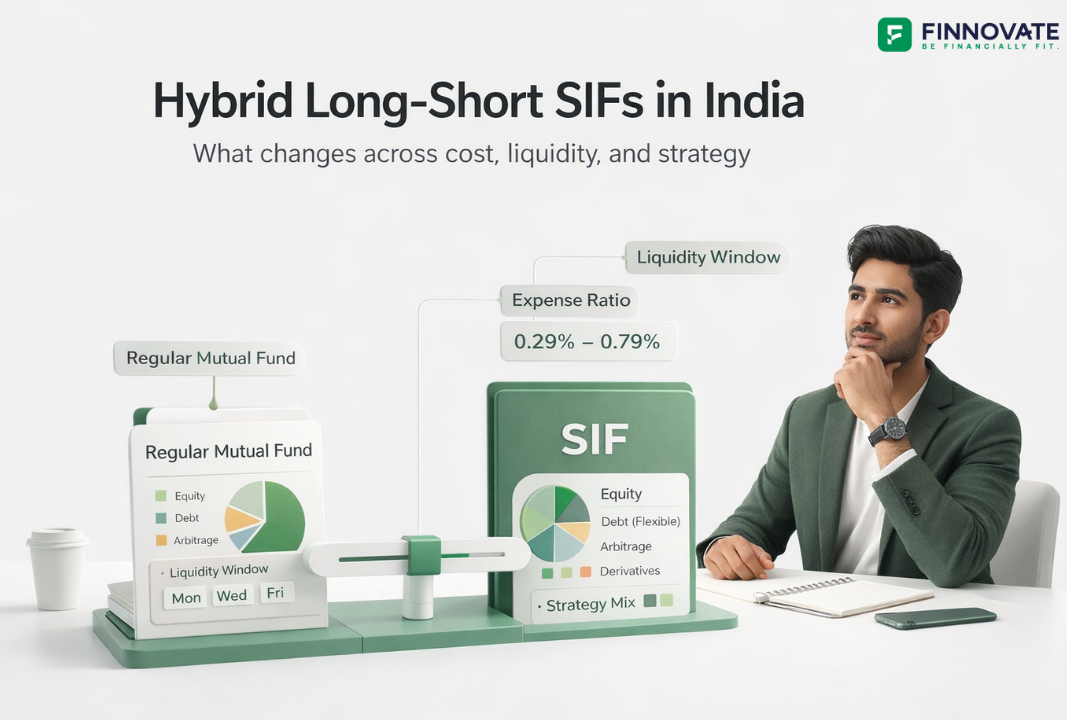
What is a SIF Hybrid Long-Short Fund? Explore how the strategy works, all 6 live funds in ...
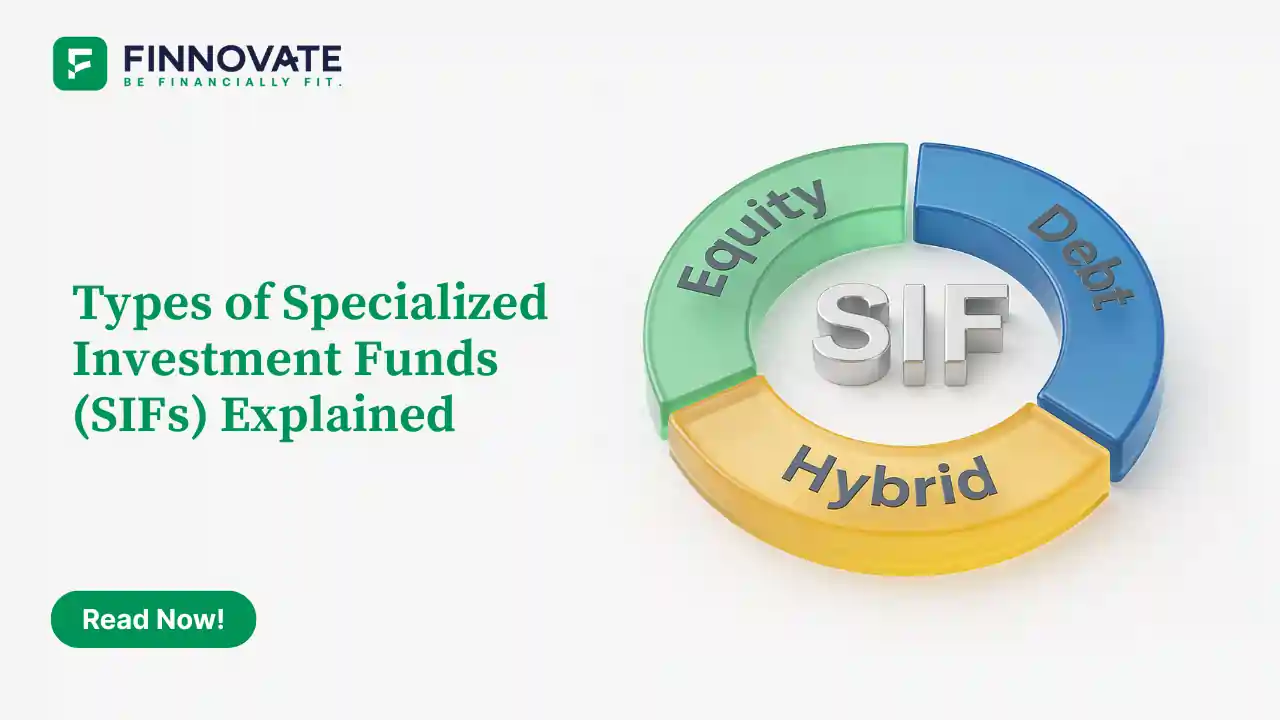
Explore the different types of Specialized Investment Funds (SIFs) - Equity, Debt, and Hyb...
Specialized Investment Funds, SIF India, SIF investment risks, long-short SIF, Quant AMC S...
Popular now
Learn how to easily download your NSDL CAS Statement in PDF format with our step-by-step g...

Looking for the best financial freedom books? Here’s a handpicked 2026 reading list with...
Learn what SIF investment means in India, SEBI rules, Rs 10 lakh minimum investment, avail...

Clear guide to mutual fund taxation in India for FY 2025–26 after July 2024 changes: equ...