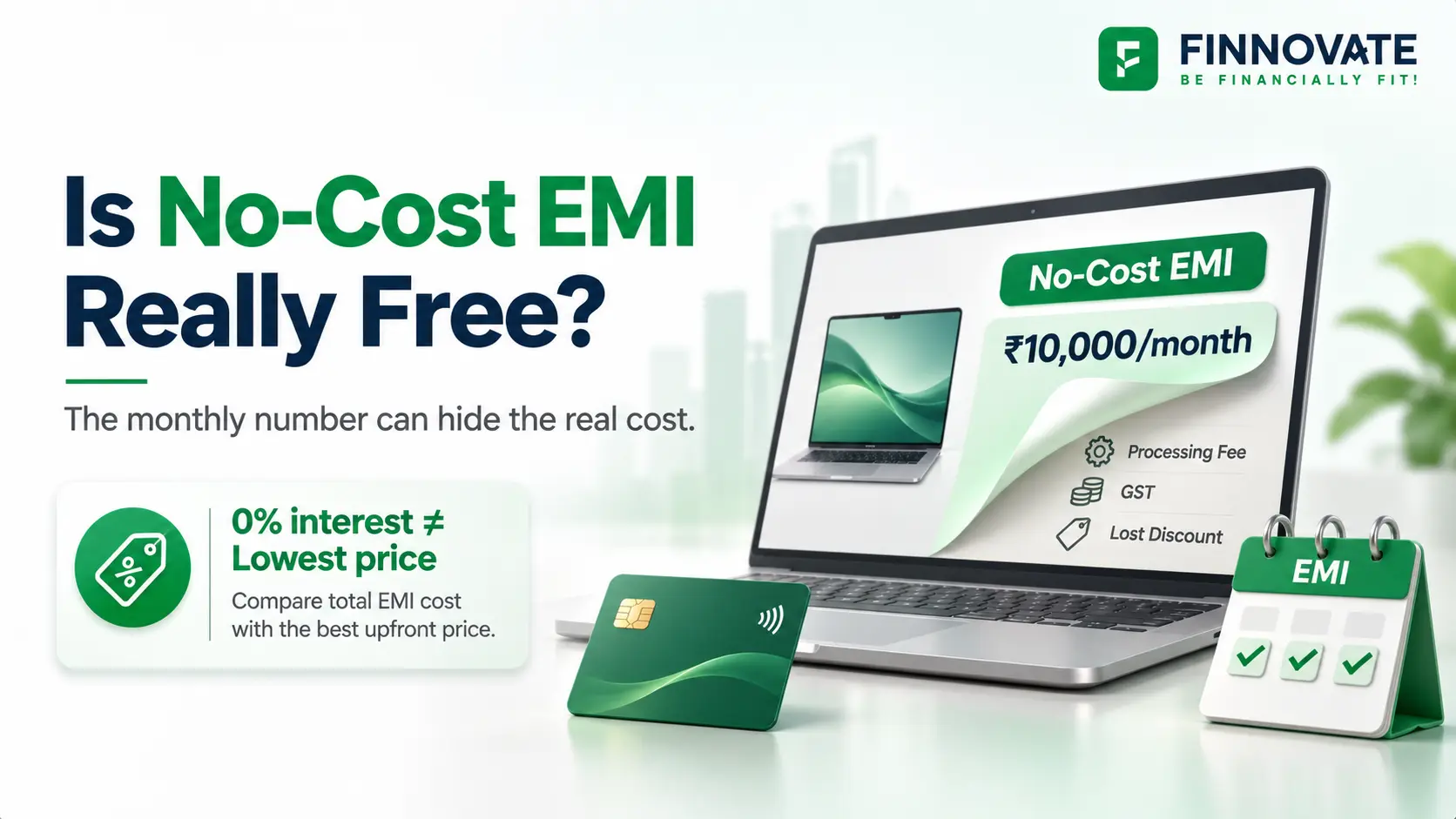
Is No-Cost EMI Really Free?

Finnovate’s editorial team researches and creates financial content using trusted sources, regulatory references and inputs from subject experts.
A ₹60,000 phone sounds expensive. But ₹10,000 a month for six months can feel much easier to manage. Add the words “No-Cost EMI”, and it may seem like there is no downside to splitting the payment.
Not always. In many offers, the lender still charges interest, while the merchant, manufacturer or card issuer provides an upfront discount designed to offset that interest.
Processing fees, applicable GST, lost upfront discounts and other charges can still make the EMI option more expensive than paying upfront.
How Does No-Cost EMI Actually Work?
A common no-cost EMI structure works through an upfront discount provided by the merchant, manufacturer or card issuer.
This structure is often called interest subvention.
Why Does RBI Care About This?
RBI has long cautioned against EMI offers that make borrowing costs difficult for consumers to see.
Under the current credit-card directions, issuers must separately disclose the principal, interest and upfront merchant or card-issuer discount used to make an EMI “no cost”.
An EMI containing interest should not simply be presented as a zero-interest product without showing how the cost is being offset.
A ₹60,000 No-Cost EMI Example
Consider a hypothetical ₹60,000 mobile purchase.
Assume a six-month credit-card EMI carrying a 16% annual reducing interest rate.
If the merchant gives an upfront discount sufficient to offset that interest, the transaction works approximately like this:
| Part of transaction | Illustrative amount |
|---|---|
| Product price | ₹60,000 |
| Upfront EMI discount | ~₹2,703 |
| Amount financed | ~₹57,297 |
| Interest charged over six months | ~₹2,703 |
| Total scheduled EMIs | ~₹60,000 |
This is why the transaction feels interest-free.
The buyer ultimately pays around the original ₹60,000 through the scheduled instalments, even though interest exists inside the lender's calculation.
So Where Does the Interest Actually Appear?
The bank does not usually charge the entire ₹2,703 interest in one go.
It is calculated on the reducing outstanding balance.
| Month | Opening balance | Interest | Principal repaid | EMI | Closing balance |
|---|---|---|---|---|---|
| 1 | ₹57,297 | ₹764 | ₹9,236 | ₹10,000 | ₹48,061 |
| 2 | ₹48,061 | ₹641 | ₹9,359 | ₹10,000 | ₹38,701 |
| 3 | ₹38,701 | ₹516 | ₹9,484 | ₹10,000 | ₹29,217 |
| 4 | ₹29,217 | ₹390 | ₹9,610 | ₹10,000 | ₹19,607 |
| 5 | ₹19,607 | ₹261 | ₹9,739 | ₹10,000 | ₹9,868 |
| 6 | ₹9,868 | ₹132 | ₹9,868 | ₹10,000 | ₹0 |
| Total | ~₹2,703 | ~₹57,297 | ₹60,000 |
This is the important distinction:
Where Can the Extra Cost Appear?
What Could the ₹60,000 Purchase Actually Cost?
Continue with the same example.
Assume:
- scheduled EMIs total approximately ₹60,000,
- GST on the illustrative ₹2,703 interest is roughly ₹487,
- processing fee is ₹69,
- GST on that fee is roughly ₹12.
The exact number will vary by card issuer and offer.
What If You Cancel or Pre-Close the EMI?
Do not assume that closing the EMI early automatically lets you keep the merchant discount while avoiding the financing cost.
Cancellation, foreclosure, partial refunds and processing-fee reversals are governed by the issuer's terms.
And What If You Miss a Payment?
No merchant subsidy protects you from the consequences of not paying your credit-card dues correctly and on time.
Late-payment charges, finance charges and other issuer costs can make the transaction considerably more expensive.
The Comparison Most Buyers Get Wrong
Suppose the same ₹60,000 laptop has a ₹3,000 instant discount for a qualifying upfront payment.
The EMI may still qualify as “no-cost” because the merchant has offset the lender's interest.
But it was not the cheapest way to buy the laptop.
What Are You Actually Paying For?
In the example above:
Best upfront cost: ₹57,000
Approximate EMI outflow: ₹60,568
Difference: ₹3,568
That changes the decision.
That is a much more useful question than simply asking whether the checkout page says “No-Cost EMI”.
Sometimes the answer may be yes.
If paying upfront would materially weaken your emergency reserve or leave very little liquidity, paying a small, known premium may be reasonable.
But if you already have sufficient cash and the upfront discount is substantial, the financing premium may offer little value.
But the Bigger Cost May Not Be the Interest
Consider a ₹72,000 phone.
vs
₹6,000 × 12 months
Viewed as ₹72,000, you may ask:
Viewed as an EMI, the question often changes to:
Those are not the same affordability test.
A purchase can fit into your monthly budget and still be a poor use of ₹72,000.
The ₹5,000 EMI Trap
One EMI may look small.
Several small EMIs can quietly become one large monthly obligation.
| Purchase | Monthly EMI |
|---|---|
| Phone | ₹4,500 |
| Laptop | ₹5,000 |
| Furniture | ₹3,500 |
| Holiday | ₹6,000 |
| Total already committed | ₹19,000/month |
Individually, each EMI may have looked manageable.
Together, ₹19,000 of next month's income is already committed before the month begins.
That leaves less room for savings, investments, emergencies and future priorities.
Credit-card EMI purchases can also reduce your available credit limit, depending on the issuer's terms.
When Can No-Cost EMI Actually Make Sense?
No-cost EMI is not automatically a bad financial decision.
Suppose you genuinely need a ₹60,000 laptop for work and have ₹1 lakh available as emergency savings.
Paying ₹60,000 upfront would reduce your readily available cash to ₹40,000.
Now suppose:
- the lender's interest is fully subsidised,
- fees and taxes are modest,
- you are not giving up a large upfront discount,
- the EMI comfortably fits your budget,
- and preserving cash has genuine value.
In that situation, paying a modest known premium to preserve liquidity may be reasonable.
If paying upfront would significantly weaken your financial buffer, it may also be worth reviewing how your emergency fund is structured .
When Should You Reconsider It?
- You are choosing a more expensive product only because the monthly EMI looks affordable.
- The upfront-payment price is meaningfully lower.
- You already have several EMIs.
- The purchase will use a large part of your available credit.
- Your monthly cash flow is already tight.
- The EMI may last longer than the value you expect to get from the product.
The 5-Number Check Before Choosing No-Cost EMI
Before clicking “Buy”, find these five numbers.
The first four numbers tell you what the EMI costs.
The fifth helps answer whether you should take another EMI at all.
Final Takeaway
No-cost EMI is not necessarily fake.
A merchant or manufacturer can genuinely subsidise the lender's interest.
But:
Processing fees and applicable GST can remain.
You may lose a better upfront price or other card benefits.
Cancelling or pre-closing the EMI may have separate conditions.
And several small instalments can quietly consume a meaningful part of your future income.
Before choosing no-cost EMI, compare the total EMI cost with the best genuine upfront price.
Then ask one final question:
If the answer changes once the monthly instalment disappears, the bigger issue may not be the cost of borrowing. It may be the purchase itself.
FAQs
1. Does no-cost EMI charge interest?
Often, yes. In many no-cost EMI structures, the lender charges interest while the merchant, manufacturer or card issuer provides an upfront discount intended to offset it. RBI requires the principal, interest and such discount to be disclosed separately for credit-card EMI conversions.
2. Why is GST charged on no-cost EMI?
For credit-card EMI transactions, applicable GST can be charged on the interest component and on processing or service fees. The exact amount depends on the issuer and transaction structure.
3. Does no-cost EMI have a processing fee?
It can. Processing fees vary by card issuer, merchant, transaction size and EMI tenure. Check the final EMI schedule and fees before confirming the purchase.
4. Is no-cost EMI better than paying upfront?
Not automatically. Compare the total EMI cost, including fees and applicable taxes, with the best genuine upfront price after discounts or cashback. EMI may still make sense if preserving liquidity is valuable and the additional cost is reasonable.
5. Does no-cost EMI affect my credit-card limit?
It can. Some issuers block the transaction amount or financed principal from the available card limit and restore the limit progressively as repayments are made. Check your issuer's applicable terms.
6. Can I cancel or prepay a no-cost EMI?
Usually, but issuer rules apply. Cancellation, partial refunds and foreclosure can be treated differently, and some fees or already billed charges may not be reversed. Do not assume pre-closing an EMI will automatically preserve the merchant discount while eliminating all financing costs.
7. Is no-cost EMI worth taking if I already have the cash?
Compare the true EMI premium with the value of keeping that cash available. If paying upfront gives a materially better price and does not weaken your emergency reserve, upfront payment may be more economical. If preserving liquidity is important and the premium is small, EMI may still be reasonable.