

EU Scrap Export Curbs: India’s Raw-Material Risk Explained
Proposed EU scrap export curbs could affect India’s metal supply and manufacturing costs...
24 September 2026

Finnovate’s editorial team researches and creates financial content using trusted sources, regulatory references and inputs from subject experts.
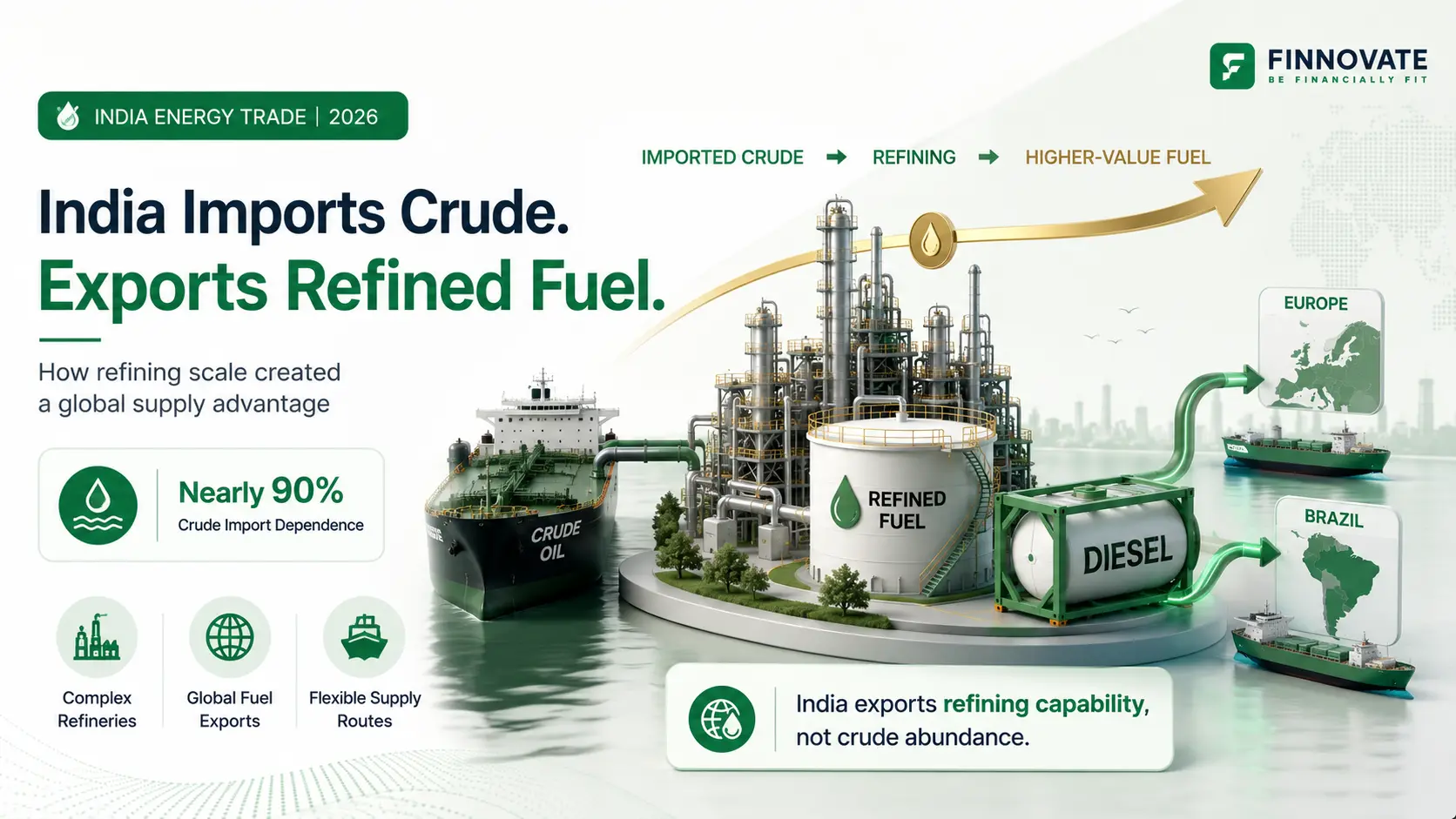
India depends on overseas suppliers for nearly 90% of the crude oil it consumes. Yet Indian refineries regularly export diesel, petrol, aviation fuel and other petroleum products to markets thousands of kilometres away.
That apparent contradiction became particularly visible in July 2026.
Reliance Industries loaded an estimated 4 million to 5 million barrels of diesel from its Jamnagar refinery for Europe during the month, the highest volume sent to the region in ten months. India’s diesel exports to Brazil were also expected to reach an 11-month high of approximately 2.8 million barrels, with cargoes coming from the Jamnagar and Vadinar refineries.
The shipments came as European diesel inventories fell to their lowest level since 2014, Russian exports declined and disruptions in the Middle East reduced the availability of Gulf cargoes.
India has not become a major crude-oil producer or achieved energy independence.
It has instead built one of the world’s largest and most flexible refining systems. That system allows imported crude to be processed into higher-value fuels and redirected towards markets facing shortages or offering stronger commercial returns.
An estimated 4 million to 5 million barrels of diesel were loaded from Reliance’s Jamnagar complex for Europe during July 2026.
The shipments represented:
India’s diesel exports to Brazil were separately projected to reach approximately 2.8 million barrels during July, the highest in 11 months. These cargoes were expected to come from both Reliance’s Jamnagar refinery and the Vadinar refinery.
The Brazil figure should therefore not be attributed entirely to Reliance.
| July 2026 export indicator | Estimated position |
|---|---|
| Reliance diesel exports to Europe | 4–5 million barrels |
| Europe volume comparison | Highest in 10 months |
| India’s diesel exports to Brazil | Around 2.8 million barrels |
| Brazil volume comparison | Highest in 11 months |
| European diesel refining margin | Around $74 per barrel |
| Jamnagar crude-processing capacity | 1.4 million barrels per day |
The $74-per-barrel figure referred to European diesel refining margins. It was not the retail price of diesel or Reliance’s net profit on each barrel.
Crude oil and petroleum products are not the same thing.
Crude oil is the raw material extracted from underground reserves. Refineries process it into fuels and feedstocks such as:
India’s domestic crude production is insufficient to meet its requirements. Its crude-import dependency was approximately 89.44% in FY2024-25, according to Energy Statistics India 2026.
However, after crude reaches Indian ports, it enters a large refining network capable of supplying both domestic customers and international buyers.
| India imports | India exports |
|---|---|
| Unrefined crude oil | Diesel |
| Crude grades used as refinery feedstock | Petrol |
| Selected LPG and other energy products | Aviation turbine fuel |
| Inputs for refining and petrochemicals | Naphtha and other petroleum products |
India is therefore not exporting crude abundance.
It is exporting the value created by processing imported crude.
India is the world’s fourth-largest refiner, with 22 operational refineries and installed refining capacity of approximately 258.1 million tonnes per annum.
Domestic petroleum-product consumption reached around 243.2 million tonnes in FY2025-26, while petroleum-product exports totalled approximately 61.5 million tonnes.
| Refining indicator | Current position |
|---|---|
| Operational refineries | 22 |
| Installed refining capacity | 258.1 MMTPA |
| FY2025-26 domestic product consumption | 243.2 million tonnes |
| FY2025-26 petroleum-product exports | 61.5 million tonnes |
| FY2024-25 crude-import dependency | 89.44% |
These numbers should not be used to calculate exports simply by subtracting domestic consumption from refining capacity.
Refineries operate at different utilisation levels and produce different combinations of fuels. India also imports and exports intermediate petroleum products, while refinery maintenance, inventory movements and product yields can change from year to year.
The figures instead demonstrate the scale of India’s refining system and its ability to participate in international product markets while meeting domestic demand.
The crude-to-fuel value chain can be understood in six steps.
This refining margin can vary sharply.
It depends on:
India is not exporting energy independence. It is exporting refining capability.
Large refineries can process substantial volumes and spread fixed costs across greater output.
Scale also allows refiners to produce large cargoes for international markets without depending only on small or irregular shipments.
Refinery complexity measures the ability to use advanced processing units to convert crude into higher-value products.
A complex refinery can generally process a wider range of crude grades, including heavier and more sulphurous crude that may trade at a discount to lighter grades.
It can also reduce the proportion of low-value residual fuel and produce more diesel, petrol, aviation fuel and petrochemical inputs.
Several major Indian refineries are located near the coast.
Western Indian refineries have access to:
This allows refineries to change destinations when regional prices move.
Large crude carriers and product tankers require deep-water terminals, storage facilities and efficient loading systems.
India’s export-oriented refining complexes have developed infrastructure that supports large international cargoes.
India has increasingly operated as a swing supplier of refined fuels.
A swing supplier can redirect available cargoes towards the region facing the greater shortage or offering the strongest economics.
That does not mean India permanently supplies one market. Cargo flows can change from Europe to Asia, Africa or Latin America depending on prices and freight.
Reliance’s Jamnagar complex is central to India’s refined-fuel export capability.
The complex has crude-processing capacity of approximately 1.4 million barrels per day and a complexity index of 21.1. Reliance says this configuration allows the refinery to process almost all major crude grades and produce fuels meeting different international specifications.
Its advantages include:
A high complexity index does not guarantee high profit in every quarter.
It provides flexibility. That flexibility becomes particularly valuable when crude discounts, fuel shortages or regional price differences change quickly.
Europe has become more dependent on imported diesel following refinery closures and restrictions on Russian energy products.
Its supply position became especially tight in July 2026.
European diesel inventories fell to their lowest level since 2014, while diesel margins rose to a record of approximately $74 per barrel. Energy Aspects estimated that Europe could face a third-quarter shortfall of around 833,000 barrels per day in middle distillates, which include diesel and aviation fuel.
The immediate shortage reflected several factors:
Indian diesel became valuable because it could be shipped into the European market relatively quickly and meet the required fuel specifications.
Brazil is a major crude-oil producer, but that does not make it self-sufficient in every petroleum product.
A country’s crude production and refinery configuration may not match the type or quantity of fuel its economy consumes.
Brazil continues to import diesel because domestic refinery output is not always sufficient to meet transport, agricultural and industrial demand.
Russian diesel exports to Brazil fell to their lowest level in nearly four years during July, creating an opportunity for cargoes from India and other suppliers.
Brazil can export crude while importing diesel, just as India can import crude while exporting diesel.
Both outcomes reflect the difference between producing the raw material and having the right refining capacity to create the products required by the domestic market.
Russia imposed a diesel export ban from July 8 after drone attacks disrupted refinery operations and domestic fuel availability.
Russian diesel and gasoil exports had averaged approximately 817,000 barrels per day in 2025. They fell to around 400,000 barrels per day in June 2026 and approximately 234,000 barrels per day during the first ten days of July.
On July 30, Russia extended restrictions on diesel and gasoline exports until January 31, 2027, although producers are expected to receive exemptions for some diesel, marine-fuel and gasoil exports from September 1.
The reduction in Russian availability forced traditional buyers, including Brazil and Turkey, to compete for alternative supplies.
It also increased demand for cargoes from:
The final effect of the Russian restrictions will depend on exemptions, refinery recovery and domestic fuel conditions inside Russia.
A refinery does not normally choose an export destination based only on the headline selling price.
The decision depends on the net amount it can earn after all costs.
Key factors include:
In late July, the spread between European and Asian diesel prices made Europe attractive. However, Asian diesel margins also strengthened to around $77 per barrel.
Shipping a large LR2 tanker from western India to Europe cost slightly more than $5 million, equivalent to approximately $55 per tonne. This meant Asia could still compete for August cargoes despite Europe’s supply shortage.
The July export surge should therefore not be treated as a permanent change in destination.
India has the ability to supply Europe, but cargoes may move east or west depending on which market offers better economics.
European restrictions on products made from Russian crude have increased the importance of tracing the origin of refinery feedstock.
Indian refiners supplying Europe may need to demonstrate:
Earlier in 2026, Reliance supplied aviation fuel to Europe after declaring that the exported product was produced from non-Russian crude. Reliance had also stopped processing Russian crude at its export-focused Jamnagar refinery ahead of tighter European restrictions.
This does not establish the origin of every diesel cargo exported in July.
European rules increasingly require Indian refiners to document the crude origin behind export-oriented production.
Sanctions compliance can affect crude purchasing, refinery scheduling, storage and the choice of export market.
No.
India’s refining strength does not remove its dependence on imported crude.
Energy independence would require India to control or produce a much larger share of the raw energy resources it consumes. India currently imports nearly nine out of every ten barrels of crude required by its economy.
Refining strength gives India:
It does not protect India from:
Finnovate’s earlier analysis of how oil above $100 affects the rupee, inflation and RBI policy examined why imported crude remains a major macroeconomic vulnerability even when India earns revenue from petroleum-product exports.
Exports do not automatically create a domestic fuel shortage.
India has substantial refining capacity, and the government reported no shortage of petroleum products in FY2025-26. Domestic consumption stood at around 243.2 million tonnes against installed refining capacity of 258.1 million tonnes.
However, international export economics can influence refinery decisions.
When overseas diesel prices rise sharply, refiners may earn more from exports than from domestic sales. Governments can respond through:
Reliance’s July shipments should not be described as having increased Indian diesel prices without evidence of a direct link.
Indian retail fuel prices are influenced by:
India’s earlier move towards greater spot-market crude purchasing also shows how refiners adjust sourcing when contracted supplies, geopolitical risks and available discounts change.
Petroleum-product exports generate dollar revenue that can partly offset India’s larger crude-import bill.
Petroleum exports represented approximately 8.2% of India’s gross exports in March 2026.
Export demand can help refineries operate at higher utilisation rates, spreading operating costs across greater output.
Fuel exports support storage terminals, pipelines, tanker movements, marine services and port activity.
Profitable refining contributes through taxes, dividends, wages and investment.
Markets facing fuel shortages increasingly view India as a potential balancing supplier.
This gives India a more significant role in global energy trade than its domestic crude production alone would suggest.
| Refining advantage | Continuing vulnerability |
|---|---|
| Export earnings | Large crude-import bill |
| Ability to redirect fuel cargoes | Exposure to freight rates |
| Flexible crude processing | Sanctions and origin restrictions |
| Strong coastal infrastructure | Shipping-route disruption |
| Higher refinery utilisation | Cyclical refining margins |
| Global customer base | Competition from other refiners |
| Product-export capability | Rupee and dollar exposure |
India’s position can therefore be valuable and vulnerable at the same time.
A rise in product exports does not automatically compensate for a sustained increase in crude prices. The economic outcome depends on volumes, crude costs, refinery margins, currency movements and domestic fuel demand.
India remains one of the world’s most crude-dependent major economies.
Yet after imported crude reaches its ports, the country plays a very different role.
Its large and complex refineries can process varied feedstocks, meet international product specifications and send cargoes towards markets facing shortages. Reliance’s July shipments to Europe, together with increased Indian exports to Brazil, demonstrate how quickly this system can respond when global diesel supply tightens.
India has therefore become an important global refined-fuel supplier without becoming a major crude producer.
That position creates export income, refinery profits and strategic relevance. It also remains dependent on imported feedstock, global shipping routes, currency stability and changing sanctions rules.
The real transformation is not from oil importer to oil producer.
It is from a country that merely buys crude to one that adds value to it and helps balance the global fuel market.
India does not produce enough crude oil domestically, but it has large refineries capable of processing imported crude into diesel, petrol, aviation fuel and other products. Surplus or commercially attractive products can then be exported.
India is not a major crude-oil exporter. It is an important exporter of refined petroleum products such as diesel, petrol and aviation fuel.
Shipping data and trade sources estimated that Reliance loaded approximately 4 million to 5 million barrels of diesel from Jamnagar for Europe during July.
The approximately 2.8 million-barrel estimate covered Indian exports to Brazil from both the Jamnagar and Vadinar refineries. The entire amount should not be attributed to Reliance.
European inventories were low, Russian exports had declined and some Gulf supplies were disrupted. Indian refineries were able to provide cargoes meeting European specifications.
Reliance’s Jamnagar complex has crude-processing capacity of approximately 1.4 million barrels per day and is among the world’s largest single-site refining complexes.
Not automatically. India has substantial refining capacity and reported no product shortage in FY2025-26. However, the government can intervene if exports threaten domestic availability.
No. India still imports nearly 90% of its crude requirements. Refined-fuel exports demonstrate processing capability, not independence from imported energy.
Disclaimer: This article is for general information and educational purposes only. It does not constitute investment, commodity-trading, legal, tax or financial advice. Cargo volumes cited from shipping data are estimates and may differ from final company or customs disclosures.
No spam. Only new posts, simple explainers, and practical money checklists for busy professionals.
Finnovate is a SEBI-registered financial planning firm that helps professionals bring structure and purpose to their money. Over 3,500+ families have trusted our disciplined process to plan their goals - safely, surely, and swiftly.
Our team constantly tracks market trends, policy changes, and investment opportunities like the ones featured in this Weekly Capsule - to help you make informed, confident financial decisions.
Learn more about our approach and how we work with you:
No comments yet. Start the conversation. What would you add?
No spam. Only new posts, simple explainers, and practical money checklists.
You may also like
Proposed EU scrap export curbs could affect India’s metal supply and manufacturing costs...

FPIs net sold $1.47 billion in Indian equities during September 1–15, 2026. Explore sect...

Nearly 39% of India’s monitored coal power plants were critically low on fuel in Septemb...

Tata Sons faces a major governance dispute over N Chandrasekaran’s reappointment, RBI li...
Popular now

Learn how to easily download your NSDL CAS Statement in PDF format with our step-by-step g...

Looking for the best financial freedom books? Here’s a handpicked 2026 reading list with...

Learn what SIF investment means in India, SEBI rules, Rs 10 lakh minimum investment, avail...

Clear guide to mutual fund taxation in India for FY 2025–26 after July 2024 changes: equ...