
NSE IPO Review 2026: Price, GMP, Financials, Valuation & Risks
After a 10-year wait, the NSE IPO is finally here. Get a complete review of the National S...
16 September 2026


Finnovate’s editorial team researches and creates financial content using trusted sources, regulatory references and inputs from subject experts.
After waiting for nearly a decade, the NSE IPO is finally moving closer to the market.
National Stock Exchange of India filed its Draft Red Herring Prospectus on June 17, 2026. The proposed IPO consists of up to 14.89 crore shares, representing roughly 6% of NSE's equity capital.
The entire issue is an Offer for Sale, which means existing shareholders are selling shares and NSE itself will not receive fresh capital from the IPO.
NSE is dominant, highly profitable and sits at the centre of India's growing capital-market ecosystem.
Table of Contents
| Detail | Current Position |
|---|---|
| DRHP filed | June 17, 2026 |
| Shares offered | Up to 14.89 crore |
| Approximate stake offered | ~6% |
| Fresh issue | None |
| IPO structure | 100% Offer for Sale |
| Proposed listing | BSE |
| Final IPO price band | Not announced yet |
NSE is not an ordinary financial-services company.
At the end of FY26, NSE had approximately:
It also reported FY26 revenue from operations of around ₹16,601 crore and consolidated PAT of around ₹10,302 crore.
In Q1 FY27, revenue from operations rose about 13% year-on-year to ₹4,560 crore, while PAT increased to around ₹3,120 crore.
This should be the first question for any IPO.
Not: Is NSE a good company?
But: What price am I paying for NSE's earnings and future growth?
The official IPO price band has not yet been announced. However, recent reports have referred to discussions around ₹2,000 to ₹2,100 per share with potential investors.
With around 247.5 crore shares outstanding, that range would imply an equity valuation of roughly:
Against FY26 consolidated PAT of ₹10,302 crore, that would imply a rough FY26 P/E multiple of around:
That does not automatically make NSE expensive. It tells us how much future success may already be reflected in the price.
| Exchange Operator | Approx. Trailing P/E, Late Aug 2026 |
|---|---|
| BSE | ~49-50x |
| Nasdaq Inc. | ~29x |
| CME Group | ~24x |
NSE also benefits from powerful network effects. Traders tend to prefer the exchange where liquidity is already highest, and higher liquidity can attract even more participants.
This may be the most important business-risk question in the IPO.
NSE earns from transaction charges, listings, data, connectivity, clearing, indices, investment income and other market-infrastructure services.
But transaction charges remain extremely important, and within them, equity options dominate.
| Segment | FY26 Transaction Charges |
|---|---|
| Equity options | ₹9,996 crore |
| Cash market | ₹1,555 crore |
| Equity futures | ₹1,370 crore |
| Others | ₹137 crore |
| Total | ₹13,057 crore |
Equity options therefore generated roughly 77% of NSE's transaction-charge revenue and around 60% of FY26 revenue from operations.
That is a significant concentration because India's derivatives market is receiving growing regulatory attention.
SEBI's latest study covering FY25 and FY26 found that 87.7% of individual equity-derivatives traders lost money in FY26.
₹91,685 crore of aggregate net losses for individual traders.
Approximately ₹1.12 lakh crore of aggregate net losses.
SEBI has already introduced measures such as larger contract sizes, fewer weekly expiries, upfront collection of option premiums and stronger risk controls.
That does not mean derivatives revenue will disappear. NSE remains exceptionally strong in this market, and Q1 FY27 revenue and profit still grew year-on-year despite changes already introduced.
NSE is a Market Infrastructure Institution.
Regulation is therefore not a side issue. It is part of the business model.
SEBI can influence:
For years, NSE's IPO was associated with the co-location and dark-fibre matters.
In July 2026, SEBI agreed in principle to settle the matters for a total of approximately ₹1,491.21 crore.
NSE paid ₹714.74 crore after adjusting ₹776.47 crore that had already been deposited with SEBI.
Heavy regulation can also create barriers to entry. Competing with NSE requires technology, approvals, clearing infrastructure, brokers, liquidity and investor trust.
So regulation can both constrain NSE and reinforce the difficulty of challenging its position.
The NSE IPO is entirely an Offer for Sale. There is no fresh issue.
If the IPO raises ₹30,000 crore, for example, that money would go to selling shareholders rather than NSE.
The DRHP proposes the sale of up to 148,905,525 existing shares.
Several long-standing shareholders acquired NSE shares at adjusted costs far below the levels being discussed today.
Those returns are remarkable, but they tell new investors very little about the return available from today's valuation.
Not automatically.
NSE is already highly profitable and cash-generative, so it may not need fresh equity capital simply because it is listing.
The structure alone cannot answer that. The valuation matters more.
There is no sensible answer yet because the most important number is still missing:
the final IPO price.
NSE clearly has major strengths:
Dominant positions across cash equities, futures and options.
Liquidity can reinforce the position of the market leader.
Strong earnings and cash generation from market infrastructure.
Exposure to increasing participation in India's capital markets.
But there are also identifiable risks:
The mistake would be to think:
"NSE is India's largest stock exchange, so the IPO must be good."
A better framework is:
| Question | What to Evaluate |
|---|---|
| Business quality | How durable is NSE's dominance? |
| Growth | How quickly can revenue and earnings grow from here? |
| Regulatory risk | What happens if derivatives rules become tougher? |
| Valuation | How much future success is already reflected in the IPO price? |
NSE filed its DRHP in June 2026 and an addendum in August. Investors should wait for the final Red Herring Prospectus, official dates and price band before making an investment decision.
The DRHP proposes an Offer for Sale of up to 14.89 crore shares, representing roughly 6% of NSE's equity capital.
No. The current IPO is entirely an Offer for Sale. The proceeds will go to selling shareholders, not NSE.
The proposed NSE IPO shares are intended to be listed on BSE.
The official price band has not yet been announced. Reported discussions around ₹2,000 to ₹2,100 per share should not be treated as the final offer price.
Yes. Equity options generated ₹9,996 crore of NSE's ₹13,057 crore FY26 transaction-charge revenue, making derivatives regulation an important business risk.
That cannot be judged responsibly until the final IPO price and Red Herring Prospectus are available. Investors should evaluate valuation, earnings growth, derivatives exposure, competitive advantages and regulatory risks together.
Disclaimer: This article is for educational and informational purposes only and does not constitute an investment recommendation or advice to subscribe to, purchase or avoid the NSE IPO. IPO details, valuation, offer size, dates and price band may change before the final offer. Investors should read the final Red Herring Prospectus, risk factors and price-band advertisement carefully and consider their financial goals and risk profile before making an investment decision.
No spam. Only new posts, simple explainers, and practical money checklists for busy professionals.
Finnovate is a SEBI-registered financial planning firm that helps professionals bring structure and purpose to their money. Over 3,500+ families have trusted our disciplined process to plan their goals - safely, surely, and swiftly.
Our team constantly tracks market trends, policy changes, and investment opportunities like the ones featured in this Weekly Capsule - to help you make informed, confident financial decisions.
Learn more about our approach and how we work with you:
No comments yet. Start the conversation. What would you add?
No spam. Only new posts, simple explainers, and practical money checklists.
You may also like
After a 10-year wait, the NSE IPO is finally here. Get a complete review of the National S...
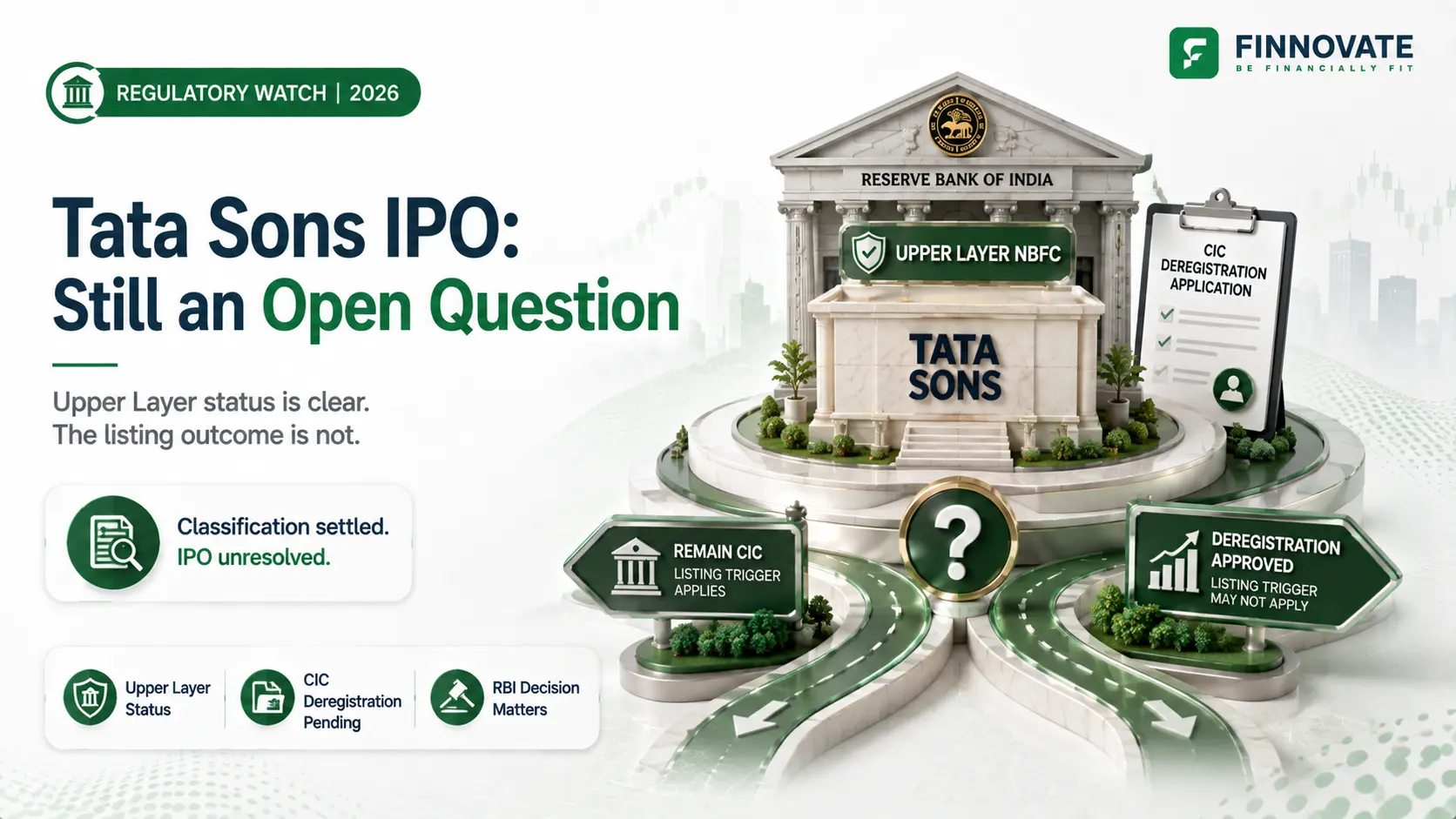
Tata Sons remains an Upper Layer NBFC in 2026. Understand RBI listing rules, CIC deregistr...
SBI Funds Management IPO: RHP-based review of price band, GMP, financials & risks, and why...

NSE filed its DRHP on June 17, 2026. Expected IPO size ₹30,000 crore, 100% OFS, valuatio...
Popular now

Learn how to easily download your NSDL CAS Statement in PDF format with our step-by-step g...

Looking for the best financial freedom books? Here’s a handpicked 2026 reading list with...
Learn what SIF investment means in India, SEBI rules, Rs 10 lakh minimum investment, avail...
Clear guide to mutual fund taxation in India for FY 2025–26 after July 2024 changes: equ...