How to Update Mutual Fund KYC After Becoming an NRI

Finnovate’s editorial team researches and creates financial content using trusted sources, regulatory references and inputs from subject experts.
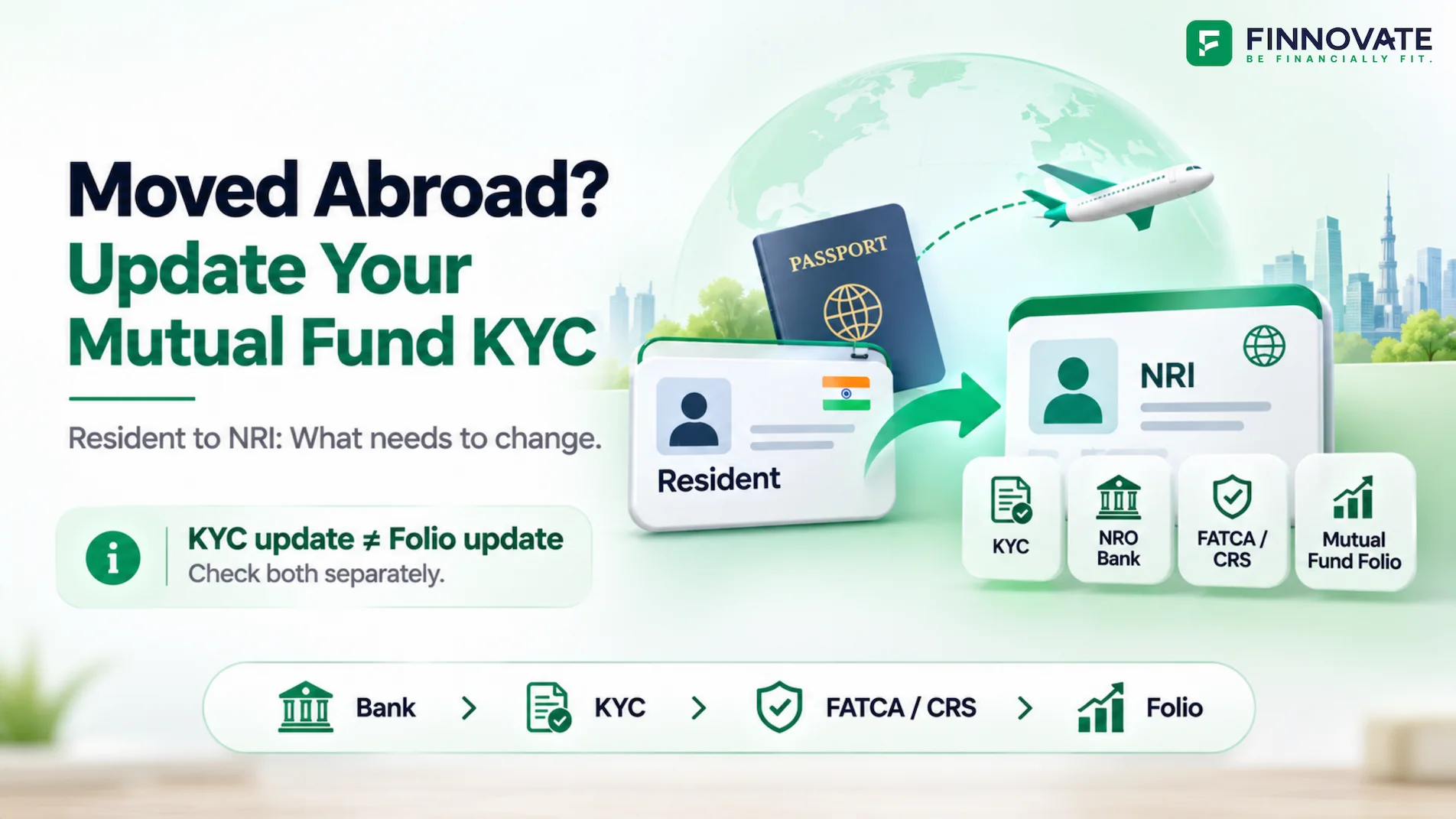
When you become a Non-Resident Indian (NRI), you must update your mutual fund KYC, residential status, bank account details and FATCA/CRS declaration. Failing to update these records can lead to transaction restrictions or rejected investment requests.
Here is how to update your existing mutual fund investments after moving abroad.
Documents Required to Update Mutual Fund KYC for NRIs
- Indian PAN card: Copy of your PAN card.
- Valid Indian passport: For identity and nationality verification.
- Overseas address proof: An accepted utility bill, bank statement or other valid proof of your overseas address.
- Visa or residence permit: A valid visa, work permit or residence document, if required.
- NRO bank account proof: Cancelled cheque or bank statement for existing mutual funds purchased while you were an Indian resident.
- KYC modification form: To update residential status from Resident to NRI.
- FATCA/CRS declaration: Country of tax residence and foreign Tax Identification Number (TIN), where applicable.
Additional documents or attestation may be required depending on the KYC Registration Agency (KRA), Asset Management Company (AMC) and country of residence.
How to Update Mutual Fund KYC After Becoming an NRI: Step-by-Step Process
Convert Your Resident Bank Account to NRO
- Contact your bank to convert your existing resident savings account into an NRO (Non-Resident Ordinary) account when your residential status changes under FEMA.
- Alternatively, arrange another eligible NRO account in your name.
- Keep the updated bank account proof ready.
Important: Existing mutual fund investments purchased while you were an Indian resident generally need to be linked to an NRO account. Changing the bank mandate to NRE does not automatically make those investments repatriable.
Modify Your KYC Details Through a KRA or AMC
Your KYC records are maintained through KYC Registration Agencies (KRAs), such as CVL KRA, CAMS KRA and NDML KRA.
- Check KYC status: Visit the official AMFI KYC page, choose its KYC Status Check link and enter your PAN.
- Submit a modification request: Use the applicable process offered by your AMC, KRA or authorised intermediary. Change your residential status from Resident Individual to NRI.
- Provide documents: Submit your passport, overseas address proof and other required details.
- Complete verification: Use video verification or eKYC where supported. Otherwise, submit signed and attested documents through the prescribed process.
Can this be done online? Some intermediaries support digital re-KYC for eligible NRIs abroad, but not all portals do. For example, CAMS's general online KYC modification facility is limited to resident individuals. Check the NRI-specific process before applying.
Submit Your FATCA/CRS Declaration
Update your overseas tax-residency information with the relevant AMC or registrar. The declaration generally requires:
- Country or countries of tax residence.
- Foreign Tax Identification Number (TIN), where applicable.
- Country of birth and nationality.
- Other details required by the declaration form.
Provide your actual tax-residency details, which may differ from your current mailing address.
Update Bank and Residential Status in Existing Mutual Fund Folios
Updating KYC records does not necessarily update every existing mutual fund folio.
- Contact the AMC or registrar where you hold investments.
- Request the Resident to NRI / Change in Tax Status Form or its available online service.
- Submit updated NRO bank account proof and the required declarations.
- Complete the status-change request for each applicable folio.
Your AMC or its registrar, such as CAMS or KFintech, can confirm the appropriate submission route.
Note: For existing resident-funded investments, an NRO bank mandate is generally required. Fresh NRI investments may use NRE or NRO accounts depending on the source of funds and applicable rules.
Processing Time & Tracking
Processing time varies by AMC, KRA, verification method and document requirements. There is no single guaranteed timeline for every NRI KYC modification.
- Check KYC status: Use the PAN-based status-check link on the AMFI KYC page.
- Check folio status: Confirm with each AMC or registrar that your residential status, NRO bank mandate and FATCA/CRS details have been updated.
- Resolve pending requests: Supply any missing documents or complete any outstanding verification.
Your KYC may appear as KYC Registered, KYC Validated or KYC On Hold. A Registered or Validated status alone does not confirm that every mutual fund folio has been updated to NRI status.
FAQs
1. Can I update mutual fund KYC online from abroad?
Yes, if your intermediary supports NRI digital re-KYC. SEBI has relaxed the India physical-location requirement for eligible existing NRI clients undertaking digital re-KYC, but some intermediaries may still require signed or attested documents.
2. Do I need to sell my existing mutual funds after becoming an NRI?
Generally, no. Becoming an NRI does not automatically require you to redeem your existing mutual funds. Update your KYC, residential status, bank mandate and applicable tax declarations.
3. Does updating KYC automatically update all my mutual fund folios?
No. Separate residential-status and bank-mandate updates may be required with the relevant AMCs or registrars.
4. Can NRIs living in the US or Canada invest in Indian mutual funds?
It depends on the AMC and scheme. Some fund houses restrict fresh investments or require additional documentation for investors residing in the US or Canada. Check current eligibility rules before investing or continuing SIPs.