

DTAA for NRIs in India: TRC, Form 41, TDS & Tax Relief
Understand DTAA for NRIs in India for 2026–27, including TRC, Form 41, TDS, NRO interest...
23 September 2026


Finnovate’s editorial team researches and creates financial content using trusted sources, regulatory references and inputs from subject experts.
For an NRI, retirement planning has an extra layer.
You may earn in one country, hold investments across two or three countries, have retirement accounts overseas and eventually spend most of your retirement money in India.
So the question is not simply:
"Have I built enough wealth to retire?"
It is also:
"Is my wealth structured for the life I plan to live in India?"
That distinction matters.
A large portfolio abroad does not automatically become a well-planned retirement corpus in India. Currency, taxes, residential status, overseas retirement accounts, bank accounts, healthcare and the way you eventually withdraw money all come into play.
If India is where you expect to retire, these decisions are better made before the move rather than after it.
Table of Contents
If you are an NRI planning to retire in India, start by defining the lifestyle you want in India and estimating what it may cost. Then map all your Indian and overseas assets against that requirement.
Before shifting large amounts of money, also understand how your residential status may change, what happens to your overseas retirement accounts, how your NRE/NRO/FCNR accounts need to be handled and which future expenses will remain outside India.
The goal is not to move everything to India. The goal is to build a retirement structure that can fund your future expenses efficiently and sustainably.
For someone who has always lived and invested in India, most parts of retirement planning operate within one financial system.
For an NRI, they may not.
You could have:
That creates a few additional questions.
Where should your retirement money remain?
Which currency should you hold it in?
Which assets will actually be available to fund retirement?
How will your tax position change when you return?
How should your portfolio move from wealth creation to regular withdrawals?
There is no single product that solves these questions. They need to be looked at together.
Before calculating returns or choosing investments, define what retirement in India will actually look like.
Someone retiring in Mumbai may need a very different corpus from someone settling in Kochi or Coimbatore.
The same is true for two families with similar wealth but different lifestyles.
Think through questions such as:
This exercise sounds basic, but it decides almost everything that follows.
Once the lifestyle is defined, estimate what it may cost.
Start with the annual expenses you expect in India. Then account for:
You should also separate regular retirement expenses from large future goals.
For example, ₹1.5 lakh of monthly household spending is one requirement. Funding a child's overseas education, buying a retirement home or providing a large financial gift is another.
Combining everything into one monthly number can understate the corpus you actually need.
You can use Finnovate's Retirement Calculator to estimate your retirement corpus based on your expected expenses, inflation and time to retirement.
This is especially important for NRIs.
Suppose your net worth is ₹10 crore, but it includes:
You do not automatically have a ₹10 crore retirement corpus.
If the ₹4 crore house is where you intend to live, it may improve your financial position because you do not need to pay rent. But unless you plan to sell, rent or borrow against it, it is not funding your monthly retirement expenses.
That difference is worth identifying early.
The next step is to create a single view of your global finances.
Many NRIs know how much money they have overall but have never put every asset into one retirement map.
A simple version could look like this:
| Asset | Country | Currency | Available at Retirement? | Main Purpose |
|---|---|---|---|---|
| Overseas retirement account | Overseas | Foreign currency | Depends on account rules | Retirement income |
| Foreign brokerage portfolio | Overseas | USD / GBP / etc. | Usually liquid | Growth / future overseas needs |
| Indian mutual funds | India | INR | Usually liquid | Growth |
| NRE / FCNR deposits | India | INR / foreign currency | Usually accessible | Liquidity / stability |
| Indian home | India | INR | Not if self-occupied | Residence |
| Indian rental property | India | INR | Income-producing | Rental income / asset |
| Bank balances | India / overseas | Multiple | Yes | Short-term liquidity |
The purpose is not to decide immediately what to sell.
It is to understand what each asset is expected to do after retirement.
An investment that made sense while you were earning abroad may not have the same role once you stop earning and begin withdrawing from your portfolio.
Currency is one of the most overlooked parts of NRI retirement planning.
Imagine that most of your wealth is in dollars, but after retirement:
Your future liability is increasingly INR-based.
Does that mean you should convert your entire overseas portfolio into rupees?
Not necessarily.
You may still have expenses abroad. Your children may live outside India. You may travel regularly. Some foreign retirement accounts may also be better left where they are because of tax or withdrawal rules.
Match your assets gradually with the currencies in which you expect to spend.
If most of your retirement spending will happen in India, it may make sense for your INR exposure to increase as retirement approaches.
If you will continue to have material dollar, pound or other foreign-currency expenses, retaining corresponding overseas assets can also have a role.
What you want to avoid is turning retirement into a single currency bet.
Moving your entire portfolio because "the rupee will depreciate" or "India will give better returns" is not retirement planning.
Moving back to India does not necessarily mean every overseas income stream immediately receives the same Indian tax treatment.
Your Indian tax position depends on your residential status for the relevant tax year.
For returning NRIs, two important tests for RNOR status look at whether you were:
Your actual status depends on your travel and stay history, so it should be calculated rather than assumed.
During RNOR status, foreign income that does not fall within the specified Indian scope may remain outside Indian taxation. Once you become Resident and Ordinarily Resident, India generally taxes worldwide income, subject to applicable tax rules and treaty relief.
This can make the period around your return especially important for planning overseas investments and retirement accounts.
An overseas retirement account should not automatically be treated like a normal investment account.
Depending on where you have worked, you could hold assets through:
These accounts can have separate rules for:
That means "bringing the money back to India" should not be the first decision.
First understand what you own and how both countries treat it.
India provides a mechanism that can help eligible returning residents deal with a mismatch between when income from certain foreign retirement accounts is taxed in India and when it is taxed on withdrawal or redemption in the notified country.
The applicable provision depends on the period in which the income arises.
The notified countries currently covered under this framework are:
This does not mean every foreign retirement account automatically qualifies. Eligibility depends on factors such as the country, type of retirement account, residential status and the applicable tax treatment.
So if a meaningful part of your retirement corpus sits in an overseas pension or retirement account, review the tax position before taking withdrawals, transfers or liquidation decisions.
Your Indian bank setup also needs attention when you return.
RBI rules link these accounts to your residential status under FEMA.
In broad terms:
When your residential status changes from non-resident to resident, the NRE account should be redesignated as a resident account or eligible funds may be transferred to a Resident Foreign Currency (RFC) account.
An NRO account may be redesignated as a resident account when you return to India with an intention to stay for an uncertain period.
Existing FCNR(B) deposits may generally continue until maturity at the contracted rate, subject to RBI conditions. On maturity, they can move into an eligible RFC account or resident rupee deposit.
RNOR is an income-tax status. NRE/NRO account treatment is governed by FEMA residential status. They should not be treated as the same test.
For most of your working life, the direction of money is:
After retirement, it reverses:
That changes the job of your portfolio.
A portfolio built only to maximise long-term growth can become uncomfortable if markets fall soon after you start taking regular withdrawals.
At the same time, moving your entire portfolio into deposits or low-growth assets can create another problem: inflation.
A retirement portfolio therefore usually needs different roles for different pools of money.
For example:
The exact mix cannot be decided from age alone.
Someone retiring at 60 with a large pension and low withdrawals may need a different portfolio from another 60-year-old whose investments must fund almost the entire household.
Your foreign assets, India assets, pensions, rental income, liabilities and expected withdrawals all matter.
The National Pension System can be one part of an NRI's retirement structure, but it should not be confused with the retirement plan itself.
Eligible NRIs and OCIs can participate in NPS under the applicable PFRDA rules and KYC requirements. For NRIs and OCIs, NPS is currently limited to the Tier-I account; PFRDA does not permit them to activate a Tier-II account.
However, NPS comes with its own investment, withdrawal and exit rules. It should therefore be evaluated alongside your existing overseas pensions, Indian investments and liquidity needs.
An NRI who already has a substantial 401(k), pension or overseas retirement account may arrive at a different decision from someone who has no formal retirement savings.
The question is not:
"Is NPS good or bad?"
It is:
"What role does NPS need to play in my overall retirement plan?"
Healthcare deserves its own retirement planning bucket.
A health insurance policy is important, but it does not solve every healthcare cost that retirement may bring.
Consider three layers:
Check whether you already have appropriate coverage in India and understand waiting periods, exclusions, co-payments and other policy conditions.
If you depend on an overseas employer policy, check whether that cover continues once you relocate.
Keep a pool of money available for costs that may not be fully covered by insurance.
Later-life care, recurring treatments, home assistance and elder-care support can be very different from a one-time hospital expense.
Healthcare inflation can also behave differently from everyday household inflation.
Many NRIs accumulate significant property exposure in India.
But property needs a defined role in the retirement plan.
Ask:
A self-occupied house can reduce the need for rental expenses, but it does not automatically produce retirement income.
A rental property can generate cash flow, but vacancies, maintenance, taxation and concentration should still be considered.
Cross-border wealth can become difficult for a family to manage if the structure is understood only by one person.
By the time you retire, review:
A nominee and a legal heir are not always the same thing.
And when assets are spread across countries, succession rules can also differ.
You do not need to solve everything on the day you book your return ticket.
A better approach is to work backwards.
Focus on the big picture.
Start preparing the portfolio.
Move from planning to execution.
Finish the transition.
Returning to India does not automatically mean every asset must return with you.
First understand taxes, currency needs and overseas account rules.
The home may be valuable, but if you intend to live in it, the capital is not automatically available for spending.
Healthcare, travel, family support and one-time goals can materially change the corpus.
Tax treatment can become more complicated once residential status changes.
It depends on your individual stay history and needs to be calculated.
The portfolio that helped you build wealth may need to change once it starts funding your life.
Currency should be linked to future spending, not forecasts about where USD/INR may move next.
Usually, there is no universal reason to do so.
The right amount to retain abroad or move to India depends on:
For some NRIs, a largely India-focused retirement portfolio may eventually make sense.
For others, maintaining meaningful assets abroad may continue to serve a purpose.
Before retirement, the question is usually:
"How much can my investments grow?"
During retirement, it becomes:
"How reliably can my investments fund my life without exhausting the corpus too early?"
That requires a different kind of planning.
Your retirement income may eventually come from a combination of:
The objective is not to maximise the income from every asset.
It is to create enough dependable cash flow while keeping the remaining corpus positioned for the years ahead.
If your finances are spread across India and overseas, retirement planning may involve more than choosing investments. Finnovate's NRI financial planning approach looks at your India and overseas assets, retirement corpus, tax transition, future cash flows, insurance and estate needs together.
Explore NRI Financial AdvisoryFor an NRI, retiring in India is not simply a relocation decision.
It is a transition between countries, currencies, tax systems and eventually between two very different phases of investing.
You move from earning to withdrawing.
From building the corpus to depending on it.
And in many cases, from managing money across countries to funding a life primarily in India.
Start with the life you want.
Then estimate the corpus.
Map your global assets.
Understand the tax and account transition.
Review overseas retirement accounts.
Plan healthcare, estate and future income.
Only after that should you decide what money needs to move, where it should be invested and how much should remain overseas.
Yes. An NRI can return and settle in India. However, the move can change your residential status under FEMA and income-tax rules, so bank accounts, investments and foreign income may need to be reviewed.
There is no fixed amount. It depends on your expected expenses, inflation, retirement duration, healthcare, future goals, existing assets and recurring income such as pensions or rent.
Not necessarily. Money required for Indian expenses may gradually be aligned with India, while overseas assets can still have a role for foreign-currency expenses, retirement accounts and commitments abroad.
After the relevant change in FEMA residential status, NRE accounts should be redesignated as resident accounts or eligible funds may move to an RFC account. NRO accounts may also be redesignated when the person returns with an intention to stay in India for an uncertain period.
Yes. Existing FCNR(B) deposits may generally continue until maturity at the contracted rate, subject to RBI conditions. The funds can then move to an eligible RFC account or resident rupee deposit.
It does not automatically need to be closed. Indian tax treatment can depend on your residential status, country, account type and withdrawal timing, so the account should be reviewed before taking major action.
No. RNOR has a narrower scope of Indian taxation than ROR, but the treatment depends on the nature and source of the income. Each income stream should be checked separately.
Eligible NRIs and OCIs can participate in NPS under applicable PFRDA rules and KYC requirements. Whether it fits depends on your overall retirement portfolio, liquidity needs and existing pension assets.
Disclaimer: This article is for educational purposes only and should not be treated as investment, tax, legal or personalised financial advice. NRI and returning-resident taxation can vary based on residential status, country of residence, applicable tax treaty, type of income and individual circumstances. FEMA, income-tax, pension and account rules may also change. Please consult appropriate financial, tax and legal professionals before making decisions involving cross-border assets or retirement accounts.
No spam. Only new posts, simple explainers, and practical money checklists for busy professionals.
Finnovate is a SEBI-registered financial planning firm that helps professionals bring structure and purpose to their money. Over 3,500+ families have trusted our disciplined process to plan their goals - safely, surely, and swiftly.
Our team constantly tracks market trends, policy changes, and investment opportunities like the ones featured in this Weekly Capsule - to help you make informed, confident financial decisions.
Learn more about our approach and how we work with you:
No comments yet. Start the conversation. What would you add?
No spam. Only new posts, simple explainers, and practical money checklists.
You may also like
Understand DTAA for NRIs in India for 2026–27, including TRC, Form 41, TDS, NRO interest...

Understand NRI capital gains tax in India for 2026–27, including LTCG, STCG, shares, mut...
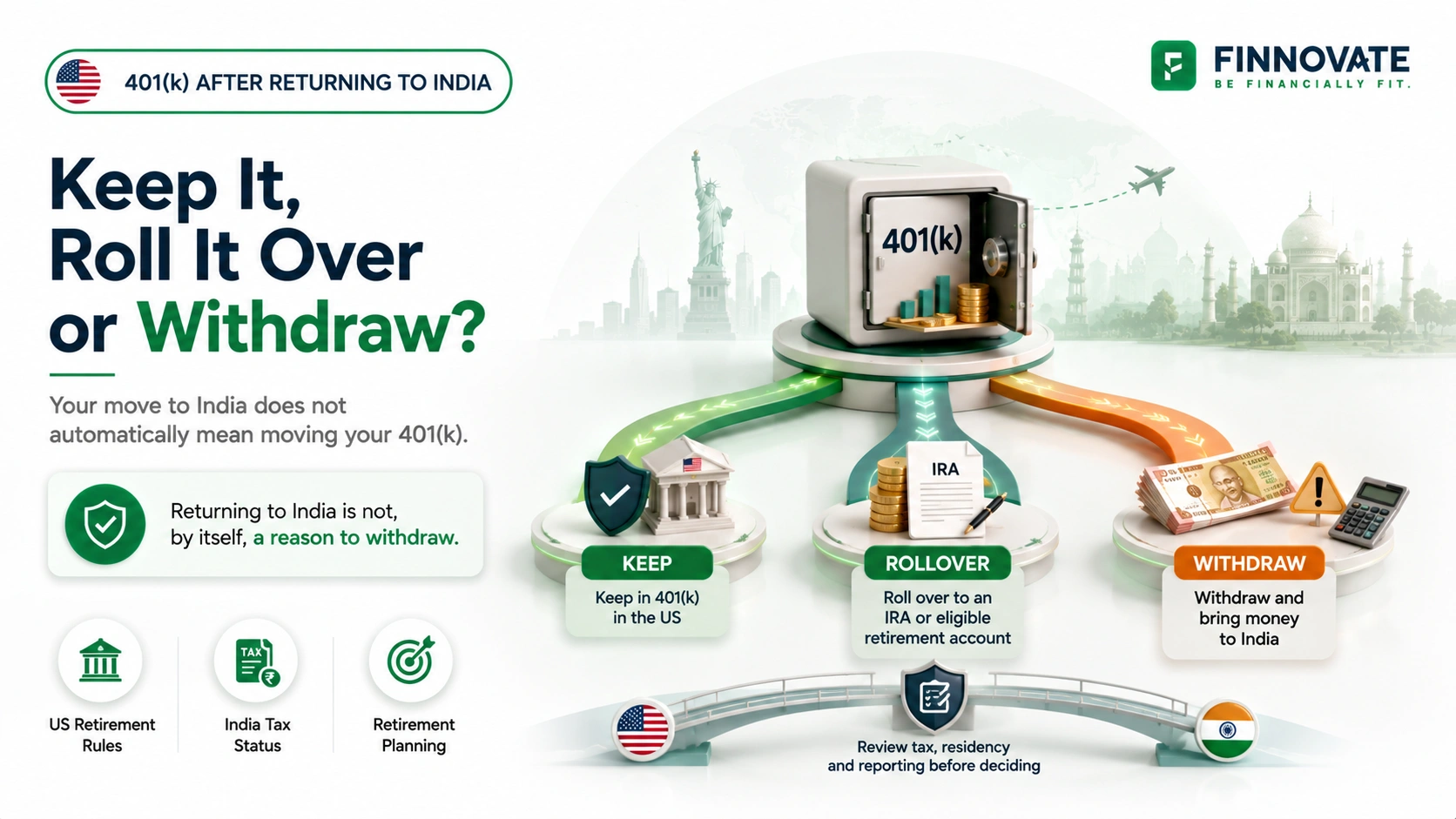
Returning to India with a 401(k)? Learn whether to keep it, roll it into an IRA or withdra...

RBI will close the special FCNR(B) swap window on August 31, 2026 after $52.3 billion in d...
Popular now

Learn how to easily download your NSDL CAS Statement in PDF format with our step-by-step g...

Looking for the best financial freedom books? Here’s a handpicked 2026 reading list with...
Learn what SIF investment means in India, SEBI rules, Rs 10 lakh minimum investment, avail...

Clear guide to mutual fund taxation in India for FY 2025–26 after July 2024 changes: equ...