
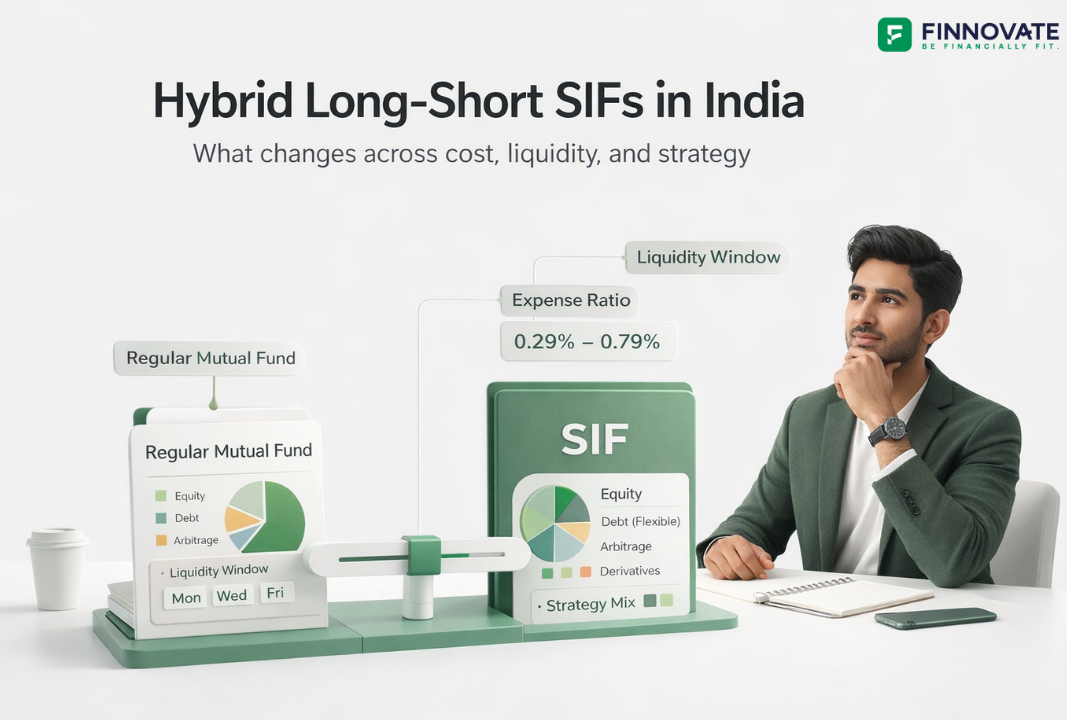
SIF Hybrid Long-Short Funds India: Meaning, Strategy, Funds & Returns
What is a SIF Hybrid Long-Short Fund? Explore how the strategy works, all 6 live funds in ...
24 March 2026
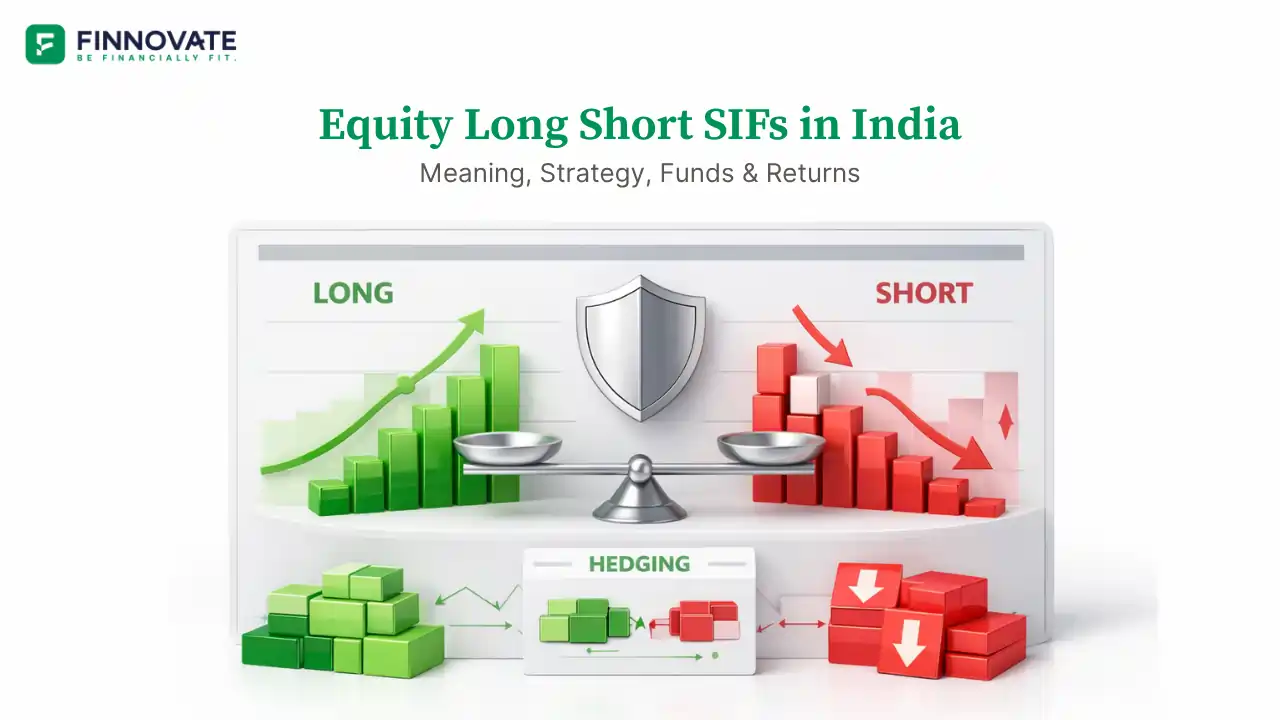
India's first SIF did not launch in the hybrid category. It launched here. Quant Mutual Fund's QSIF Equity Long-Short Fund opened for subscription on September 17, 2025, making it the pioneer of the entire SIF universe in India.
Yet within months, the category has delivered a story most investors did not anticipate. All four live equity long-short SIFs are currently showing negative returns since inception, while the hybrid category has broadly stayed positive over the same period. This article breaks down what SIF equity long-short funds are, how the two sub-categories differ, what is actually happening with returns, and what investors need to understand before considering this category.
A SIF Equity Long-Short Fund is a SEBI-regulated investment strategy under the Specialized Investment Fund framework that invests primarily in listed equities and uses derivatives to take both long and short positions in the same portfolio.
A regular equity mutual fund can only go long. It buys stocks and profits when they rise. An equity long-short SIF can also profit from falling stocks by taking short positions through exchange-traded futures and options.
Under SEBI's framework, the standard Equity Long-Short SIF must maintain a minimum of 80% in equity and equity-related instruments across all market caps. Unhedged short exposure via derivatives is capped at 25% of net assets. There is no mandatory debt allocation. This is a pure equity strategy.
One structural point that many investors miss: All four equity long-short SIFs currently live in India are open-ended with daily redemption. Unlike most hybrid SIFs which are interval funds with twice-weekly or monthly redemption windows, equity SIFs offer daily liquidity. Exit loads are the primary constraint, not redemption windows.
Wondering if an equity SIF fits your portfolio? A quick call can help clarify the fit.
Book a free callThis is the most important distinction in the entire category and the one most content gets wrong. SEBI defines two separate strategies under equity-oriented SIFs, and they are not the same product.
| Equity Long-Short Fund | Equity Ex-Top 100 Long-Short Fund | |
|---|---|---|
| Minimum equity allocation | 80% | 65% |
| Investment universe | All market caps (flexi-cap approach) | Stocks outside top 100 by market cap (mid and small cap) |
| Short exposure cap | 25% of NAV | 25% of NAV |
| Risk profile | High | Higher (mid and small cap concentrated) |
| Best suited for | All market cycles with active stock selection | Mid and small cap recovery phases |
The Equity Long-Short Fund has full flexibility across large, mid, and small caps. The Ex-Top 100 Fund deliberately targets the mid and small cap universe, covering companies ranked below the top 100 by market capitalisation as defined by AMFI. These are less researched companies where pricing inefficiencies tend to be larger, creating more alpha opportunity in theory but also significantly more volatility.
This sub-category difference directly explains why QSIF's Ex-Top 100 fund has declined more sharply than its standard Equity Long-Short fund during the same market correction period. More on that in the performance section.
A SIF equity long-short fund pursues returns through four interconnected mechanisms:
As of May 2026, four equity long-short SIFs are live across two sub-categories.
Equity Long-Short Funds:
| Fund Name | AMC | Inception | Scheme Type | Expense Ratio (Direct) | Redemption |
|---|---|---|---|---|---|
| QSIF Equity Long-Short Fund | Quant | Oct 8, 2025 | Open-Ended | 0.81% (as of May 25, 2026) | Daily |
| Diviniti Equity Long-Short Fund | ITI MF | Dec 1, 2025 | Open-Ended | 0.84% (as of May 25, 2026) | Daily |
Equity Ex-Top 100 Long-Short Funds:
| Fund Name | AMC | Inception | Scheme Type | Expense Ratio (Direct) | Redemption |
|---|---|---|---|---|---|
| QSIF Equity Ex-Top 100 Long-Short Fund | Quant | Nov 13, 2025 | Open-Ended | 0.83% (as of May 25, 2026) | Daily |
| iSIF Equity Ex-Top 100 Long-Short Fund | ICICI Prudential | Feb 5, 2026 | Open-Ended | 0.53% (as of May 25, 2026) | Daily |
Three observations worth noting:
All four funds are open-ended with daily liquidity.
This is the most meaningful structural difference from the hybrid SIF category. Investors can redeem on any business day, with no fixed redemption windows to plan around. Exit loads are the primary constraint: QSIF funds charge 1% within 15 days, iSIF charges 1% within 12 months, and Diviniti has a flexible structure where 10% of units can be redeemed free within 6 months with 0.50% load on the balance.
The two sub-categories serve different investor objectives.
The standard Equity Long-Short fund is closer to a flexi-cap strategy with a short overlay, offering broad market exposure with active stock selection across all cap sizes. The Ex-Top 100 fund is a deliberate mid and small cap bet. Both use the same long-short mechanism, but the underlying universe and associated volatility are meaningfully different. The sub-category you choose should reflect your view on market segments, not just the "equity long-short" label.
AUM tells a clear story about where investor confidence is flowing.
The iSIF Ex-Top 100, despite being the newest fund (launched February 2026), has already accumulated ₹1,090 crore in AUM, making it the largest of all equity SIFs. QSIF Equity Long-Short holds ₹561 crore as the category pioneer. Diviniti, backed by CIO Rajesh Bhatia's 30-year institutional long-short background, holds ₹345 crore. QSIF Ex-Top 100 is the smallest at ₹170 crore. The iSIF AUM advantage reflects investor confidence in ICICI Prudential's research infrastructure. The fund draws on coverage of over 550 companies across 27 sectors.
The tables below show NAV and absolute returns since inception as of May 25, 2026, based on data from fund platform screenshots.
Equity Long-Short Funds:
| Fund | AMC | Inception | NAV (May 25, 2026) | Absolute Return Since Inception |
|---|---|---|---|---|
| QSIF Equity Long-Short | Quant | Oct 8, 2025 | ₹10.30 | +2.98% |
| Diviniti Equity Long-Short | ITI MF | Dec 1, 2025 | ₹932.09 | -6.79% |
Equity Ex-Top 100 Long-Short Funds:
| Fund | AMC | Inception | NAV (May 25, 2026) | Absolute Return Since Inception |
|---|---|---|---|---|
| QSIF Equity Ex-Top 100 | Quant | Nov 13, 2025 | ₹9.99 | -0.10% |
| iSIF Equity Ex-Top 100 | ICICI Prudential | Feb 5, 2026 | ₹10.04 | +0.40% |
NAV and absolute return data as of May 25, 2026. Diviniti uses a ₹1,000 face value per unit structure (inception NAV ₹1,000). The return reflects movement from ₹1,000 to ₹932.09. Past performance is not indicative of future returns.
Understanding the numbers in context. The picture has shifted meaningfully since the March 2026 correction. QSIF Equity Long-Short has recovered to positive territory at +2.98% since inception, reflecting a strong rebound in equity markets after the March lows. The Ex-Top 100 category shows a split: iSIF has turned positive at +0.40% while QSIF Ex-Top 100 remains marginally negative at -0.10%. Diviniti continues to show the steepest decline at -6.79%, consistent with its more concentrated approach.
What the short side can and cannot do. The short positions in these funds are capped at 25% of NAV. In a sharp, broad market sell-off, even a well-executed short book can only partially offset a declining long portfolio. The short side is designed to generate alpha through stock selection and reduce portfolio beta over time, and not to make the fund market-neutral or immune to corrections. Investors entering this category need to understand this boundary.
This data spans between four months and eight months of fund history, which is far too short to evaluate long-term performance or fund manager skill. A meaningful assessment requires at minimum two to three years of data across rising, falling, and sideways markets. Early NAVs reflect market conditions more than execution quality. Past performance, especially at this stage, does not indicate future returns.
Taxation here is more straightforward than the hybrid SIF category. Since all equity long-short SIFs maintain at least 65–80% in equity, they follow equity mutual fund taxation rules.
| Holding Period | Tax |
|---|---|
| Less than 12 months (STCG) | 20% |
| More than 12 months (LTCG) | 12.5% (₹1.25 lakh exempt per financial year) |
For your specific tax situation, always consult a qualified financial advisor. Tax treatment is subject to prevailing income tax laws and may change.
SIF Equity Long-Short Funds carry risks that are more acute than hybrid SIFs. Five are particularly important before committing capital:
SIFs are not meant to replace a core equity mutual fund portfolio. A Finnovate advisor can help assess whether this category fits your goals, timeline, and risk capacity.
Book a free callIf you are comparing the two categories, the distinction comes down to one structural fact. A hybrid long-short SIF carries a mandatory allocation of at least 25% each in equity and debt, layered with arbitrage and income strategies. This built-in cushion is precisely why hybrid SIFs stayed broadly positive while equity SIFs declined during the same market correction. The equity long-short SIF is a purer, higher-beta strategy. It offers more upside potential in a sustained bull market, but deeper drawdowns when equity markets fall. Neither is better in absolute terms. The right choice depends entirely on your risk tolerance, your portfolio composition, and your investment horizon. For a detailed breakdown of how hybrid SIFs work and which funds are available, read our article on SIF Hybrid Long-Short Funds.
SIF Equity Long-Short Funds represent India's first attempt at bringing institutional long-short equity strategies into a SEBI-regulated, accessible structure. The category pioneer launched in September 2025. By May 2026, four funds are live, all open-ended, with returns ranging from +2.98% to -6.79% since inception.
That spread in performance across just eight months tells a meaningful story: fund selection and sub-category choice matter more than the broad "equity long-short" label. The equity market correction from mid-2025 through early 2026 was a difficult backdrop, and the recovery since March has revealed meaningful differences in how each fund managed its positioning. What matters for the long-term investor is whether this structure delivers better risk-adjusted returns across full market cycles. That answer will take at least two to three more years of data to emerge properly. For now, this is a category worth understanding clearly, not chasing early or dismissing prematurely.
Let your money serve you. Safely, surely, and swiftly.
Disclaimer: This blog is for informational and educational purposes only and does not constitute financial, investment, or tax advice. Mutual fund and SIF investments are subject to market risks. Please read all scheme-related documents carefully and consult a SEBI-registered qualified financial advisor before making any investment decision.
No spam. Only new posts, simple explainers, and practical money checklists for busy professionals.
Finnovate is a SEBI-registered financial planning firm that helps professionals bring structure and purpose to their money. Over 3,500+ families have trusted our disciplined process to plan their goals - safely, surely, and swiftly.
Our team constantly tracks market trends, policy changes, and investment opportunities like the ones featured in this Weekly Capsule - to help you make informed, confident financial decisions.
Learn more about our approach and how we work with you:
No comments yet. Start the conversation. What would you add?
No spam. Only new posts, simple explainers, and practical money checklists.
You may also like
What is a SIF Hybrid Long-Short Fund? Explore how the strategy works, all 6 live funds in ...
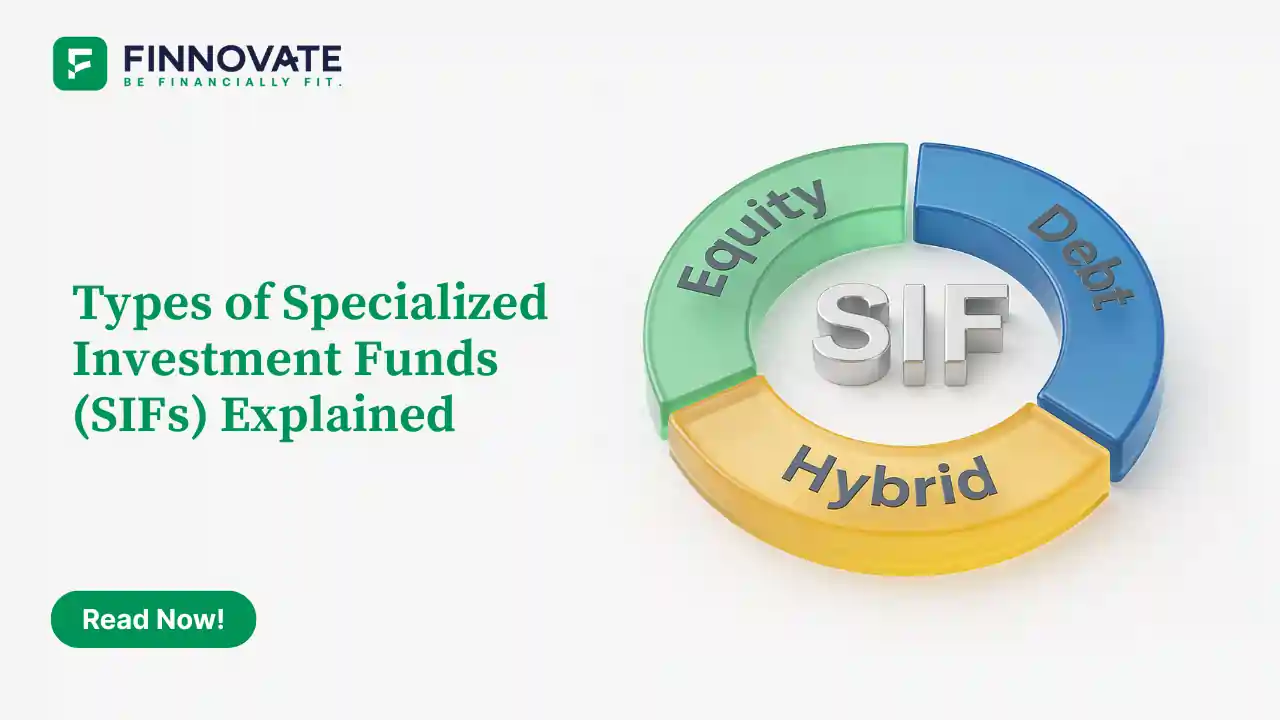
Explore the different types of Specialized Investment Funds (SIFs) - Equity, Debt, and Hyb...
Specialized Investment Funds, SIF India, SIF investment risks, long-short SIF, Quant AMC S...
Learn what SIF investment means in India, SEBI rules, Rs 10 lakh minimum investment, avail...
Popular now
Learn how to easily download your NSDL CAS Statement in PDF format with our step-by-step g...

Looking for the best financial freedom books? Here’s a handpicked 2026 reading list with...
Learn what SIF investment means in India, SEBI rules, Rs 10 lakh minimum investment, avail...
Clear guide to mutual fund taxation in India for FY 2025–26 after July 2024 changes: equ...