
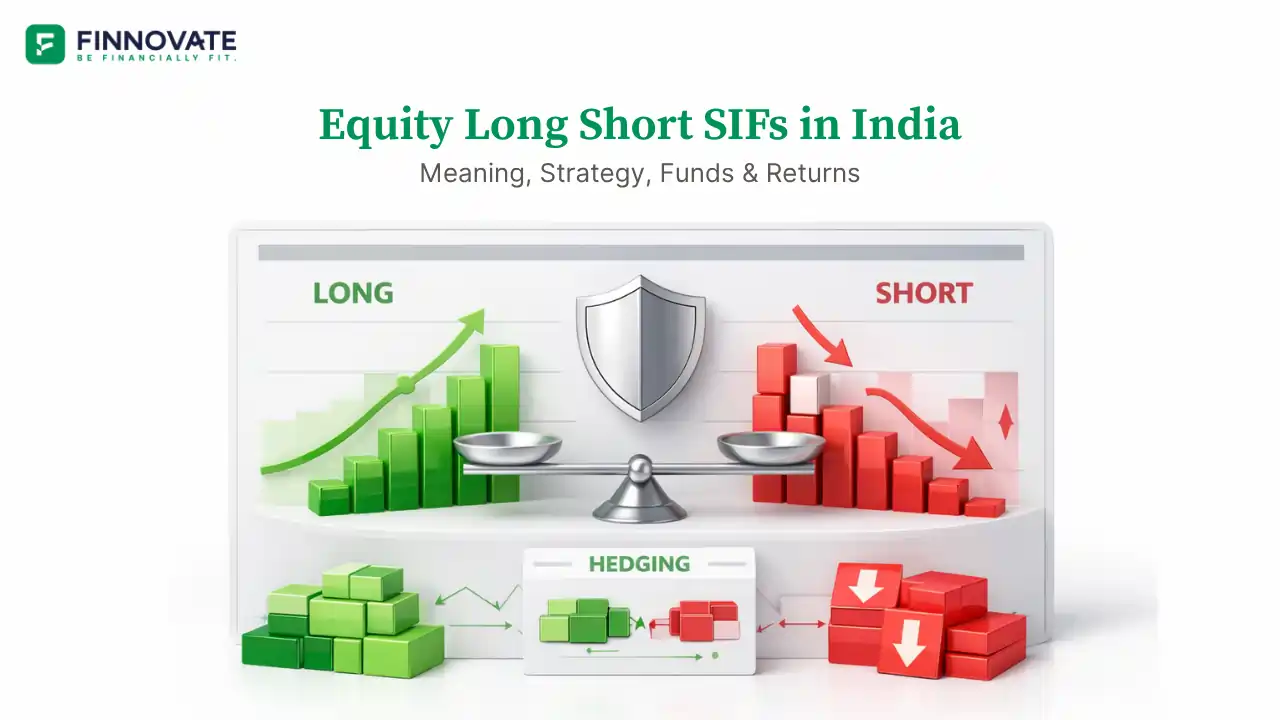
SIF Equity Long-Short Funds India: Strategy, Funds & Returns
What is a SIF Equity Long-Short Fund? Explore 2 sub-categories, 4 live funds, latest NAV d...
27 March 2026
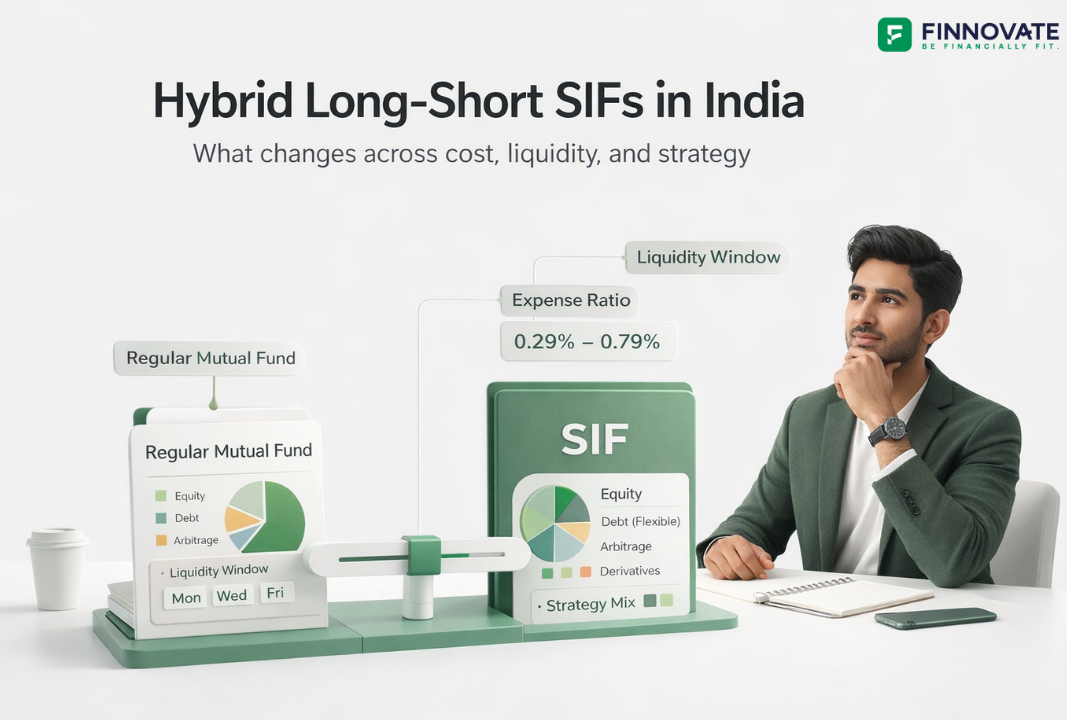
If you have been tracking India's new SIF space, one pattern stands out clearly. Nearly every major AMC that has entered this category launched a hybrid long-short strategy first. That is not a coincidence. As of April 30, 2026, hybrid long-short SIFs alone accounted for ₹8,933 crore, around 72% of total SIF AUM.
In this article, we break down exactly what a SIF Hybrid Long-Short Fund is, how each of the six live funds is structured, what early data tells us and, just as importantly, what it does not yet tell us.
A SIF Hybrid Long-Short Fund is a SEBI-regulated investment strategy under the Specialized Investment Fund framework that combines equity, debt, and derivatives in a single fund. What separates it from a regular hybrid mutual fund is one specific capability: it can take short positions.
A regular hybrid fund can only go long. It buys equity and debt instruments and profits when those assets rise in value. A SIF Hybrid Long-Short Fund can also go short through derivatives, meaning it can take positions that generate returns when selected assets fall in value.
Under SEBI's framework, a Hybrid Long-Short SIF must maintain a minimum of 25% in equity and 25% in debt. Unhedged short exposure through derivatives is capped at 25% of the fund's net assets. The fund can also invest in REITs and InvITs within prescribed limits. This gives the fund manager considerably more tools to work with across different market conditions.
A hybrid SIF combines equity, debt, and derivatives to generate returns across different market conditions. Unlike a traditional hybrid fund that only holds long positions, this strategy is built on four core components working together:
Wondering if a hybrid SIF fits your portfolio? A free call can help clarify the fit.
Book a free callThe numbers remain striking. Based on AMFI SIF Monthly data as of April 30, 2026:
For context, the entire SIF category did not exist before April 2025. The hybrid long-short category has consistently captured the majority of investor flows since the category launched.
Why have investors chosen hybrid over pure equity SIFs so decisively? A few reasons stand out. India's equity markets went through a sharp correction in the second half of 2025, particularly in the mid and small-cap space. Hybrid SIFs, with their built-in debt allocation and hedging capability, held up better than pure equity long-short strategies during that period. There is also a strong familiarity factor. Many HNI investors are comfortable with the concept of balanced or hybrid funds. A hybrid SIF feels like a natural next step, offering better flexibility without the full jump into PMS territory.
As of early 2026, six hybrid long-short SIFs have been launched under SEBI's SIF framework. Here is a structured look at each, covering key details an investor needs to compare them fairly.
| Fund Name | AMC | Inception | Scheme Type | Expense Ratio (Direct) | Redemption Window |
|---|---|---|---|---|---|
| Altiva Hybrid Long-Short Fund | Edelweiss | Oct 24, 2025 | Interval | 0.68% | Mon & Wed |
| Magnum Hybrid Long-Short Fund | SBI | Oct 29, 2025 | Interval | 0.47% | Mon & Wed |
| QSIF Hybrid Long-Short Fund | Quant | Oct 20, 2025 | Interval | 0.64% | Tue & Wed |
| Titanium Hybrid Long-Short Fund | Tata | Dec 17, 2025 | Interval | 0.56% | 1st working day of month |
| iSIF Hybrid Long-Short Fund | ICICI Prudential | Feb 5, 2026 | Interval | 0.79% | Mon & Wed |
| Arudha Hybrid Long-Short Fund | Bandhan | Feb 4, 2026 | Interval | 0.29% | Mon & Thu |
Three Observations:
All 6 funds in this list are interval funds.
That means liquidity is available only during defined redemption windows, so they should not be viewed like regular open-ended mutual funds. This is not a small structural detail. It directly affects flexibility, exit planning, and how an investor should use the product within a wider portfolio.
The category label is the same, but the underlying strategy mix is not identical.
These six funds may all sit in the hybrid long-short bucket, but they are not built the same way. Some appear more income-oriented, using a mix of arbitrage, covered calls, and fixed income, while others allow more tactical use of equity, debt, and derivatives. So a fair comparison should go beyond the fund name and include structure, liquidity rules, portfolio role, and manager approach.
Expense ratios differ meaningfully even within this small category
In the current list, direct plan expense ratios range from 0.29% to 0.79%. Cost alone should not decide suitability, but it remains an important comparison point, especially in a category where underlying structures can look similar at first glance. Over time, even a moderate difference in annual cost can affect investor outcomes.
The table below shows the latest available NAV and absolute returns since inception for five funds where recent data is publicly available. QSIF Hybrid Long-Short is excluded from this update as the most recently available data for that fund dates to March 2026. NAV data is sourced from publicly available AMC and AMFI-linked feeds. Data dates vary by fund.
| Fund | AMC | Inception | NAV (May 25, 2026) | Expense Ratio (Direct) | Absolute Return Since Inception |
|---|---|---|---|---|---|
| Altiva Hybrid Long-Short | Edelweiss | Oct 24, 2025 | ₹10.67 | 0.60% | +6.71% |
| Magnum Hybrid Long-Short | SBI | Oct 29, 2025 | ₹10.35 | 0.40% | +3.50% |
| Arudha Hybrid Long-Short | Bandhan | Feb 4, 2026 | ₹10.15 | 0.25% | +1.51% |
| Titanium Hybrid Long-Short | Tata | Dec 17, 2025 | ₹10.05 | 0.55% | +0.52% |
| iSIF Hybrid Long-Short | ICICI Prudential | Feb 5, 2026 | ₹9.99 | 0.72% | -0.09% |
NAV and expense ratio data as of May 25, 2026. Absolute returns calculated from inception NAV (₹10.00) to May 25, 2026 NAV. Past performance is not indicative of future returns. QSIF Hybrid Long-Short is not included as verified current data was not available at the time of this update.
The data for iSIF and Arudha covers approximately three to four months. For Altiva and Magnum, it covers approximately seven months. None of this is sufficient to evaluate long-term performance or fund quality.
What the data does show is that different strategy positioning has led to different outcomes even within the same category over the same period. Altiva's income-first approach, anchored in arbitrage and event-driven special situations, leads the category at +6.71% since inception. Magnum's conservative covered-call positioning has delivered steady positive returns. Titanium has turned slightly positive since inception after recovering from the March 2026 correction. iSIF remains marginally negative at -0.09%, reflecting its higher equity orientation in a volatile period.
A proper evaluation of any SIF requires at minimum two to three years of data across different market cycles, including both bull phases and corrections. Early NAVs tell you about market conditions more than fund manager skill. Past performance, especially at this stage, does not indicate future returns.
The tax treatment of a SIF Hybrid Long-Short Fund depends on each fund's actual equity allocation. Three scenarios can apply:
| Equity Allocation | Tax Treatment | STCG | LTCG | Holding Period for LTCG |
|---|---|---|---|---|
| 65% or more | Equity-oriented | 20% | 12.5% (₹1.25L exempt/year) | 12 months |
| 35% to 65% | Middle-lane hybrid | As per slab | 12.5% (no indexation) | 24 months |
| Less than 35% | Debt-oriented | As per slab | As per slab | No LTCG benefit (post Apr 2023) |
Based on official fund disclosures, SBI Magnum and iSIF Hybrid (both with 65% or more equity allocation) follow equity-oriented taxation. Altiva, structured with equity ranging between 25% and 75%, is taxed as a middle-lane hybrid with LTCG applicable after 24 months. Arudha, with its more balanced 35% to 65% equity range and conservative benchmark, also follows the 24-month LTCG rule.
For your specific tax situation, always consult a qualified financial advisor, as tax treatment depends on the fund's actual allocation at the time of redemption.
SIF Hybrid Long-Short Funds carry risks that are different in nature from regular mutual funds. Five are particularly important to understand before committing capital:
SIFs are not meant to replace a core mutual fund portfolio. A Finnovate advisor can help you assess whether a hybrid SIF fits your goals, liquidity needs, and risk profile.
Book a free callSIF Hybrid Long-Short Funds represent a genuinely new option in India's investment landscape. They offer a different structure from traditional hybrid mutual funds and sit below PMS in ticket size, while remaining within SEBI's regulated framework. The investor response has been strong, with over ₹7,300 crore flowing into this category in under six months.
But strong inflows are not the same as strong performance. This is a category worth understanding carefully and considering only when it fits your goals, your timeline, and your actual risk capacity. The right question is not whether hybrid SIFs are good or bad. The right question is whether a hybrid long-short SIF fits where you are in your financial journey right now.
Let your money serve you. Safely, surely, and swiftly.
Disclaimer: This blog is for informational and educational purposes only and does not constitute financial, investment, or tax advice. Mutual fund and SIF investments are subject to market risks. Please read all scheme-related documents carefully and consult a SEBI-registered qualified financial advisor before making any investment decision.
No spam. Only new posts, simple explainers, and practical money checklists for busy professionals.
Finnovate is a SEBI-registered financial planning firm that helps professionals bring structure and purpose to their money. Over 3,500+ families have trusted our disciplined process to plan their goals - safely, surely, and swiftly.
Our team constantly tracks market trends, policy changes, and investment opportunities like the ones featured in this Weekly Capsule - to help you make informed, confident financial decisions.
Learn more about our approach and how we work with you:
No comments yet. Start the conversation. What would you add?
No spam. Only new posts, simple explainers, and practical money checklists.
You may also like
What is a SIF Equity Long-Short Fund? Explore 2 sub-categories, 4 live funds, latest NAV d...
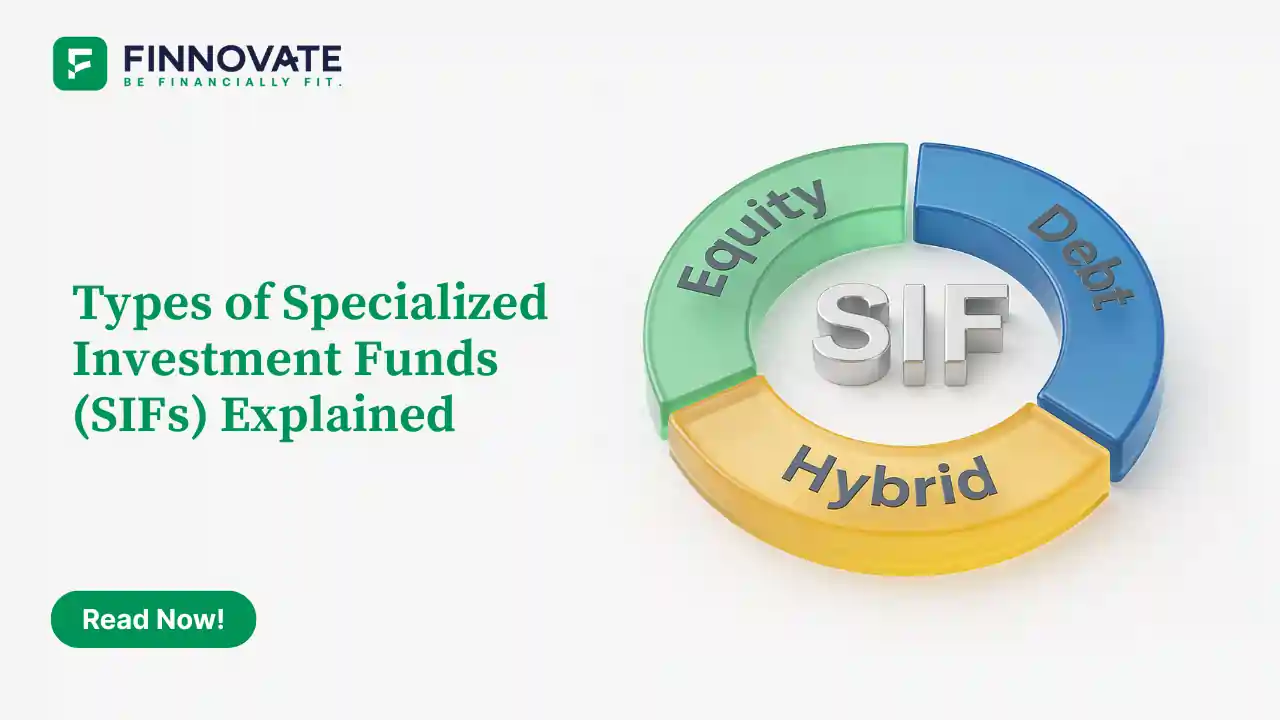
Explore the different types of Specialized Investment Funds (SIFs) - Equity, Debt, and Hyb...
Specialized Investment Funds, SIF India, SIF investment risks, long-short SIF, Quant AMC S...
Learn what SIF investment means in India, SEBI rules, Rs 10 lakh minimum investment, avail...
Popular now
Learn how to easily download your NSDL CAS Statement in PDF format with our step-by-step g...

Looking for the best financial freedom books? Here’s a handpicked 2026 reading list with...
Learn what SIF investment means in India, SEBI rules, Rs 10 lakh minimum investment, avail...
Clear guide to mutual fund taxation in India for FY 2025–26 after July 2024 changes: equ...