SEBI’s ₹25 Lakh PRIM Route: What Changes for Mutual Fund Investors?

Finnovate’s editorial team researches and creates financial content using trusted sources, regulatory references and inputs from subject experts.
Imagine you have built a mutual fund portfolio yourself. Some money goes into equity funds for long-term growth, and some into debt funds to balance the risk.
Each scheme has a fund manager or team looking after its investments. But you still decide how much money goes into each fund.
Now equity markets rise sharply. Your equity investments grow faster and take up a larger share of your portfolio than you originally planned.
Who decides whether to restore the balance?
That decision rests with you. The managers of your individual schemes do not decide how your total money should be split across funds.
You can handle the second job yourself, take advice or hire a portfolio manager.
SEBI has now approved PRIM, a dedicated route for professionally managed portfolios built through permitted fund products, with a ₹25 lakh minimum investment.
That is half the usual ₹50 lakh entry amount for conventional Portfolio Management Services, or PMS. The lower threshold applies specifically to PRIM.
For investors who want to hand over ongoing portfolio decisions, this could widen their options. But what does the service add, and when is it worth paying for?
What is SEBI’s PRIM route?
On September 24, 2026, SEBI’s board approved the introduction of PRIM, the Portfolio Managers Route for Investing in Mutual Fund units.
Under this route, portfolio managers can invest client money in direct plans of mutual funds, including exchange-traded funds, index funds and specialised investment funds, or SIFs, offered by Indian asset management companies.
Existing portfolio managers can offer PRIM through a separate investment approach. Applicants planning to operate strictly within its permitted investments can seek a dedicated registration.
| Route | Standard minimum investment | What the manager invests in |
|---|---|---|
| Conventional PMS | ₹50 lakh | Permitted securities, which can include individual shares, bonds and mutual funds, depending on the strategy |
| PRIM | ₹25 lakh | Permitted fund products, including direct mutual fund plans, ETFs, index funds and SIFs of Indian AMCs |
Scroll left or right to view the full table.
Separate regulatory exemptions may apply to standard minimum investment requirements.
The ₹25 lakh threshold comes with a defined investment scope. A manager cannot use it to offer a portfolio that directly buys individual shares.
It is also separate from investing in mutual funds on your own, where the minimum purchase amount depends on the scheme.
Portfolio managers could already build portfolios using mutual funds. PRIM gives this form of management a dedicated framework, a lower entry amount and specific conditions.
Its rollout will depend on the notified regulations and implementation timelines.
What does the extra manager do?
An equity fund’s manager decides which shares the scheme should hold, within its investment strategy. A debt fund’s manager makes decisions about that scheme’s debt investments.
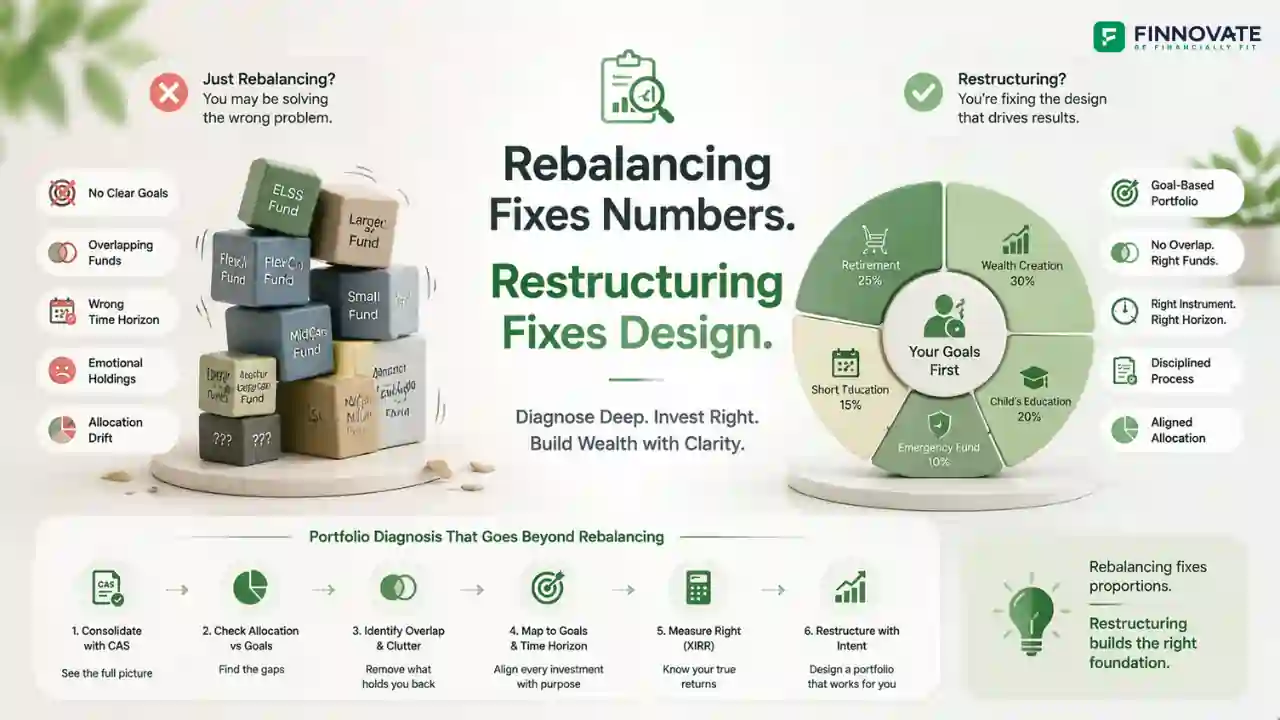
A portfolio manager decides how those schemes fit together for you.
Suppose your agreed allocation is 60% equity and 40% debt. After a strong period for shares, it becomes 70% equity and 30% debt.
Your agreed allocation
After equity grows faster
Illustrative example. The equity share has increased by 10 percentage points.
Both funds may be performing well. Yet your portfolio now carries more equity risk than you planned.
A portfolio manager can review that change and decide whether to restore the agreed balance, within the authority you have given them.
They can also check for overlap. Three funds with different names may own many of the same companies. Adding another fund does not necessarily spread your risk more widely.
The work involves choosing schemes, deciding their allocations, reviewing the combined exposure and making changes when needed.
Investors already using discretionary portfolio management may have someone doing this work. PRIM broadens access to a particular form of that service.
How does it compare with investing yourself or taking advice?
A large portfolio does not automatically require PMS. Someone with ₹1 crore in mutual funds may manage it independently, work with an adviser or delegate decisions to a portfolio manager.
The choice depends on the help they need and the control they want to retain.
| Question | Self-managed direct funds | Registered investment adviser | Discretionary management through PRIM |
|---|---|---|---|
| Who chooses the investments? | You | The adviser recommends; you decide | The manager chooses within the agreed mandate |
| Who authorises changes? | You | You retain decision authority | The manager acts within the authority you have agreed |
| What help are you seeking? | You handle selection and reviews | Advice and agreed support | Portfolio decisions and execution |
| What should you assess? | Your time, knowledge and discipline | Advice, scope and fees | Mandate, risk, total costs and service |
Scroll left or right to view the full table.
An investment adviser may also help implement recommendations, subject to applicable rules. That assistance does not give the adviser the same authority as a discretionary portfolio manager.
With discretionary management, the manager can act within agreed limits without seeking approval for every transaction. The service agreement defines those limits.
For a busy professional, that may be useful. Someone who prefers to approve each change may choose advice. A person comfortable managing a simple portfolio may continue independently.
The scope of the service matters too. Managing investments does not automatically include reviewing insurance, loans, estate arrangements or the family’s entire financial plan.
What would PRIM cost?
SEBI’s board release caps the fixed management fee at 1% of the client’s assets under management. It also permits a performance-based fee model.
Consider a simple illustration.
Fixed management fee: an illustration
A portfolio that stays at ₹25 lakh throughout the year, charged at 1% a year:
₹25,000Before applicable taxes and other costs.
Actual charges depend on the agreement, calculation method and changes in portfolio value. A provider may charge less than the ceiling.
The underlying investments have costs too.
Direct mutual fund plans exclude distributor commissions, but they still carry expenses for running the scheme. Paying a portfolio manager does not remove those expenses.
An investor therefore needs to examine:
- Expenses charged within the underlying funds.
- Fixed or performance-based portfolio-management fees, as applicable.
- Other disclosed charges and applicable taxes.
If a performance-based fee applies, ask what return triggers it, how it is calculated and how previous losses are treated. A fee illustration for both a good year and a weak year can make the arrangement easier to assess.
Then consider what you receive for the total amount.
A suitable allocation, consistent reviews and timely execution can have value. More funds, more reports or more frequent switches do not, by themselves, prove better management.
What safeguards come with PRIM?
The approved framework includes a 25% cap on investments in schemes of affiliated, group or associate asset management companies.
This matters when the portfolio manager has links to a fund house. The cap limits investment in related fund houses, but it does not eliminate every possible conflict of interest.
Investors should still ask how funds are selected and whether business relationships influence those choices.
The framework also requires separation of mutual fund distribution and PRIM activities and clients, except for accredited investors.
For applicants seeking dedicated registration under PRIM, the minimum net worth is ₹2 crore. This applies to the provider and is separate from the investor’s ₹25 lakh entry amount.
SEBI has also approved a waiver of exit-load provisions under PRIM. Investors should check the final rules and individual scheme terms for any charges that may still apply when underlying investments are sold.
These safeguards set boundaries for the service. They do not guarantee returns or remove investment risk.
What risks should investors examine?
The risk depends on what the portfolio holds.
A portfolio with a large equity allocation remains exposed to stock-market falls. Several funds can still leave an investor heavily exposed to the same sectors or companies.
PRIM also permits SIFs, so understanding the actual strategies matters. Investors should not assume every proposed investment behaves like a familiar mutual fund.
The ₹25 lakh threshold tells you how much money is needed to enter. It does not tell you how much risk the manager will take.
Before handing over decisions, establish what the manager can buy, what allocation limits apply and when those allocations can change.
Performance needs a fair comparison too. A portfolio combining equity and debt should be assessed against a benchmark suited to that mix. Comparing it only with an equity index can give a misleading impression of success or failure.
Look at results after relevant fees and costs, alongside the risk taken.
Who might find PRIM useful?
The lower threshold is particularly relevant to someone with ₹25 lakh to less than ₹50 lakh available for this service, who would not meet the usual entry requirement for conventional PMS.
But meeting the threshold is only the first test.
PRIM may interest someone who wants ongoing management of a fund portfolio and is comfortable allowing a professional to act within agreed limits.
It may also appeal to an investor who understands the broad plan but repeatedly postpones reviews or leaves decisions unfinished.
For such investors, the potential benefit is consistent execution. The manager takes responsibility for the decisions covered by the agreement.
The service may offer less value to someone with a simple, well-maintained portfolio who is comfortable managing it independently.
And someone whose main concern is whether they can retire, fund a child’s education or repay debt may first need a broader financial plan. Portfolio management can support that plan once the role of the investments is defined.
Before choosing a service, establish four things:
- Authority: What decisions can the manager make without asking you?
- Cost: What will you pay across all layers of fees and expenses?
- Accountability: How will risk, performance and service be reviewed?
- Access: How can you withdraw money or end the arrangement?
These answers tell you more about suitability than the entry amount alone.
The decision beyond ₹25 lakh
The investor in our opening example chose the funds themselves. Each scheme had a manager, but the responsibility for combining those schemes still rested with the investor.
PRIM offers a dedicated route for handing that responsibility to a portfolio manager, with a ₹25 lakh minimum and specific conditions. The usual ₹50 lakh threshold for conventional PMS remains separate.
For some investors, the cost may be justified by disciplined decisions and dependable execution. Others may be well served by advice or their own approach.
Sources and further reading
- SEBI: Key decisions taken at the September 24, 2026 board meeting, particularly sections 1.2.1.5.1 and 1.2.1.5.2.
- SEBI Investor: Portfolio Management Services.
- AMFI: Understanding direct plans.
Disclaimer: This article is for educational purposes and does not constitute investment advice. Information is based on SEBI’s September 24, 2026 board announcement. Implementation is subject to notified regulations and timelines. Examples are illustrative. Investments are subject to market risk.