

SEBI PRIM Explained: ₹25 Lakh Minimum, Fees & PMS Comparison
Understand SEBI’s approved ₹25 lakh PRIM route for managed mutual fund portfolios, its...
26 September 2026

Most investors check their portfolio occasionally. They look at returns, notice if a fund has dropped, and maybe shift one SIP. What they rarely do is a structured review that covers every dimension of the portfolio in a single sitting. The gaps that compound quietly over years, nominations not updated after a marriage, LTCG headroom left unused year after year, a term cover that has not kept pace with income growth, sit outside the return-and-allocation check most investors do.
This checklist covers all eight dimensions that a professional portfolio review typically examines. It is designed to be completed once a year, ideally in April at the start of the Indian financial year when LTCG planning is most actionable. Each dimension has a clear set of checks and a pass criterion. The full checklist takes most investors one to two hours to work through.
For the underlying framework behind each dimension, see How to Review Your Investment Portfolio in India.
Each item in the checklist has one of three outcomes. Work through every dimension and assign an outcome to each item before moving to the scoring section.
A review cannot begin without a complete picture. Many investors carry a fragmented view of their own wealth: mutual funds on one platform, direct equity on another, EPF on a third, and physical gold with no recorded value anywhere. The first step is assembling one consolidated snapshot.
Return measurement is where most self-directed reviews go wrong. CAGR is the commonly cited figure but is only accurate for lump sum investments. XIRR is the correct metric for any portfolio built through SIPs or with multiple investment dates, as it accounts for the timing and size of every cash flow.
Markets move continuously, causing allocation to drift from its original intent. A portfolio set at 60% equity three years ago may now be running 72% to 75% equity after sustained market appreciation, taking on meaningfully more risk than the investor originally intended. The 5-percentage-point rule offers a practical threshold for evaluating drift.
| Drift from target | Status | Review outcome |
|---|---|---|
| Less than 5pp | Within range | Pass. Monitor at next review. |
| 5pp to 10pp | Mild drift | Flag or Act. Consider rebalancing this cycle. |
| More than 10pp | Significant drift | Act. Portfolio risk level has shifted materially from intent. |
Finnovate's Asset Allocation Calculator can help model what an appropriate target allocation may look like based on age and goals.
An investment without a mapped goal has no success criterion. There is no way to know if it is working. Goal mapping is the step most investors have either never completed or completed once and never revisited as goals and timelines evolved.
The FinnFit financial fitness score structures the goal mapping exercise across six dimensions of financial health and highlights where gaps exist in the current portfolio relative to stated goals.
Fund accumulation is not the same as diversification. Multiple funds holding largely identical underlying stocks create concentration rather than spread, while multiplying total expense ratio drag. The overlap check and fund count review are among the highest-value items in an annual review for investors who have been adding funds over several years.
An investment portfolio is only as secure as the protection structure around it. An underinsured investor's portfolio is exposed to being prematurely liquidated in the event of an adverse life event. A portfolio without updated nominations creates significant legal and practical friction for family members at the worst possible time.
Tax planning is not a year-end activity. An annual portfolio review in April is the ideal moment to set a tax strategy for the financial year ahead: using LTCG headroom before it goes unused, identifying positions where harvesting a loss offsets a gain elsewhere, and confirming the old vs new regime choice before the first salary TDS cycle locks in the decision.
For a comprehensive guide to tax planning across all investment instruments, see Tax Planning in India: Investor's Guide.
Estate readiness is the dimension most investors defer indefinitely. A valid will, updated nominations, and a family member who knows where assets are held cost nothing but time to establish and maintain. The absence of any one of these three has material consequences for the people the investor is trying to protect.
For a detailed guide on estate planning structures in India including wills, nominations, and trusts, see Estate Planning in India: Complete Guide.
After completing all eight dimensions, count how many pass fully with no Act or Flag items. Use the score below as a directional guide.
Every item from the checklist produces one of three outcomes. The action path depends on which outcome it falls into.
An annual portfolio review covering all eight dimensions takes most investors one to two hours. The value is not in the time spent but in what it uncovers: the nomination that was never updated, the LTCG headroom that went unused for three years, the fund overlap that was visible only when looked at together. Each of these has a real cost that accumulates quietly between reviews.
The checklist above covers what a professional review examines. The difference between a self-directed review and a professional one is not in the dimensions covered but in the depth of the evaluation and the sequencing of any changes that result.
We cover all eight dimensions in a single structured review. No product recommendations, no commissions. The first conversation is complimentary.
Book a Complimentary ConsultationA portfolio review checklist is a structured framework covering every dimension of an investment portfolio that warrants annual examination. A comprehensive checklist covers returns measurement, asset allocation, goal mapping, fund overlap, insurance adequacy, nominations, tax position, and estate readiness. It provides a consistent format for reviewing the portfolio in full rather than checking returns in isolation.
An annual review covering all eight dimensions is appropriate for most long-term investors. April is a practical timing choice because it aligns with the start of the Indian financial year, allows LTCG tax planning to be set at the beginning of the year, and provides a natural moment to review the old vs new tax regime selection. An additional review may be warranted after any major life event. For more on review frequency, see How to Review Your Investment Portfolio in India.
XIRR (Extended Internal Rate of Return) is the correct metric for measuring returns on a portfolio built through SIPs or with multiple investment dates. Unlike CAGR, which assumes a single starting investment, XIRR accounts for the timing and size of every cash flow. A portfolio that looks reasonable by CAGR may show a materially different XIRR when the actual investment timing is factored in. Past performance is not indicative of future returns.
For FY 2025-26, gains on equity-oriented investments held for more than 12 months are taxed as long-term capital gains (LTCG) at 12.5% above ₹1.25 lakh per financial year. Gains up to ₹1.25 lakh per year are exempt from tax. Many investors leave this exemption unused by not booking any gains, even when it would be tax-efficient to do so. An annual review is the right moment to assess whether partial gain booking is worth considering. Please consult a SEBI-registered investment adviser or tax professional before making any decisions.
A self-directed checklist covers the same dimensions a professional review examines and is a meaningful step beyond a returns-only check. Professional review adds value when the portfolio has accumulated complexity across multiple asset classes and tax treatments, when a major life event has changed the financial picture significantly, or when the sequencing of any changes needs to be optimised across financial years. Please consult a SEBI-registered investment adviser for guidance specific to your situation.
April aligns with three practical advantages for Indian investors. It marks the start of the financial year, making it the ideal moment to set LTCG tax strategy and the old vs new regime choice before TDS decisions are locked in. Any rebalancing executed in April avoids short-term capital gains treatment on holdings that may cross the 12-month threshold within weeks. And it creates a consistent annual review date that is easy to maintain as a discipline.
Disclaimer: This article is for general information and educational purposes only. It does not constitute investment advice, a recommendation, or an offer to buy or sell any securities or financial instruments. All references to portfolio review dimensions, tax rates, allocation thresholds, and insurance guidelines are based on publicly available regulatory and market information as of FY 2025-26 and are subject to revision. The LTCG exemption limit of ₹1.25 lakh and tax rates cited are current as of FY 2025-26. Healthcare inflation data referenced from public available top sources. Past market behaviour is not indicative of future returns. Investors should not make any investment decision based solely on this article. Please consult a SEBI-registered investment adviser or qualified financial professional before making any investment, rebalancing, or restructuring decision. Mutual fund investments are subject to market risks. Please read all scheme-related documents carefully before investing.
No spam. Only new posts, simple explainers, and practical money checklists for busy professionals.
Finnovate is a SEBI-registered financial planning firm that helps professionals bring structure and purpose to their money. Over 3,500+ families have trusted our disciplined process to plan their goals - safely, surely, and swiftly.
Our team constantly tracks market trends, policy changes, and investment opportunities like the ones featured in this Weekly Capsule - to help you make informed, confident financial decisions.
Learn more about our approach and how we work with you:
No comments yet. Start the conversation. What would you add?
No spam. Only new posts, simple explainers, and practical money checklists.
You may also like
Understand SEBI’s approved ₹25 lakh PRIM route for managed mutual fund portfolios, its...
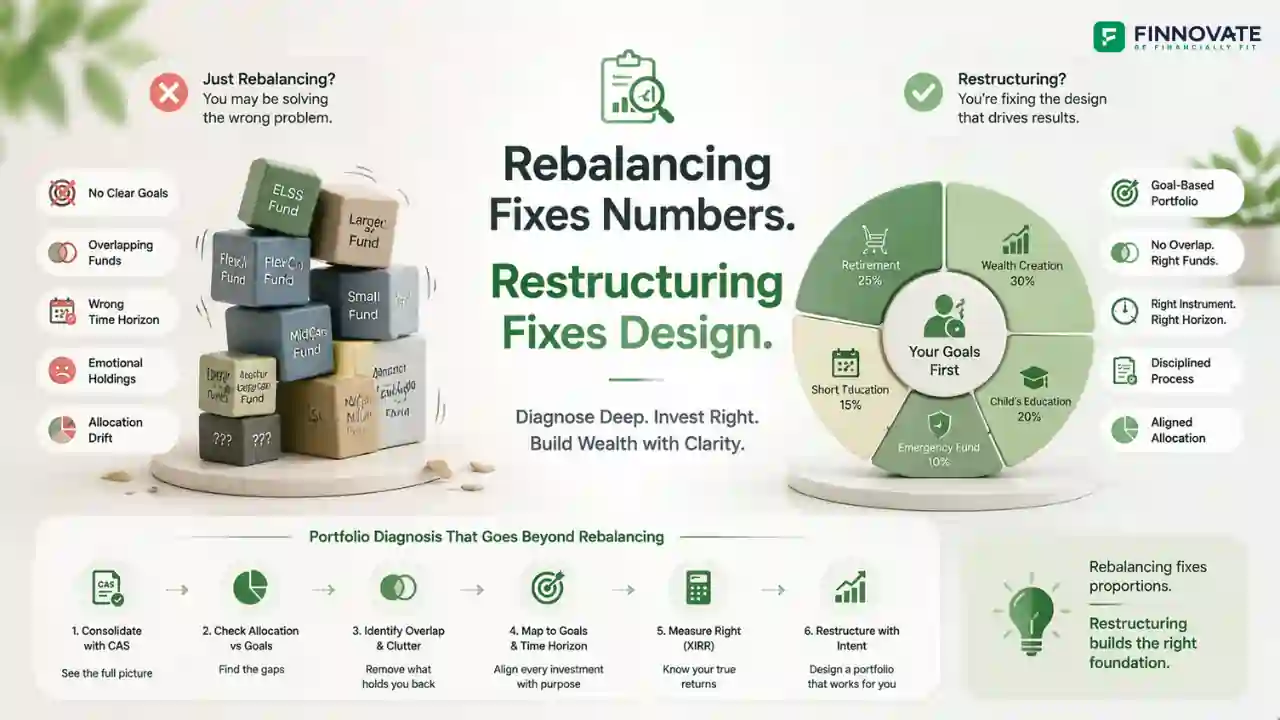
Allocation drift is fixed by rebalancing. These 7 signs point to something deeper. A pract...

A 6-step framework to review your investment portfolio in India - XIRR vs benchmark, alloc...

Asset allocation drives more of your long-term returns than fund selection. This guide cov...
Popular now

Learn how to easily download your NSDL CAS Statement in PDF format with our step-by-step g...

Looking for the best financial freedom books? Here’s a handpicked 2026 reading list with...
Learn what SIF investment means in India, SEBI rules, Rs 10 lakh minimum investment, avail...

Clear guide to mutual fund taxation in India for FY 2025–26 after July 2024 changes: equ...