

Portfolio Review Checklist for Indian Investors (Annual Guide)
A complete annual portfolio review checklist for Indian investors - 8 dimensions covering ...
19 June 2026
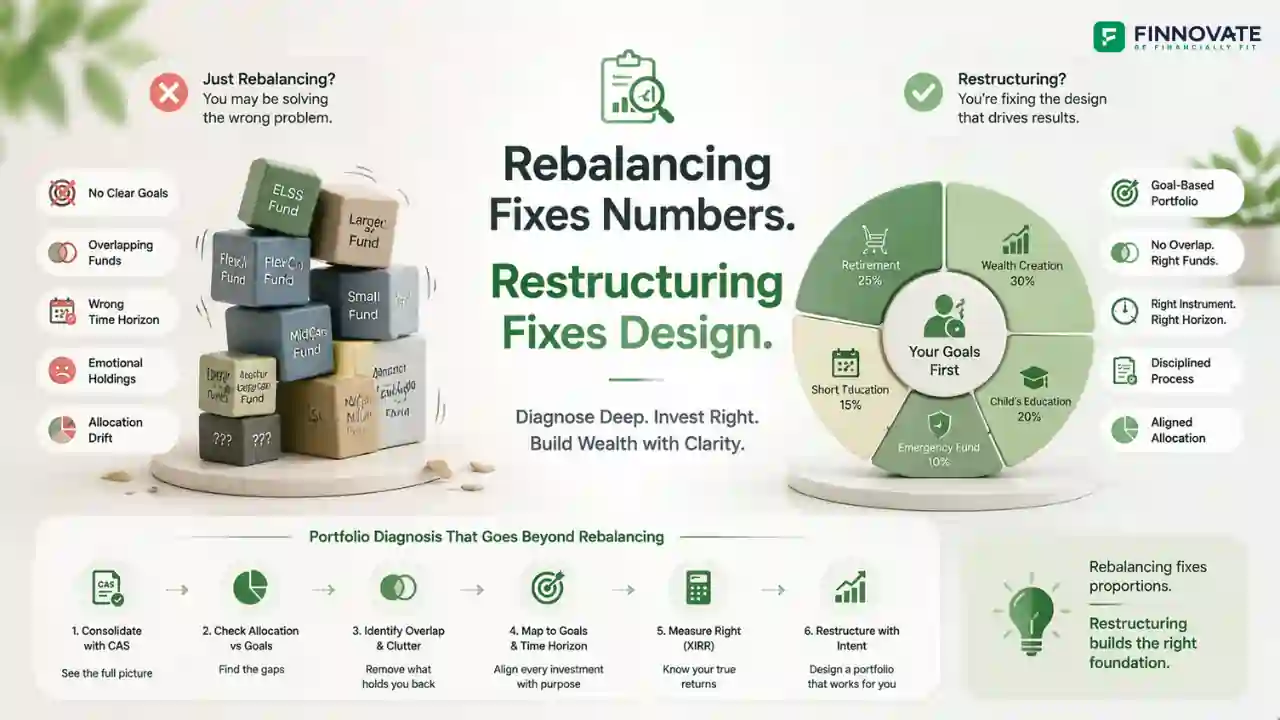
Most investors who feel something is wrong with their portfolio reach for rebalancing as the fix. They adjust equity to debt ratios, redirect a few SIPs, and wait for results. Months later, the same sense of unease returns. The portfolio still does not feel right. Returns are still disappointing. The strategy still feels scattered.
The reason rebalancing did not help is that the problem was never allocation drift. The portfolio's design was the issue from the start. Rebalancing a poorly structured portfolio is like adjusting the tyre pressure on a car with a broken engine. The mechanics are correct. The diagnosis was wrong.
This article covers seven signs that point to a structural problem, along with a practical framework for understanding what restructuring actually involves. For the full six-step process of running a portfolio review before arriving at any conclusion, see How to Review Your Investment Portfolio in India.
Before diagnosing a portfolio, it helps to be precise about what each intervention actually does.
A portfolio with the wrong design will underperform regardless of how precisely it is rebalanced. Identifying which problem is present determines which intervention is appropriate. The seven signs below are indicators of structural problems, not drift problems.
For a detailed look at rebalancing methods, including calendar, threshold, and hybrid approaches, see Portfolio Rebalancing in India: Calendar, Threshold and Hybrid Methods.
The most fundamental structural failure is also the most common. The investor has been investing diligently for years, but no holding has ever been assigned a purpose. There is no answer to the question: which goal does this serve, and when will it be needed?
Without goal mapping, there is no success criterion. A fund that has returned 11% per year may be performing well in absolute terms but completely failing its purpose if it was meant to fund a goal arriving in two years and has taken on 15% volatility in the process.
A portfolio without goal mapping grows in size but not in purpose. The investor feels a sense of progress because the corpus is growing, but has no way of knowing whether they are on track for any of the things they actually want. The FinnFit financial fitness score structures this gap check across six dimensions, including goal alignment. For more on the distinction between wealth building and fund accumulation, see Are You Building Wealth or Just Collecting Mutual Funds Through SIPs?
Owning ten mutual funds does not mean the portfolio is diversified. If seven of those funds are equity-oriented and hold largely the same set of large-cap stocks, the portfolio is concentrated, not diversified. The investor is paying multiple expense ratios for what is effectively one position.
This pattern typically develops over time rather than by design. A fund started on one platform, a few added during a market rally, one inherited from a distributor. Each seemed like a reasonable choice at the time. Together, they create substantial overlap with no strategic benefit.
Use the Finnovate MF Overlap Calculator to identify what percentage of underlying holdings two funds share. Overlap above 60% between two funds in the same category is a signal that one may not be adding genuine diversification. For a detailed framework on the right number of funds for a portfolio, see How Many Mutual Funds Should You Have in Your Portfolio?
Every instrument in a portfolio is appropriate for some timelines and inappropriate for others. The mismatch between an instrument and its goal's timeline is a structural problem that cannot be fixed by changing the allocation between two incorrectly chosen instruments.
| Goal timeline | Appropriate instruments | Problematic mismatch |
|---|---|---|
| 0 to 3 years | Liquid funds, short-duration debt, FDs, arbitrage funds | Equity funds, small-cap funds, sector funds |
| 3 to 7 years | Hybrid funds, conservative equity, target-maturity debt funds | 100% small-cap equity, undiversified thematic bets |
| 7 years and beyond | Equity-heavy allocation, flexi-cap, mid and small-cap exposure | 100% in liquid or short-duration funds, missing compounding |
The two most damaging mismatches in practice: equity funds serving a goal that is 18 to 24 months away (a market correction before withdrawal crystallises the loss), and a growing long-term corpus sitting in liquid or overnight funds indefinitely (compounding opportunity cost compounds silently over years). For how the bucket principle structures this correctly, see How to Review Your Investment Portfolio in India.
Underperformance in one year is normal. Markets are volatile and no portfolio outperforms every year. Consistent underperformance relative to a relevant benchmark over three or more years, even after disciplined rebalancing, is a different signal. It points to asset selection or strategy as the source of drag, not allocation drift.
Life events change the financial picture fundamentally. A significant salary increase, a new dependent, a property purchase, an inheritance, a job change to a variable income structure, an NRI returning to India: each of these changes the goals, the timeline, the risk capacity, and sometimes the tax situation. A portfolio that was designed for a 32-year-old without dependants does not automatically become appropriate for a 38-year-old with two children, a home loan, and approaching school fees.
This is one of the most structurally significant life events from a portfolio perspective. NRI status carries specific investment restrictions and tax treatments. On return, residential status changes under Section 6(1) of the Income Tax Act, affecting which instruments remain eligible, how global income is taxed, and how existing foreign holdings are treated. The portfolio structure that was appropriate as an NRI is rarely appropriate from day one of returning. This warrants a comprehensive structural review, not a rebalancing adjustment.
Every investor has at least one holding that has survived not because of its strategic merit, but because of what it represents. A fund started with a first salary. A stock gifted by a parent. A policy taken when the term seemed responsible and the relationship with the agent seemed important to maintain.
Emotional attachment to investments is understandable. It becomes a structural problem when those holdings are consuming allocation space that could be used by instruments better aligned to current goals, or when they are performing poorly but are never evaluated because questioning them feels uncomfortable.
A holding belongs in a portfolio when it serves a specific goal, suits the goal's timeline, and compares favourably with available alternatives in its category. Applying this test to every holding, including the ones with emotional history, is part of a genuine structural review. A holding that fails the test on all three criteria but remains because of sentiment is a structural problem.
This sign is distinct from Sign 5 in an important way. Sign 5 describes a portfolio that was designed for a previous life stage and never updated. Sign 7 describes a specific event that has already occurred and has created a new financial situation that the current portfolio is not equipped to handle.
The most common versions in practice: a property was recently sold and the proceeds are sitting in a savings account because no investment decision has been made. An inheritance was received and has been held in a fixed deposit for 18 months while the investor decides what to do. A retirement date is 14 months away and the portfolio is still 80% equity.
Restructuring is not a single transaction. It is a sequenced process that, when done correctly, minimises tax impact and avoids the cost of exiting well-performing positions prematurely.
A common misconception is that restructuring requires liquidating the entire portfolio and starting fresh. In practice, most portfolios have holdings that are well-suited to their goals and performing adequately. The restructuring scope is typically limited to holdings that fail the strategic test. The tax and exit load cost of unnecessary exits can outweigh the benefit of the change. For a detailed guide on tax implications across different instruments and asset classes, see Mutual Fund Taxation in India FY 2025-26.
A self-directed restructuring is feasible for a simple portfolio: four to six funds, a clear set of goals, and limited tax complexity. The investor who can run XIRR, map holdings to goals, and identify overlap can execute a basic restructuring using the framework above.
Professional involvement adds measurable value when the portfolio has accumulated complexity that makes sequencing difficult. Multiple asset classes across MFs, direct equity, NPS, EPF, and real estate each carry different tax treatments on exit. A restructuring that does not account for all of these simultaneously may save on one cost while creating a larger liability elsewhere.
The other threshold where professional involvement is consistently valuable: when a major life event has changed the financial picture significantly and the investor is not certain which changes are necessary versus optional. A SEBI-registered fee-only adviser with no product commissions has a clear incentive to recommend only the changes that are genuinely in the investor's interest. For a broader view of what professional portfolio management involves, see Portfolio Management in India: Meaning, Types, and How It Works.
Rebalancing is maintenance. Restructuring is surgery. Most portfolios need the former regularly and the latter rarely. But when the latter is needed, continuing to apply the former is not just ineffective. It delays a correction that compounds in cost over time.
The seven signs in this article are diagnostic indicators, not definitive conclusions. A portfolio displaying two or three of them warrants a structured review. A portfolio displaying five or more has likely needed structural attention for longer than the investor realises.
We map your full picture: goals, timelines, tax position, and existing holdings, before recommending any change. The first conversation is complimentary.
Book a Complimentary ConsultationRebalancing restores a portfolio to its intended asset allocation after market movements have caused drift. It assumes the underlying design is sound. Restructuring addresses the design itself: goals were never mapped, instruments do not match timelines, or the strategy is internally inconsistent. Rebalancing is appropriate when the framework is correct and proportions have shifted. Restructuring is appropriate when the framework itself needs to change.
A useful test: can every holding in the portfolio be assigned a specific goal, a withdrawal timeline, and a reason why this instrument suits that timeline? If the answer is yes and allocation has drifted from target, rebalancing is likely sufficient. If the mapping cannot be made clearly for most holdings, or if the instrument-to-timeline fit is poor, the portfolio may need structural attention rather than a proportional adjustment.
Not typically. Most portfolios have holdings that are well-suited to their goals and performing adequately. The restructuring scope covers holdings that fail the strategic test: those without a goal, those mismatched to their timeline, and those creating redundant overlap. The tax and exit load cost of unnecessary exits can outweigh the benefit of the change, so restructuring is generally done in a sequenced, tax-efficient way rather than as a complete liquidation. Please consult a SEBI-registered investment adviser before making any restructuring decisions.
Restructuring involves redemptions, which create taxable events. For equity-oriented funds, gains on units held beyond 12 months are taxed as LTCG at 12.5% above ₹1.25 lakh per financial year. Gains on units held for 12 months or less are taxed as STCG at 20%. Debt fund gains are taxed at the investor's applicable income slab rate. Sequencing exits across financial years and using the annual LTCG exemption can reduce the overall tax cost of restructuring materially. Please consult a SEBI-registered investment adviser or tax professional for guidance specific to your situation.
A well-structured portfolio with clear goal mapping and appropriate instruments rarely needs restructuring more than once every several years. Most annual reviews confirm that rebalancing is sufficient. Restructuring is typically triggered by a major life event that changes goals, timelines, or risk capacity, or by a gradual realisation that the original portfolio was never structured with clear intent. Unlike rebalancing, restructuring is not a routine activity. It is a response to a genuine structural gap identified through a thorough review.
A simple portfolio of four to six funds with clear goals and limited tax complexity can be restructured independently using a structured review framework. The process becomes more complex when multiple asset classes are involved, when a major life event has changed the tax situation, or when the sequencing of exits needs to be optimised across financial years to minimise tax liability. In these cases, a SEBI-registered fee-only investment adviser can provide objective guidance without a conflict of interest from product commissions. Please consult a SEBI-registered investment adviser before making any restructuring decisions.
Disclaimer: This article is for general information and educational purposes only. It does not constitute investment advice, a recommendation, or an offer to buy or sell any securities or financial instruments. All references to portfolio management, asset allocation, tax rates, and instrument suitability are based on publicly available regulatory and market information as of FY 2025-26 and are subject to revision. Tax rates cited (LTCG at 12.5%, STCG at 20% on equity) are current as of FY 2025-26 and may be updated by subsequent Finance Acts. Past market behaviour is not indicative of future returns. Investors should not make any investment decision based solely on this article. Please consult a SEBI-registered investment adviser or qualified financial professional before making any investment or restructuring decision. Mutual fund investments are subject to market risks. Please read all scheme-related documents carefully before investing.
No spam. Only new posts, simple explainers, and practical money checklists for busy professionals.
Finnovate is a SEBI-registered financial planning firm that helps professionals bring structure and purpose to their money. Over 3,500+ families have trusted our disciplined process to plan their goals - safely, surely, and swiftly.
Our team constantly tracks market trends, policy changes, and investment opportunities like the ones featured in this Weekly Capsule - to help you make informed, confident financial decisions.
Learn more about our approach and how we work with you:
No comments yet. Start the conversation. What would you add?
No spam. Only new posts, simple explainers, and practical money checklists.
You may also like
A complete annual portfolio review checklist for Indian investors - 8 dimensions covering ...

A 6-step framework to review your investment portfolio in India - XIRR vs benchmark, alloc...

Asset allocation drives more of your long-term returns than fund selection. This guide cov...
Explore the key differences between active and passive portfolio management strategies and...
Popular now

Learn how to easily download your NSDL CAS Statement in PDF format with our step-by-step g...

Looking for the best financial freedom books? Here’s a handpicked 2026 reading list with...
Learn what SIF investment means in India, SEBI rules, Rs 10 lakh minimum investment, avail...

Clear guide to mutual fund taxation in India for FY 2025–26 after July 2024 changes: equ...