

Tax Planning and Benefits for Married Couples in India: 2026 Guide
Tax planning for married couples in India explained for 2026. Compare tax regimes, deducti...
05 September 2026


Finnovate’s editorial team researches and creates financial content using trusted sources, regulatory references and inputs from subject experts.

For many retirees, tax planning is no longer just about saving tax. It is about making pension, interest income, and savings last longer.
The good part is that India's tax system still gives specific benefits to senior citizens, especially under the old tax regime. At the same time, the new tax regime has become more attractive after recent slab and rebate changes, so the better option is not always obvious.
This guide breaks down the main benefits in simple terms and shows where senior citizens should compare carefully before choosing a regime.
Quick Answer: Income tax slabs for senior citizens (FY 2025-26)
The new tax regime applies uniform slabs to all ages. The old tax regime gives higher exemption limits based on age. Both regimes are shown below.
Old Tax Regime slabs (FY 2025-26)
| Income range | Below 60 | Senior citizen (60-79) | Super senior citizen (80+) |
|---|---|---|---|
| Nil tax | Up to Rs 2.5 lakh | Up to Rs 3 lakh | Up to Rs 5 lakh |
| 5% | Rs 2.5L to Rs 5L | Rs 3L to Rs 5L | Not applicable |
| 20% | Rs 5L to Rs 10L | Rs 5L to Rs 10L | Rs 5L to Rs 10L |
| 30% | Above Rs 10L | Above Rs 10L | Above Rs 10L |
New Tax Regime slabs (FY 2025-26): uniform across all ages
| Income range | Tax rate | Note |
|---|---|---|
| Up to Rs 4 lakh | Nil | Basic exemption for all ages |
| Rs 4L to Rs 8L | 5% | Section 87A rebate: income up to Rs 12 lakh is effectively tax-free for residents |
| Rs 8L to Rs 12L | 10% | |
| Rs 12L to Rs 16L | 15% | |
| Rs 16L to Rs 20L | 20% | |
| Rs 20L to Rs 24L | 25% | |
| Above Rs 24L | 30% |
The new regime has no age-based slab differences. Senior citizens get no higher basic exemption under the new regime. All figures above are before cess (4%) and surcharge. Please consult a qualified tax adviser before choosing a regime.
Age and residential status both matter. A resident individual aged 60 to 79 years is a senior citizen. A resident individual aged 80 or above is a super senior citizen. The higher basic exemption limits under the old regime are available only to resident senior and super senior citizens. NRIs do not get the age-based slab benefit even under the old regime, regardless of age.
The old regime slab tables are shown in the Quick Answer box above. The key practical point: the age-based advantage is concentrated at the entry level. A senior citizen pays no tax on income up to Rs 3 lakh vs Rs 2.5 lakh for others, and a super senior citizen has no tax up to Rs 5 lakh with the 5% band eliminated entirely. After that, all three age groups face identical rates. This matters most for retirees with moderate income who are still in the deduction-based old regime.
Not automatically, but the comparison is worth running carefully. The new tax regime is the default and applies the same slabs to all ages (shown in the Quick Answer box above). No age-based slab advantage exists here. But after Budget 2025 slab and rebate changes, the new regime can still work out better for many retirees, particularly those with simpler income and fewer deductions.
Assume a resident senior citizen has pension income of Rs 12.75 lakh and qualifies for the Rs 75,000 standard deduction, because regular pension is generally taxed under the head Salaries. Then taxable income becomes Rs 12 lakh. This illustration is relevant to regular pension income, not family pension, which is taxed differently.
| Details | Amount | Explanation |
|---|---|---|
| Pension income | Rs 12,75,000 | Pension taxable under Salaries |
| Standard deduction | Rs 75,000 | Available to salaried / pension taxpayers |
| Taxable income | Rs 12,00,000 | After deduction |
| Tax on Rs 4L to Rs 8L | Rs 20,000 | 5% on Rs 4 lakh |
| Tax on Rs 8L to Rs 12L | Rs 40,000 | 10% on Rs 4 lakh |
| Total tax payable | Rs 60,000 | Before rebate |
| Rebate under Section 87A | Rs 60,000 | Subject to applicable conditions |
| Net tax payable | Nil | In this illustration |
This does not mean every senior citizen with Rs 12.75 lakh income pays zero tax. It works only when the income fits the new regime conditions and the taxpayer qualifies for the standard deduction. Also, family pension is treated differently from regular pension, so that distinction should not be ignored.
This is one of the most common questions from retired investors who depend on bank FD and post office interest income.
Section 80TTB is one of the most relevant tax benefits for retirees who rely on interest income.
It allows eligible senior citizens to claim a deduction of up to Rs 50,000 on interest earned from bank deposits, post office deposits, and cooperative bank deposits, subject to conditions.
A related practical point is Form 15H. A resident senior citizen may submit Form 15H only if the final tax liability for the year is expected to be nil. It is not a blanket form for everyone above 60.
Health costs rise with age, so Section 80D matters a lot for senior citizens.
Broadly, premium paid for health insurance for a senior citizen can qualify for deduction up to Rs 50,000, subject to the section's conditions and payment rules. A son or daughter paying premium for senior citizen parents may also claim deduction under the parents' block, within the prescribed limits.
This deduction is available under the old tax regime only.
This relief is useful but often misunderstood.
A resident senior citizen is not liable to pay advance tax if they do not have income chargeable under the head profits and gains of business or profession.
So if a senior citizen only has pension, interest, rent, or capital gains, this relief may apply. If you want to understand how gains from assets are taxed separately, read our guide on capital gains tax in India. If business or professional income also exists, this relief does not apply.
There is one more compliance relief that is useful for a narrow group of very senior taxpayers.
Under Section 194P, certain senior citizens aged 75 years or above may not be required to file an income tax return if specific conditions are met. Broadly, this applies where the individual is resident, has only pension income and interest income, and the interest is earned from the same specified bank where the pension is received. The senior citizen must also submit the required declaration to that bank.
This is not a general exemption for all retirees above 75. It is a conditional compliance relief. Income tax itself continues to be due; the bank deducts TDS on behalf of the taxpayer. Eligibility depends on whether all the stated conditions are satisfied.
The Senior Citizens Savings Scheme (SCSS) is a government-backed retirement savings option for eligible individuals.
SCSS has a 5-year tenure, can be extended, and currently allows a maximum deposit of Rs 30 lakh across accounts for one customer. Individuals aged 60 years and above can open it, and certain retirees aged 55 to below 60 may also qualify subject to scheme conditions.
From a tax angle, three things are important to note:
SCSS can be useful in a retirement plan, but it should not be chosen purely on the basis of the Section 80C deduction.
| Point | Old Tax Regime | New Tax Regime | What It Means |
|---|---|---|---|
| Age-based relief | Yes | No | Old regime helps seniors at the base slab level |
| Standard deduction for pension | Available within old-regime framework | Rs 75,000 under current framework | Helps pensioners compare seriously |
| Section 87A relief | Available, but at a lower threshold | Available at a much wider practical threshold under the latest framework | New regime can work well for moderate income cases |
| 80TTB / 80D / 80C style deductions | Available subject to rules | Not available | Deduction-heavy cases may prefer old regime |
This comparison is where many retirees need to pause. The old regime gives more familiar deductions, but the new regime can still win when the income structure is simpler and deductions are limited.
| Scenario | Regime to Compare First | Why |
|---|---|---|
| Lower deductions, simpler income structure | New Tax Regime | Lower slab rates and rebate structure may work better |
| High 80TTB, 80D, and 80C usage | Old Tax Regime | Deductions can materially reduce taxable income |
| Pension income close to the rebate-friendly threshold | Compare both carefully | Standard deduction and rebate can change the outcome |
| Super senior citizen with relatively modest income | Old Tax Regime | Higher basic exemption can still be useful |
This is only a decision aid, not a fixed rule. The final answer depends on income mix, deduction usage, and whether the new regime rebate actually brings the tax payable down to nil.
For most retirees, the answer comes down to three variables: the mix of pension and interest income, the value of deductions like 80TTB and 80D under the old regime, and whether the new regime rebate actually eliminates the tax liability. Running the numbers under both regimes before filing is the most reliable way to know.
No. The higher exemption under the old regime is for resident senior and super senior citizens only. Non-resident Indians (NRIs) do not get the age-based slab benefit even under the old regime.
Not necessarily. It gives no separate age-based slab relief, but it can still be better in some cases because of slab design, rebate, and standard deduction. The only way to know is to compute tax under both regimes for your specific income and deduction profile.
No. Section 80TTB is available only under the old tax regime. Senior citizens in the new regime do not get a separate deduction on interest income. They are subject to the same slab structure as all other taxpayers, but the Rs 4 lakh basic exemption and Section 87A rebate may still reduce or eliminate tax on moderate incomes.
Yes, subject to Section 80D conditions and limits. A son or daughter can claim deduction for health insurance premium paid for senior citizen parents, up to Rs 50,000 under the parents' block. This is available only under the old tax regime.
No. The relief applies only to resident senior citizens who do not have income from business or profession. A senior citizen with rental income, pension, or interest income may qualify. A senior citizen running a business or practice continues to be liable for advance tax in the usual manner.
No. SCSS investment may qualify under Section 80C in the old regime, but interest earned is fully taxable. TDS is deducted by the post office or bank on SCSS interest when it exceeds the applicable threshold.
No. A widely circulated claim suggests that all individuals above 75 years of age are completely exempt from income tax. This is inaccurate. Section 194P provides a conditional ITR filing relief for individuals aged 75 or above who have only pension income and bank interest from the same bank where pension is credited, and who submit a specific declaration to that bank. Income tax still applies; the bank deducts TDS on behalf of the taxpayer. This is a compliance simplification, not a tax exemption. All other senior and super senior citizens continue to pay income tax in the normal manner under the applicable regime.
Disclaimer: This article is for educational and informational purposes only. It is not tax advice, investment advice, or a recommendation to choose any specific tax regime or product. Tax rules are subject to change. The Income Tax Act, 2025 is in force from 1 April 2026; for FY 2025-26 returns, the provisions of the Income Tax Act, 1961 apply. Always verify your tax position with a qualified chartered accountant or tax adviser before filing returns or making tax-linked financial decisions.
No spam. Only new posts, simple explainers, and practical money checklists for busy professionals.
Finnovate is a SEBI-registered financial planning firm that helps professionals bring structure and purpose to their money. Over 3,500+ families have trusted our disciplined process to plan their goals - safely, surely, and swiftly.
Our team constantly tracks market trends, policy changes, and investment opportunities like the ones featured in this Weekly Capsule - to help you make informed, confident financial decisions.
Learn more about our approach and how we work with you:
No comments yet. Start the conversation. What would you add?
No spam. Only new posts, simple explainers, and practical money checklists.
You may also like
Tax planning for married couples in India explained for 2026. Compare tax regimes, deducti...
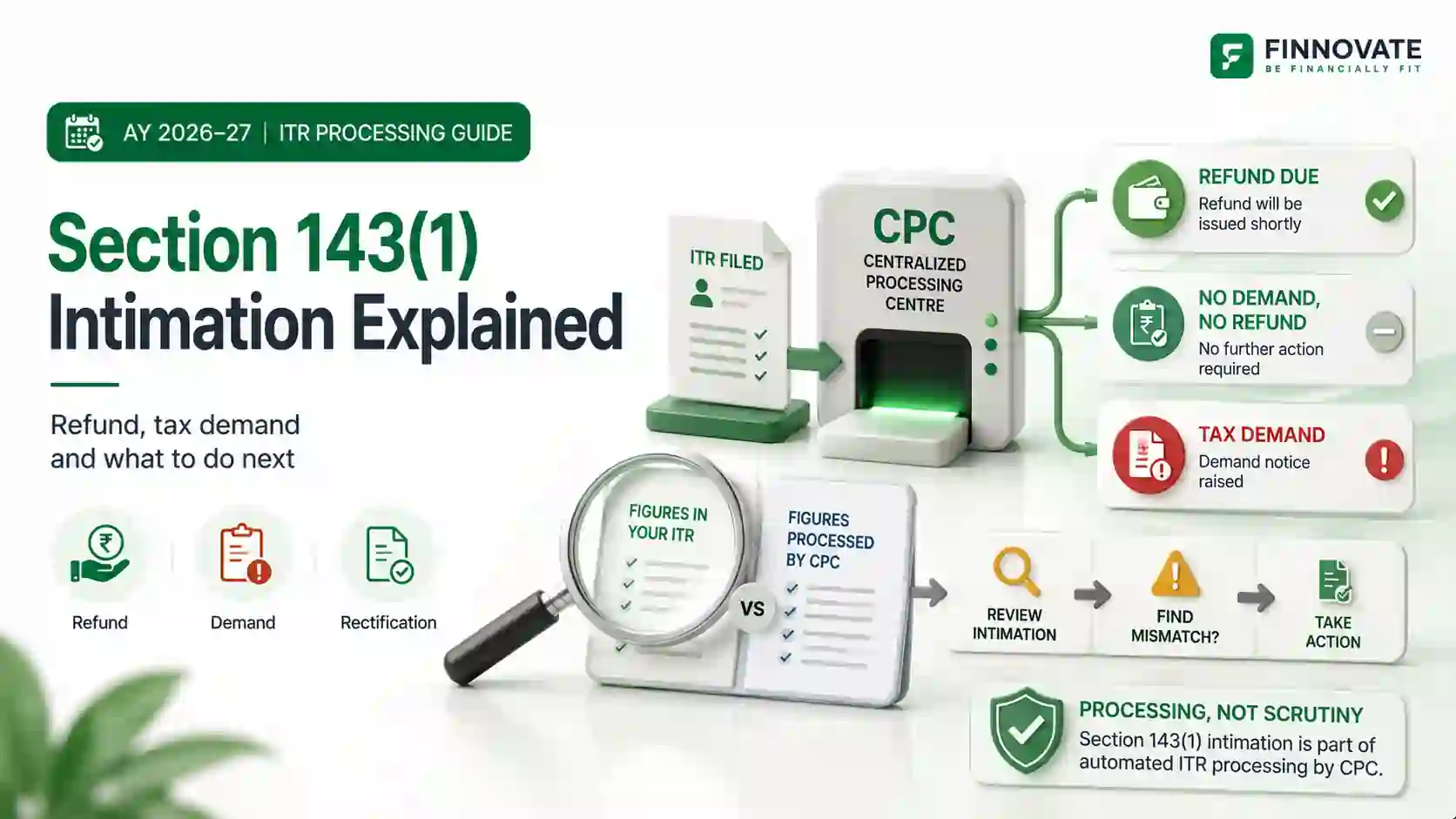
Received a Section 143(1) intimation? Understand CPC adjustments, refunds, tax demands, re...
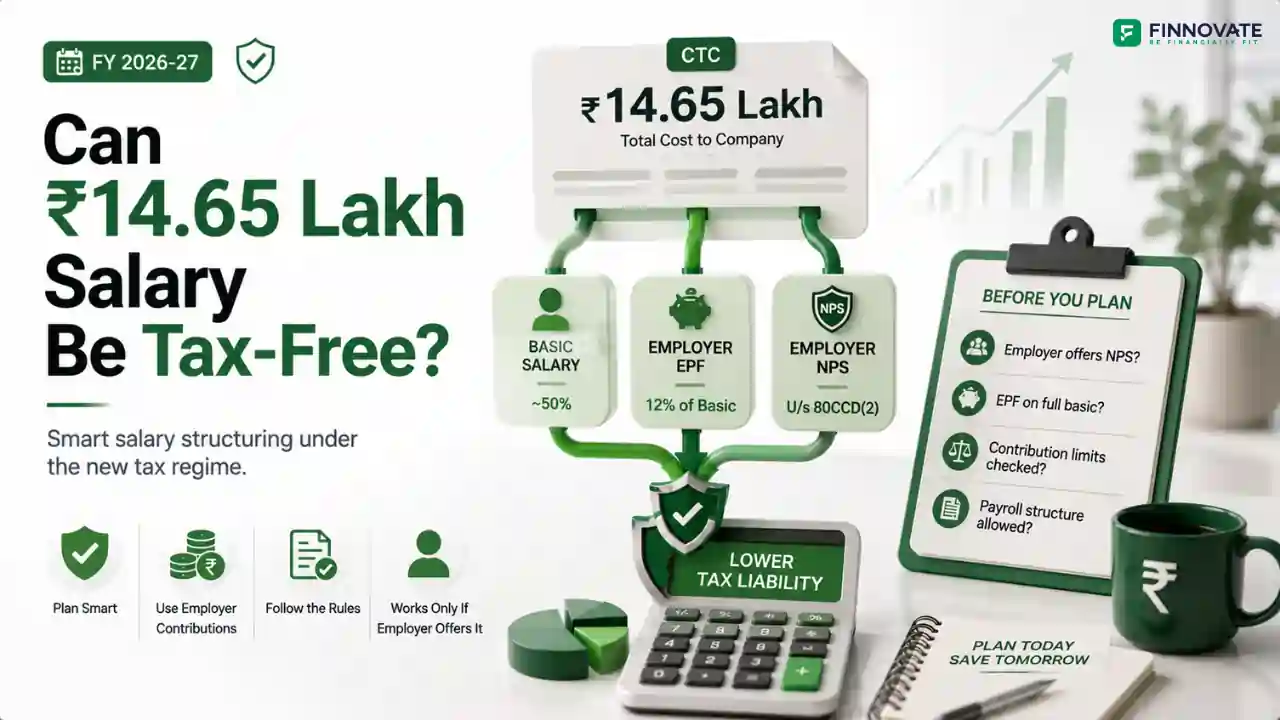
Zero tax on a ₹14.65 lakh salary is real, but only if your employer contributes EPF on f...
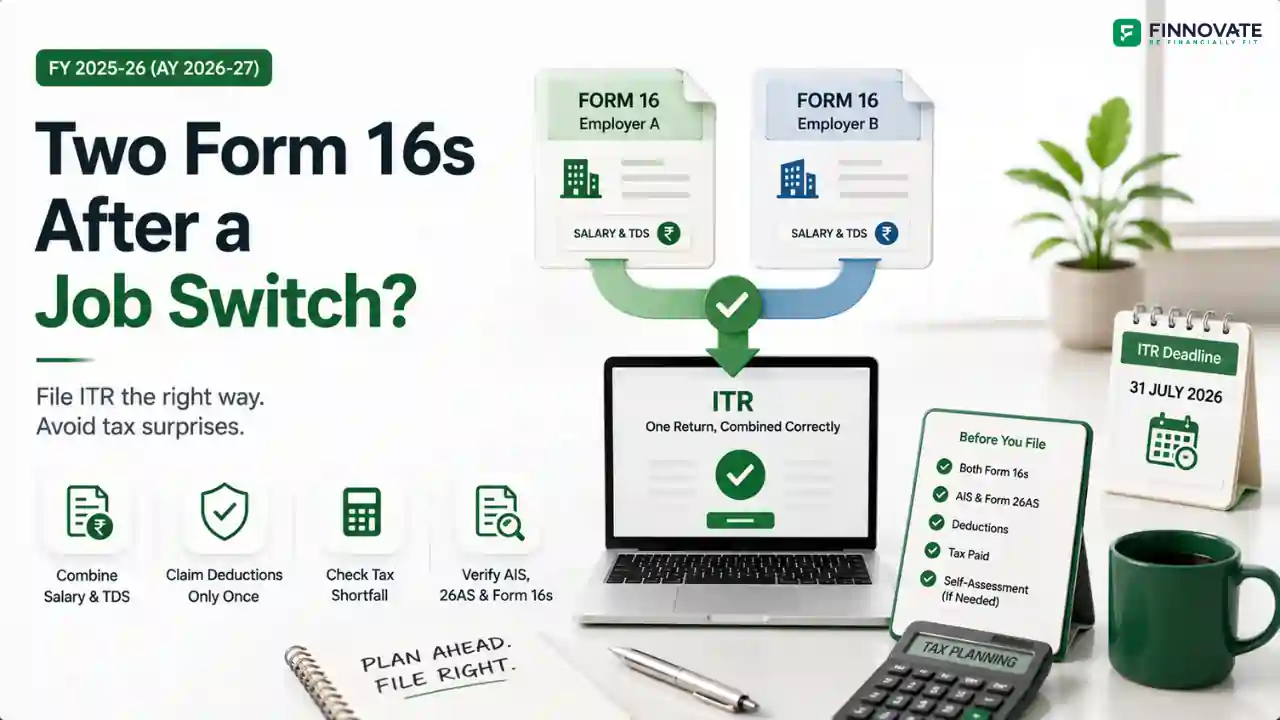
Changed jobs in FY 2025-26? See why combining two Form 16s can create a tax shortfall past...
Popular now

Learn how to easily download your NSDL CAS Statement in PDF format with our step-by-step g...

Looking for the best financial freedom books? Here’s a handpicked 2026 reading list with...

Learn what SIF investment means in India, SEBI rules, Rs 10 lakh minimum investment, avail...
Clear guide to mutual fund taxation in India for FY 2025–26 after July 2024 changes: equ...