

The Great Economic Decoupling of 2026: Oil, AI & India
Rising oil prices and booming AI investment are shaping an uneven global economy in 2026. ...
24 October 2026

Finnovate’s editorial team researches and creates financial content using trusted sources, regulatory references and inputs from subject experts.
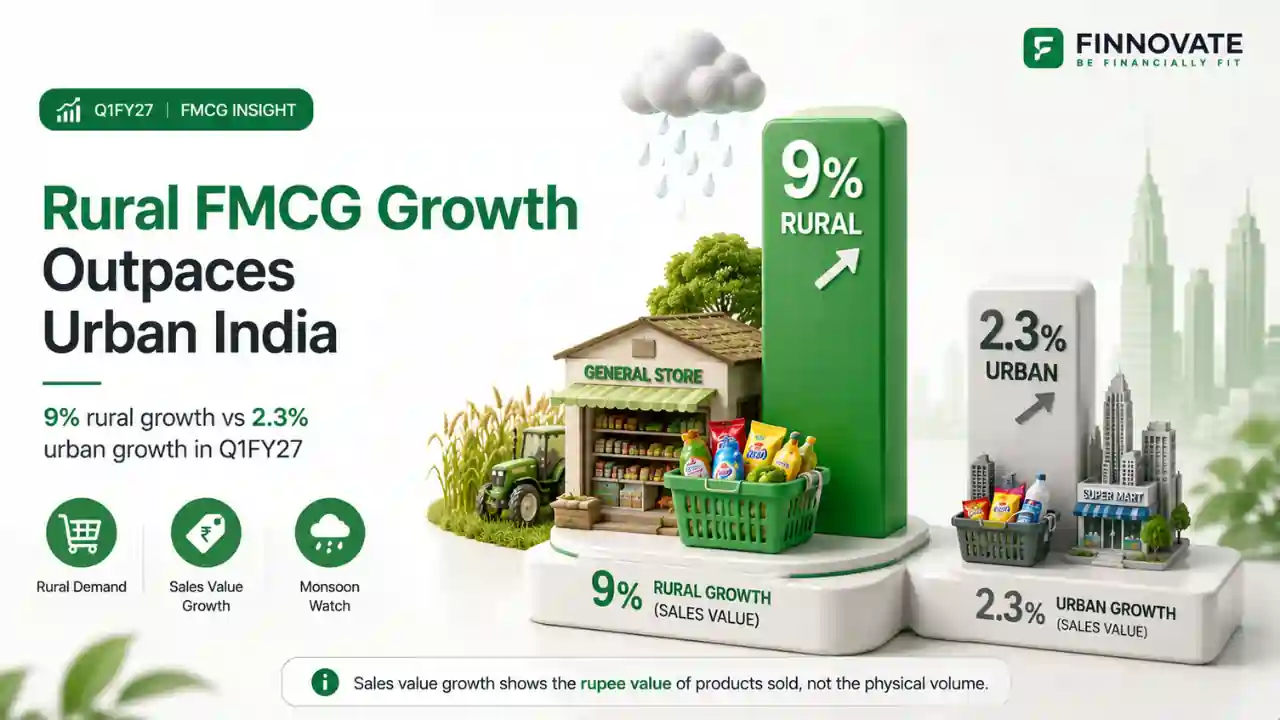
Rural India has emerged as the stronger part of the fast-moving consumer goods market at the start of FY27.
FMCG value growth in rural markets reached 9% during the April to June 2026 quarter, compared with only 2.3% in urban markets. Overall industry value growth stood at 6.8%, recovering from 3.6% in the preceding quarter but remaining below the 7.3% recorded a year earlier.
The contrast is striking. Rural markets have now recorded stronger FMCG value growth than urban markets in five of the past six quarters.
| Indicator | Q1FY27 | Q4FY26 | Q1FY26 |
|---|---|---|---|
| Overall FMCG value growth | 6.8% | 3.6% | 7.3% |
| Rural value growth | 9.0% | 5.0% | 7.0% |
| Urban value growth | 2.3% | 1.2% | 7.7% |
| Rural ahead of urban | Yes | Yes | No |
Bizom tracks FMCG sales value across more than eight million retail outlets. It does not report volume growth.
This distinction matters because sales value can rise for several reasons:
The 9% rural figure therefore shows that the rupee value of FMCG sales grew faster in rural markets. It does not reveal how much of that growth came from higher consumption and how much came from pricing or product mix.
This does not weaken the rural story. It makes the interpretation more precise.
No single data point can fully explain the rural and urban gap. However, three broader developments provide useful context.
The Household Consumption Expenditure Survey for 2023-24 estimated average monthly per-capita expenditure at ₹4,122 in rural India, up around 9% in nominal terms from the previous year. Urban expenditure increased by about 8% to ₹6,996.
The gap between urban and rural monthly expenditure also narrowed to around 70%, compared with nearly 84% in 2011-12.
FMCG companies can now reach rural consumers through a wider mix of traditional distributors, local retailers and digitally supported ordering systems.
India had approximately 546.6 million rural wireless subscribers at the end of March 2026, up from 538.6 million three months earlier.
FMCG companies frequently adjust pack sizes, bundles and price points when household budgets are under pressure.
This can protect sales value and market reach, although smaller packs may also signal affordability pressure rather than stronger household finances.
The Economic Survey 2025-26 cited a November 2025 NABARD survey in which 79.2% of rural households reported increased consumption over the previous year. The Survey linked this improvement partly to softer inflation and stronger purchasing power from rural non-farm income.
These indicators do not directly explain the Q1FY27 Bizom numbers, but they show that rural consumption entered the year with supportive momentum.
Urban FMCG value growth improved from 1.2% in the March quarter to 2.3% in Q1FY27, but it remained significantly below rural growth.
Bizom attributed the slower performance to pressure on discretionary spending, higher household expenses and cautious consumer sentiment in larger cities. Premium categories continued to support selected parts of the urban market, but broader consumption remained uneven.
Higher-income consumers may continue to spend on premium products, convenience and digital channels. At the same time, middle-income households facing higher housing, education, transport and food expenses may become more selective about routine purchases.
Urban weakness therefore does not mean that every category or consumer group is slowing. It suggests that growth is less broad-based.
Rural FMCG momentum entered Q1FY27 from a position of strength. The monsoon outlook makes the rest of the year less certain.
The southwest monsoon covered the entire country on 9 July 2026, only one day later than the normal date. But rainfall during the week from 9 to 15 July was 51% below normal across India.
Cumulative rainfall from 1 June to 15 July was 23% below the long-period average. IMD also reported that El Niño conditions were present and expected to strengthen during the southwest monsoon season.
The national average also hides regional differences. Seasonal rainfall was 36% below normal in east and northeast India, 26% below normal in the southern peninsula, 19% below normal in northwest India and 13% below normal in central India as of 15 July.
Government data as of 10 July 2026 showed that sowing remained below the corresponding 2025 level for several important crop groups.
| Crop group | Area in 2026 | Area in 2025 | Direction |
|---|---|---|---|
| Rice | 114.69 lakh hectares | 125.53 lakh hectares | Lower |
| Pulses | 56.63 lakh hectares | 73.85 lakh hectares | Lower |
| Oilseeds | 117.83 lakh hectares | 149.18 lakh hectares | Lower |
| Coarse cereals | Below the previous year | Higher than 2026 | Lower |
| Cotton | Below the previous year | Higher than 2026 | Lower |
| Sugarcane and jute | Modestly higher | Lower than 2026 | Higher |
This does not mean that the kharif season has failed. Sowing can recover if rainfall distribution improves. It does mean that the outlook cannot yet be described as secure.
Rural demand is not entirely dependent on crop income.
This gives the sector some resilience. But resilience is not immunity.
If weak rainfall reduces farm output, lifts food inflation or weakens rural wages, current sales-value momentum may slow. The impact may first appear through smaller packs, lower purchase frequency or a shift towards cheaper products.
| Indicator | Why it matters |
|---|---|
| Rainfall distribution | Regional rainfall matters more for crops than one national average. |
| Kharif sowing | Acreage provides an early signal of agricultural activity. |
| FMCG volume growth | Shows whether sales-value growth reflects higher quantities. |
| Food inflation | Influences the purchasing power of rural and urban households. |
| Small-pack sales | May indicate affordability pressure or wider market access. |
Volume growth will be especially important. If rural sales value remains strong while volumes weaken, pricing and pack mix may be doing more of the work. If both value and volume rise, the rural recovery would look more broad-based.
The Q1FY27 data confirms that rural markets are currently the stronger contributor to FMCG value growth.
The 9% rural growth figure is well ahead of the 2.3% recorded in urban markets. It also extends a pattern seen in five of the past six quarters.
However, the rural advantage is entering a more difficult phase. Rainfall was 23% below normal through 15 July, El Niño was strengthening and sowing of several important crops lagged the previous year.
The rural FMCG story is therefore strong but not settled.
The next few months will show whether the current value growth reflects a durable improvement in household consumption or whether weather, inflation and crop conditions begin to narrow the rural lead.
Rural households entered FY27 with improving consumption momentum, while FMCG distribution and connectivity have widened. Urban markets continue to face uneven discretionary spending and cautious household sentiment.
No. Bizom reports sales-value growth, not volume growth. The figure may reflect a combination of higher quantities, price changes, premiumisation and product mix.
The monsoon affects crop production, farm incomes, rural employment and food inflation. These factors influence how much rural households can spend and which pack sizes or brands they purchase.
It may remain resilient because rural income also comes from non-farm work, government support, construction, livestock and remittances. However, a prolonged rainfall deficit could weaken farm income and purchasing power.
Disclaimer: This article is for general information and educational purposes only. It does not constitute investment advice, a recommendation, or an offer to buy or sell any security or financial instrument. FMCG demand, agricultural output, rainfall, inflation and company performance are subject to change. Readers may consult a qualified financial professional before making any investment decision. Equity investments are subject to market risks.
No spam. Only new posts, simple explainers, and practical money checklists for busy professionals.
Finnovate is a SEBI-registered financial planning firm that helps professionals bring structure and purpose to their money. Over 3,500+ families have trusted our disciplined process to plan their goals - safely, surely, and swiftly.
Our team constantly tracks market trends, policy changes, and investment opportunities like the ones featured in this Weekly Capsule - to help you make informed, confident financial decisions.
Learn more about our approach and how we work with you:
No comments yet. Start the conversation. What would you add?
No spam. Only new posts, simple explainers, and practical money checklists.
You may also like
Rising oil prices and booming AI investment are shaping an uneven global economy in 2026. ...

Explore FPI equity flows for October First Half, 2026: ₹47,955 crore in net outflows, th...

Understand the India–Mauritius tax treaty’s Principal Purpose Test, its August 2026 ef...

Explore India’s AI hardware opportunity through the proposed Adani–Jabil venture, from...
Popular now

Learn how to easily download your NSDL CAS Statement in PDF format with our step-by-step g...

Looking for the best financial freedom books? Here’s a handpicked 2026 reading list with...
Learn what SIF investment means in India, SEBI rules, Rs 10 lakh minimum investment, avail...

Clear guide to mutual fund taxation in India for FY 2025–26 after July 2024 changes: equ...