

Tax Planning and Benefits for Married Couples in India: 2026 Guide
Tax planning for married couples in India explained for 2026. Compare tax regimes, deducti...
05 September 2026

Finnovate’s editorial team researches and creates financial content using trusted sources, regulatory references and inputs from subject experts.

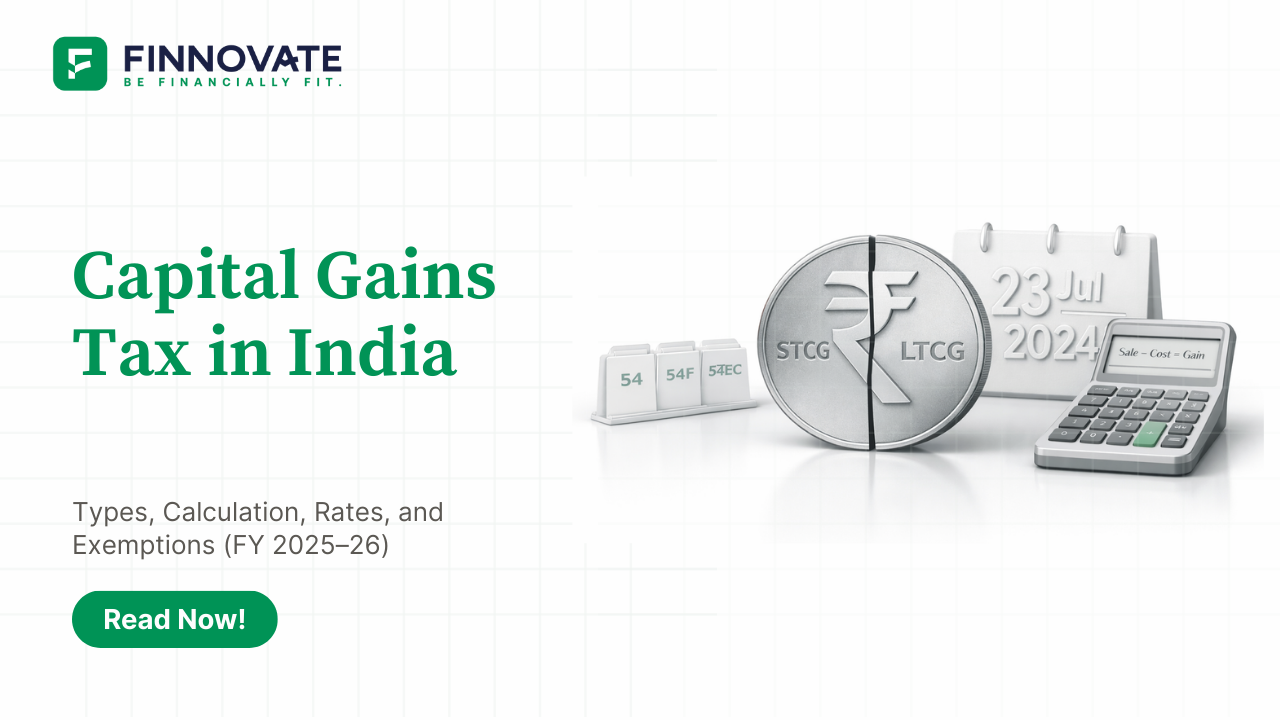
When you sell a capital asset at a profit, that profit is subject to capital gains tax. The rate you pay and how you calculate it depends on what you sold, how long you held it, and whether the sale happened before or after July 23, 2024. The Finance (No. 2) Act, 2024 made the most significant changes to capital gains taxation in years, and those changes now form the baseline for FY 2025-26.
This guide covers the current framework in full: what counts as a capital asset, how to calculate gains, the updated holding periods and tax rates, how to reduce tax liability through exemptions, and what changed with the July 2024 reforms.
Applicable for FY 2025-26 (AY 2026-27). Last reviewed against the Finance (No. 2) Act, 2024 and CBDT Notification No. 70/2025 (CII for FY 2025-26). Tax outcomes depend on facts, dates, and asset type. Consult a qualified Chartered Accountant for transaction-specific decisions.
Table of Contents
Capital gains tax applies when a capital asset is sold at a profit. Capital assets include property, shares, mutual fund units, gold, bonds, and intangible assets such as trademarks and patents.
Certain personal-use items are excluded from the definition of capital assets under the Income Tax Act. One commonly misunderstood exception applies to jewellery.
If a capital asset is sold below its purchase price, the result is a capital loss. These losses can reduce the overall capital gains liability, subject to specific set-off rules.
| Type of Loss | Can Be Set Off Against | Carry Forward Period |
|---|---|---|
| Short-term capital loss (STCL) | Both STCG and LTCG | Up to 8 assessment years |
| Long-term capital loss (LTCL) | LTCG only (cannot set off against STCG) | Up to 8 assessment years |
The basic formula applies to all capital assets:
Once the gain figure is established, classify it as STCG or LTCG based on the holding period, then apply the relevant tax rate.
Before July 2024, three holding period buckets applied depending on asset type: 12 months, 24 months, and 36 months. The Finance (No. 2) Act, 2024 simplified this to two buckets for most assets.
| Asset Type | Long-Term If Held For | Short-Term If Held For |
|---|---|---|
| Listed equity shares, equity-oriented mutual funds, units of business trusts (STT conditions apply) | More than 12 months | 12 months or less |
| Immovable property (land, building, house) | More than 24 months | 24 months or less |
| Gold, unlisted shares, and most other assets | More than 24 months | 24 months or less |
| Listed units of REITs and InvITs, effective July 23, 2024 | More than 12 months (reduced from 36 months) | 12 months or less |
The following rates apply to transfers made on or after July 23, 2024 for resident individuals and HUFs unless otherwise noted. All rates are before surcharge and cess.
| Type of Gain | Section | Tax Rate | Exemption Threshold |
|---|---|---|---|
| STCG on listed equity shares, equity MFs, business trust units (STT paid) | 111A | 20% | None |
| LTCG on listed equity shares, equity MFs, business trust units (STT paid) | 112A | 12.5% | First ₹1.25 lakh per financial year is exempt |
| LTCG on all other assets (property, gold, unlisted shares, bonds, etc.) | 112 | 12.5% without indexation | None (exemptions under 54/54F/54EC apply separately) |
| STCG on property, gold, and other non-equity assets | Slab rate | As per applicable income tax slab | None |
Indexation adjusts the cost of acquisition for inflation using the Cost Inflation Index (CII) published by CBDT annually. By increasing the effective cost, it reduces the taxable gain. Before July 23, 2024, long-term capital gains on most assets were eligible for indexation at a 20% rate. The Finance (No. 2) Act, 2024 removed indexation for most transfers, paired with the reduced 12.5% rate.
For immovable property acquired before July 23, 2024 and sold by a resident individual or HUF on or after that date, a choice is available between two options:
The taxpayer may choose whichever option results in a lower tax liability. The right option depends entirely on the specific numbers: the original purchase year, the current CII, the sale value, and the purchase price. The worked example in this article illustrates how to compare the two. The CII for FY 2025-26 is 376, as notified by CBDT via Notification No. 70/2025 dated July 1, 2025. CII values are available on the official Income Tax India portal (incometaxindia.gov.in).
Certain instruments lose the benefit of long-term capital gains treatment entirely, regardless of holding period.
Under Section 50AA, gains from the following are treated as short-term capital gains irrespective of how long they are held:
Even if these instruments are held for five or more years, gains are taxed at the applicable slab rate, not at the 12.5% LTCG rate.
The Income Tax Act provides reinvestment-based exemptions that allow reducing or deferring capital gains tax if specific conditions are met. The three most commonly used are Sections 54, 54F, and 54EC.
| Condition | Detail |
|---|---|
| Who can claim | Individuals and HUFs only |
| Asset sold | Long-term residential house property |
| New investment required | Purchase or construction of one residential house in India |
| Time limit for purchase | Within 1 year before or 2 years after the date of sale |
| Time limit for construction | Within 3 years from the date of sale |
| Exemption amount | Lower of: capital gains or cost of new property (capped at ₹10 crore) |
| Two-house option | Allowed once in a lifetime if LTCG does not exceed ₹2 crore |
| Lock-in | New property must not be sold within 3 years; exemption is withdrawn if sold earlier |
| Condition | Detail |
|---|---|
| Who can claim | Individuals and HUFs only |
| Asset sold | Any long-term capital asset except a residential house (shares, gold, land, etc.) |
| New investment required | Entire net sale consideration (not just the gain) invested in one residential house in India |
| Time limit for purchase | Within 1 year before or 2 years after the date of sale |
| Time limit for construction | Within 3 years from the date of sale |
| Exemption amount | Proportionate to reinvestment (full exemption only if entire sale proceeds reinvested), capped at ₹10 crore |
| Key condition | Taxpayer must not own more than one residential house on the date of sale (other than the new one being purchased) |
| Lock-in | New property must not be sold within 3 years; exemption is withdrawn if sold earlier |
| Condition | Detail |
|---|---|
| Who can claim | Any taxpayer (individuals, HUFs, companies, etc.) |
| Asset sold | Long-term land or building or both |
| New investment required | Specified bonds (NHAI or REC bonds) within 6 months from date of transfer |
| Maximum investment | ₹50 lakh per financial year across all eligible bond investments |
| Lock-in period | 5 years from date of investment |
| Exemption amount | Lower of: capital gains or amount invested in bonds |
Sections 54, 54F, and 54EC each have different eligibility rules, time limits, and reinvestment requirements. Our advisory team can help identify the right route before capital is committed.
Book a Tax Planning CallInvestment of ₹5,00,000 in an equity mutual fund, sold after 14 months for ₹7,50,000.
| Particulars | Amount |
|---|---|
| Sale value | ₹7,50,000 |
| Cost of acquisition | ₹5,00,000 |
| Total LTCG | ₹2,50,000 |
| Less: annual Section 112A exemption | ₹1,25,000 |
| Taxable LTCG | ₹1,25,000 |
| Tax at 12.5% | ₹15,625 (plus surcharge and cess if applicable) |
Plot of land (held more than 24 months) sold in FY 2025-26 for ₹90,00,000. Transfer expenses ₹2,00,000. Original purchase price ₹58,00,000.
| Particulars | Amount |
|---|---|
| Sale consideration | ₹90,00,000 |
| Less: transfer expenses | ₹2,00,000 |
| Less: cost of acquisition | ₹58,00,000 |
| LTCG (at 12.5%, without indexation) | ₹30,00,000 |
| Invested in Section 54EC bonds within 6 months | ₹30,00,000 |
| Taxable LTCG after exemption | Nil |
If only ₹20,00,000 were invested in bonds, the exemption would be limited to ₹20,00,000 and ₹10,00,000 would remain taxable at 12.5%.
In FY 2025-26:
| Transaction | Amount |
|---|---|
| STCG from equity sale (Section 111A) | ₹1,00,000 |
| LTCG from equity sale (Section 112A) | ₹2,00,000 |
| STCL from another equity sale | ₹70,000 |
The ₹70,000 STCL is first set off against the STCG of ₹1,00,000, leaving ₹30,000 net STCG. The LTCG of ₹2,00,000 is reduced by the ₹1,25,000 annual 112A exemption, leaving ₹75,000 taxable LTCG. Tax is then computed on ₹30,000 at 20% (Section 111A) and ₹75,000 at 12.5% (Section 112A).
House purchased in FY 2015-16 for ₹40,00,000, sold in FY 2025-26 for ₹90,00,000. As a resident individual selling property acquired before July 23, 2024, two options are available.
CII values used: FY 2015-16 = 254, FY 2025-26 = 376 (CBDT Notification No. 70/2025 dated July 1, 2025).
| Particulars | Option 1: 12.5% without indexation | Option 2: 20% with indexation |
|---|---|---|
| Sale consideration | ₹90,00,000 | ₹90,00,000 |
| Cost of acquisition | ₹40,00,000 | ₹40,00,000 × (376 ÷ 254) = ₹59,21,260 (indexed) |
| LTCG | ₹50,00,000 | ₹30,78,740 |
| Tax payable | ₹6,25,000 (at 12.5%) | ₹6,15,748 (at 20%) |
With the correct CII of 376 for FY 2025-26, Option 2 (20% with indexation) produces marginally lower tax in this scenario. The difference narrows or reverses depending on purchase year and CII ratio. For properties purchased much earlier, the indexed cost may be substantially higher, making Option 2 more compelling. For recently purchased properties, Option 1 is typically better. The right choice is always specific to the transaction.
Transfer expenses not included for simplicity. Consult a qualified Chartered Accountant for your specific computation.
Before October 1, 2024, share buybacks were taxed at the company level under Section 115QA. Shareholders received buyback proceeds effectively free of further tax at their end.
From October 1, 2024, this changed. Buyback proceeds are now taxed as dividend income in the hands of the shareholder at their applicable slab rate. The cost of acquisition of shares bought back is treated as a capital loss, which can be set off or carried forward under normal capital loss rules.
Section 87A provides a tax rebate for resident individuals whose total income does not exceed specified thresholds. For FY 2025-26, the rebate is up to ₹12,500 under the old regime (income up to ₹5 lakh) or up to ₹60,000 under the new regime (income up to ₹12 lakh).
Capital gains taxed at special rates under Sections 111A, 112A, and 112 are specifically excluded from the Section 87A rebate. This means:
Accurate documentation makes filing clean and protects against scrutiny. The following are relevant for common capital gains situations:
No. The 12.5% rate applies to LTCG under Sections 112A and 112. STCG on listed equity and equity mutual funds is 20% under Section 111A. STCG on property, gold, and other non-equity assets is taxed at the applicable slab rate. The correct rate depends on asset type and holding period.
Yes, but only for resident individuals and HUFs selling immovable property acquired before July 23, 2024. The choice is between 12.5% without indexation or 20% with indexation using the applicable CII values. The CII for FY 2025-26 is 376, notified by CBDT via Notification No. 70/2025. For property acquired on or after July 23, 2024 and for all other assets, indexation is not available.
No. The ₹1.25 lakh annual exemption applies only to LTCG under Section 112A, covering listed equity shares, equity-oriented mutual funds, and business trust units where STT is paid. It does not apply to property, gold, debt funds, or other asset classes.
No. Capital losses can only be set off against capital gains. Short-term capital losses can be set off against both STCG and LTCG. Long-term capital losses can only be set off against LTCG. Neither type can be adjusted against salary, business income, or other income heads.
From AY 2024-25 onwards, the maximum exemption under both Section 54 and Section 54F is capped at ₹10 crore. Capital gains reinvested beyond this amount do not qualify for exemption under these sections, regardless of the reinvestment amount.
No. Debt-oriented mutual funds with 35% or less equity exposure acquired on or after April 1, 2023 are covered by Section 50AA and taxed at slab rate irrespective of holding period. The 12.5% LTCG treatment does not apply regardless of how long the units are held.
From October 1, 2024, buyback proceeds are taxed as dividend income in the hands of the shareholder at the applicable slab rate. The cost of shares bought back is treated as a capital loss. Buyback income is reported under Income from Other Sources, not under capital gains.
No. Capital gains taxed at special rates under Sections 111A, 112A, and 112 are excluded from the Section 87A rebate for FY 2025-26. Even if total income falls below the rebate threshold, capital gains tax at the applicable special rate remains payable. Please consult a SEBI-registered investment adviser or qualified tax professional if you are unsure how this applies to your specific situation.
Up to 8 assessment years, provided the income tax return for the year in which the loss was incurred was filed on time. A late-filed return forfeits the right to carry forward capital losses for that year.
Where the reinvestment required for Sections 54 or 54F cannot be completed before the ITR filing due date, the unspent capital gains may be deposited in a CGAS account with a notified PSU bank. This preserves exemption eligibility while the purchase or construction is completed within the prescribed time limits. Unutilised CGAS deposits at the end of the time limit are treated as taxable LTCG in that year.
Broadly similar rates apply to NRIs for Indian assets, but with important differences. TDS is deducted at source on capital gains arising to NRIs, with the buyer required to deduct before payment. NRIs cannot offset the basic exemption limit against special-rate capital gains under Sections 111A or 112A, unlike resident individuals who can use the unexhausted basic exemption against such gains in some cases. The applicable Double Taxation Avoidance Agreement (DTAA) between India and the NRI's country of residence may modify the effective rate. NRIs should assess their position under the relevant DTAA before any significant capital asset disposal.
Disclaimer: This article is for general information and educational purposes only. It does not constitute investment advice, a recommendation, or an offer to buy or sell any securities or financial instruments. Capital gains tax rates, holding periods, CII values, and exemption conditions referenced here are based on the Finance (No. 2) Act, 2024, CBDT Notification No. 70/2025, and publicly available Income Tax Department guidance applicable for FY 2025-26 (AY 2026-27). Rules may change in subsequent budgets or notifications. Past market behaviour is not indicative of future outcomes. Please consult a SEBI-registered investment adviser or qualified Chartered Accountant before making any tax filing or investment decision.
No spam. Only new posts, simple explainers, and practical money checklists for busy professionals.
Finnovate is a SEBI-registered financial planning firm that helps professionals bring structure and purpose to their money. Over 3,500+ families have trusted our disciplined process to plan their goals - safely, surely, and swiftly.
Our team constantly tracks market trends, policy changes, and investment opportunities like the ones featured in this Weekly Capsule - to help you make informed, confident financial decisions.
Learn more about our approach and how we work with you:
No comments yet. Start the conversation. What would you add?
No spam. Only new posts, simple explainers, and practical money checklists.
You may also like
Tax planning for married couples in India explained for 2026. Compare tax regimes, deducti...
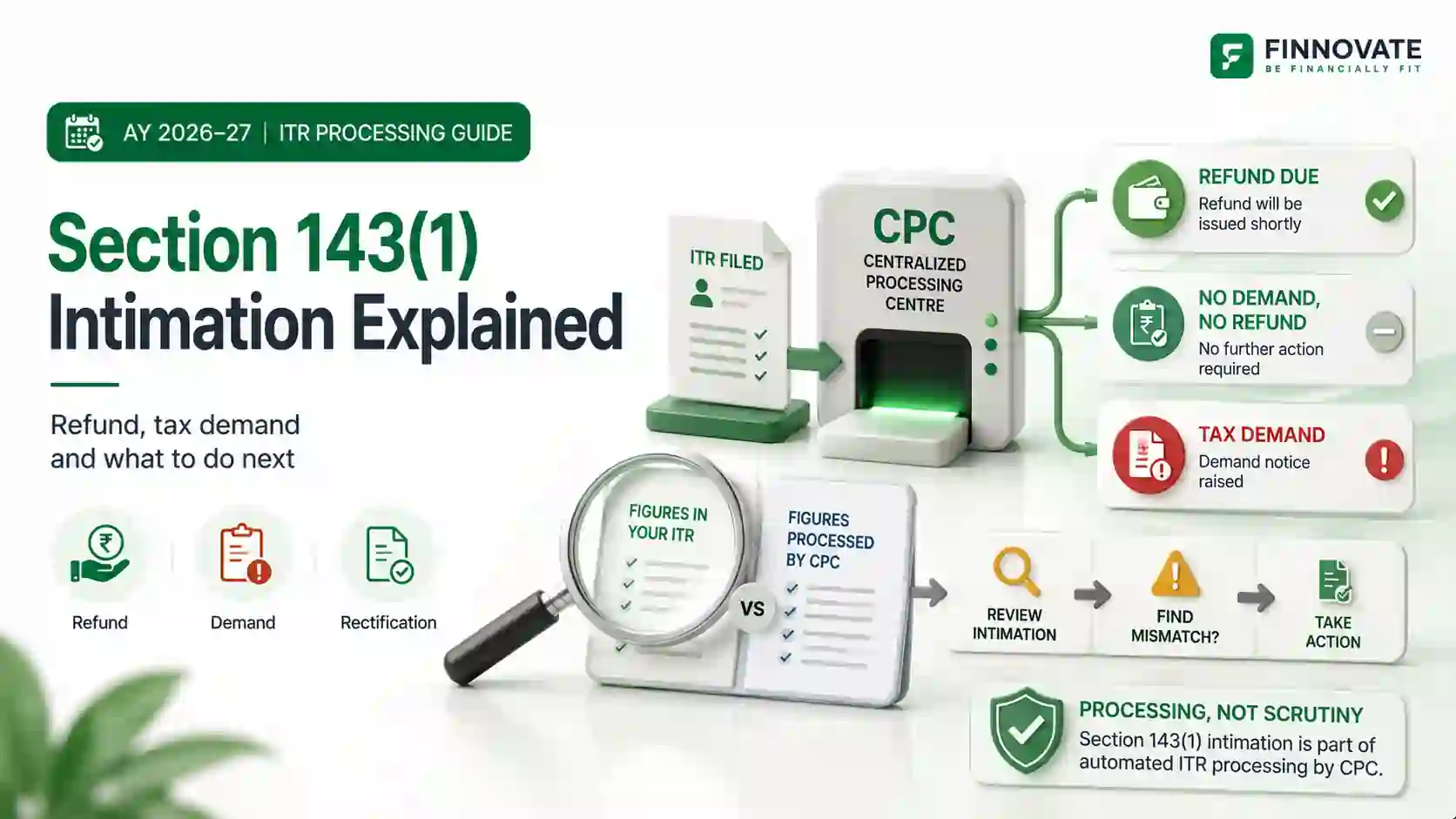
Received a Section 143(1) intimation? Understand CPC adjustments, refunds, tax demands, re...
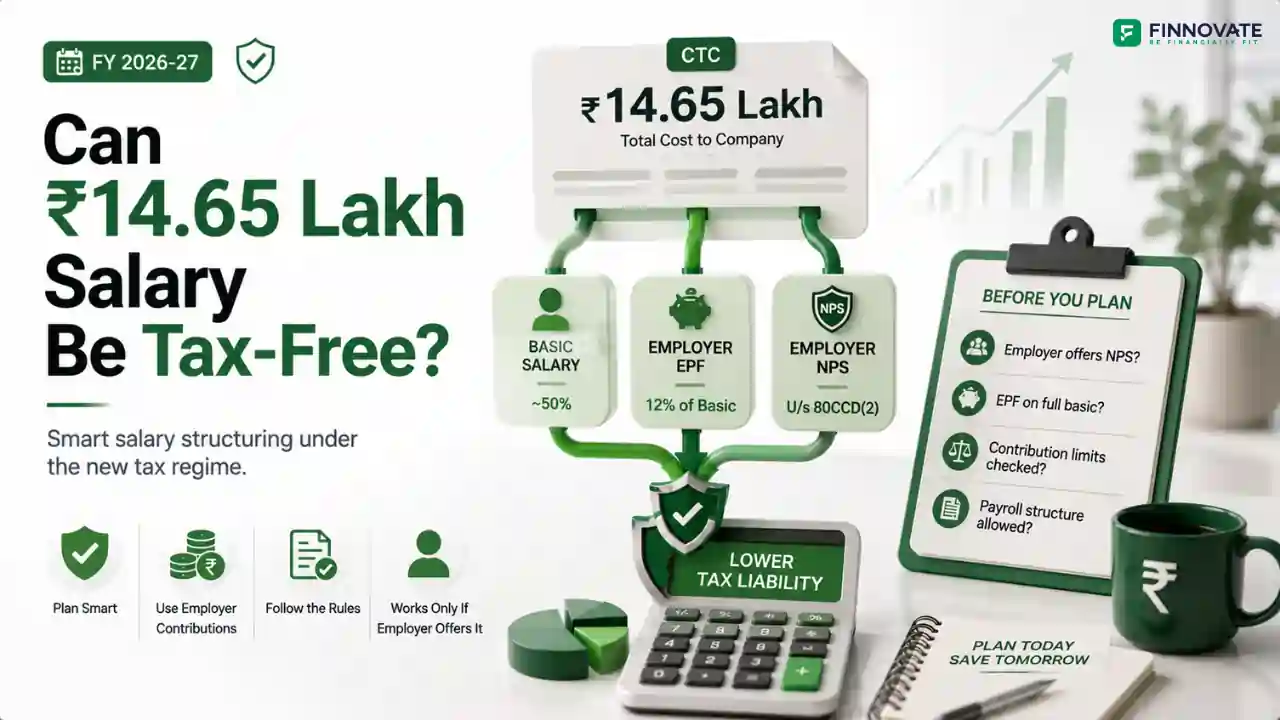
Zero tax on a ₹14.65 lakh salary is real, but only if your employer contributes EPF on f...

Changed jobs in FY 2025-26? See why combining two Form 16s can create a tax shortfall past...
Popular now

Learn how to easily download your NSDL CAS Statement in PDF format with our step-by-step g...

Looking for the best financial freedom books? Here’s a handpicked 2026 reading list with...
Learn what SIF investment means in India, SEBI rules, Rs 10 lakh minimum investment, avail...
Clear guide to mutual fund taxation in India for FY 2025–26 after July 2024 changes: equ...