

The Great Economic Decoupling of 2026: Oil, AI & India
Rising oil prices and booming AI investment are shaping an uneven global economy in 2026. ...
24 October 2026

Finnovate’s editorial team researches and creates financial content using trusted sources, regulatory references and inputs from subject experts.
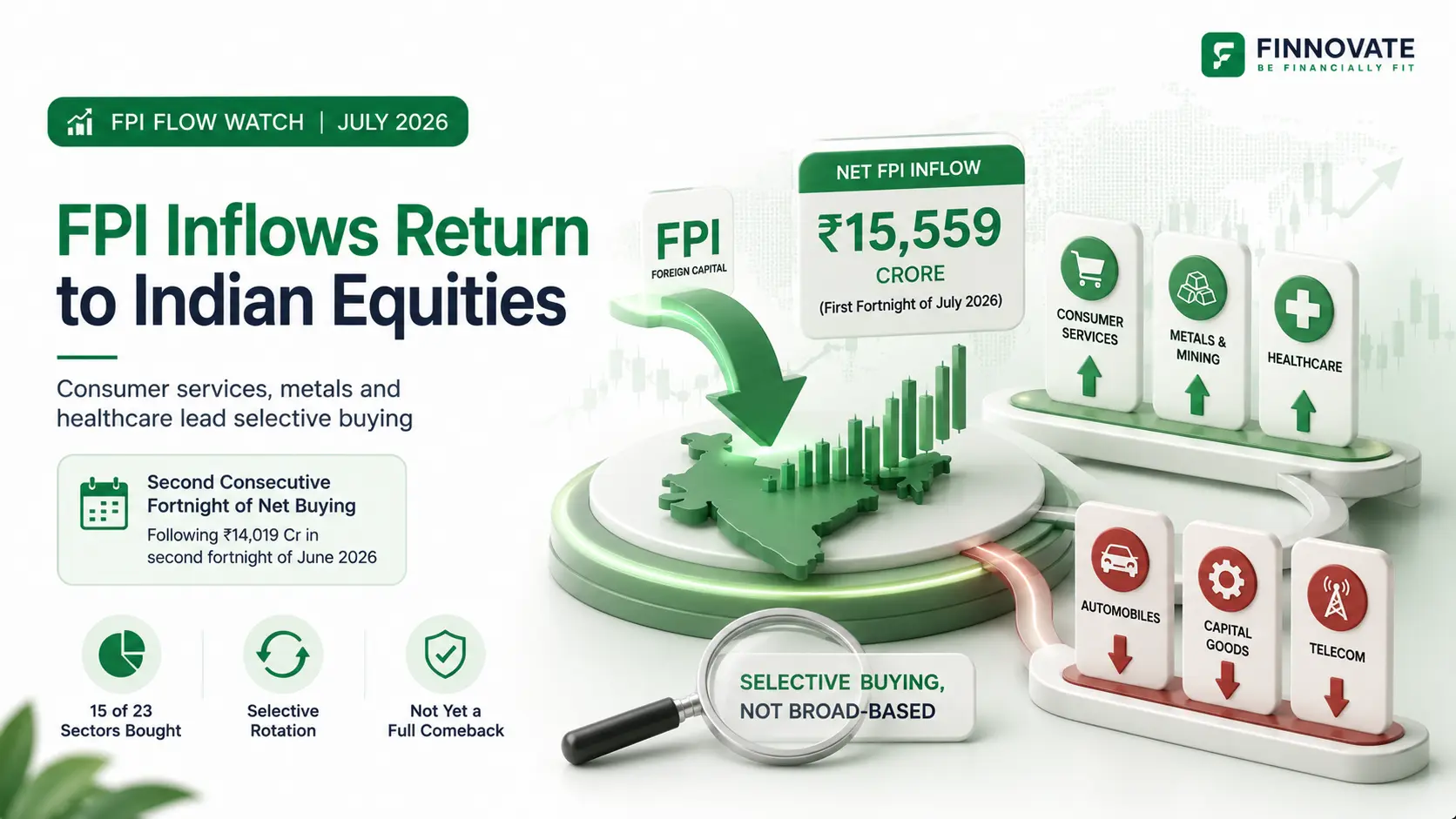
Foreign portfolio investors invested approximately ₹15,559 crore, or $1.62 billion, in Indian equities during the first fortnight of July 2026. Consumer services, metals and mining, and healthcare attracted the largest inflows, while automobiles, capital goods and telecommunications continued to see selling.
The positive flow was not an isolated reversal. FPIs had already invested around ₹14,019 crore during the second fortnight of June, making the first fortnight of July the second consecutive fortnight of net buying and the strongest fortnightly inflow since early February.
The shift is meaningful after the sharp selling recorded during the first fortnight of June. However, the sectoral pattern suggests that foreign investors are selectively rebuilding exposure rather than turning broadly bullish on India.
The change across the last three fortnights has been significant.
| Period | Net FPI equity flow | Direction |
|---|---|---|
| First fortnight of June 2026 | Approximately -$6.70 billion | Heavy selling |
| Second fortnight of June 2026 | Approximately ₹14,019 crore | Net buying |
| First fortnight of July 2026 | Approximately ₹15,559 crore | Net buying |
The first fortnight of June had seen selling across 19 sectors, with financial services and oil and gas bearing a large part of the outflow. During the second fortnight, foreign investors returned to banking and other large-cap stocks, supported by more attractive valuations and expectations of stable earnings.
Our earlier analysis of the sharp FPI selling recorded in the first fortnight of June examined how oil prices, currency pressure and global uncertainty had accelerated the withdrawal.
The buying recorded during the first fortnight of July shows that indiscriminate selling has eased. It does not yet reverse the larger withdrawal recorded during 2026.
According to the NSDL sectoral classification, 15 of the 23 listed sectors recorded net buying during the fortnight.
| Sector | Net FPI flow |
|---|---|
| Consumer services | $765 million |
| Metals and mining | $623 million |
| Healthcare | $426 million |
| Services | $250 million |
| Consumer durables | $248 million |
| Realty | $215 million |
| Financial services | $206 million |
| Construction materials | $163 million |
| Others | $146 million |
| Construction | $42 million |
| Oil, gas and consumable fuels | $27 million |
| Textiles | $26 million |
| Utilities | $12 million |
| Information technology | $6 million |
| Diversified | $3 million |
| Forest materials | -$1 million |
| Chemicals | -$12 million |
| Media and entertainment | -$30 million |
| FMCG | -$115 million |
| Power | -$132 million |
| Telecommunications | -$255 million |
| Capital goods | -$276 million |
| Automobiles and components | -$721 million |
| Total | $1.62 billion |
The distribution of flows matters as much as the headline total. Buying was concentrated in a few sectors, while several established domestic-growth themes did not participate fully.
Consumer services attracted approximately $765 million, or ₹7,361 crore, making it the largest recipient of FPI capital during the first fortnight of July. Metals and mining followed with ₹5,993 crore, while healthcare received ₹4,101 crore.
Consumer services includes a mix of consumer-facing digital platforms, travel, hospitality and related service businesses. The inflows may reflect renewed interest in businesses linked to formalisation, online consumption and discretionary services.
However, sectoral data does not reveal which individual companies received the investment. The flow should therefore be viewed as a broad sector preference rather than evidence of buying in every new-age or e-commerce stock.
Metals and mining moved from net selling during the previous fortnight to approximately $623 million of buying during the first fortnight of July.
The change coincided with stronger commodity prices and renewed policy attention around mining, strategic minerals and domestic resource security. Valuations and short covering may also have contributed to the reversal.
The important observation is the scale of the change. Metals moved from being a source of foreign selling to the second-largest recipient of FPI capital within one fortnight.
This also shows why short-period sectoral flows can change quickly with commodity prices, global risk appetite and positioning.
Healthcare received approximately $426 million of net buying.
The sector can attract foreign investors during uncertain markets because demand for medicines and healthcare services is generally less sensitive to the economic cycle. At the same time, Indian pharmaceutical companies have opportunities in generics, complex formulations, biosimilars and global product launches.
This combination gives healthcare both defensive characteristics and long-term growth potential.
The buying also came as global investors reassessed the concentration of capital in a relatively small group of AI-linked technology companies. India's healthcare, consumption, financial and industrial sectors offer a different earnings mix from technology-heavy Asian markets.
Consumer durables attracted approximately $248 million, financial services received $206 million and realty recorded $215 million of inflows.
Consumer durables should not be grouped with healthcare as a defensive sector. It is more closely connected to household income, discretionary spending, credit availability and premiumisation.
Financials and realty may have benefited from expectations that domestic interest rates would remain broadly stable. Lower or stable borrowing costs can support housing affordability, credit demand and the valuation of rate-sensitive businesses.
However, the buying remained moderate compared with the large inflow into financial stocks during the second fortnight of June. This suggests that FPIs were adding exposure without repeating the same concentrated banking trade.
Automobiles and components recorded approximately $721 million of net selling, the largest outflow among all sectors.
Fortnightly flow data cannot establish one definitive reason for the selling. Possible factors include:
The selling should not automatically be attributed to weak rural demand. Recent consumption indicators have shown rural demand outperforming urban demand in several categories.
The auto outflow is better viewed as evidence that foreign investors remained valuation-conscious even while returning to Indian equities.
Capital goods, power and telecommunications recorded combined selling of approximately $663 million.
This does not necessarily indicate that India's infrastructure or capital-expenditure cycle has weakened. Foreign investors can reduce sector exposure because of valuations, profit-taking or portfolio limits even when the underlying industry remains active.
The flow pattern instead suggests that the rebound during the first fortnight of July was not broad enough to include every domestic investment theme.
FPIs were willing to buy consumer services, commodities, healthcare and selected rate-sensitive sectors, but they were not yet rebuilding positions across the entire market.
Since late 2024, India has competed for foreign capital with technology-heavy Asian markets such as Taiwan and South Korea. These markets benefited from strong investor demand for semiconductors and artificial-intelligence infrastructure.
By mid-2026, concerns around high valuations, concentrated positioning and the returns generated on large AI investments had started to affect those trades. Published market commentary linked part of India's first-fortnight July inflow to diversification away from crowded technology positions.
India offers a different sector mix:
This can make India relatively attractive when global investors want to reduce dependence on a narrow technology theme.
The change should not be interpreted as a permanent exit from AI-linked markets. It may instead represent tactical diversification after a period of unusually concentrated capital flows.
Despite two consecutive positive fortnights, FPIs remained major net sellers of Indian equities during 2026. By July 20, cumulative equity selling for the year was approximately $28 billion. The buying recorded during the first fortnight of July had recovered only a small part of that withdrawal.
The inflows also remained concentrated. Consumer services, metals and healthcare together accounted for a large share of the total, while automobiles, capital goods, telecom, power and FMCG continued to see selling.
A durable return would require:
The selective FPI return seen in February 2026 also showed that one strong period of buying does not necessarily establish a lasting trend.
The second fortnight of July and the following quarter will show whether foreign buying is becoming more durable.
The most important indicators are:
Assets under custody can provide additional context, but changes in AUC reflect market prices and currency movements as well as fresh flows. A higher AUC figure does not, by itself, prove stronger investor conviction.
The first fortnight of July marked a second consecutive fortnight of FPI buying and a meaningful improvement from the heavy selling recorded during the first fortnight of June.
Consumer services, metals and healthcare led the return, while autos, capital goods and telecom remained under pressure. This is consistent with tactical sector rotation and reduced pessimism rather than a broad bullish position on India.
FPIs are no longer selling Indian equities indiscriminately. They are still choosing sectors carefully.
A lasting return of foreign capital will depend not only on one fortnight's inflow, but on whether earnings, valuations, oil prices and the rupee allow that selective interest to expand across the market.
FPIs invested approximately ₹15,559 crore, or $1.62 billion, during the first fortnight of July 2026.
Consumer services led with approximately $765 million, followed by metals and mining at $623 million and healthcare at $426 million.
Automobiles and components recorded the largest outflow at approximately $721 million.
No. FPIs had already turned net buyers during the second fortnight of June, when they invested approximately ₹14,019 crore. The first fortnight of July extended that positive trend.
The data indicates improved sentiment and selective buying. However, FPIs remained substantial net sellers for 2026, and several major sectors continued to see outflows.
Sectoral flows show where foreign investors are increasing or reducing exposure. They can provide insight into relative preferences, although they do not reveal the exact stocks purchased or the motives of every investor.
Disclaimer: This article is for general information and educational purposes only. It does not constitute investment advice, a recommendation, or an offer to buy or sell any securities or financial instruments. FPI flow data is sourced from NSDL sectoral investment data for the first fortnight of July 2026. Past FPI flow patterns are not indicative of future flows or market performance. Please consult a SEBI-registered investment adviser before making any investment decision.
No spam. Only new posts, simple explainers, and practical money checklists for busy professionals.
Finnovate is a SEBI-registered financial planning firm that helps professionals bring structure and purpose to their money. Over 3,500+ families have trusted our disciplined process to plan their goals - safely, surely, and swiftly.
Our team constantly tracks market trends, policy changes, and investment opportunities like the ones featured in this Weekly Capsule - to help you make informed, confident financial decisions.
Learn more about our approach and how we work with you:
No comments yet. Start the conversation. What would you add?
No spam. Only new posts, simple explainers, and practical money checklists.
You may also like
Rising oil prices and booming AI investment are shaping an uneven global economy in 2026. ...
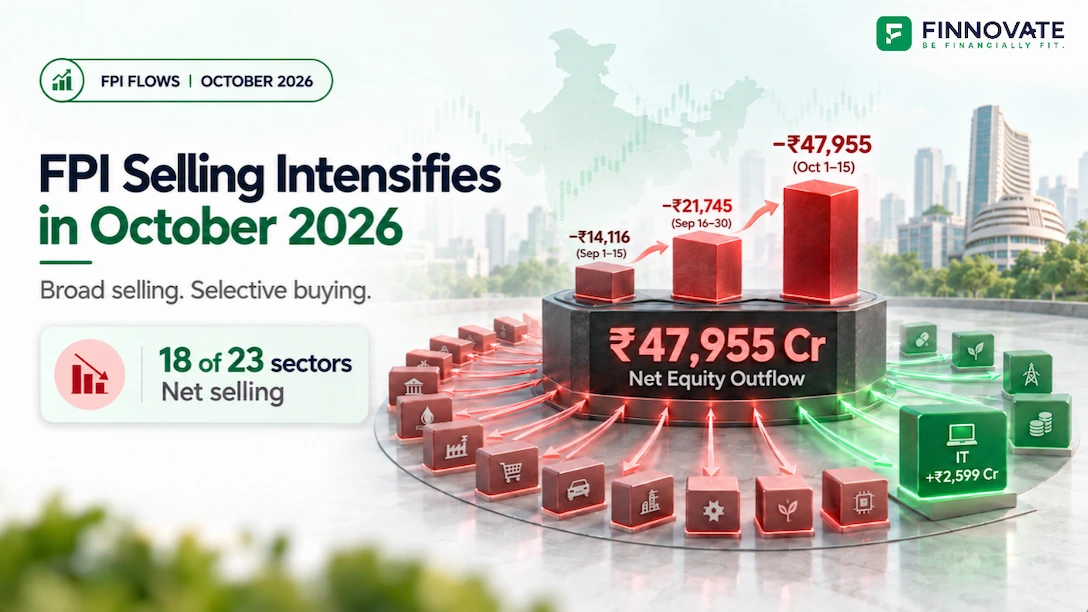
Explore FPI equity flows for October First Half, 2026: ₹47,955 crore in net outflows, th...
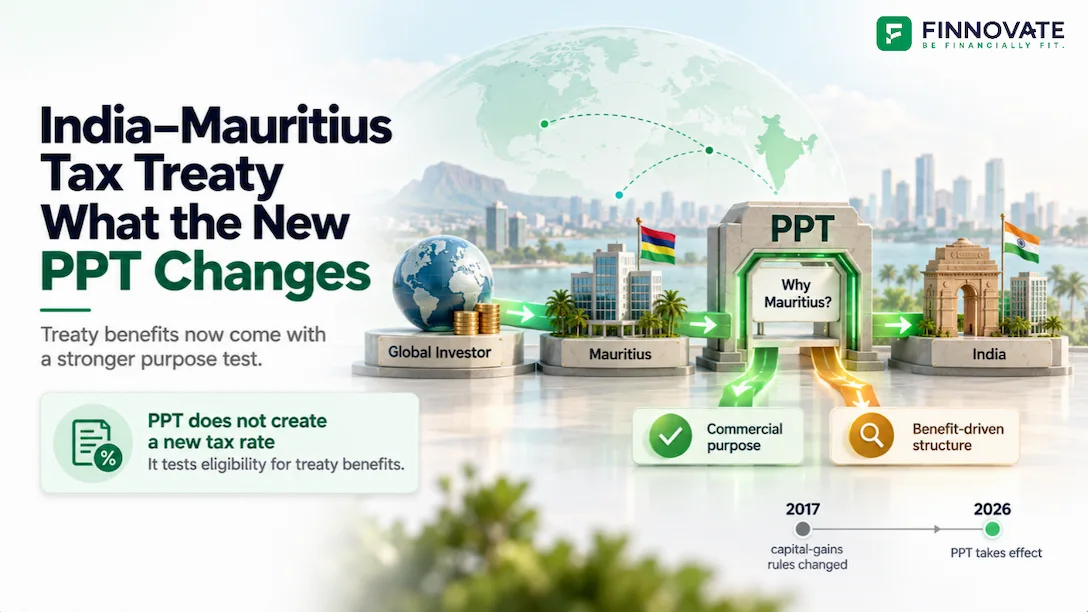
Understand the India–Mauritius tax treaty’s Principal Purpose Test, its August 2026 ef...

Explore India’s AI hardware opportunity through the proposed Adani–Jabil venture, from...
Popular now

Learn how to easily download your NSDL CAS Statement in PDF format with our step-by-step g...

Looking for the best financial freedom books? Here’s a handpicked 2026 reading list with...

Learn what SIF investment means in India, SEBI rules, Rs 10 lakh minimum investment, avail...

Clear guide to mutual fund taxation in India for FY 2025–26 after July 2024 changes: equ...