

Shiller CAPE Ratio Above 40: Is the US Stock Market Overvalued?
The Shiller CAPE ratio is near its 1999 peak. Explore what it means for US stock valuation...
09 October 2026

Finnovate’s editorial team researches and creates financial content using trusted sources, regulatory references and inputs from subject experts.
India has received an extraordinary amount of foreign currency over the past few months.
By August 21, 2026, the Reserve Bank of India’s special forex swap facility had attracted about $72.85 billion through FCNR(B) deposits, overseas foreign-currency borrowings and external commercial borrowings. Almost $65.4 billion of that came through FCNR(B) deposits alone.
India’s foreign-exchange reserves have also climbed sharply, reaching about $716.9 billion as of August 14.
Foreign portfolio investors have returned to Indian equities too.
Yet the rupee is still hovering around ₹95.7 to ₹96 per US dollar.
So where did all those dollars go?
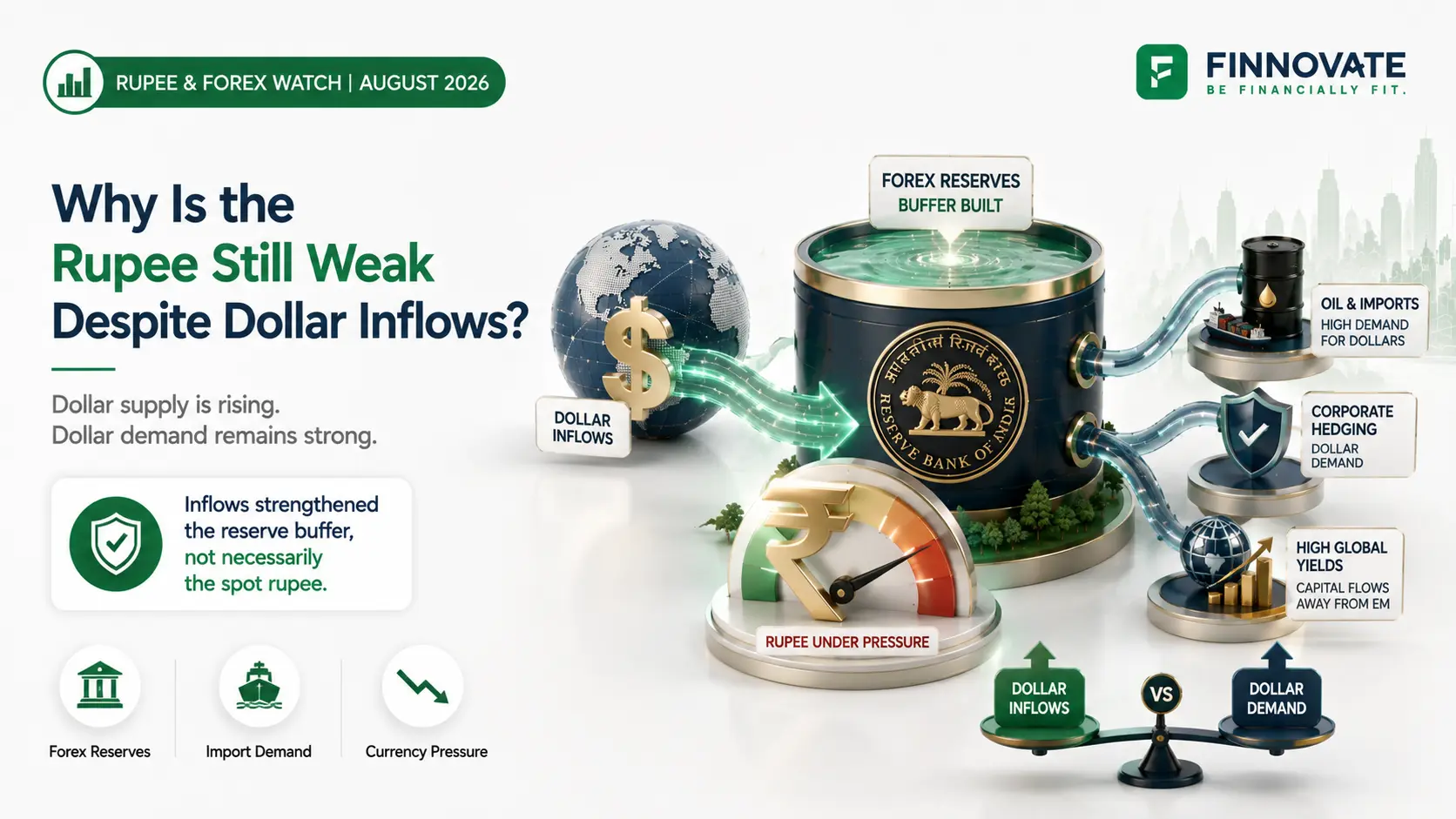
A large share of the foreign-currency inflows has strengthened the RBI’s reserve buffer, while oil imports, the trade deficit, corporate hedging and high global yields continue creating demand for dollars.
Table of Contents
| Indicator | Latest Position |
|---|---|
| USD/INR | Around ₹95.7-₹96 |
| Forex inflows under RBI swap facility | $72.85 billion |
| FCNR(B) contribution | $65.40 billion |
| Forex reserves | $716.9 billion |
| Apr-Jul merchandise trade deficit | $118.60 billion |
| July merchandise trade deficit | $31.98 billion |
| Dollar Index | Around 99 |
At first glance, these numbers look difficult to reconcile.
India has attracted large foreign-currency inflows, rebuilt its reserves and seen foreign investors return to stocks.
Yet the rupee remains under pressure.
The RBI introduced a special USD-INR forex swap facility covering fresh eligible foreign-currency mobilisation through FCNR(B) deposits, External Commercial Borrowings and Overseas Foreign Currency Borrowings.
| Source | Dollar Inflows |
|---|---|
| FCNR(B) deposits | $65.40bn |
| Overseas foreign-currency borrowings | $4.86bn |
| External commercial borrowings | $2.59bn |
| Total | $72.85bn |
Banks raising eligible foreign currency can swap those dollars with the RBI.
This means a large part of the dollar inflow does not remain as additional dollar supply in the open forex market. Instead, it moves onto the RBI’s balance sheet.
India’s foreign-exchange reserves reached approximately $716.9 billion as of August 14, a six-month high.
More importantly, the reserve pile had increased by almost $50 billion in seven weeks.
The objective is not necessarily to push USD/INR sharply lower. Part of the purpose is to build a larger foreign-currency buffer that the RBI can use when market conditions become difficult.
While billions of dollars are flowing into the financial system, Indian businesses are simultaneously buying billions of dollars to pay for imports.
| Merchandise Trade | Apr-Jul 2026 |
|---|---|
| Exports | $173.78bn |
| Imports | $292.38bn |
| Trade deficit | $118.60bn |
The deficit had been $96.66 billion during the same period a year earlier, meaning India’s merchandise trade deficit widened by roughly 23%.
July alone produced a merchandise deficit of approximately $31.98 billion.
Exports: $30.17bn
Imports: $78.92bn
Gap: ~$48.75bn
Exports: $21.11bn
Imports: $52.82bn
Gap: ~$31.71bn
Combined, the reported petroleum and electronics categories show a gap of roughly $80 billion.
This should not be directly subtracted from the RBI’s $72.85 billion of financial inflows. Trade flows and capital flows are different parts of the balance of payments.
Brent crude has recently traded above $90 per barrel amid continuing geopolitical uncertainty.
India imports more than 85% of the oil it consumes. When crude prices rise, Indian refiners need more dollars to pay suppliers abroad.
Indian companies also require dollars for imports, overseas borrowings, debt repayments, derivatives and hedging future foreign-currency liabilities.
Corporate hedging demand has remained strong.
The US 30-year Treasury yield recently reached around 5.34%, its highest level since 2007. The 10-year yield has also traded around 4.7%.
If investors can earn high yields on US government bonds, the hurdle rate for investing in emerging markets becomes higher.
Rising US debt, inflation concerns, heavy Treasury issuance and geopolitical risks have all contributed to pressure on long-term US yields.
US government debt has now crossed $40 trillion.
The US Dollar Index has recently been around 99.
That is below 100 and hardly represents a runaway dollar rally.
This also explains why some other currencies can strengthen against the dollar while INR remains stuck near ₹96.
Foreign portfolio flows have improved meaningfully, with overseas investors buying more than $2.5 billion of Indian equities in August by August 25 after approximately $2.1 billion of buying in July.
That is supportive for the currency, but it must be viewed against the scale of other dollar demand.
So FPI inflows can reduce pressure without necessarily producing rupee appreciation.
No.
The fact that the rupee has not strengthened sharply does not mean the RBI’s dollar-mobilisation programme has failed.
India’s reserve buffer has moved back towards record levels.
A larger reserve pile gives RBI more room to sell dollars during disorderly market moves.
Higher reserves make it easier to absorb temporary shocks in oil, capital flows and global markets.
The additional buffer can offset some pressure created by importers and global volatility.
We cannot know exactly where the rupee would have traded without these inflows. But the larger reserve buffer gives the RBI more capacity to smooth excessive currency volatility.
A sustained fall in Brent would reduce India’s import bill and immediate dollar demand.
A narrowing merchandise deficit would improve the underlying demand-supply equation for foreign currency.
Continued FPI inflows into equities and bonds would increase dollar supply.
Lower US yields could make emerging-market assets relatively more attractive.
How aggressively the RBI buys or sells dollars will continue to influence short-term USD/INR movements.
The FCNR(B) special swap window closes on August 31, making the period after the window an important test of how much support remains once this extraordinary source of dollar mobilisation slows.
That is why the rupee can remain weak even while India’s foreign-exchange reserves become much stronger.
A large part of the foreign currency raised under the RBI’s special swap facility is being absorbed into the central bank’s reserves rather than entering the spot currency market. At the same time, oil imports, the merchandise trade deficit and corporate dollar demand continue to pressure the rupee.
As of August 21, 2026, around $72.85 billion had been mobilised, including approximately $65.4 billion through FCNR(B) deposits.
India’s forex reserves stood at around $716.9 billion as of August 14, 2026, close to the record level reached earlier in the year.
India imports most of its crude oil. Higher oil prices increase the number of dollars Indian refiners need to buy, increasing demand for USD and putting pressure on INR.
No official ₹96 exchange-rate target has been announced. Traders have, however, repeatedly reported RBI-linked dollar selling when the rupee approaches that area, suggesting the central bank is trying to limit excessive volatility rather than defend a formally declared exchange rate.
Disclaimer: This article is for educational and informational purposes only and should not be treated as investment, currency or financial advice. Exchange rates can move rapidly because of global interest rates, oil prices, capital flows, trade conditions and central-bank actions.
No spam. Only new posts, simple explainers, and practical money checklists for busy professionals.
Finnovate is a SEBI-registered financial planning firm that helps professionals bring structure and purpose to their money. Over 3,500+ families have trusted our disciplined process to plan their goals - safely, surely, and swiftly.
Our team constantly tracks market trends, policy changes, and investment opportunities like the ones featured in this Weekly Capsule - to help you make informed, confident financial decisions.
Learn more about our approach and how we work with you:
No comments yet. Start the conversation. What would you add?
No spam. Only new posts, simple explainers, and practical money checklists.
You may also like
The Shiller CAPE ratio is near its 1999 peak. Explore what it means for US stock valuation...

Can Starlink change internet access in India? Explore why Jio and Airtel signed deals, how...

AI demand is pushing up memory chip prices. Here's why the shortage could make smartphones...

FPIs sold ₹35,861 crore in Indian equities in September 2026. See which sectors saw outf...
Popular now

Learn how to easily download your NSDL CAS Statement in PDF format with our step-by-step g...

Looking for the best financial freedom books? Here’s a handpicked 2026 reading list with...
Learn what SIF investment means in India, SEBI rules, Rs 10 lakh minimum investment, avail...

Clear guide to mutual fund taxation in India for FY 2025–26 after July 2024 changes: equ...